
DECK SCREWS
Structural & Corrosion-Resistant Fastening Systems for Exterior and Infrastructure Applications
Manufacturer & Global Exporter: Super Industries
Website: https://superindustriesindia.in
Industry Context
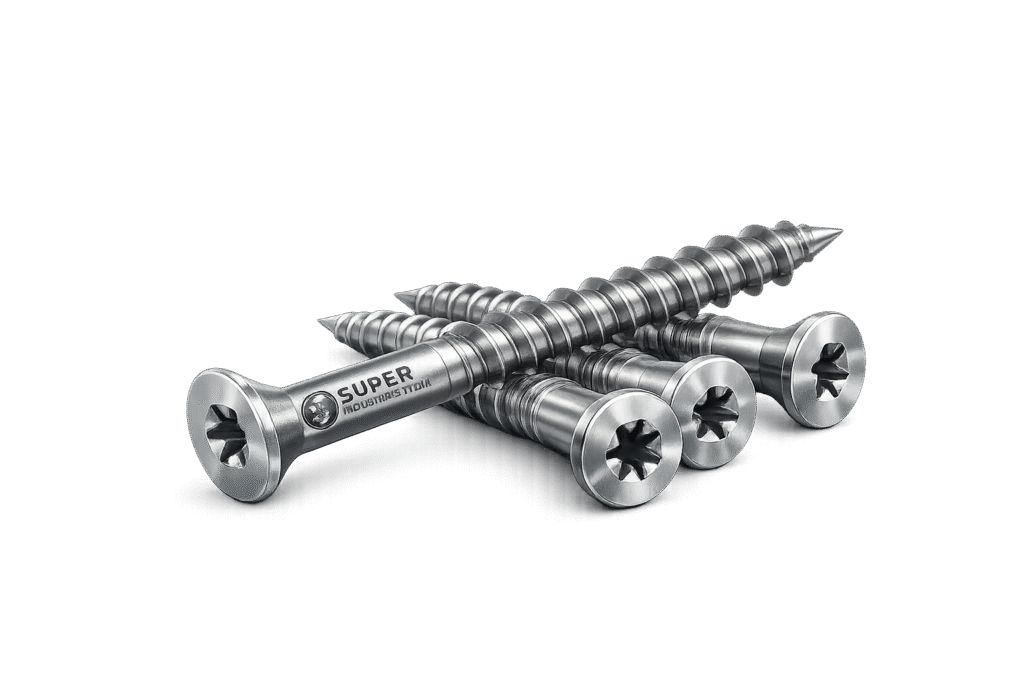
Why Deck Screws Are Critical in Exterior, Load-Bearing, and Corrosion-Exposed Assemblies
In exterior and semi-exposed industrial environments, fastening systems are subjected to cyclic moisture, temperature variation, airborne chlorides, UV exposure, vibration, and sustained service loads. In such conditions, the failure mode of a fastener is rarely immediate tensile rupture; instead, it is progressive loss of holding capacity driven by corrosion, thread degradation, coating breakdown, or joint relaxation.
Deck Screws are engineered specifically to address this class of exposure-driven risk. Unlike generic wood screws or self-tapping screws intended for interior, non-critical use, deck screws are designed as corrosion-controlled, geometry-optimized fasteners for outdoor, infrastructure, and platform-type assemblies.
Across EPC, infrastructure, and export-oriented projects, deck screws are specified where the following conditions apply:
- The joint is non-pressure-retaining but structurally relevant
- The assembly is exposed to weather, humidity, or marine-adjacent atmospheres
- Long-term holding performance is more critical than short-term installation speed
- The substrate includes timber, engineered wood, polymer-wood composites, or hybrid systems
- Access for frequent retightening is limited or undesirable
In these contexts, deck screws function as load-sharing, corrosion-resistant connectors rather than commodity consumables. For EPC engineers and consultants, the selection of deck screws is therefore a materials and durability decision, not a convenience choice.
Technical Definition
What Deck Screws Are and How They Differ from Other Screw Types
A Deck Screw is a threaded fastening element engineered for exterior structural fastening in wood-based or composite assemblies, characterized by:
- A bugle or modified countersunk head for controlled surface seating
- Coarse or optimized thread geometry for high pull-out resistance
- Hardened core strength balanced with ductility to resist snap failure
- Multi-layer or alloy-based corrosion protection systems
- Drive systems designed to reduce cam-out under high installation torque
Deck screws differ fundamentally from:
- Standard wood screws, which lack long-term corrosion resistance and controlled metallurgy
- Self-tapping screws, which are optimized for thin metal penetration, not wood holding capacity
- Structural bolts, which require pre-drilled holes, nuts, and washers and are not suited for timber substrates
From an engineering standpoint, deck screws occupy a defined niche: they provide reliable axial holding strength and moderate shear capacity in exterior assemblies without the complexity of bolted joints.
Head Design & Drive Systems
Bugle Head Geometry, Countersinking Behavior, and Torque Transmission
Bugle Head Geometry
The defining feature of deck screws is the bugle head, which transitions smoothly from the shank to the head bearing surface. This geometry is intentional and provides several mechanical advantages:
- Progressive countersinking without splitting wood fibers
- Reduced surface crushing compared to flat countersunk heads
- Improved load distribution under the head
In exterior assemblies, uncontrolled countersinking leads to fiber damage, moisture ingress, and long-term loosening. Bugle heads mitigate this by spreading compressive stress over a wider zone.
Drive Systems
Deck screws are commonly produced with:
- Torx / star drives for high torque transmission
- Square (Robertson) drives for reduced cam-out
- Less commonly, Phillips or combination drives, typically avoided in EPC-grade work
From a consultant and inspection perspective, drive integrity is not cosmetic. Stripped drives indicate poor heat treatment control or substandard drive geometry and are a frequent cause of site rejection.
Thread Geometry & Penetration Control
Coarse Threads, Cutting Tips, and Engagement Logic
Thread Form
Deck screws typically employ coarse or dual-thread profiles, optimized to:
- Maximize pull-out resistance in wood and composites
- Reduce installation torque while maintaining holding strength
- Minimize fiber tearing and splitting
Unlike machine screws, which rely on nut engagement, deck screws depend entirely on substrate interaction. Thread depth, flank angle, and pitch are therefore primary design parameters.
Cutting Tips and Points
High-quality deck screws incorporate:
- Type 17 or cutting notches to reduce driving torque
- Controlled point geometry to initiate penetration cleanly
- Reduced risk of substrate cracking near edges
These features are particularly relevant in hardwood, laminated timber, and composite decking, where uncontrolled penetration can compromise joint integrity.
Engineering Relevance
Pull-Out Strength, Shear Resistance, and Long-Term Stability
From an engineering standpoint, deck screw performance is evaluated across three primary criteria:
- Axial pull-out resistance
- Shear load behavior
- Durability under environmental exposure
Pull-Out Strength
Pull-out capacity depends on:
- Thread engagement length
- Substrate density
- Thread geometry and surface condition
In EPC and infrastructure specifications, pull-out values are treated as design inputs, not marketing figures. Conservative design margins are typically applied.
Shear Resistance
Deck screws are not substitutes for structural bolts. However, when correctly sized and distributed, they can safely carry moderate shear loads in decking, platforms, and secondary structural elements.
Long-Term Joint Stability
The dominant failure mode in exterior assemblies is loss of preload due to corrosion or fiber relaxation, not immediate fracture. Deck screws are engineered to delay or prevent this progression through coating systems and controlled metallurgy.
Material & Standard Alignment
Carbon Steel, Alloy Steel, Stainless Steel — Standards and Service Conditions
Material Options
- Carbon steel deck screws: Cost-effective, used with advanced coatings
- Alloy steel deck screws: Higher core strength for demanding applications
- Stainless steel deck screws (A2 / A4): Preferred in marine or chloride-rich environments
Material selection is driven by corrosion risk, required service life, and inspection philosophy.
Standards and References
While deck screws are not pressure-retaining components, their manufacture and testing often align with principles derived from:
- ASTM material standards for steel quality
- ISO / EN dimensional consistency
- Project-specific corrosion class definitions
Consultants typically require documented material traceability for EPC-linked or export projects.
Coatings & Corrosion Protection
Zinc, Ceramic, Polymer, and Stainless Systems
Corrosion protection is the defining differentiator between commodity screws and EPC-acceptable deck screws.
Common Coating Systems
- Electro-zinc: Limited exterior durability; generally not EPC-preferred
- Hot-dip galvanized: Thick coatings; dimensional impact must be managed
- Ceramic or polymer coatings: Multi-layer systems offering extended service life
- Bare stainless steel: Intrinsic corrosion resistance without coating dependency
Each system is selected based on exposure class, not cost alone. In marine-adjacent or industrial atmospheres, inadequate coating selection results in premature failure and consultant rejection.
Manufacturing & Quality Discipline
From Wire Selection to Finished Fastener
Deck screw performance is governed by process control across multiple stages:
- Wire rod selection with controlled chemistry
- Cold forming to establish head geometry
- Thread rolling to enhance fatigue resistance
- Heat treatment to balance hardness and ductility
- Coating application with thickness verification
- Final inspection for dimensional and surface integrity
Inconsistent heat treatment or coating thickness is a primary cause of brittle fracture or accelerated corrosion in low-grade products.
Procurement, Installation & Inspection View
What EPC Engineers and Inspectors Verify
During procurement and site inspection, EPC teams and consultants typically review:
- Coating type and thickness certification
- Drive geometry and hardness consistency
- Batch traceability and lot segregation
- Dimensional consistency across samples
On site, common rejection causes include:
- Flaking or uneven coating
- Drive deformation during installation
- Visible corrosion prior to commissioning
Deck screws used in EPC projects are therefore treated as engineered components, not consumables.
Application Mapping
Where Deck Screws Are Technically Appropriate
Deck screws are routinely applied in:
- Infrastructure decks and walkways
- Industrial platforms and access systems
- Utility and service flooring
- Marine-adjacent structures (with appropriate material selection)
- Temporary or semi-permanent EPC installations
They are not suitable for:
- Pressure-retaining joints
- Primary structural steel connections
- High-temperature assemblies
Professional Technical Tables
Diameter & Length Ranges (Indicative)
| Diameter | Typical Length Range |
|---|---|
| 3.5 – 4.5 mm | 25 – 75 mm |
| 5.0 – 6.0 mm | 40 – 150 mm |
| 6.5 – 8.0 mm | 75 – 200 mm |
Drive Types & Head Styles
| Drive Type | Engineering Advantage |
|---|---|
| Torx / Star | High torque, low cam-out |
| Square | Stable engagement |
| Phillips | Limited EPC use |
Material Grades & Coatings
| Material | Typical Coating |
|---|---|
| Carbon steel | Ceramic / polymer |
| Alloy steel | Multi-layer protective |
| Stainless steel | None (intrinsic) |
Corrosion Class vs Application
| Environment | Recommended System |
|---|---|
| Mild exterior | Coated carbon steel |
| Industrial | Advanced polymer coating |
| Marine | Stainless steel A4 |
Custom Manufacturing Options
- Non-standard lengths
- Project-specific coatings
- Controlled hardness ranges
- Full traceability documentation
Manufacturer-Focused Conclusion
Deck Screws used in EPC, infrastructure, and export projects must be evaluated as durability-critical fastening systems, not commodity items. Their performance is determined by thread geometry, material integrity, coating discipline, and manufacturing control, all of which directly influence long-term joint stability in exterior environments.
Super Industries manufactures deck screws with engineered thread profiles, controlled heat treatment, verified corrosion protection systems, and EPC-aligned quality documentation, supporting reliable service performance and consultant acceptance in demanding industrial and infrastructure applications.
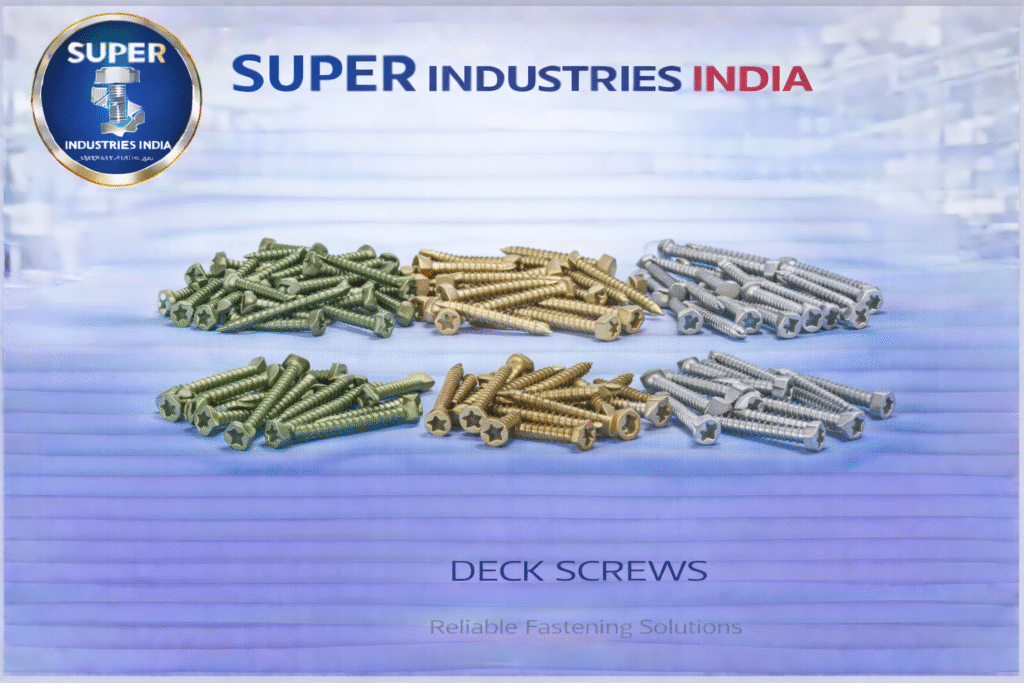
The Ultimate Guide to Premium Deck Screws in India | Super Industries
Welcome to Super Industries India, your trusted partner for high-performance deck screws and construction fasteners designed for the rigorous demands of the Indian climate. A beautiful deck is a significant investment; protect it with the right hardware. Our deck screws are specifically engineered to provide a secure, durable, and stain-free fastening solution for all your outdoor decking projects, from coastal resorts to urban rooftops.
Why Specialized Deck Screws are Essential for Your Project
Standard wood screws simply won’t last in an outdoor environment. They lack the corrosion resistance, head design, and holding power needed to keep your deck boards fastened securely through cycles of rain, sun, humidity, and extreme heat.
Choosing Super Industries’ Deck Fasteners means investing in hardware that addresses the unique challenges of decking:
- Corrosion & Rust: Decking materials like treated lumber and hardwoods often react with poor-quality fasteners, causing ugly black streaks and structural weakening. Our screws eliminate this risk.
- Wood Movement: Outdoor lumber constantly expands and contracts. Our specialized threads and shanks are designed to grip the wood securely while accommodating this movement, preventing the screws from “popping” out of the deck surface.
- Aesthetics: We offer head styles that countersink perfectly, ensuring a smooth, splinter-free walking surface that is both safe and visually appealing.
Our Comprehensive Range of Deck Screw Materials
We understand that different projects require different levels of protection and performance. That’s why we offer a diverse range of decking screw materials and coatings:
1. Stainless Steel Deck Screws (SS 304 & SS 316)
For the ultimate defense against the elements, Stainless Steel Deck Screws are the gold standard.
- SS 304 Grade: Ideal for standard outdoor applications across India where moisture and rain are a concern. It offers excellent resistance to rust and staining in most environments.
- SS 316 Marine Grade: Absolutely essential for coastal areas, near swimming pools, boardwalks, and in high-humidity regions. This marine-grade alloy provides superior resistance to chlorides and salt spray, ensuring decades of structural integrity without corrosion.
2. Premium Coated Deck Screws
These screws offer exceptional protection and cost-effectiveness for most general decking applications.
- Advanced Polymer & Ceramic Coatings: Our high-performance coatings are rigorously tested, often exceeding 1000-hour Salt Spray standards. This heavy-duty coating forms a protective barrier over the hardened carbon steel core, making it the best deck screw choice for pressure-treated lumber and most composites.
Specialized Screw Designs for Modern Decking
The right screw isn’t just about the material—it’s also about the design features that simplify installation and improve deck longevity.
a) Head & Drive Types for Professionals:
- Torx Drive (Star Drive) Deck Screws: The preferred choice of professional deck builders across world. The 6-point recess offers maximum torque transfer, eliminating cam-out (stripping the screw head) and making installation fast and reliable, especially in dense materials.
- Bugle Head & Trim Head Screws: Our Bugle Head Deck Screws are designed to sit flush, providing a clean finish on most wood and WPC boards. The smaller Trim Head Screw is perfect for hardwoods or when a less visible fastener is desired.
b) Features for Flawless Installation:
- Self-Drilling & Type 17 Point: These sharp points cut through the decking material cleanly, reducing the need for pre-drilling in softwoods and allowing for faster, easier driving. This is a crucial time-saver on large construction sites.
- Reverse and Coarse Threads: The combination of a specialized leading thread and a reverse upper thread on some models helps to pull the board down securely to the joist while keeping the head seated properly, preventing the common problem of composite deck mushrooming.
The Right Fastener for Your Decking Material
| Decking Material | Recommended Screw from Super Industries | Key Feature |
| Hardwood (Ipe, Teak, Sal) | SS 316 Trim Head Screws | High sheer strength; ultimate corrosion resistance. |
| Pressure-Treated Wood | Coated Carbon Steel Deck Screws | High salt spray rating; countersinking nibs. |
| Wood-Plastic Composite (WPC) | Composite Deck Screws (Coated) | Unique thread design to prevent mushrooming. |
| Aluminum or Steel Deck Framing | Bi-Metal Self-Drilling Screws | Quickly drills and taps into metal sub-structures. |
Get Bulk Pricing & Fast Delivery Across world
As a leading Deck Screws Manufacturer and Supplier in India, Super Industries is equipped to handle orders of all sizes, from small residential projects to major commercial developments.
We offer bulk deck screws and reliable supply chain logistics to ensure prompt delivery to your site, or any location across the globe.
Don’t compromise the structure and beauty of your deck with inferior hardware.
Tags
- Deck Screws India
- Stainless Steel Deck Screws Price
- Corrosion Resistant Deck Fasteners
- Marine Grade SS 316 Screws
- Torx Drive Deck Screws Bulk
- Composite Deck Screws Supplier
- Best Screws for Outdoor Decking in India