
SELF-DRILLING SCREWS (TEK SCREWS)
Structural Steel Fastening Systems for EPC, Infrastructure & Export Projects
Manufacturer & Global Exporter: Super Industries
Website: https://superindustriesindia.in
Industry Context
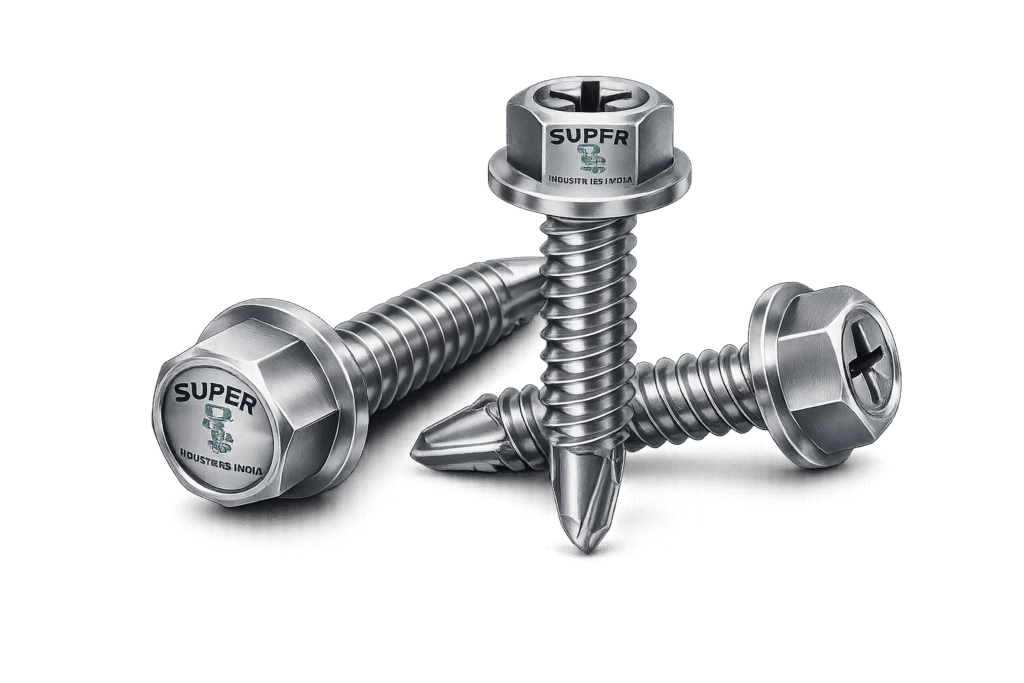
Why Self-Drilling Screws Are Critical in Modern Steel Construction, Industrial Fabrication, Infrastructure Projects, and High-Speed Installation Environments
In contemporary EPC execution, speed of construction is no longer a convenience; it is a program requirement. Steel-intensive projects—pre-engineered buildings (PEB), pipe racks, equipment skids, industrial enclosures, substations, LNG auxiliary structures, and infrastructure support systems—are designed around repeatable, high-volume steel-to-steel connections.
Within this context, Self-Drilling Screws have evolved from light-gauge sheet fasteners into engineered fastening elements capable of delivering predictable performance when used within clearly defined limits.
Their adoption in EPC and infrastructure work is driven by five structural realities:
- Elimination of pre-drilling reduces installation time, labor dependency, and alignment errors.
- Consistent hole geometry generated by the drill point improves repeatability of clamp load.
- Controlled thread engagement in thin to medium-thickness steel provides adequate pull-out and shear resistance for non-pressure, non-primary structural joints.
- Compatibility with automated and semi-automated installation supports large-scale modular fabrication.
- Reduced site variability compared to drilling + tapping sequences, particularly in elevated or constrained environments.
It is essential to state clearly: self-drilling screws are not substitutes for structural bolts, anchor bolts, or pressure bolting systems. They are used where design intent explicitly allows screw-based fastening, typically governed by thickness limits, load envelopes, and inspection logic.
This page addresses self-drilling screws strictly from an EPC-safe, engineering-disciplined perspective, defining where they are appropriate, how they function, and how they are evaluated by consultants, inspectors, and procurement teams.
Technical Definition
What Self-Drilling Screws Are and How the Integrated Drill Point Functions
A Self-Drilling Screw is a threaded fastener with an integrated drill point capable of:
- Drilling a pilot hole into steel or metal substrates
- Tapping threads into the drilled material
- Developing clamp load between connected components
All three actions occur in a single installation operation.
Distinction from Other Screw Types
Self-Drilling vs Self-Tapping Screws
- Self-tapping screws require a pre-drilled hole.
- Self-drilling screws generate their own hole via a hardened drill point.
Self-Drilling vs Machine Screws
- Machine screws require pre-tapped threads or nuts.
- Self-drilling screws rely on thread forming/cutting in base material.
Self-Drilling vs Bolted Connections
- Bolts rely on nuts or tapped holes and develop higher preload.
- Self-drilling screws are installation-efficient fasteners, not high-preload structural elements.
Understanding these differences is central to correct specification and EPC approval.
Drill Point Engineering
Geometry, Flute Design, Drilling Capacity, and Steel Thickness Compatibility
The drill point is the most critical engineered feature of a self-drilling screw. Its geometry determines whether the screw performs as intended or fails prematurely.
Drill Point Geometry
Key parameters include:
- Point angle – affects penetration efficiency and heat generation
- Web thickness – controls strength and resistance to tip breakage
- Flute geometry – governs chip evacuation during drilling
A properly engineered drill point must:
- Penetrate steel without excessive torque
- Avoid work hardening of the substrate
- Produce a clean hole that supports thread engagement
Drilling Capacity
Self-drilling screws are classified by maximum combined steel thickness they can penetrate. Exceeding this capacity results in:
- Drill point overheating
- Loss of hardness
- Incomplete drilling followed by thread stripping
Drilling capacity is not negotiable and must be verified against project steel thickness.
Thread & Load Behavior
Thread Engagement, Pull-Out Resistance, Shear Performance, and Clamp Load Development
Once drilling is complete, the screw transitions into a thread-forming and clamping role.
Thread Engagement Logic
- Threads are optimized for thin-gauge to medium-gauge steel
- Engagement length directly affects pull-out capacity
- Over-penetration reduces effective thread engagement
Pull-Out Resistance
Pull-out capacity depends on:
- Screw diameter
- Thread geometry
- Base steel thickness
- Base steel yield strength
Self-drilling screws are not designed for high pull-out loads in thick sections; their strength envelope is deliberately bounded.
Shear Performance
In steel-to-steel lap joints:
- Shear load is shared between the screw shank and bearing in steel
- Proper screw diameter selection is essential to avoid shear failure
Clamp Load Behavior
Unlike bolts, self-drilling screws develop limited preload. Their function is positional and restraining, not high-tension clamping.
Types of Self-Drilling Screws
TEK Classifications, Head Forms, and Sealing Variaimnts
TEK Classifications (Indicative)
| TEK Class | Typical Drilling Capacity |
|---|---|
| TEK-1 | Thin sheet metal |
| TEK-2 | Light gauge steel |
| TEK-3 | Medium gauge steel |
| TEK-4 | Heavy gauge steel |
| TEK-5 | Thick structural sections |
(Exact capacities are manufacturer-specific and must be verified.)
Head Types
- Hex washer head – highest torque capacity, EPC-preferred
- Pan head – enclosures and equipment housings
- Wafer head – low-profile applications
Sealing Washer Variants
- EPDM-bonded washers for weatherproofing
- Metal-backed washers for load distribution
Sealing elements are used only where specified, not as universal practice.
Material & Standard Alignment
Carbon Steel, Alloy Steel, Stainless Steel — Service Condition Logic
Carbon Steel Self-Drilling Screws
- Most common for industrial and infrastructure use
- Require coating for corrosion protection
Stainless Steel Self-Drilling Screws
- Used in corrosive or coastal environments
- Lower drilling capacity due to material hardness trade-offs
Standards Framework
Self-drilling screws supplied to EPC projects align with:
- ASTM dimensional and material logic
- DIN / ISO screw form standards
- Project-specific technical specifications
Manufacturing & Quality Discipline
Drill Point Consistency, Heat Treatment, Thread Rolling, and Traceability
Self-drilling screws are process-sensitive fasteners. Quality depends on:
- Precision cold heading of blanks
- Controlled drill point forming
- Localized heat treatment to balance hardness and toughness
- Rolled threads for fatigue resistance
- Coating adhesion control
- Lot-wise traceability and inspection
Inconsistent drill point hardness is the single most common cause of field failure.
Procurement, Installation & Inspection View
What EPC Engineers, Inspectors, and Consultants Verify
During approval and execution, EPC stakeholders typically verify:
- Declared drilling capacity vs actual steel thickness
- Head marking and manufacturer identification
- Coating type and thickness
- Torque limits and installation procedure
- Batch traceability and documentation
Improper substitution of screw class or diameter is a frequent non-conformance.
Application Mapping
Where Self-Drilling Screws Are Commonly Approved
Typical EPC-approved applications include:
- PEB frames and secondary members
- Purlins and girts
- Cladding and sheet systems
- Equipment enclosures
- Cable trays and light supports
They are not used for:
- Pressure-retaining joints
- Primary load-bearing structural joints
- Flange connections
Professional Technical Tables
Drill Capacity vs Steel Thickness (Indicative)
| TEK Class | Max Combined Steel Thickness |
|---|---|
| TEK-2 | ~2.5 mm |
| TEK-3 | ~4.5 mm |
| TEK-4 | ~6.0 mm |
| TEK-5 | ~12.0 mm |
Diameter & Length Ranges
| Diameter | Typical Length Range |
|---|---|
| 4.8 mm | 16–50 mm |
| 5.5 mm | 19–75 mm |
| 6.3 mm | 25–100 mm |
Head Types & Washer Options
| Head Type | Typical Use |
|---|---|
| Hex washer | Steel structures |
| Pan head | Enclosures |
| Hex + EPDM | Roofing / weather exposure |
Material Grades & Coatings
| Material | Coating | Environment |
|---|---|---|
| Carbon steel | Zinc plated | Indoor |
| Carbon steel | HDG / coated | Outdoor |
| Stainless steel | None | Marine / corrosive |
Application Suitability Matrix
| Application | Suitable |
|---|---|
| PEB secondary members | Yes |
| Pipe racks (secondary) | Yes |
| Pressure systems | No |
| Primary structural joints | No |
Custom Manufacturing Options
- Project-specific lengths
- Special coatings
- Washer-integrated assemblies
- Controlled head markings
Manufacturer-Focused Conclusion
Self-Drilling Screws are engineered fastening solutions designed to deliver speed, consistency, and controlled performance in steel-to-steel connections where EPC design permits screw-based fastening.
Their correct use depends on drill point engineering, material selection, coating discipline, installation control, and strict adherence to defined load envelopes. When misapplied, they fail quickly; when specified and manufactured correctly, they support reliable, repeatable EPC execution.
Super Industries manufactures self-drilling screws with controlled drill geometry, verified heat treatment, consistent thread rolling, EPC-grade coatings, and documented traceability, enabling safe deployment across industrial, infrastructure, and export projects where installation efficiency must coexist with engineering discipline.
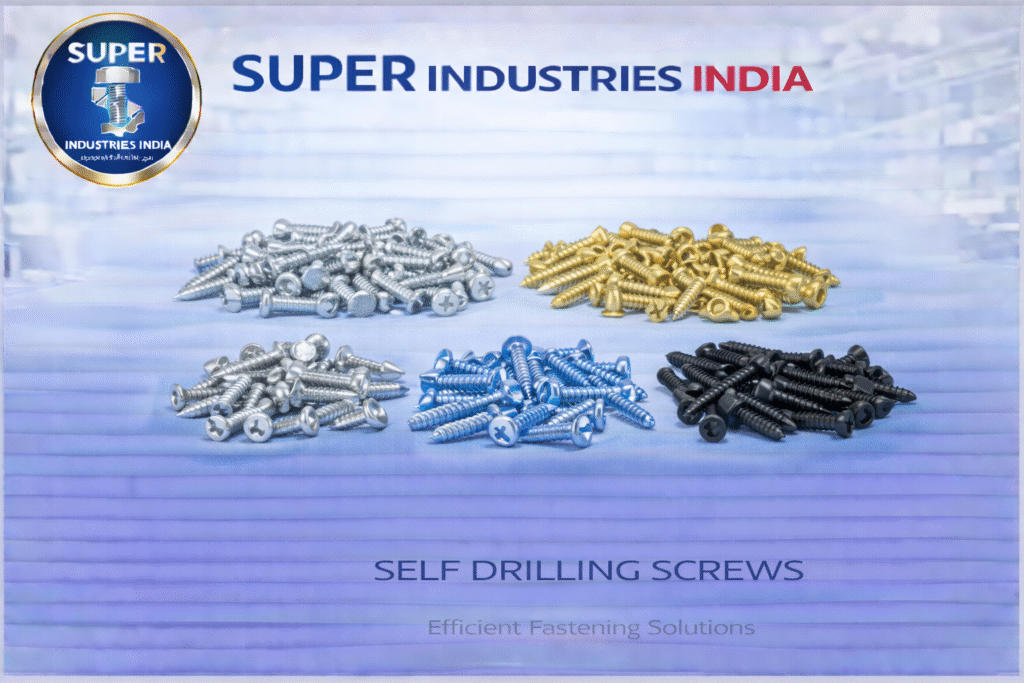
Self-Drilling Screws: The Ultimate Guide to Fastening Solutions in India
Powering Precision and Speed in Construction & Fabrication
Welcome to Super Industries India, your trusted partner for premium quality fasteners. In the dynamic world of construction, metal fabrication, and industrial assembly, speed and durability are non-negotiable. This is where Self-Drilling Screws (SDS), often called Tek Screws, step in as the revolutionary fastening solution, eliminating the need for pre-drilling and transforming your project efficiency.
As a leading Self-Drilling Screw Manufacturer and Supplier in India, Super Industries offers a comprehensive range of SDS engineered for exceptional performance, reliability, and long-lasting strength in the demanding Indian environment.
What Exactly Are Self-Drilling Screws?
A self-drilling screw is a specialized type of fastener characterized by its unique point, which resembles a drill bit. This design allows the screw to:
- Drill its own hole.
- Tap its own mating thread.
- Fasten the materials securely.
All in one swift, simple operation. This three-in-one capability significantly reduces installation time, labor costs, and the chances of material misalignment, making them indispensable for modern construction techniques, particularly in metal-to-metal applications.
The Super Industries Advantage: Why Choose Our SDS?
When sourcing Self-Drilling Screws in India, quality, material grade, and coating are paramount. Super Industries ensures every screw meets stringent national and international quality standards.
Key Features & Benefits:
- Exceptional Time Savings: Eliminate the time-consuming process of drilling separate pilot holes.
- Superior Holding Power: Designed for strong, vibration-resistant connections with excellent pull-out resistance.
- Corrosion Resistance: Our screws are available with high-performance coatings like Zinc Plating, Ruspert, or Xylan/XYLON (Anti-Corrosive Coating) to withstand India’s diverse climatic conditions, especially critical for outdoor applications like roofing.
- High-Grade Material: Manufactured from case-hardened Carbon Steel (AISI 1022) or high-quality Stainless Steel (SS-410, SS-304), ensuring maximum toughness and durability.
- Versatility Across Substrates: Ideal for fastening metal sheets, steel framing, aluminum sections, timber, and even plastic components.
Comprehensive Range of Self-Drilling Screws
We stock a wide variety of SDS types to cater to the specific demands of your project, from light gauge metalwork to heavy-duty structural applications.
| SDS Type | Head Style | Common Applications | Key Features |
| Hex Head Self-Drilling Screws | Hexagonal Flange Head, with/without EPDM Washer | Metal Roofing, Cladding, PEB (Pre-Engineered Buildings) Structures, Heavy-Duty Metal-to-Metal Fixing. | Provides maximum driving torque and a large bearing surface. EPDM Washer ensures a watertight, secure seal against leaks. |
| Pan Head Self-Drilling Screws | Rounded, Flat-Top Head (Phillips Drive) | HVAC ductwork, Interior Sheet Metal Work, Light Gauge Fabrication, Electrical Components. | Provides a smooth, non-snagging, aesthetic finish with excellent grip on thin materials. |
| Truss Head Self-Drilling Screws | Oversized, Low-Profile Dome (Phillips Drive) | Attaching signs, Security Screens, Thin Sheet Metal-to-Frame Connections. | Wide surface area for clamping, ideal for soft or thin materials to prevent head pull-through. |
| Countersunk (CSK) Head SDS | Flat Top, Tapered Underside (Phillips Drive) | Woodworking (attaching metal to wood), Furniture Assembly, Applications requiring a flush, clean finish. | Head sinks perfectly into the material for a seamless, aesthetic finish. |
| Wing-Tip Self-Drilling Screws | Hex Flange Head | Fixing wood/timber to steel (e.g., wooden purlins to steel structure). | Wings ream out a clearance hole in the wood, then break off when hitting the steel, preventing thread damage. |
Applications Across Industries in India
The efficiency and reliability of self-drilling screws have made them a cornerstone in various sectors:
- Metal Roofing & Cladding: The most common application. SDS with EPDM washers provide weatherproof, secure fastening for corrugated and trapezoidal sheets onto steel purlins.
- Pre-Engineered Buildings (PEB): Essential for quickly assembling steel frames, purlins, and girts in industrial sheds and warehouses.
- HVAC Systems: Used extensively for assembling metal ductwork and ventilation systems.
- Drywall Construction: Specific SDS types are used for quickly attaching gypsum boards to metal stud framing.
- Automotive & Machinery: Utilized in the assembly of vehicle bodies, metal enclosures, and various machinery parts.
- General Fabrication: Fastening sheet metal, brackets, and fixtures in workshops and fabrication units across the country.
Technical Considerations for Optimal Performance
Choosing the correct Self-Drilling Screw is crucial. Consider the following:
- Drilling Capacity (Point Type): The drill point’s size determines the maximum total thickness of the metal you can drill through.
- Point #2/#3: For thinner metals (up to 3-4mm).
- Point #4/#5/#6 (Heavy Duty): For thicker steel sections (up to 12mm).
- Length & Gauge: Must be sufficient to fully penetrate the top layer, drill the pilot hole, and fully engage the threads in the substrate for maximum pull-out strength.
- Corrosion Protection: For coastal, high-humidity, or industrial zones, always opt for superior coatings like Ruspert or Xylan for extended life.
Ready to Fasten Your Project with Confidence?
Whether you require Hex Self-Drilling Screws for roofing, Pan Head SDS for light fabrication, or specialized Wing-Tip screws for steel-to-wood connections, Super Industries India is your one-stop solution. We ensure timely delivery and competitive pricing.
Contact Super Industries India today to discuss your specific requirements and receive a quote for the highest quality, most reliable Self-Drilling Screws available in the Indian market.
Tags
- Self-Drilling Screws
- SDS Screws
- Tek Screws
- Self-Drilling Screw Manufacturer India.
- Hex Head Self-Drilling Screws
- Roofing Screws India
- Metal Screws
- Pan Head Self-Drilling Screws
- Truss Head SDS
- Stainless Steel Self-Drilling Screws
- Super Industries India Fasteners
- Buy Hex Head Self-Drilling Screws with EPDM Washer
- Best Self-Drilling Screw Supplier in india
- Xylan Coated SDS Screws India
- Self-Drilling Screws for PEB structures