
HEX SCREWS
Structural & General-Purpose Fastening Systems for EPC, Industrial, and Export Applications
Manufacturer & Global Exporter: Super Industries
Website: https://superindustriesindia.in
Industry Context
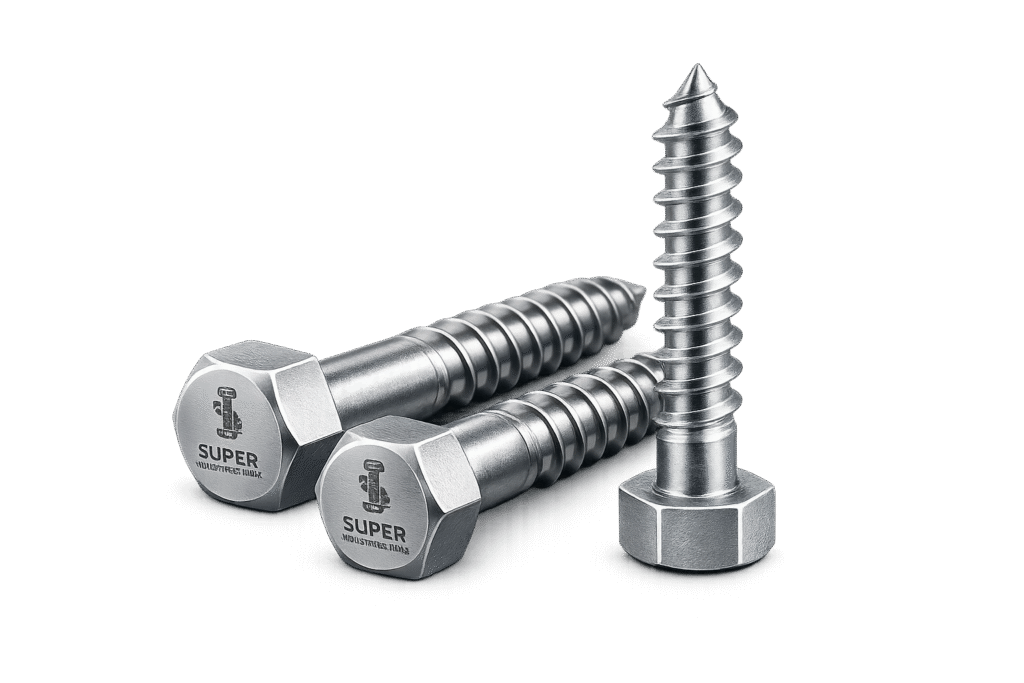
Why Hex Screws Remain the Most Widely Specified Fastener in EPC, Mechanical, Piping, and Structural Assemblies
Across EPC, capital projects, and export-oriented industrial supply chains, Hex Screws continue to be the most frequently specified fastening element. Their dominance is not historical inertia; it is the result of engineering efficiency, predictable mechanical behavior, tool accessibility, and standardization across global codes.
In oil & gas facilities, power plants, petrochemical units, LNG terminals, hydrogen infrastructure, and heavy equipment installations, hex screws are selected because they provide:
- Reliable preload generation using standard torque-controlled methods
- High tolerance to installation variability, especially in site conditions
- Clear separation of load paths between clamping force and shear resistance
- Global dimensional and material standardization, enabling multi-country sourcing
- Ease of inspection, replacement, and traceability over long operating lifecycles
From an EPC perspective, hex screws offer a balance between structural adequacy and operational practicality. They can be used in machinery bases, pipe supports, skid assemblies, equipment housings, access platforms, and auxiliary steel without introducing the complexity of stud-and-nut systems where such complexity is unnecessary.
Importantly, hex screws are not universal substitutes for studs, structural bolts, or specialty fasteners. Their correct application is governed by joint design, load direction, service environment, and inspection philosophy. This page addresses hex screws strictly from that disciplined, engineering-controlled viewpoint.
Technical Definition
What Hex Screws Are and How They Differ from Hex Bolts, Machine Screws, and Studs
A Hex Screw is a fastener with:
- An external hexagonal head designed for wrench or socket engagement
- A threaded shank, which may be fully or partially threaded
- A design intent to be installed into a tapped hole or nut, depending on configuration
Hex Screws vs Hex Bolts
Although often used interchangeably in casual language, engineering specifications distinguish between them:
- Hex Screws are commonly fully threaded and frequently installed into tapped components.
- Hex Bolts are typically partially threaded and intended for use with nuts, with a defined grip length.
In EPC documentation, the distinction matters because it affects shear plane location, thread engagement requirements, and preload behavior.
Hex Screws vs Machine Screws
Machine screws are generally smaller-diameter fasteners with finer threads, intended for light-duty assemblies. Hex screws, by contrast, are structural-capable fasteners available in larger diameters and higher strength classes.
Hex Screws vs Studs
Studs provide symmetrical loading and are preferred in pressure-retaining joints. Hex screws are preferred where one-sided access, ease of replacement, or compact assembly is required.
Head Geometry & Tool Engagement
Hex Head Dimensions, Torque Transfer, and Rounding Resistance
The hex head is a defining advantage of this fastener type.
Hex Head Geometry
Standardized across ASTM, ISO, DIN, and EN systems, hex head geometry ensures:
- High torque transmission efficiency
- Reduced cam-out risk compared to internal drives
- Compatibility with common site tools, including spanners and impact sockets
Across-flats dimensions, head height, and chamfer geometry are tightly controlled because deviations directly affect tool fit, torque accuracy, and head durability.
Torque Transfer Behavior
External hex geometry allows torque to be applied at a larger effective radius than internal-drive fasteners. This reduces localized stress concentrations and makes hex screws more tolerant of repeated installation cycles—an important consideration during commissioning, alignment, and maintenance.
Thread Design & Load Transfer
Coarse vs Fine Threads, Full vs Partial Threading, and Shear Plane Control
Coarse vs Fine Threads
- Coarse threads are preferred in general EPC use due to resistance to galling, faster installation, and tolerance to contamination.
- Fine threads provide higher tensile stress area and finer preload control but are more sensitive to damage and misalignment.
Full vs Partial Threading
- Fully threaded hex screws allow flexibility in grip length but may place threads in the shear plane.
- Partially threaded hex screws allow designers to position the unthreaded shank in the shear plane, improving fatigue performance.
Engineering specifications typically dictate thread configuration based on joint type and expected load direction.
Load Transfer Logic
In a properly designed joint, hex screws are primarily tension members, generating clamping force. Shear loads should be resisted by friction between clamped parts, not by the fastener shank in bearing, except in secondary or controlled cases.
Engineering Relevance
Clamping Force, Preload Behavior, and Fatigue Performance
The engineering value of hex screws lies in their predictable preload behavior.
Preload Generation
Torque applied to a hex screw is converted into preload, which:
- Holds joint members in compression
- Prevents relative movement under service loads
- Reduces fatigue loading on the fastener
Vibration Resistance
Hex screws rely on preload stability, not mechanical locking, for vibration resistance. In EPC practice, this means:
- Correct torque application
- Controlled surface conditions
- Appropriate use of washers or flange faces where specified
Fatigue Performance
Fatigue failures are typically the result of insufficient preload or poor surface condition, not inherent fastener weakness. Hex screws with rolled threads and controlled heat treatment provide superior fatigue resistance.
Material & Standard Alignment
Carbon Steel, Alloy Steel, Stainless Steel — Codes and Service Conditions
Common Material Classes
- Carbon steel hex screws: General-purpose, cost-effective, used with coatings
- Alloy steel hex screws: High-strength applications requiring higher preload
- Stainless steel hex screws: Corrosion resistance in wet or chemical environments
Standards Overview
Hex screws supplied for EPC and export projects commonly align with:
- ASTM material and dimensional standards
- ISO metric fastener systems
- DIN legacy specifications for European projects
Material Test Certificates (MTCs) are typically mandatory for EPC procurement.
Manufacturing & Quality Discipline
From Forging to Finished Fastener
The performance of a hex screw is determined by manufacturing discipline:
- Hot or cold forging to form head geometry
- Thread rolling, not cutting, to improve fatigue life
- Heat treatment to achieve target mechanical properties
- Surface finishing or coating
- Dimensional and mechanical inspection
Deviation at any stage compromises preload predictability and service reliability.
Coatings & Surface Treatments
Corrosion Behavior vs Environment
Common surface treatments include:
- Black oxide: Minimal corrosion protection, indoor use
- Electro-zinc plating: Light corrosion resistance
- Hot-dip galvanizing: Outdoor and structural exposure
- PTFE / fluoropolymer coatings: Chemical resistance and torque control
Selection is governed by environmental exposure, not aesthetics.
Procurement, Installation & Inspection View
What EPC Engineers and Inspectors Verify
During approval and inspection, EPC teams typically review:
- Head markings and grade identification
- Dimensional compliance
- Surface finish and coating thickness
- Heat treatment records and MTCs
Improper markings or undocumented substitutions are common causes of rejection.
Application Mapping
Typical EPC and Industrial Use Cases
Hex screws are widely used in:
- Oil & gas skids and modules
- Power plant auxiliary systems
- Petrochemical structures
- LNG and hydrogen facilities
- Heavy equipment and machinery
They are not typically used as primary pressure boundary fasteners unless explicitly specified.
Professional Technical Tables
Diameter & Length Ranges (Indicative)
| Diameter | Typical Length Range |
|---|---|
| M6 – M12 | 20 – 120 mm |
| M16 – M24 | 30 – 200 mm |
| M30 – M36 | 50 – 300 mm |
Thread Types
| Thread System | Typical Use |
|---|---|
| Metric coarse | General EPC |
| Metric fine | Precision preload |
| UNC | North American projects |
| UNF | High tensile applications |
Material Grades vs Applications
| Material | Typical Application |
|---|---|
| Carbon steel | General industrial |
| Alloy steel | High-load joints |
| Stainless steel | Corrosive environments |
Coating Options vs Environment
| Coating | Environment |
|---|---|
| Black oxide | Dry indoor |
| Zinc plated | Mild exterior |
| HDG | Outdoor / infrastructure |
| PTFE | Chemical exposure |
Torque & Preload (Reference Only)
Torque values are application-specific and must be defined by joint design calculations and lubrication condition.
Custom Manufacturing Options
- Non-standard lengths
- Project-specific coatings
- Controlled mechanical property windows
- Full batch traceability
Manufacturer-Focused Conclusion
Hex Screws remain the backbone of EPC, industrial, and export fastening because they combine mechanical reliability, global standardization, and practical installation logic. Their correct application depends on disciplined selection of material grade, thread configuration, surface condition, and installation practice.
Super Industries manufactures hex screws with controlled forging processes, rolled threads, verified heat treatment, documented coatings, and EPC-aligned traceability, supporting safe, predictable performance across mechanical, structural, and industrial assemblies in global projects.
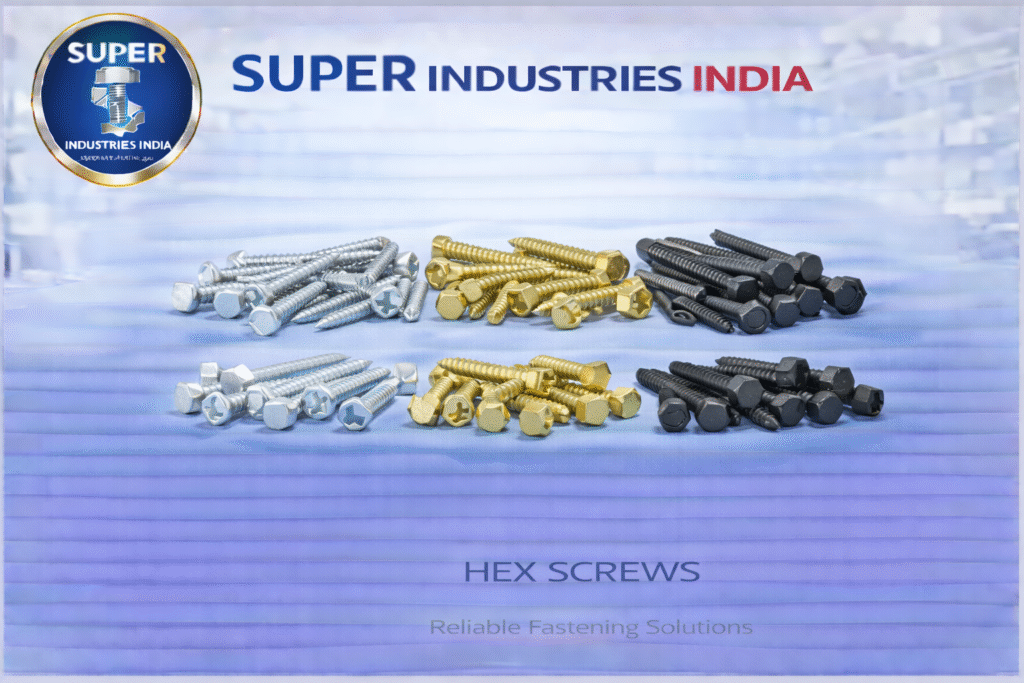
Precision Hex Screws & Bolts Manufacturer in India | Super Industries
Welcome to Super Industries India, your premier destination for high-strength, precision-engineered Hex Screws and Hex Bolts. From heavy-duty industrial machinery to critical infrastructure projects across world, the hexagonal head is the universal symbol of reliable fastening. We manufacture a comprehensive range of hex fasteners designed to meet the rigorous demands of construction, automotive, energy, and fabrication sectors.
The Power of the Hex Head: Strength, Torque, and Reliability
A hex screw (often interchangeably called a hex bolt or hex cap screw) is distinguished by its six-sided head, which is engineered for maximum performance.
Why choose Super Industries Hex Fasteners?
- Superior Torque Transfer: The six contact points of the hexagonal head allow for significantly higher torque to be applied using a standard wrench, spanner, or socket. This ensures a tighter, more vibration-resistant, and secure joint.
- High Tensile Strength: We utilize high-grade materials and advanced manufacturing processes (including cold and hot forging) to produce screws that meet and exceed international standards (DIN, ISO, ASTM).
- Versatility: Hex screws are the workhorse of the fastening world. They can be used with a nut for through-hole applications or driven directly into a tapped hole or softer material.
Our Comprehensive Range of Hex Fasteners
We offer a diverse inventory of hex head screws to suit every environment and load requirement across the Indian market.
1. Hex Cap Screws (Fully & Partially Threaded)
- Hex Cap Screw (Full Thread): Defined by threads running the entire length of the shank. Ideal for applications requiring full engagement across the entire fastening depth, offering maximum grip. (Conforming to standards like ISO 4017 / DIN 933)
- Hex Cap Screw (Partial Thread / Hex Bolt): Features a threaded section and an unthreaded shank portion near the head. The unthreaded section acts as a strong shear pin, providing superior load-bearing capacity and joint stability, commonly used in structural connections. (Conforming to standards like ISO 4014 / DIN 931)
2. Specialized Hex Head Fasteners
| Type of Hex Screw | Primary Use Case | Key Benefit |
| Hex Washer Head Self-Drilling Screws (SDS) | Metal Roofing, HVAC, Steel Framing, Industrial Sheds. | Drills its own hole and taps the thread in one operation, dramatically speeding up construction time. Features an integrated washer for better load distribution. |
| Hex Lag Screws (Coach Screws) | Heavy Timber Construction, Wood Decking, Railings, Fence Posts. | Designed for driving directly into wood or masonry (with a plug). Provides extreme holding power in wooden structures. |
| Heavy Hex Bolts | Structural Steel, Bridges, Flange Connections in Oil & Gas. | Features a larger and thicker head than standard bolts, providing a greater bearing surface and enabling even higher pre-load tension. |
| Hex Flange Bolts | Automotive, Engine Assembly, Machinery. | Integrates a flange (washer) under the head to distribute the load over a wider area, eliminating the need for a separate washer. |
Critical Materials & Grades
The choice of material is crucial for the longevity of your assembly, especially in India’s varying climatic conditions, from the humid coast to the dry plains.
| Material / Grade | Property Class | Ideal Application in India |
| High Tensile Steel Hex Screws | Grade 8.8, 10.9, 12.9 | Heavy Machinery, Automotive Chassis, Structural Framework. Offers exceptional strength to withstand immense pressure and shear forces. |
| Stainless Steel Hex Screws (SS 304) | A2-70, A2-80 | General Outdoor Use, Food & Beverage, Architectural Fittings. Excellent corrosion resistance for standard environments. |
| Marine Grade Stainless Steel (SS 316) | A4-70, A4-80 | Coastal Areas, Marine/Shipbuilding, Chemical Plants, Oil & Gas. Superior resistance to salt water, chlorides, and harsh chemicals. |
| Mild Steel Hex Screws | Grade 4.6, 4.8 | General Purpose, Light Fabrication, Furniture Assembly. Cost-effective solution for non-critical, low-load applications. |
Essential Coatings & Finishes
To further enhance durability, we provide a variety of protective finishes:
- Hot Dip Galvanized (HDG): Provides a thick, long-lasting zinc coating for outdoor and industrial environments (Structural Steel, Telecom Towers).
- Zinc Plated (Yellow/Blue/Black): Economical and aesthetically pleasing finish for indoor or mildly corrosive environments (Automotive, Electronics).
- Black Oxide/Blackening: Provides mild corrosion resistance and a clean, matte black finish (Automotive Engine Parts, Decorative Assemblies).
Applications We Serve
As a leading Hex Screw Manufacturer in Mumbai, Super Industries proudly supplies critical fasteners to various industries:
- Infrastructure & Construction: Securing girders, beams, and columns in skyscrapers, bridges, and flyovers.
- Automotive Industry: Used for engine components, suspension, and vehicle chassis assembly where high-strength fastening is non-negotiable.
- Energy Sector (Solar & Wind): Fastening solar panel mounting structures and wind turbine components, demanding weather resistance (SS 304/316) and high tensile strength.
- Heavy Engineering & Fabrication: Assembly of industrial presses, conveyors, and mining equipment where consistent torque and vibration dampening are essential.
- Machinery & Equipment: Securing motor mounts, gearboxes, and precision tooling.
Custom Hex Screw Manufacturing & Bulk Supply
Do you require non-standard dimensions, a unique material alloy, or specialized threading for a large-scale project?
Super Industries excels in Custom Hex Bolt Manufacturing. Send us your drawings, and our technical team will engineer a solution that adheres to your precise specifications and international quality standards.
We are geared for bulk hex screw supply with efficient logistics to ensure on-time delivery across the entire Indian sub-continent.
Invest in the foundation of your project. Choose Super Industries for Hex Screws that are built to last.
Tags
- Hex Screws Manufacturer India
- Hex Bolts Price List India
- High Tensile Hex Screws Grade 8.8 10.9
- Stainless Steel Hex Bolts SS 304 316
- Hex Washer Head Self Drilling Screws Supplier
- Heavy Hex Bolts India
- Custom Hex Fasteners India