
FLANGE STUD BOLTS
EPC / CAPITAL PROJECT / PRESSURE-JOINT BOLTING REFERENCE
Manufacturer & Global Exporter: Super Industries
Website: https://superindustriesindia.in
1. Industry Context
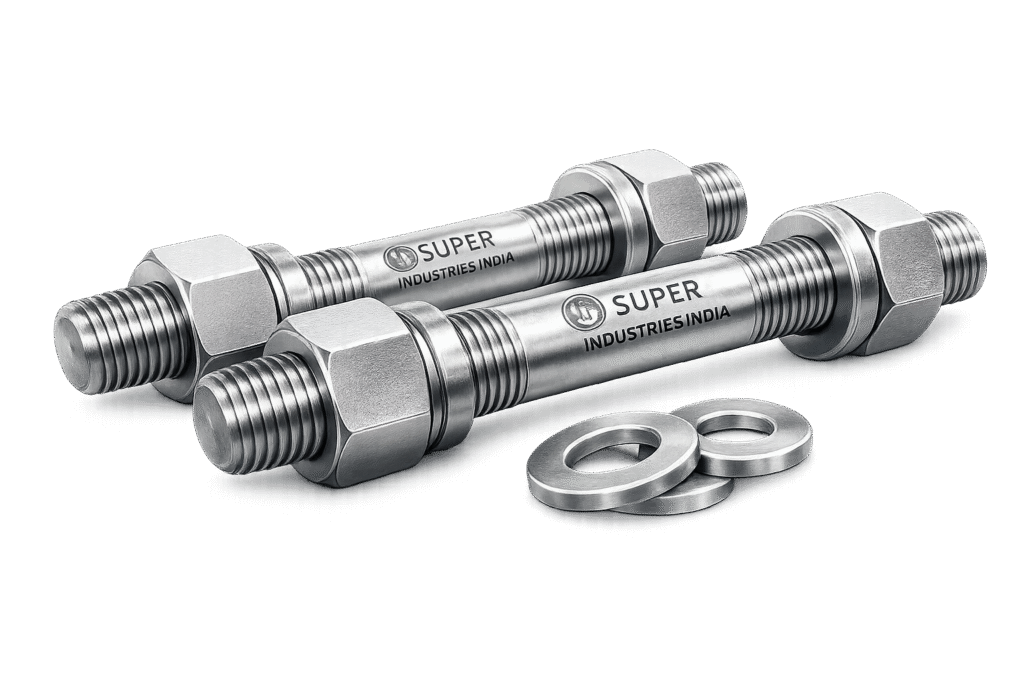
Why Flange Stud Bolts Are Critical in Pressure-Containing Joints
In EPC and capital projects, flanged joints represent the most critical demountable interfaces in pressure piping systems. Whether in upstream oil & gas, power generation, petrochemical processing, LNG, hydrogen, or offshore infrastructure, flange joints must maintain pressure integrity, leak tightness, and long-term mechanical stability under:
- Internal pressure
- Thermal cycling
- Vibration and external loading
- Installation and reassembly during plant life
Flange Stud Bolts are the primary load-bearing elements that convert tightening torque into controlled gasket compression. Their performance directly determines whether a flange joint seals reliably or becomes a chronic leakage risk.
For this reason, flange stud bolts are never treated as general-purpose fasteners in EPC specifications. They are engineered pressure-joint components governed by codes, material traceability rules, and strict inspection regimes.
2. Technical Definition
What Are Flange Stud Bolts?
Flange Stud Bolts are threaded fasteners designed specifically for bolted flange connections. They are typically used with:
- Two heavy hex nuts (one on each end)
- Flat or hardened washers where specified
- Metallic or non-metallic gaskets
Unlike general-purpose studs, flange stud bolts are selected based on:
- Flange rating (ASME B16.5 / B16.47)
- Pressure–temperature design conditions
- Gasket type and seating stress requirements
They are installed through aligned flange bolt holes and tightened to generate the required axial clamping force.
3. Role of Stud Bolts in Flanged Joints
Joint Integrity
The stud bolt provides uniform axial force that:
- Compresses the gasket to its effective sealing stress
- Maintains contact pressure during pressure and temperature changes
Gasket Compression Control
Correct stud selection and tightening prevent:
- Under-compression → leakage
- Over-compression → gasket damage or extrusion
Pressure Containment
Stud bolts resist the separating force generated by internal pressure acting on the effective gasket area.
Reusability & Maintenance
Stud bolting allows controlled disassembly without damaging flange faces, a key requirement in EPC plant lifecycle management.
4. Engineering Relevance of Weight
The weight of flange stud bolts influences more than logistics. It affects:
Flange Load Calculations
In large-diameter or high-pressure flanges, cumulative stud weight contributes to:
- Nozzle loading
- Pipe support design
- Structural interaction at equipment connections
Handling & Installation
Heavy stud bolts in large sizes (e.g., 2½” and above) require:
- Controlled lifting
- Installation sequencing planning
Dynamic Behavior
In vibrating systems, unnecessary mass can influence fatigue behavior and flange joint stability.
5. Weight Determination Logic
Flange stud bolt weight is determined by:
- Nominal diameter
- Effective length (flange thickness + gasket + nut height + projection)
- Thread form (UNC / UNF / Metric)
- Material density
- Manufacturing tolerances
- Coating or galvanizing allowance
Unlike full-threaded rods used structurally, flange studs are often length-optimized, making accurate weight calculation essential during EPC material take-offs.
6. Flange Stud Bolt Types & Characteristics
Full-Thread Studs
- Threaded over entire length
- Common for flange applications
- Simplifies nut positioning
Double-End Studs
- Defined thread lengths at both ends
- Unthreaded body may be used in specific designs
Tap-End vs Continuous Thread
- Tap-end studs are rarely used in standard flange joints
- Continuous-thread studs dominate pressure piping applications
Selection is driven by code requirements and flange design, not convenience.
7. Material & Standard Alignment
Common Governing Standards
Stud Materials
- ASTM A193 – high-temperature alloy steel (e.g., B7, B16)
- ASTM A320 – low-temperature service
- ASTM A307 – non-pressure, structural bolting (limited flange use)
Nut Compatibility
- ASTM A194 grades matched to stud material
Flange Standards Interface
Stud bolt dimensions and spacing must align with:
- ASME B16.5 – NPS ½” to 24”
- ASME B16.47 – large-diameter flanges
Material selection is dictated by:
- Design pressure and temperature
- Process fluid
- Corrosion environment
- Applicable piping code (ASME B31 series)
8. Manufacturing & Quality Discipline
Manufacturing Route
- Controlled raw material selection
- Forging or bar processing
- Thread rolling (preferred for fatigue resistance)
- Heat treatment per material grade
- End finishing and chamfering
Quality Control
- Dimensional verification
- Thread gauge inspection
- Mechanical testing
- Hardness verification
- Heat number traceability
Flange stud bolts are treated as pressure-retaining components, requiring a higher level of discipline than structural fasteners.
9. Procurement, Installation & Inspection View
EPC Procurement Checks
- Correct diameter, length, and grade
- Matching nut grade
- Compliance with project specifications
- Complete MTCs and heat traceability
Installation Considerations
- Proper lubrication
- Controlled tightening method (torque, tensioning, or combined)
- Correct tightening sequence (cross-pattern)
Inspection Focus
- Dimensional conformity
- Surface condition
- Marking and traceability
- Certification compliance
10. Application Mapping
Flange Stud Bolts are critical in:
- Oil & Gas: pipelines, manifolds, pressure vessels
- Power: steam systems, turbine auxiliaries
- Petrochemical & LNG: high-integrity process lines
- Hydrogen: leak-sensitive pressure systems
- Offshore & Refineries: cyclic loading environments
They are universally present wherever pressure containment is required.
11. Professional Technical Tables
Diameter & Length Range
| Parameter | Typical Range |
|---|---|
| Diameter | ½” – 4” (M12 – M100) |
| Length | As per flange standard and gasket stack |
Flange Stud Bolts – Weight Logic (Indicative)
| Factor | Effect on Weight |
|---|---|
| Diameter | Primary |
| Length | Linear |
| Material Density | Significant |
| Coating | Minor |
(Exact weight charts are prepared per flange size, pressure class, and project requirement.)
Material Grades vs Pressure–Temperature Service
| Material Grade | Typical Application |
|---|---|
| ASTM A193 B7 | General high-pressure service |
| ASTM A193 B16 | Higher temperature |
| ASTM A320 L7 | Low-temperature service |
| Stainless Steel | Corrosive environments |
Nut Compatibility
| Stud Grade | Compatible Nut Grade |
|---|---|
| A193 B7 | A194 2H |
| A193 B16 | A194 4 |
| A320 | A194 7 |
Customization Options
- Project-specific lengths
- Special coatings (PTFE, Xylan, HDG)
- Controlled marking and packaging
- EPC-specific documentation sets
12. Manufacturer-Focused Conclusion
Flange Stud Bolts are the backbone of pressure joint integrity in EPC and capital projects. Their performance depends on engineering accuracy, metallurgical discipline, and manufacturing control, not marketing claims.
Super Industries manufactures flange stud bolts with:
- Strict dimensional and material compliance
- Compatibility with ASME flange systems
- Full traceability and EPC-acceptable inspection
- Production discipline aligned with pressure-service requirements
The result is bolting that is predictable, auditable, and safe for critical flange joints.
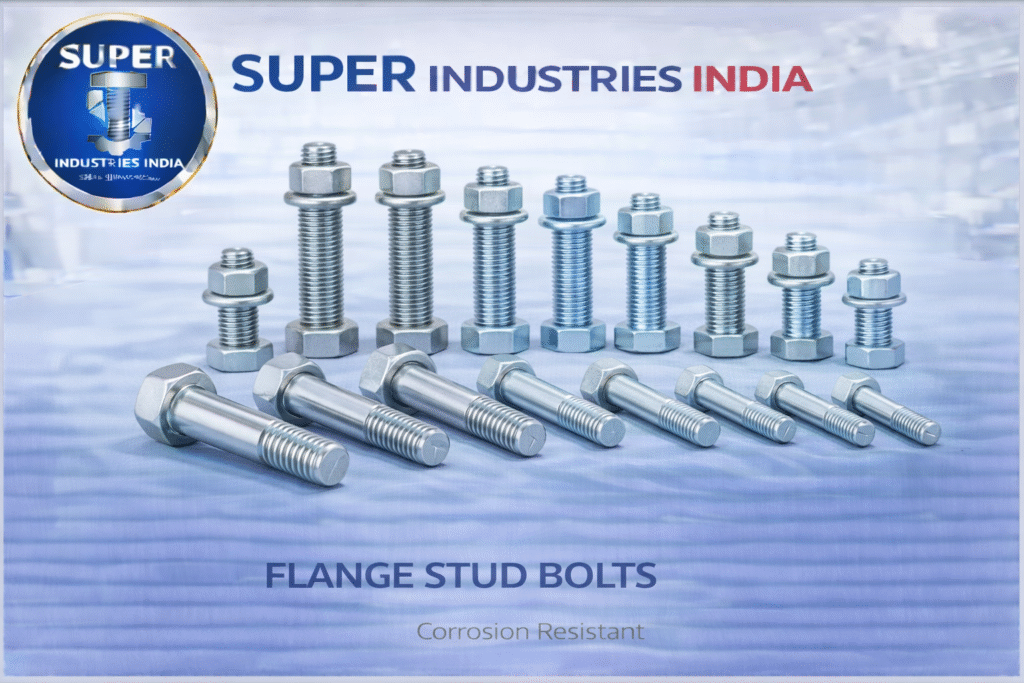
Superior Flange Stud Bolts: Your Trusted Fastener Manufacturer in India
Welcome to Super Industries India, your leading, trusted partner and manufacturer of high-quality Flange Stud Bolts in India. In critical applications across the oil & gas, petrochemical, power generation, and general industrial sectors, the integrity of a pipeline or pressure vessel connection hinges entirely on the fasteners used. Our precision-engineered flange stud bolts are the foundational elements that ensure a secure, leak-proof, and durable joint, even under the most demanding conditions of high temperature and high pressure.
What is a Flange Stud Bolt and Why is it Critical?
A Flange Stud Bolt is a fully or partially threaded bar designed to join two pipe flanges, creating a secure seal in a piping system. Unlike a standard bolt, a stud bolt is typically used with two heavy hexagonal nuts (one at each end) and applies a uniform, measurable tension across the flange faces. This setup is crucial for:
- Uniform Clamping Force: The stud bolt and paired nuts distribute axial stress evenly, which is vital for compressing the gasket and maintaining a leak-tight seal.
- High-Stress Applications: They are engineered to withstand extreme mechanical loads, thermal expansion, and vibration inherent in heavy industries.
- Ease of Maintenance: In comparison to large machine bolts, stud bolts facilitate easier assembly and disassembly of flanged joints.
The Benchmark in Quality: Our Flange Stud Bolt Materials and Grades
At Super Industries India, we specialize in manufacturing stud bolts that conform meticulously to international standards like ASTM, ASME, DIN, and ISO. Our commitment to material excellence ensures peak performance in any operating environment.
Most Popular Alloy Steel Grade: ASTM A193 B7 Stud Bolts
The ASTM A193 Grade B7 stud bolt is arguably the most recognized and widely used fastener in the industrial piping and pressure vessel industry globally.
| Key Feature | Description & Benefit |
| Material | Heat-Treated Chromium-Molybdenum Alloy Steel (AISI 4140). |
| Mechanical Strength | Exceptional minimum tensile strength of 125 ksi (860 MPa) and yield strength of 105 ksi (720 MPa) for sizes up to 2.5 inches. |
| Temperature Service | Ideal for high-temperature service applications, with a maximum recommended temperature of up to 450∘C (842∘F). |
| Paired Nut | Always used with a heavy hex nut of grade ASTM A194 Grade 2H, ensuring maximum strength and compatibility. |
Custom Solutions: Beyond Standard B7
While the B7 grade is a workhorse, your specific project requirements might demand different material compositions. As a premier Flange Stud Bolt Supplier in India, we offer a comprehensive range of grades including:
Corrosion and Low-Temperature Service
- ASTM A193 B7M: A lower hardness version of B7, often required for sour gas service (NACE MR0175/ISO 15156 compliance).
- ASTM A320 Grade L7/L7M: Specifically for low-temperature service, maintaining ductility in cryogenic and sub-zero environments.
- Stainless Steel (B8, B8M): Grades like ASTM A193 Grade B8 (Type 304 Stainless Steel) and B8M (Type 316 Stainless Steel) offer superior corrosion resistance, essential for chemical and marine applications.
Premium Alloy Grades
- ASTM A193 B16: For elevated temperatures and high pressure, offering better creep resistance than B7.
- Duplex & Super Duplex Steels: UNS S31803 (Duplex) and UNS S32750/S32760 (Super Duplex) for exceptional resistance to pitting and stress corrosion cracking in aggressive chloride environments.
Advanced Coatings and Finishes: Maximizing Durability
The external environment plays a significant role in fastener longevity. We provide a variety of high-performance coatings to protect your flange stud bolts from corrosion and galling, ensuring they are easy to remove during maintenance.
| Coating Type | Application and Benefit |
| Hot Dip Galvanizing (HDG) | Provides a thick zinc coating for excellent corrosion protection in atmospheric and outdoor conditions. |
| PTFE / Fluoropolymer Coating (Xylan/Teflon) | A low-friction coating that prevents galling, improves chemical resistance, and facilitates easy, repeatable torquing. Highly recommended for marine and petrochemical environments. |
| Zinc Plating (Yellow/Blue Passivation) | Common and cost-effective corrosion protection for moderate environments. |
| Cadmium Plating | Provides superior corrosion resistance, often used in aerospace and marine applications. |
Our Manufacturing and Quality Assurance Process
As a leading Industrial Fastener Manufacturer in India, Super Industries India adheres to a stringent quality management system to ensure every stud bolt delivered meets your exact specifications and industry requirements.
- Material Sourcing: We source raw materials (like AISI 4140 for B7) only from approved, certified mills to guarantee chemical composition.
- Forging & Machining: Our facility utilizes both hot and cold forging techniques, followed by precision CNC machining and thread rolling to maximize fatigue life and thread accuracy.
- Heat Treatment: Stud bolts are precisely quenched and tempered to achieve the required mechanical properties, such as the specific tensile and yield strengths of ASTM A193 B7.
- Quality Testing: Every batch undergoes comprehensive testing, including Spectro Analysis for chemical composition, Hardness Testing (Max 35 HRC for B7), Tensile Testing for ultimate strength, and Non-Destructive Evaluation (NDE).
- Certification: All products are supplied with Mill Test Certificates (MTC) confirming compliance with 3.1 or 3.2 standards, as required.
Why Choose Super Industries India for Flange Stud Bolts?
Searching for a reliable Flange Stud Bolt Manufacturer in India? Our reputation is built on reliability, precision, and a customer-first approach.
- Expertise in ASTM Standards: Decades of experience in producing fasteners to stringent specifications like ASTM A193 B7 and ASTM A194 2H.
- Ready Stock and Rapid Delivery: We maintain a large inventory of standard metric and imperial sizes (e.g., 1/2″ to 4″ diameter, M12 to M100) to meet urgent project timelines.
- Custom Fastening Solutions: We manufacture fully threaded stud bolts, double end studs, and bolts in non-standard lengths and custom materials to match unique project demands.
Contact Super Industries India today to discuss your next project. We supply the strength and precision you need to build connections that last. Get a quick quote for your ASTM A193 B7 Stud Bolt requirements!