
RIVET GUN
Industrial Riveting Tools for EPC, Export & Capital Project Execution
Manufacturer & Global Exporter: Super Industries
Website: https://superindustriesindia.in
Industry Context
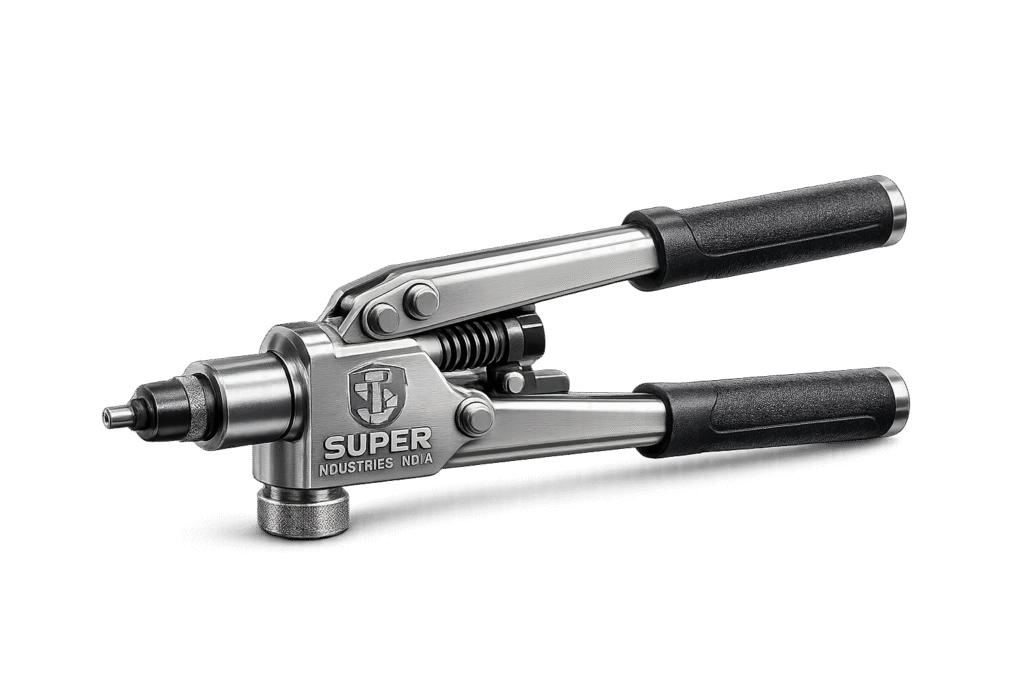
Why Rivet Guns Remain Critical in EPC and Industrial Assembly
In EPC-driven projects, permanent mechanical fastening is evaluated not only by the fastener itself, but by the installation method, force control, repeatability, and inspection visibility. Riveted joints remain prevalent where welding is impractical, heat input must be avoided, or where consistent clamp force across thin sections is required.
A Manual Rivet Guns is therefore not a workshop accessory; it is an installation control device. Its selection and use directly influence:
- Joint integrity and fatigue behavior
- Consistency across production batches
- Rework rates during inspection
- Acceptance by third-party inspectors and consultants
In Oil & Gas skids, power plant auxiliaries, LNG modules, infrastructure panels, and fabricated assemblies, rivet guns enable repeatable, operator-independent fastening, provided the tool is correctly specified.
Technical Definition
What a Rivet Gun Is and How It Operates
A rivet gun is a mechanical or powered installation tool designed to set rivets by applying axial force sufficient to plastically deform the rivet body, creating a permanent joint between two or more components.
Fundamental characteristics:
- Converts mechanical, pneumatic, hydraulic, or electric energy into linear force
- Applies force through controlled stroke and pressure
- Produces a permanent, non-threaded joint
Unlike threaded fasteners, rivets rely on material deformation, not torque. The rivet gun therefore defines the final clamp condition of the joint.
Engineering Purpose & Performance Criteria
Clamp Force Consistency
Rivet guns must deliver:
- Repeatable force output
- Minimal variation across cycles
- Stable performance over duty cycles
Installation Repeatability
In EPC fabrication environments, repeatability reduces:
- Operator dependency
- Joint variability
- Inspection failures
Joint Integrity
Correct riveting ensures:
- Full rivet expansion
- Proper head formation
- Uniform load distribution
Fatigue Performance
Riveted joints installed with consistent force demonstrate:
- Lower fretting risk
- Reduced crack initiation
- Predictable service life
Rivet Gun Selection Logic
Engineering Variables Governing Tool Selection
Selection of a rivet gun is driven by application mechanics, not convenience.
Key parameters:
- Rivet type (blind, solid, structural)
- Rivet material (aluminum, steel, stainless steel)
- Grip range and material stack thickness
- Access constraints and orientation
- Required production rate
- Power availability (air, hydraulic, battery)
Incorrect tool selection often results in:
- Incomplete rivet setting
- Excessive deformation of sheets
- Premature tool wear
- Rejection during inspection
Types of Rivet Guns & Characteristics
Manual Rivet Guns
- Hand-operated
- Limited force output
- Suitable only for light-duty assemblies
Pneumatic Rivet Guns
- Compressed air driven
- High repeatability
- Common in fabrication shops
Hydraulic Rivet Guns
- High-force output
- Used for structural and large-diameter rivets
- Preferred in EPC modules and heavy fabrication
Battery-Operated Rivet Guns
- Controlled force with portability
- Suitable for site installation
- Requires strict maintenance discipline
Heavy-Duty Industrial Rivet Guns
- Designed for continuous duty cycles
- Reinforced housings and seals
- Used in high-volume EPC fabrication
Standards, Safety & Compliance Alignment
While rivet guns are installation tools, EPC environments expect compliance with:
- ISO and EN tool safety norms
- Site safety and ergonomics requirements
- Pressure equipment safety (for pneumatic/hydraulic tools)
Inspectors evaluate:
- Tool suitability for rivet size
- Pressure regulation controls
- Maintenance and calibration practices
Manufacturing & Quality Discipline
Tool Design Considerations
Industrial-grade rivet guns require:
- High-strength housings
- Wear-resistant internal components
- Stable force transmission mechanisms
Durability & Service Life
EPC fabrication environments demand:
- Predictable service intervals
- Availability of spares
- Resistance to contamination
Pressure & Force Control
In pneumatic and hydraulic tools:
- Pressure regulation must be precise
- Leakage must be minimized
- Stroke consistency must be maintained
Procurement, Installation & Inspection View
What EPC Engineers and Inspectors Verify
- Rivet gun force capability vs rivet specification
- Compatibility with rivet material and size
- Duty cycle suitability
- Maintenance and calibration records
Installation Expectations
- Correct air or hydraulic pressure settings
- Proper nosepiece selection
- Verification of fully set rivets
Improperly specified rivet guns are frequently cited in joint non-conformance reports, even when rivets themselves meet standards.
Application Mapping
Rivet guns are routinely used in:
- Oil & Gas skids and enclosures
- Power plant auxiliaries
- Petrochemical fabrication
- LNG and hydrogen module assemblies
- Infrastructure panels and cladding
- Industrial equipment fabrication
Their role is particularly critical where welding is restricted or distortion must be controlled.
Professional Technical Tables
Rivet Gun Types vs Applications
| Rivet Gun Type | Typical Application |
|---|---|
| Manual | Light panels |
| Pneumatic | Fabrication shops |
| Hydraulic | Structural riveting |
| Battery-operated | Site installation |
| Heavy-duty industrial | EPC module fabrication |
Compatible Rivet Sizes & Materials
| Rivet Material | Typical Diameter Range |
|---|---|
| Aluminum | Small to medium |
| Steel | Medium |
| Stainless steel | Medium to large |
Operating Force / Pressure Ranges (Indicative)
| Tool Type | Force Capability |
|---|---|
| Manual | Low |
| Pneumatic | Medium |
| Hydraulic | High |
Duty Cycle Suitability
| Production Requirement | Recommended Tool |
|---|---|
| Low volume | Manual / battery |
| Medium | Pneumatic |
| High / continuous | Hydraulic / heavy-duty |
Project-Specific Tooling Options
- Custom nosepieces
- Extended reach configurations
- Controlled pressure regulators
- Site-specific safety adaptations
Manufacturer-Focused Conclusion
A Rivet Gun is a critical link between design intent and as-installed joint performance. In EPC and export environments, the tool defines:
- Clamp force consistency
- Installation repeatability
- Inspection outcomes
Super Industries approaches rivet guns with engineering discipline, focusing on:
- Tool reliability
- Application-appropriate force delivery
- Compatibility with EPC installation practices
This ensures alignment with the expectations of project engineers, consultants, and third-party inspectors, not just fabrication convenience.
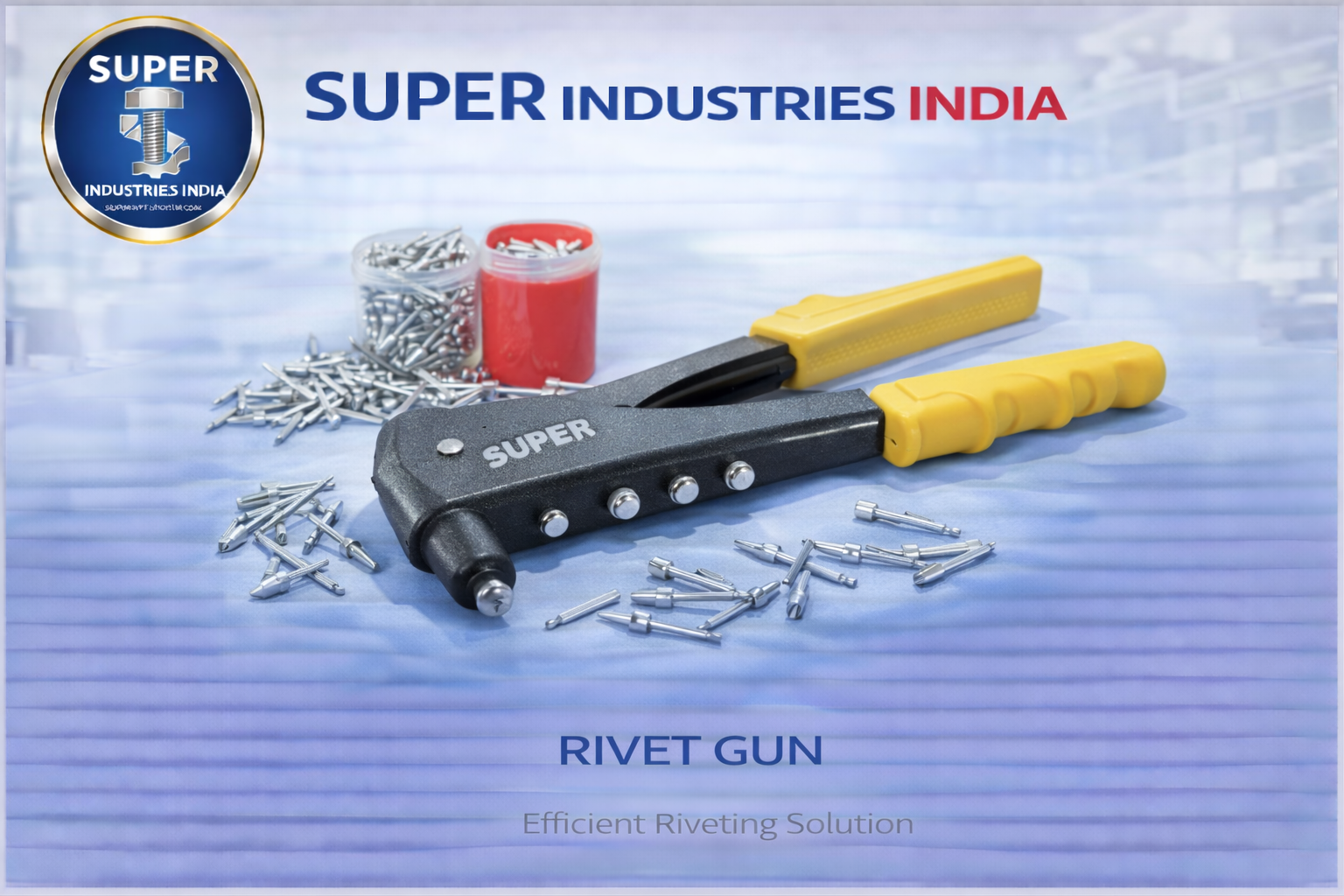
Secure Your Connections: The Ultimate Guide to Choosing the Right Rivet Gun 🛠️
A rivet gun, also popularly known as a riveter or a rivet tool, is an indispensable instrument for creating strong, permanent, and vibration-resistant joints in materials like metal, plastic, and composites. Whether you’re in the massive Indian construction sector, the dynamic automotive industry, or tackling precision metal fabrication, selecting the correct rivet gun is crucial for efficiency, durability, and safety.
At Super Industries India, we provide a comprehensive range of high-quality rivet guns and riveting solutions to meet the demanding requirements of various Indian industries. This guide will help you understand the types of rivet guns, their key applications, and how to choose the best model for your specific needs.
Understanding the Power of a Rivet Gun: Applications in the Indian Market
A rivet gun is a tool designed to set or “buck” rivets, causing the tail end of the rivet to deform (or expand) and form a new head, permanently clamping the materials together. This process creates a joint that holds strong even under significant stress and vibration—a necessity in India’s challenging industrial environments.
Key Industries and Uses:
- Automotive and Transportation: Rivet guns are essential for securing car body panels, internal fixtures, and chassis components, especially where blind fastening is required. They are vital in the manufacturing of rail cars and buses, where joints must withstand constant vibration.
- Construction and Infrastructure: From assembling metal roofing and HVAC ductwork to fastening structural elements in pre-engineered buildings and bridges, rivet guns ensure the integrity of metal frames and sheet metal structures.
- Metal Fabrication and Assembly: Used extensively in sheet metal enclosures, electronics assembly, and general engineering workshops for joining different material types quickly and securely.
- Aerospace and Defence: While requiring specialised tools, the principle of riveting is foundational, with rivet guns ensuring safety and reliability in critical airframe and component assembly.
- DIY and Maintenance: Manual rivet guns are perfect for smaller jobs like home repairs, fixing ladders, assembling furniture, and light metalwork where portability is key.
Types of Rivet Guns: Manual vs. Power Tools
Rivet guns come in several forms, each offering distinct advantages depending on the project volume, material, and required speed. The primary categories are Manual, Pneumatic, and Electric.
| Feature | Manual Rivet Gun (Hand Riveter) | Pneumatic Rivet Gun (Air Riveter) | Electric/Cordless Rivet Gun |
| Power Source | Operator’s physical force | Compressed Air | Battery (Cordless) or Electricity |
| Speed | Slow to Moderate | Very Fast (High Volume) | Fast (Moderate to High Volume) |
| Effort/Fatigue | High (Requires significant force) | Very Low (Air does the work) | Low |
| Cost | Most Affordable | Moderate (Plus compressor cost) | High |
| Portability | Excellent (No external power needed) | Limited (Needs air compressor/hose) | Excellent (Cordless models) |
| Best For | Small-scale projects, DIY, occasional use, soft materials. | Industrial assembly, high-volume production, heavy-duty applications. | Mid-to-large projects, on-site work where air is not available. |
Export to Sheets
1. Manual Rivet Guns (Hand Riveters)
Manual rivet guns are the simplest and most cost-effective option. They operate via a lever mechanism—squeezing the handle pulls the mandrel of a blind rivet, setting the rivet.
- Plier Type: Compact and ideal for small diameter rivets (2.4mm, 3.2mm) and light-duty work.
- Lever Type (Lazy Tong): Offers increased mechanical advantage for slightly larger rivets (up to 4.8mm) and reduced hand strain compared to the plier type.
2. Pneumatic Rivet Guns (Air Riveters)
Pneumatic tools are the workhorses of the industry. They use compressed air to generate powerful, consistent pulling force, allowing for rapid and effortless installation of numerous rivets.
- High Speed and Consistency: Perfect for assembly lines and high-volume tasks common in the Indian manufacturing sector.
- Reduced Fatigue: Minimal physical effort is required, making them suitable for long shifts and heavy-duty riveting (up to 6.4mm or larger).
3. Electric/Cordless Rivet Guns
A middle ground between manual and pneumatic, these tools offer power and high speed without the need for an air compressor.
- Maximum Mobility: Cordless versions are incredibly versatile for on-site construction or repairs in areas without easy access to air lines or power outlets.
- Consistent Force: Provides the reliability of power-assisted riveting, though generally slower than pneumatic models.
Choosing Your Ideal Rivet Gun: Factors to Consider
Selecting the right rivet gun from Super Industries India ensures maximum productivity and a flawless finish on your projects. Here are the crucial factors to evaluate:
1. Rivet Type and Size
The most critical factor is the type and diameter of the rivets you’ll be using.
- Blind Rivets (Pop Rivets): These are the most common type and require a standard rivet gun. Ensure the tool’s nosepiece and pulling capacity match the diameter of your rivets (e.g., 3.2mm, 4.0mm, 4.8mm).
- Rivet Nuts (Threaded Inserts): Require a specialized tool called a Rivet Nut Gun (or rivnut tool), which is designed to install a threaded insert into a thin material.
2. Required Volume and Speed
- For occasional use or small projects (less than 50 rivets): A durable Manual Hand Riveter is sufficient and cost-effective.
- For daily use or high-volume production (hundreds of rivets): A Pneumatic Hydraulic Air Rivet Gun is essential for maintaining high efficiency and preventing operator fatigue.
3. Material and Joint Strength
If you are joining harder materials like stainless steel or thicker aluminium sheets, you will require a tool with greater pulling force. Pneumatic rivet guns are engineered to handle the higher force necessary to set larger and tougher rivets securely.
Why Choose Super Industries India for Your Rivet Gun Needs?
As a leading supplier of industrial tools in India, Super Industries India is committed to providing durable, reliable, and high-performance riveting solutions.
- Quality and Durability: Our range includes heavy-duty manual riveters and industrial-grade pneumatic guns built with robust materials to withstand the rigorous demands of the construction and manufacturing industries.
- Wide Selection: We stock tools compatible with all major rivet sizes and materials (aluminium, steel, stainless steel) to ensure you find the perfect fit for your application.
- Expert Support: Our team provides the technical guidance necessary to select the most efficient and cost-effective riveting solution for your business.
Ready to secure your toughest connections with precision and power?