
NICKEL ALLOY
- NICKEL ALLOY
- 1️⃣ Industry Context
- 2️⃣ Technical Definition
- 3️⃣ Engineering & Service Relevance
- 4️⃣ Alloying Elements & Metallurgical Logic
- 5️⃣ Nickel Alloy Families & Selection Logic
- 6️⃣ Mechanical Properties & Service Behavior
- 7️⃣ Standards & Specification Alignment
- 8️⃣ Manufacturing & Quality Discipline
- 9️⃣ Procurement, Fabrication & Inspection View
- 🔟 Application Mapping
- 1️⃣1️⃣ Professional Technical Tables
- 1️⃣2️⃣ Manufacturer-Focused Conclusion
- High-Performance Nickel Alloy Fasteners: Engineering Excellence for Extreme Conditions
- Why Choose Nickel Alloy Fasteners for Critical Applications?
- Our Range of Speciality Nickel Alloy Fasteners
- Technical Specifications and Manufacturing Expertise
- Nickel Alloy Fasteners Serving Indian Industry
High-Performance Materials for Extreme Temperature, Pressure & Corrosive Service
EPC / Export / MNC Standard
Manufacturer & Global Exporter: Super Industries
Website: https://superindustriesindia.in
1️⃣ Industry Context
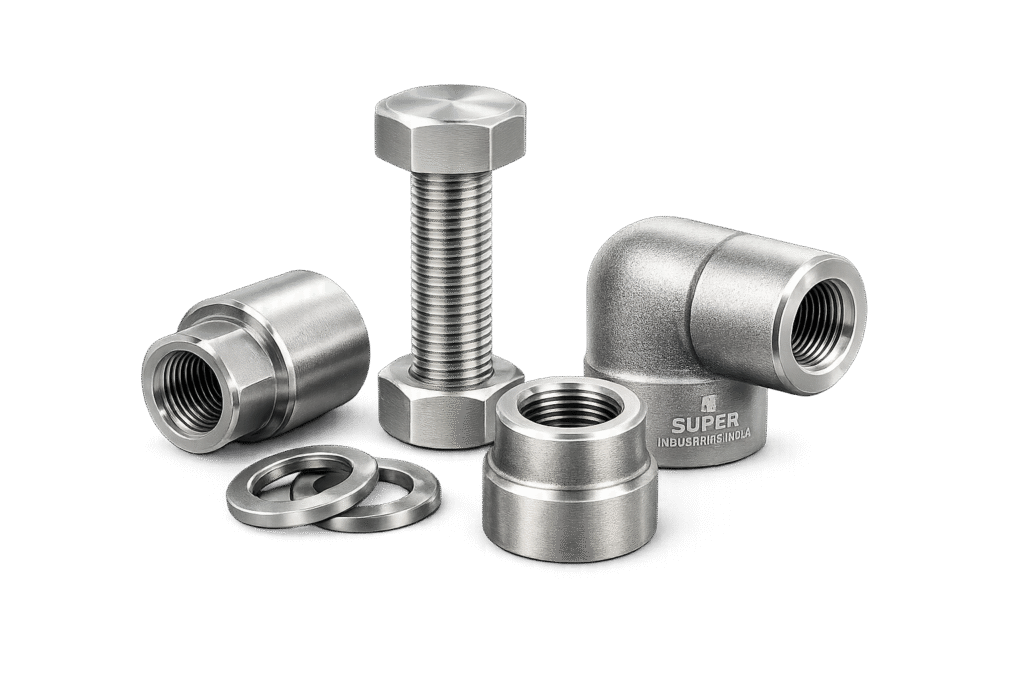
Why Nickel Alloys Are Critical Materials in EPC and Capital Projects
Modern EPC and capital projects increasingly operate at the intersection of high temperature, high pressure, aggressive chemistry, and long design life expectations. Conventional carbon steels and many stainless steels reach their metallurgical and corrosion limits well before project operating envelopes are met.
Nickel alloys are specified when service conditions exceed the safe and predictable performance range of iron-based materials. Their selection is typically driven by one or more of the following requirements:
- Sustained or cyclic operation at elevated temperatures
- Severe corrosion exposure (chlorides, acids, sour media, seawater, mixed environments)
- Combined mechanical stress and thermal cycling
- Long service life with low failure tolerance
- Compliance with pressure equipment codes and international EPC specifications
In Oil & Gas, LNG, Power, Petrochemical, Hydrogen, Offshore, and Infrastructure projects, nickel alloys are not “premium alternatives”; they are risk-control materials chosen to protect safety, uptime, and asset integrity.
2️⃣ Technical Definition
What Nickel Alloys Are and How They Differ from Carbon and Stainless Steels
A Nickel Alloy is a metallic system in which nickel is the principal alloying element, typically exceeding 30% by weight and often forming the majority of the matrix. Unlike carbon steels and most stainless steels, the metallurgical behavior of nickel alloys is governed by nickel’s inherent stability at high temperature and resistance to chemical attack.
Fundamental Differences
Carbon Steels
- Strength derived mainly from carbon and microstructure
- Limited corrosion resistance
- Rapid strength loss at elevated temperature
Stainless Steels
- Iron-based with chromium for corrosion resistance
- Good general corrosion performance
- Restricted high-temperature strength and creep resistance
Nickel Alloys
- Nickel-based matrix with tailored alloying additions
- Stable mechanical properties at high temperature
- Exceptional resistance to specific corrosive environments
- Predictable long-term behavior under extreme service
Nickel alloys are therefore selected where failure mechanisms are driven by temperature, corrosion kinetics, or time-dependent deformation, rather than simple static strength.
3️⃣ Engineering & Service Relevance
Performance Drivers Across Extreme Operating Conditions
High-Temperature Strength
Nickel retains its mechanical strength at temperatures where iron-based alloys rapidly lose load-bearing capacity. This makes nickel alloys suitable for heaters, reformers, high-temperature piping, and fasteners.
Corrosion Resistance
Through controlled additions of chromium, molybdenum, copper, and other elements, nickel alloys resist:
- Pitting and crevice corrosion
- Stress corrosion cracking
- Acidic and alkaline attack
- Seawater and chloride environments
Creep & Time-Dependent Deformation
Nickel alloys exhibit superior creep resistance, allowing components to maintain dimensional stability under sustained stress over long periods.
Fatigue Performance
Thermal cycling and pressure fluctuations induce fatigue. Nickel alloys resist crack initiation and propagation due to their stable microstructure and toughness.
Lifecycle Reliability
For EPC stakeholders, the primary value of nickel alloys is predictable degradation behavior, enabling inspection planning and risk management.
4️⃣ Alloying Elements & Metallurgical Logic
How Chemistry Defines Nickel Alloy Performance
Nickel alloys are not defined by nickel alone. Performance is engineered through carefully balanced alloying systems.
Nickel (Ni)
- Forms the primary matrix
- Maintains ductility and strength at high temperature
- Provides resistance to many corrosive media
Chromium (Cr)
- Enables oxidation and corrosion resistance
- Essential for high-temperature and oxidizing environments
Molybdenum (Mo)
- Improves resistance to pitting and crevice corrosion
- Enhances strength in reducing environments
Iron (Fe)
- Controlled addition improves fabricability and cost efficiency
- Maintained at low levels in corrosion-critical alloys
Copper (Cu)
- Improves resistance to hydrofluoric acid and certain reducing acids
Niobium (Nb), Titanium (Ti), Aluminum (Al)
- Enable precipitation strengthening
- Critical for high-strength and creep-resistant grades
The interaction of these elements defines whether a nickel alloy is optimized for corrosion dominance, temperature dominance, or combined extreme service.
5️⃣ Nickel Alloy Families & Selection Logic
When and Why Each Alloy System Is Selected
Nickel alloys are grouped into families based on dominant performance attributes.
Inconel (Ni–Cr–Mo / Nb)
- High-temperature strength and oxidation resistance
- Selected for extreme heat, pressure, and stress
Incoloy (Ni–Fe–Cr)
- Balanced heat and corrosion resistance
- Used where iron dilution improves fabricability and cost
Hastelloy (Ni–Cr–Mo)
- Superior corrosion resistance in aggressive chemical environments
- Selected for acids, mixed media, and severe corrosion risk
Monel (Ni–Cu)
- Exceptional resistance to seawater and hydrofluoric acid
- Used in marine and chemical service
Alloy 20 (Ni–Fe–Cr–Cu–Mo)
- Optimized for sulfuric acid service
- Common in chemical processing
Nickel 200 / 201
- Commercially pure nickel
- Excellent corrosion resistance and electrical properties
- Limited high-temperature strength
Selection is always application-specific and must align with pressure, temperature, corrosion mechanism, fabrication method, and lifecycle expectations.
6️⃣ Mechanical Properties & Service Behavior
Strength, Ductility, Oxidation & Fabrication Considerations
Strength & Ductility
Nickel alloys maintain high tensile and yield strength while preserving ductility, reducing brittle fracture risk.
Creep Resistance
At elevated temperature, time-dependent deformation becomes critical. Nickel alloys resist creep through stable microstructures and strengthening mechanisms.
Oxidation Resistance
Chromium-bearing nickel alloys form adherent oxide layers that protect against high-temperature oxidation and carburization.
Fabrication Implications
- Higher cutting forces during machining
- Controlled forming to manage work hardening
- Qualified welding procedures to maintain corrosion and mechanical properties
Engineering teams must consider fabrication constraints during material selection to avoid downstream execution risk.
7️⃣ Standards & Specification Alignment
Global Code Acceptance for EPC Projects
Nickel alloys are fully standardized, allowing global EPC acceptance.
Common Standards Framework
- ASTM: Material specifications for pipes, fittings, flanges, fasteners
- ASME Section II: Allowable stresses and pressure design data
- EN / ISO / DIN: European and international compliance
This alignment ensures compatibility with:
- Pressure vessel and piping codes
- Third-party inspection regimes
- Multinational project requirements
8️⃣ Manufacturing & Quality Discipline
Process Control Behind Reliable Nickel Alloy Supply
Melting Routes
- Controlled melting to achieve tight chemistry
- Low inclusion content and cleanliness
Forging & Machining
- Directional grain flow aligned to load paths
- Dimensional stability for pressure components
Heat Treatment
- Solution annealing and aging where required
- Microstructure and grain size control
Traceability & Inspection
- Heat-wise traceability from raw material to finished component
- PMI verification
- Mechanical testing and NDT as per ITP
For nickel alloys, manufacturing discipline is inseparable from material performance.
9️⃣ Procurement, Fabrication & Inspection View
What EPC Engineers and Consultants Verify
During vendor approval and execution, EPC teams typically verify:
- Certified chemical composition and heat numbers
- Mechanical and creep properties
- Heat treatment records
- PMI results on finished components
- Welding compatibility and procedure qualifications
- Compliance with project specifications and codes
Nickel alloys often attract enhanced inspection due to their cost and criticality.
🔟 Application Mapping
Where Nickel Alloys Are Deployed
Oil & Gas
High-pressure piping, sour service, high-temperature equipment, fasteners.
LNG
Cryogenic to high-temperature transitions, process piping, valves.
Power
Heat exchangers, superheaters, gas turbine-related systems.
Petrochemical & Chemical
Reformers, reactors, acid handling systems.
Hydrogen
High-pressure, high-temperature hydrogen service components.
Offshore & Infrastructure
Marine exposure, long-life structural and pressure systems.
1️⃣1️⃣ Professional Technical Tables
Major Nickel Alloy Families & Typical Standards
| Alloy Family | Typical Standards |
|---|---|
| Inconel | ASTM B163 / B564 |
| Incoloy | ASTM B407 / B564 |
| Hastelloy | ASTM B622 / B564 |
| Monel | ASTM B165 / B564 |
| Alloy 20 | ASTM B463 |
| Nickel 200/201 | ASTM B160 |
Chemical Composition – Indicative Ranges
| Alloy Family | Ni % | Cr % | Mo % | Fe % |
|---|---|---|---|---|
| Inconel | 50–70 | 15–25 | 0–10 | Balance |
| Hastelloy | 55–65 | 14–22 | 13–16 | Low |
| Incoloy | 30–35 | 19–23 | – | Balance |
| Monel | 60–70 | – | – | Balance |
| Alloy 20 | 30–35 | 19–21 | 2–3 | Balance |
Mechanical Properties (Indicative)
| Alloy Family | Yield Strength (MPa) | Tensile Strength (MPa) |
|---|---|---|
| Inconel | High | Very High |
| Hastelloy | Moderate | High |
| Incoloy | Moderate | Moderate |
| Monel | Moderate | Moderate |
| Nickel 200 | Low | Low |
Maximum Typical Service Temperatures
| Alloy Family | Approx. Limit |
|---|---|
| Inconel | Up to ~900 °C |
| Hastelloy | ~600–800 °C |
| Incoloy | ~800 °C |
| Monel | ~500 °C |
| Nickel 200 | ~315 °C |
Corrosion Resistance vs Environment
| Environment | Suitable Nickel Alloys |
|---|---|
| Seawater | Monel, Hastelloy |
| Acids | Hastelloy, Alloy 20 |
| High-temperature oxidation | Inconel |
| Chlorides | Hastelloy, Inconel 625 |
| Hydrogen | Inconel, Incoloy |
Typical Product Forms
| Product | Availability |
|---|---|
| Pipes & Tubes | Seamless / Welded |
| Forged Fittings | Elbows, tees, outlets |
| Flanges | All pressure classes |
| Fasteners | Studs, bolts, nuts |
| Custom Forgings | As per EPC drawings |
Project-Specific Customization Options
| Parameter | Options |
|---|---|
| Alloy family & grade | Project-specified |
| Size & rating | EPC MTO |
| Heat treatment | Solution / aged |
| Inspection | PMI, UT, PT |
| Certification | EN 10204 3.1 / 3.2 |
1️⃣2️⃣ Manufacturer-Focused Conclusion
Nickel Alloys represent the highest tier of material selection in EPC and capital projects, where temperature, pressure, corrosion, and lifecycle risk converge. Their successful application depends on metallurgical understanding, disciplined manufacturing, and rigorous quality control—not on nominal grade alone.
Super Industries supplies nickel alloy components manufactured under controlled processes aligned with international standards and EPC expectations. Our focus on traceability, inspection discipline, and export-grade quality supports technically sound material selection and long-term service reliability in the most demanding operating environments.
High-Performance Nickel Alloy Fasteners: Engineering Excellence for Extreme Conditions
When industrial applications involve extreme temperatures, aggressive corrosion, and intense pressure, standard stainless steels often reach their limits. Super Industries India, a leading manufacturer and supplier of specialty fasteners, offers a robust range of Nickel Alloy fasteners designed to thrive in the world’s harshest operating environments. Our commitment to precision in manufacturing high-quality Inconel, Monel, Hastelloy, and other Nickel Alloy bolts, nuts, and studs ensures the ultimate integrity and safety of your critical infrastructure projects in India and internationally.
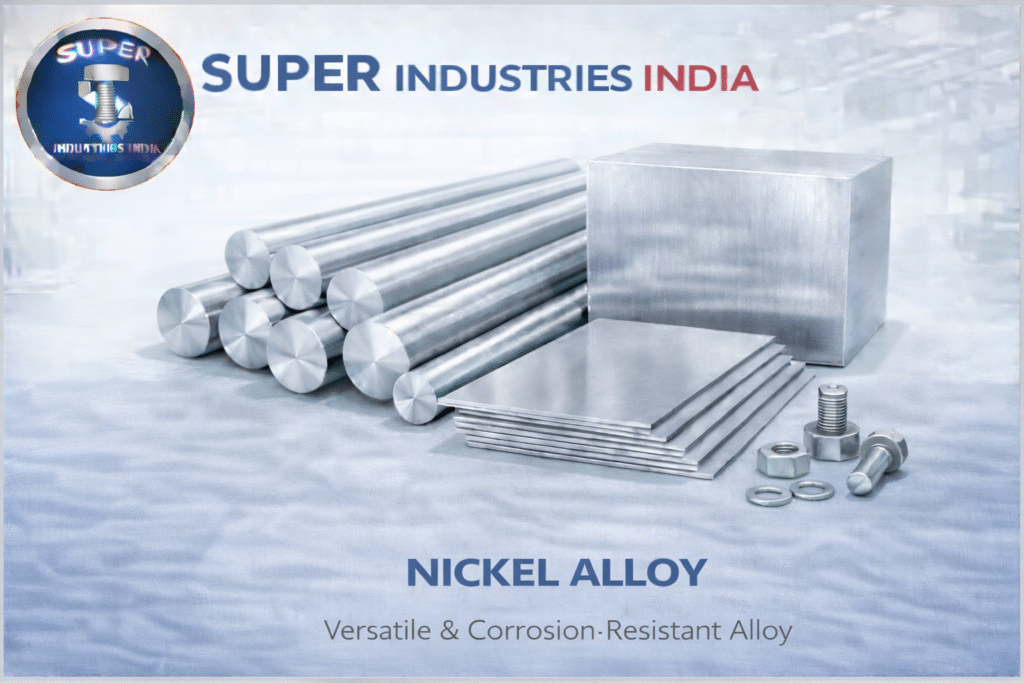
Why Choose Nickel Alloy Fasteners for Critical Applications?
Nickel alloys are superalloys, which means they maintain high mechanical strength and excellent surface stability even when exposed to high temperatures and highly corrosive agents. These properties are indispensable in industries like aerospace, chemical processing, and nuclear power generation.
The primary advantages of using Nickel Alloy fasteners include:
- Superior Corrosion Resistance: Unmatched resistance to stress corrosion cracking (SCC), crevice corrosion, and pitting in severe media like concentrated acids, chlorides, and sour gas environments.
- High-Temperature Stability: Retain exceptional strength and oxidation resistance at elevated temperatures (up to 1200∘C), making them ideal for high-heat industrial equipment.
- High Strength and Toughness: Excellent creep and rupture strength, ensuring long-term structural integrity under sustained high stress.
- Low Thermal Expansion: Crucial for maintaining tight tolerances in assemblies subject to rapid and extreme temperature changes.
Our Range of Speciality Nickel Alloy Fasteners
Super Industries India manufactures and supplies fasteners in the most recognized and high-performing nickel alloy grades:
1. Inconel Fasteners (High Temperature & Oxidation Resistance)
Inconel alloys are primarily composed of Nickel and Chromium. They are renowned for their ability to maintain mechanical properties when red-hot.
| Inconel Grade | Primary Properties | Key Applications |
| Inconel 600 | Excellent resistance to oxidation and carburization at high temperatures. | Furnace components, chemical processing equipment, thermal wells. |
| Inconel 625 | High strength and outstanding resistance to chloride ion stress corrosion cracking and pitting. | Marine, Aerospace, Oil & Gas (downhole equipment), and jet engine components. |
| Inconel 718 | Extremely high tensile and creep-rupture strength up to 700∘C. | Aerospace (turbine blades), nuclear reactors, high-strength bolting. |
2. Monel Fasteners (Marine & Strong Corrosives)
Monel alloys are Nickel-Copper alloys that possess exceptional resistance to rapidly flowing seawater and many acids and alkalis.
- Monel 400 (UNS N04400): Highly resistant to seawater, hydrofluoric acid, and sulfuric acid. Ideal for: Marine applications, pump and valve components, heat exchangers.
3. Hastelloy Fasteners (Aggressive Chemical Resistance)
Hastelloy grades are Nickel-Molybdenum-Chromium alloys known for their unparalleled resistance to a wide range of chemical process environments, including reducing and oxidizing media.
- Hastelloy C276: The most versatile corrosion-resistant alloy. Excellent resistance to pitting, crevice corrosion, and stress corrosion cracking. Ideal for: Flue gas desulfurization systems, sour gas wells, highly corrosive chemical reactors.
- Hastelloy C22: Provides even better resistance to uniform and localized corrosion than C276. Ideal for: Pharmaceutical and highly aggressive chemical processing.
4. Other Nickel Alloys
We also offer fasteners in other essential grades, including Nickel 200/201, Incoloy (Nickel-Iron-Chromium alloys), and Nimonic, catering to niche engineering requirements.
Technical Specifications and Manufacturing Expertise
At Super Industries India, our production of Nickel Alloy fasteners adheres to stringent international specifications, ensuring every product is fit for its critical purpose.
Key Industry Standards & Grades
We manufacture to comply with the primary American Society for Testing and Materials (ASTM) specifications for high-strength bolting:
- ASTM B166 (Nickel-Chromium-Iron Rod, Bar, and Wire)
- ASTM B164 (Nickel-Copper Alloy Rod, Bar, and Wire)
- ASTM B574 (Low-Carbon Nickel-Molybdenum-Chromium Rod)
- ASME B18.2.1/2.2: Dimensional standards for heavy hex bolts and nuts.
- NACE MR0175/ISO 15156: Critical for sour service (H₂S environments) in the Oil & Gas industry.
Fastener Product Range:
Our customized and standard Nickel Alloy fasteners include:
- Hex Head Bolts (Full Thread & Partial Thread)
- Heavy Hex Nuts and Lock Nuts
- Stud Bolts and Threaded Rods
- Washers (Plain, Flat, Custom)
- Anchor Bolts and Specialized Fasteners
Manufacturing Process:
Our in-house capabilities allow for manufacturing via both cold forging (for smaller sizes and high volume) and hot forging/precision machining (for larger diameters and specialty components), ensuring optimal metallurgical integrity and precision in every piece.
Nickel Alloy Fasteners Serving Indian Industry
We are a trusted Nickel Alloy fastener supplier to high-value projects across India’s industrial landscape, including Mumbai, Gujarat (Petrochemical corridor), Chennai, and Hyderabad (Aerospace). Our fasteners provide reliable connections in:
- Oil & Gas (Upstream & Downstream): Flanges, valve bodies, and heat exchanger bolting.
- Chemical Processing: Reactors, pressure vessels, and piping systems handling sulfuric acid, hydrochloric acid, and chlorine.
- Power Generation: Superheaters, reheaters, and boiler components in thermal and nuclear plants.
- Aerospace: High-strength, temperature-resistant engine assemblies and structural components.
Need certified, high-performance Inconel, Monel, or Hastelloy fasteners for your next extreme service application?
Contact Super Industries India—Your specialist partner for advanced Nickel Alloy fastening solutions.