
DUPLEX & SUPER DUPLEX STAINLESS STEEL
- DUPLEX & SUPER DUPLEX STAINLESS STEEL
- 1️⃣ Industry Context
- 2️⃣ Technical Definition
- 3️⃣ Engineering & Service Relevance
- 4️⃣ Metallurgical Structure & Alloying Logic
- 5️⃣ Duplex vs Super Duplex – Selection Logic
- 6️⃣ Mechanical Properties & Service Behavior
- 7️⃣ Corrosion Performance & PREN Logic
- 8️⃣ Standards & Specification Alignment
- 9️⃣ Manufacturing & Quality Discipline
- 🔟 Procurement, Fabrication & Inspection View
- 1️⃣1️⃣ Application Mapping
- 1️⃣2️⃣ Professional Technical Tables
- 1️⃣3️⃣ Manufacturer-Focused Conclusion
- Unmatched Strength and Corrosion Resistance: Duplex & Super Duplex Stainless Steel Fasteners
- What are Duplex and Super Duplex Stainless Steels?
- Duplex Stainless Steel (DSS) Fasteners: The Workhorse of Harsh Environments
- Super Duplex Stainless Steel (SDSS) Fasteners: The Ultimate Corrosion Solution
- Quality and Compliance: Super Industries India's Guarantee
High-Strength, High-Corrosion-Resistance Materials for EPC & Capital Projects
Manufacturer & Global Exporter: Super Industries
Website: https://superindustriesindia.in
1️⃣ Industry Context
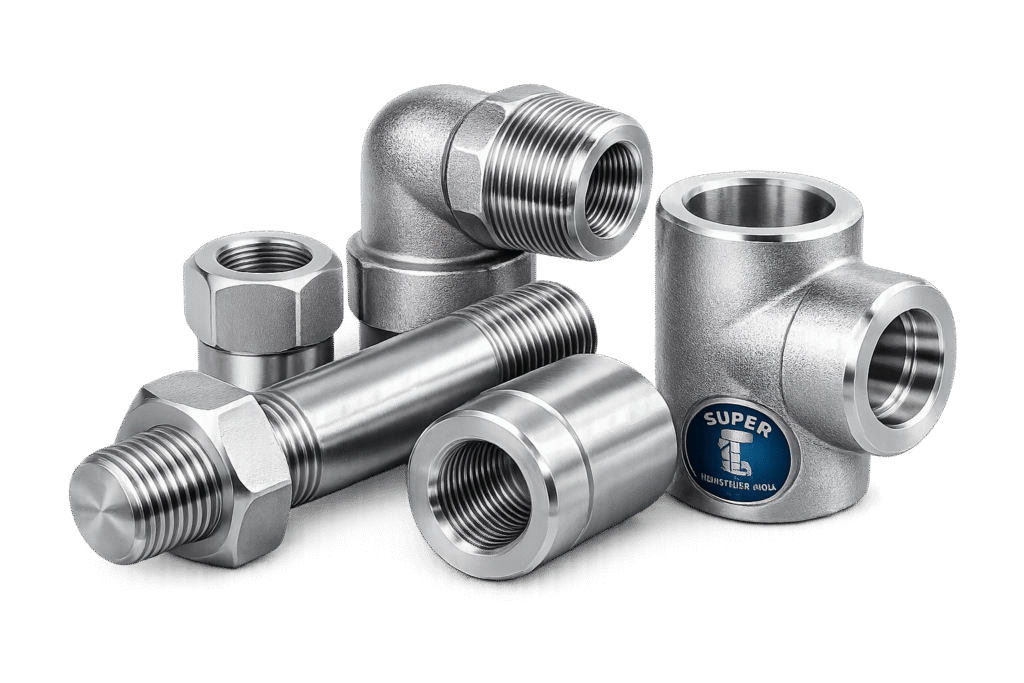
Why Duplex & Super Duplex Stainless Steels Are Strategic Materials in EPC Projects
EPC and capital projects increasingly operate in environments where corrosion risk, mechanical loading, and lifecycle reliability intersect. Offshore platforms, subsea systems, LNG terminals, hydrogen infrastructure, high-pressure pipelines, and marine-facing facilities expose materials to chlorides, pressure cycling, and long-term fatigue.
Conventional austenitic stainless steels such as 304L and 316L often reach their practical limits under these conditions, particularly with respect to:
- Stress corrosion cracking in chloride environments
- Strength limitations leading to heavier sections
- Reduced safety margins under combined pressure and corrosion
Duplex and Super Duplex stainless steels were developed to address these limitations through a balanced metallurgical structure that delivers higher strength and superior corrosion resistance without the cost escalation of nickel-based alloys.
In EPC execution, these materials are selected not for nominal performance, but for risk reduction, weight optimization, and predictable long-term behavior under aggressive service.
2️⃣ Technical Definition
What Duplex and Super Duplex Stainless Steels Are
Duplex and Super Duplex stainless steels are iron-based alloys with a dual-phase microstructure, consisting of approximately equal proportions of:
- Ferrite (α phase)
- Austenite (γ phase)
This dual-phase structure is intentionally engineered during melting and heat treatment.
How They Differ from Other Stainless Steels
Austenitic Stainless Steels (e.g., 316L)
- Single-phase austenitic structure
- Good general corrosion resistance
- Lower yield strength
- Susceptible to chloride stress corrosion cracking
Martensitic Stainless Steels
- High strength, limited corrosion resistance
- Used for wear and mechanical components
Duplex / Super Duplex Stainless Steels
- Dual-phase ferrite–austenite structure
- Approximately 2× yield strength of austenitic grades
- Excellent resistance to chloride-induced corrosion and cracking
Super Duplex grades extend this concept further through higher alloy content, providing increased corrosion resistance and safety margins.
3️⃣ Engineering & Service Relevance
Why EPC Engineers Specify Duplex & Super Duplex
Strength-to-Weight Advantage
Duplex and Super Duplex stainless steels typically offer double the yield strength of 300-series stainless steels. This enables:
- Thinner wall sections
- Lower overall system weight
- Reduced material and fabrication volume
Corrosion Resistance
These alloys demonstrate strong resistance to:
- Pitting corrosion
- Crevice corrosion
- Chloride-induced stress corrosion cracking
Fatigue & Lifecycle Performance
The combined strength and toughness of the dual-phase structure improves resistance to cyclic loading and fatigue crack initiation.
Safety Margin in Aggressive Environments
Super Duplex grades are frequently selected where failure consequences are severe and inspection access is limited, such as subsea or offshore systems.
4️⃣ Metallurgical Structure & Alloying Logic
How Duplex Microstructure Is Achieved and Controlled
Ferrite–Austenite Balance
The target phase balance is typically 40–60% ferrite and 60–40% austenite. Deviations outside this range negatively affect toughness, corrosion resistance, or weldability.
Key Alloying Elements
Chromium (Cr)
- Primary contributor to corrosion resistance
- Typically 22–26% depending on grade
Molybdenum (Mo)
- Improves pitting and crevice corrosion resistance
- Critical in offshore and chloride-rich environments
Nitrogen (N)
- Stabilizes austenite
- Increases strength and PREN value
Nickel (Ni)
- Supports austenite formation
- Lower than austenitic stainless steels, improving cost efficiency
The interaction of these elements defines whether a grade is classified as Duplex or Super Duplex.
5️⃣ Duplex vs Super Duplex – Selection Logic
Engineering Criteria for Grade Selection
Duplex Stainless Steel (e.g., 2205)
- Suitable for moderate to high chloride exposure
- Common in onshore oil & gas, pipelines, pressure vessels
- PREN typically ~35
Super Duplex Stainless Steel (e.g., 2507, Zeron-type)
- Higher chromium, molybdenum, and nitrogen
- Designed for severe chloride, offshore, and subsea service
- PREN typically ≥40
Selection is driven by:
- Chloride concentration
- Operating temperature
- Pressure and stress level
- Required design life and inspection accessibility
Super Duplex is specified when standard Duplex does not provide sufficient corrosion safety margin.
6️⃣ Mechanical Properties & Service Behavior
Structural Performance in EPC Applications
Yield & Tensile Strength
Duplex and Super Duplex steels typically provide:
- Yield strength: ~450–550 MPa (Duplex)
- Yield strength: ~550–650 MPa (Super Duplex)
This allows engineers to reduce wall thickness while maintaining pressure integrity.
Toughness
Adequate impact toughness is maintained when phase balance is controlled. Excess ferrite can reduce low-temperature toughness, emphasizing the importance of proper heat treatment.
Temperature Limits
- Recommended continuous service typically up to ~300 °C
- Not intended for high-temperature creep-dominated service
Fabrication Implications
- Higher forming forces required due to strength
- Controlled welding procedures to maintain phase balance
- Post-weld heat treatment generally not required, but ferrite control is essential
7️⃣ Corrosion Performance & PREN Logic
Understanding Pitting Resistance
The Pitting Resistance Equivalent Number (PREN) is used to estimate resistance to localized corrosion:
PREN ≈ %Cr + 3.3(%Mo) + 16(%N)
Typical PREN Values
- 316L: ~24
- Duplex 2205: ~35
- Super Duplex 2507: ≥40
Higher PREN values correlate with improved resistance to pitting and crevice corrosion in chloride environments.
Offshore & Marine Suitability
Super Duplex grades are widely used in seawater systems, offshore platforms, and subsea hardware due to their high PREN and resistance to stress corrosion cracking.
8️⃣ Standards & Specification Alignment
Global Code Acceptance
Duplex and Super Duplex stainless steels are fully standardized and accepted across EPC projects.
Common Standards
- ASTM: Pipes, fittings, flanges, fasteners
- ASME Section II: Allowable stresses for pressure design
- EN / ISO / DIN: European and international harmonization
This enables seamless integration into pressure piping, vessel design, and global procurement frameworks.
9️⃣ Manufacturing & Quality Discipline
Process Control for Duplex & Super Duplex Materials
Melting & Refining
- Controlled melting to achieve precise chemistry
- Tight nitrogen control
Forging & Machining
- Grain flow aligned with load paths
- Dimensional stability critical for pressure components
Heat Treatment
- Solution annealing to restore phase balance
- Rapid quenching to avoid deleterious phases
Inspection & Traceability
- Heat-wise traceability
- PMI verification
- Ferrite testing
- Mechanical and corrosion testing as required
For Duplex and Super Duplex, process discipline directly determines service performance.
🔟 Procurement, Fabrication & Inspection View
What EPC Teams Verify
During vendor qualification and execution, EPC stakeholders typically review:
- Chemical composition and nitrogen content
- Ferrite percentage in base material and welds
- Mechanical properties and impact toughness
- PMI and heat treatment records
- Compliance with project specifications
Enhanced inspection is common due to the criticality of these materials.
1️⃣1️⃣ Application Mapping
Oil & Gas
Flowlines, pressure piping, manifolds, fasteners.
Offshore & Marine
Seawater systems, risers, structural connectors.
Power & Energy
Cooling water systems, high-strength piping.
Petrochemical & LNG
Process piping exposed to chlorides and pressure cycling.
Hydrogen
High-pressure systems requiring strength and corrosion resistance.
Infrastructure
Marine bridges, coastal installations, desalination plants.
1️⃣2️⃣ Professional Technical Tables
Duplex & Super Duplex Grades and Standards
| Grade | Typical Standard |
|---|---|
| Duplex 2205 | ASTM A182 / A790 |
| Super Duplex 2507 | ASTM A182 / A790 |
| Zeron-type | Project-specified |
Chemical Composition – Indicative Ranges
| Grade | Cr % | Mo % | Ni % | N % |
|---|---|---|---|---|
| 2205 | 21–23 | 2.5–3.5 | 4.5–6.5 | 0.14–0.20 |
| 2507 | 24–26 | 3–4 | 6–8 | 0.24–0.32 |
Mechanical Properties (Typical)
| Grade | Yield Strength (MPa) | Tensile Strength (MPa) |
|---|---|---|
| 2205 | ~450 | ~620 |
| 2507 | ~550 | ~800 |
PREN Values
| Grade | PREN |
|---|---|
| 2205 | ~35 |
| 2507 | ≥40 |
Maximum Typical Service Temperatures
| Grade | Temperature Limit |
|---|---|
| 2205 | ~300 °C |
| 2507 | ~300 °C |
Typical Product Forms
| Product | Availability |
|---|---|
| Pipes & Tubes | Seamless / Welded |
| Forged Fittings | Elbows, tees, outlets |
| Flanges | All pressure classes |
| Fasteners | Studs, bolts, nuts |
| Custom Forgings | EPC drawings |
Grades vs Applications
| Application | Recommended Grade |
|---|---|
| Onshore pipelines | Duplex 2205 |
| Offshore systems | Super Duplex 2507 |
| Seawater exposure | Super Duplex |
| High-pressure piping | Duplex / Super Duplex |
Project-Specific Customization Options
| Parameter | Options |
|---|---|
| Grade | Project-specified |
| Size & rating | EPC MTO |
| Heat treatment | Solution annealed |
| Inspection | PMI, ferrite, UT |
| Certification | EN 10204 3.1 / 3.2 |
1️⃣3️⃣ Manufacturer-Focused Conclusion
Duplex & Super Duplex Stainless Steels occupy a critical position between conventional stainless steels and nickel-based alloys, offering a unique combination of high strength, corrosion resistance, and cost efficiency for demanding EPC applications.
Their successful deployment depends on precise metallurgical control, disciplined manufacturing, and rigorous inspection—particularly with respect to phase balance and corrosion performance.
Super Industries supplies Duplex and Super Duplex components manufactured under controlled processes aligned with international standards and EPC requirements. Our focus on traceability, inspection integrity, and export-grade quality supports long-term reliability in offshore, marine, and high-pressure service environments.
Unmatched Strength and Corrosion Resistance: Duplex & Super Duplex Stainless Steel Fasteners
For the most demanding industrial environments—where extreme pressures, high temperatures, and aggressive corrosive media are common—standard stainless steel simply won’t suffice. Super Industries India, a leading Duplex and Super Duplex Stainless Steel fastener manufacturer and supplier in India, provides precision-engineered components that offer a step change in performance, reliability, and lifespan.
Our specialized fasteners, including Duplex nuts, Super Duplex bolts, and custom anchors, are the definitive choice for critical applications in the Oil & Gas, Petrochemical, Offshore, and Chemical Processing industries across India and globally.
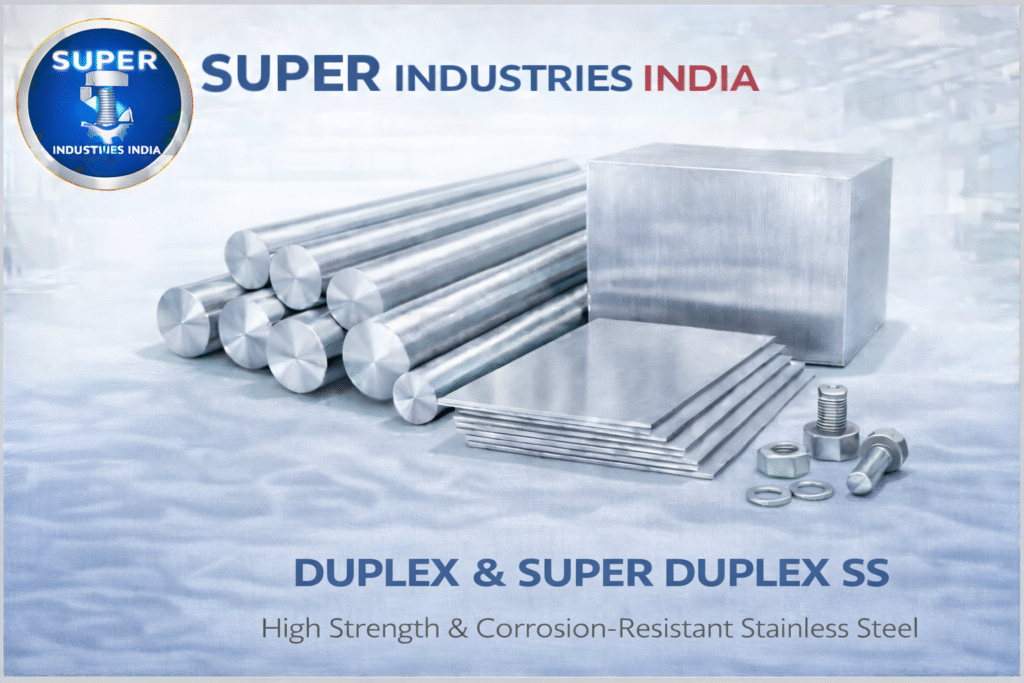
What are Duplex and Super Duplex Stainless Steels?
Duplex Stainless Steel (DSS) and Super Duplex Stainless Steel (SDSS) represent an advanced class of alloys that deliver superior properties compared to the standard Austenitic grades (like SS 304 and SS 316). The name “Duplex” refers to the material’s unique microstructure, which is approximately 50% Ferrite and 50% Austenite. This two-phase structure is the source of their exceptional strength and corrosion resistance.
The Duplex Advantage over Standard SS 316
| Feature | Standard Austenitic (SS 316/A4) | Duplex/Super Duplex (UNS S31803 / UNS S32750) |
| Tensile Strength | Good | Twice the Strength of 316 |
| Pitting Corrosion | Moderate (Pitting Resistance Equivalent Number – PREN ≈25) | Excellent (PREN ≈35−45) |
| Stress Corrosion Cracking (SCC) | Vulnerable to SCC in chloride environments | Highly Resistant |
| Weldability | Excellent | Very Good (Requires controlled procedures) |
Duplex Stainless Steel (DSS) Fasteners: The Workhorse of Harsh Environments
Our Duplex Stainless Steel fasteners are primarily manufactured from Grade UNS S31803 / S32205 (F51 / F60). These grades are widely considered the ideal balance between cost-effectiveness and high performance for heavy-duty industrial applications.
Key Properties & Benefits:
- High Mechanical Strength: The yield strength of Duplex 2205 is roughly double that of 316L, allowing for the use of smaller, lighter components without compromising load-bearing capacity. This is critical in reducing material cost and overall assembly weight.
- Chloride Pitting Resistance: The elevated Chromium, Molybdenum, and Nitrogen content ensures excellent resistance to localized corrosion, particularly pitting and crevice corrosion in chloride-rich media, making Duplex bolts essential for marine and brackish water processing.
- Resistance to Stress Corrosion Cracking (SCC): Duplex grades are inherently more resistant to SCC than standard 300 series stainless steels, a vital attribute for equipment in contact with hot chlorides, such as heat exchangers.
Common Fasteners in Duplex 2205:
- Duplex Hex Head Bolts
- Duplex Heavy Hex Nuts
- Duplex Stud Bolts and Threaded Rods
- Duplex Washers (Plain and Spring)
Super Duplex Stainless Steel (SDSS) Fasteners: The Ultimate Corrosion Solution
When conditions push beyond the limits of Duplex steel, our Super Duplex Stainless Steel fasteners step in. These grades, notably UNS S32750 (F53) and UNS S32760 (F55), contain even higher levels of corrosion-fighting elements.
The Power of Super Duplex:
- Extreme Pitting Resistance: With a PREN value typically above 40, Super Duplex is engineered for the harshest chemical processing and offshore environments. It offers unmatched resistance to acids and highly concentrated chlorides.
- Superior Strength: Provides the highest mechanical strength among standard corrosion-resistant alloys, ensuring structural integrity in high-pressure installations.
- Thermal Stability: Excellent performance across a broad temperature range, vital for equipment running constantly in elevated temperatures.
Critical Applications for Super Duplex Fasteners:
Super Duplex fasteners are non-negotiable for the world’s most critical infrastructure:
- Offshore Oil & Gas: Platform construction, subsea equipment, pipe connectors, and risers, where exposure to seawater and sour gas is constant.
- Chemical Tankers: Fastening components on ships that transport highly corrosive chemicals.
- Desalination Plants: Equipment exposed to hot, concentrated brine solutions.
- Pulp & Paper Industry: Handling corrosive liquors and bleaching agents.
Quality and Compliance: Super Industries India’s Guarantee
As a specialized fastener manufacturer in India, Super Industries India ensures that all Duplex and Super Duplex components are manufactured to strict international quality standards, ensuring reliability and full traceability:
| Standard / Grade | Description | Application Focus |
| ASTM A182 | Forged or Rolled Alloy Steel Pipe Flanges, Forged Fittings, and Valves and Parts. (Material for our raw stock) | Flange bolting, valve assemblies. |
| ASTM A276 | Standard Specification for Stainless Steel Bars and Shapes. (Material for our raw stock) | Manufacturing of bolts and studs. |
| ASTM A479 | Standard Specification for Stainless Steel Bars and Shapes for Use in Boilers and Other Pressure Vessels. | High-pressure equipment. |
| UNS S31803 / S32205 | Duplex Grade (F51 / F60) | General oil & gas, process equipment. |
| UNS S32750 / S32760 | Super Duplex Grade (F53 / F55) | Offshore, extreme chemical exposure. |
Super Industries India is your trusted source for high-integrity Duplex and Super Duplex fasteners designed to outlast and outperform in any environment.
Need a custom quote or immediate supply of certified F51, F53, or F55 grade fasteners?
Contact Super Industries India—the experts in high-performance specialty steel fasteners.