
LAG SCREWS (LAG BOLTS)
Structural & Heavy-Duty Anchoring Fasteners for EPC, Infrastructure, and Export Projects
Manufacturer & Global Exporter: Super Industries
Website: https://superindustriesindia.in
Industry Context
Why Lag Screws Are Critical in Structural Assemblies, Timber Engineering, Infrastructure Supports, and Heavy-Load Anchoring Systems
Within EPC and infrastructure projects, Lag Screws occupy a very specific and technically defined role. They are not general-purpose screws, nor are they substitutes for anchor bolts or structural bolts. Lag screws are engineered fastening elements intended to transfer load directly into timber or timber-based substrates, and in certain controlled cases, into pre-drilled masonry or composite interfaces.
Their continued specification across infrastructure and industrial projects is driven by three fundamental engineering realities:
- Timber remains a structural material in global EPC work—railway sleepers, utility poles, substation frames, equipment skids, marine fenders, temporary works, and industrial access structures all rely on timber elements.
- Load paths in timber differ fundamentally from steel or concrete, requiring fasteners with deep threads, controlled bearing behavior, and predictable pull-out performance.
- Lag screws provide a balance between load capacity, installation practicality, and field adaptability, particularly where cast-in anchors or through-bolting are impractical.
In capital projects, lag screws are typically found in:
- Power transmission and distribution structures
- Railway sleepers and trackside infrastructure
- Heavy timber frames and industrial supports
- Equipment foundations with timber interface layers
- Marine and coastal structures (with appropriate material selection)
From an EPC approval standpoint, lag screws are evaluated not as “screws,” but as structural anchoring components whose performance depends on diameter, embedment depth, timber density, moisture condition, and installation control. This page addresses lag screws strictly from that structural and engineering-disciplined perspective.
Technical Definition
What Lag Screws Are and How They Differ from Wood Screws, Coach Screws, and Anchor Bolts
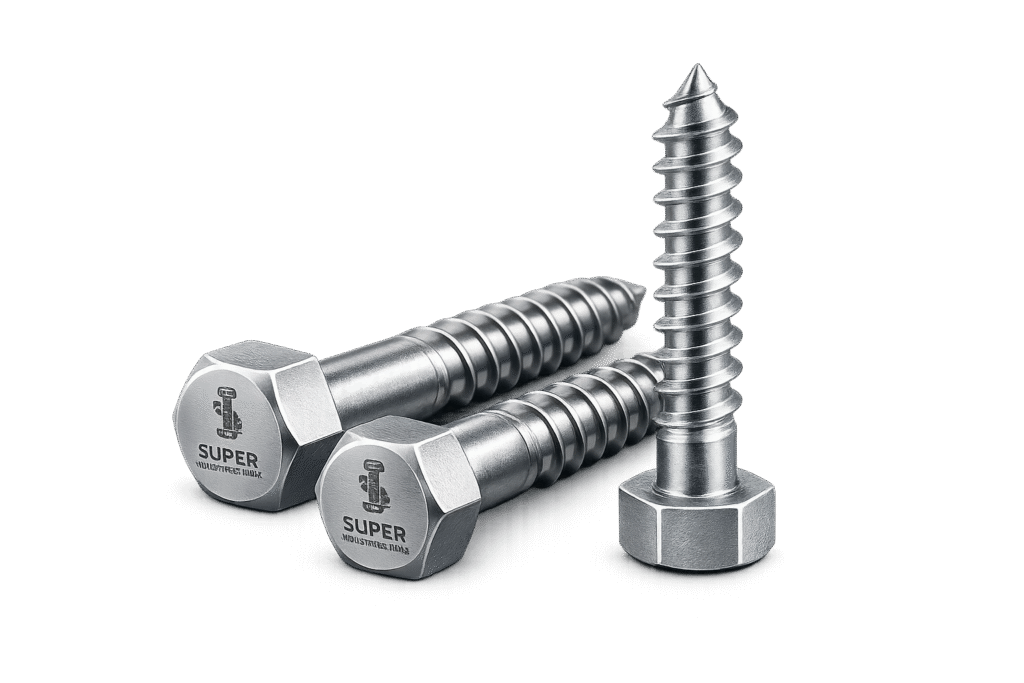
A Lag Screw (also referred to as a Lag Bolt in some standards) is defined by the following characteristics:
- Large external hex head for high torque application
- Deep, coarse threads designed to cut and bear into timber
- Partially threaded shank, allowing controlled load transfer
- Installation without a nut, relying on thread-to-wood engagement
Lag Screws vs Wood Screws
Wood screws are typically smaller, fully threaded, and intended for joinery or light construction. Lag screws are structural fasteners, designed to resist significant shear and pull-out forces.
Lag Screws vs Coach Screws
In many regions, “coach screw” is used interchangeably with lag screw. From an engineering standpoint, both refer to heavy hex-head wood screws; however, EPC specifications typically standardize on the term lag screw to avoid ambiguity.
Lag Screws vs Anchor Bolts
Anchor bolts transfer load into concrete via embedment or mechanical expansion. Lag screws transfer load into timber fibers via thread bearing and friction. Substitution between the two is not acceptable without engineering recalculation.
Thread & Shank Engineering
Thread Depth, Pitch, Partial Threading Logic, and Load Transfer into Timber
The defining performance feature of lag screws is their thread geometry.
Deep Coarse Threads
Lag screws use deep, widely spaced threads to:
- Maximize bearing area against wood fibers
- Reduce splitting risk when installed with correct pilot holes
- Improve pull-out resistance in low-density timbers
Partial Threading
The unthreaded shank serves two purposes:
- It allows tight clamping of connected members
- It positions the shear plane on the solid shank, not the threads
This distinction is critical in structural joints subjected to cyclic or lateral loads.
Load Transfer Mechanism
Unlike steel-to-steel fasteners, lag screws transfer load through:
- Thread bearing against compressed wood fibers
- Friction generated by clamping force
- Shear resistance of the shank
Engineering calculations must account for timber species, moisture content, and grain orientation.
Head Design & Torque Transfer
Hex Head Geometry, Wrench Engagement, and Washer Interaction
Lag screws feature an external hex head, selected for structural reasons rather than convenience.
Hex Head Advantages
- Allows high installation torque without drive failure
- Compatible with impact tools and calibrated torque equipment
- Provides clear visual confirmation of head integrity
Washer Usage
In structural EPC practice, lag screws are almost always installed with washers to:
- Distribute bearing pressure on timber surfaces
- Prevent local crushing of wood fibers
- Improve long-term preload retention
Washer diameter and hardness are part of the engineered joint, not accessories.
Load Performance & Structural Behavior
Pull-Out Resistance, Shear Capacity, Bearing Stress, and Creep
Pull-Out Resistance
Pull-out capacity depends on:
- Screw diameter
- Thread length embedded
- Timber density
- Installation quality
Over-driving or under-embedding directly compromises performance.
Shear Capacity
Shear loads should be carried primarily by:
- The unthreaded shank
- Bearing between connected members
Threads in the shear plane increase fatigue risk and are avoided in engineered designs.
Bearing Stress in Timber
Excessive clamping force can crush wood fibers, reducing long-term capacity. Proper torque limits are therefore essential.
Creep Behavior
Timber exhibits time-dependent deformation. Lag screw joints must be designed with creep allowance, especially in sustained load applications.
Material & Standard Alignment
Carbon Steel, Alloy Steel, Stainless Steel — Structural Suitability
Carbon & Alloy Steel Lag Screws
- Used in most infrastructure applications
- Require corrosion protection for outdoor exposure
Stainless Steel Lag Screws
- Selected for marine, coastal, or chemically aggressive environments
- Lower strength than alloy steel; diameter selection compensates
Standards Framework
Lag screws supplied for EPC projects typically align with:
- ASTM mechanical property requirements
- DIN / ISO dimensional logic
- Project-specific technical specifications
Manufacturing & Quality Discipline
Forging, Thread Rolling, Heat Treatment, and Traceability
Structural lag screws are forged products, not improvised fasteners.
Key manufacturing controls include:
- Controlled head forging to prevent cracking
- Rolled threads for fiber flow continuity
- Heat treatment for strength and toughness balance
- Dimensional inspection of shank and thread geometry
- Batch traceability and material certification
Coatings & Corrosion Protection
Matching Coating Systems to Exposure Conditions
Common coating systems include:
- Hot-dip galvanizing for outdoor infrastructure
- Mechanical galvanizing for dimensional consistency
- Zinc plating for indoor or temporary use
Coating thickness directly affects thread fit and must be accounted for in pilot hole sizing.
Procurement, Installation & Inspection View
What EPC Engineers, Inspectors, and Consultants Verify
During approval and site inspection, EPC teams typically verify:
- Diameter and length conformity
- Thread quality and coating integrity
- Washer usage and bearing condition
- Pilot hole compliance
- Installation torque documentation
- Material Test Certificates (MTCs)
Improper installation is the most common cause of lag screw joint failure—not material defects.
Application Mapping
Typical EPC and Infrastructure Use Cases
Lag screws are commonly used in:
- Power transmission poles and frames
- Railway sleepers and timber ties
- Industrial equipment supports
- Heavy timber frames and bracing
- Temporary works and modular structures
They are not used as pressure-retaining fasteners or primary steel-to-steel structural bolts.
Professional Technical Tables
Diameter & Length Ranges (Indicative)
| Diameter | Typical Length Range |
|---|---|
| M8 – M12 | 40 – 120 mm |
| M16 – M20 | 80 – 200 mm |
| M24+ | Project-specific |
Recommended Pilot Hole Sizes (Indicative)
| Lag Screw Diameter | Pilot Hole Diameter |
|---|---|
| M10 | 6–7 mm |
| M16 | 10–12 mm |
| M20 | 14–16 mm |
(Final values depend on timber density and moisture content.)
Load Capacity (Reference Only)
| Diameter | Pull-Out Capacity* | Shear Capacity* |
|---|---|---|
| M12 | Application-dependent | Application-dependent |
| M20 | Application-dependent | Application-dependent |
*Design values must be calculated per project.
Material Grades vs Environment
| Material | Environment |
|---|---|
| Carbon steel + HDG | Outdoor infrastructure |
| Alloy steel + coating | Heavy structural |
| Stainless steel | Marine / coastal |
Custom Manufacturing Options
- Non-standard lengths
- Project-specific coatings
- Oversized heads or shanks
- Enhanced traceability requirements
Manufacturer-Focused Conclusion
Lag Screws are structural anchoring fasteners whose performance depends on engineering discipline, correct sizing, controlled installation, and material suitability. In EPC and infrastructure projects, they form a critical interface between timber and structural systems, where failure is not acceptable.
Super Industries manufactures lag screws with forged heads, rolled threads, verified heat treatment, controlled coatings, and EPC-grade traceability, supporting reliable performance in infrastructure, industrial, and export projects where load paths, service life, and inspection requirements are non-negotiable.
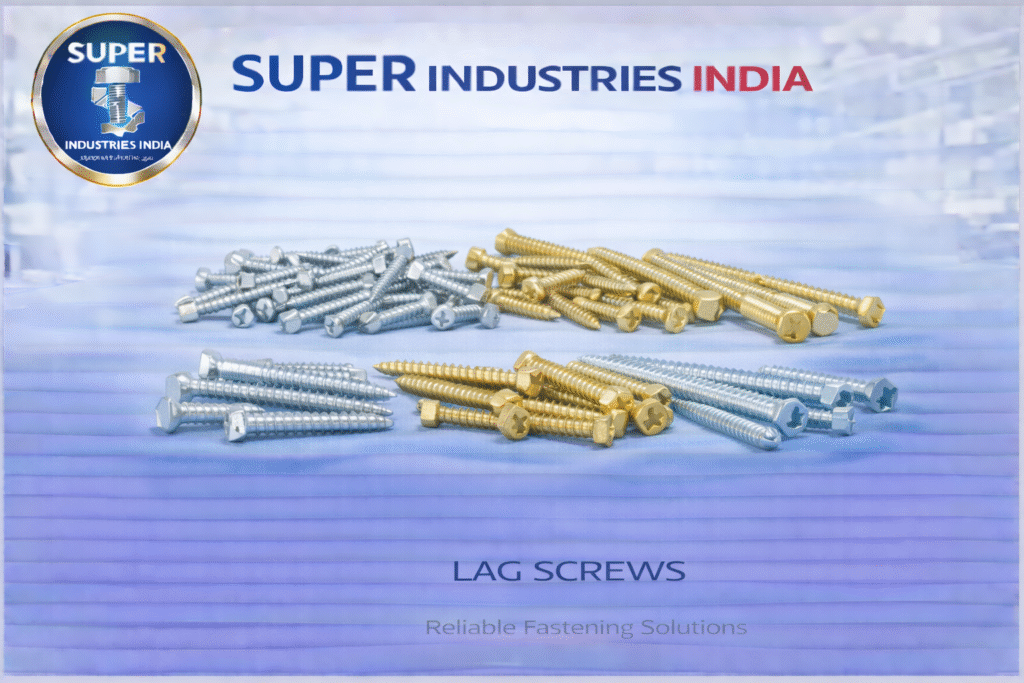
As a leading manufacturer and supplier of industrial fasteners, Super Industries India understands the critical role that high-quality fasteners play in every construction and engineering project. Among our most robust and essential products are Lag Screws, often referred to as Lag Bolts or Coach Screws.
This comprehensive guide will detail everything you need to know about our premium range of Lag Screws, their unmatched strength, versatile applications, and why Super Industries India is your trusted partner for heavy-duty fastening solutions across the world.
Lag Screws: The Heavy-Duty Fasteners for Structural Strength
Lag Screws are a class of fasteners specifically engineered for applications that demand superior holding power and load-bearing capability. They are substantially larger and thicker than standard wood screws, designed to secure heavy timber, lumber, and structural components with exceptional tenacity.
What Sets Lag Screws Apart?
- Hexagonal Head: Our Lag Screws feature a distinct hexagonal head, designed to be driven using a wrench, socket, or powerful drilling tool. This allows for the application of significantly higher torque compared to standard screw heads, ensuring an extremely tight and secure connection.
- Coarse, Deep Threads: The coarse threads are specifically designed to grip deeply into the material (primarily wood, but also used with masonry anchors), creating a powerful friction joint that resists pull-out and shear forces under heavy load.
- Partially Threaded Shank: Typically, Lag Screws have threads that run for only a portion of the shank. The unthreaded upper shank allows the two fastened materials to be pulled together tightly without the threads stripping the material closest to the head, providing maximum clamping force.
Applications of Super Industries India’s Lag Screws
Due to their robust design, our Lag Screws are the preferred choice for structural and heavy-duty fastening in numerous industries.
1. Heavy Construction & Structural Fastening
- Deck Building: Securing ledger boards to a house or fastening heavy deck posts and beams.
- Framing: Joining thick timber, posts, and heavy lumber in truss and framing structures.
- Playgrounds & Outdoor Structures: Essential for assembling sturdy, load-bearing wooden components in gazebos, pergolas, and children’s playsets.
2. Industrial & Commercial Use
- Machinery Anchoring: Securing heavy-duty machines, equipment, and large shelving units to wooden floors or structures.
- Pallet & Crating: Building extremely robust wooden crates and pallets for heavy industrial shipping.
3. Specialized Applications
- Marine Environments: Used in boat building and dock construction, especially with specialized corrosion-resistant materials (Stainless Steel, Hot Dip Galvanized).
- Attaching Metal to Wood: Fastening metal brackets, supports, and railings to timber structures.
Our Comprehensive Lag Screw Range: Material, Coating, and Size
At Super Industries India, we manufacture Lag Screws to meet both national and international standards, offering a variety of specifications to suit every project’s demand for strength, durability, and corrosion resistance.
| Feature | Standard Specifications Available | Ideal Application |
| Material Grades | Mild Steel (MS), Carbon Steel, Stainless Steel (SS 304, SS 316), Alloy Steel | From general interior construction to high-corrosion environments. |
| Coatings/Finishes | Hot Dip Galvanized (HDG): Superior protection for outdoor and marine use. Yellow/Blue Zinc Plated: Excellent indoor corrosion resistance and bright finish. Black Phosphate: Standard internal use, high strength. PTFE Coated: Specialized resistance to chemicals and extreme temperatures. | Corrosive, humid, or aesthetically demanding environments. |
| Head Types | Hex Head: Standard and most common for high-torque applications. Square Head (Available on request): Traditional look for certain architectural or heavy-duty applications. | High torque installation. |
| Standards | DIN 571, ASME B18.2.1, ISO, and customized as per client drawings/requirements. | Projects requiring adherence to specific engineering codes. |
| Sizes | Wide range of diameters (from 1/4″ to over 1″) and lengths (from 1″ to 12″ and above). | Tailored to match the thickness and load of the materials being joined. |
Why Choose Super Industries India for Your Lag Screws?
As a premier Lag Screw Manufacturer and Supplier in India, Super Industries India stands for quality, reliability, and precision engineering.
✅ Uncompromised Quality: Our Lag Screws are manufactured in our state-of-the-art facility using the finest raw materials, adhering to stringent quality control procedures to ensure every fastener meets specified strength and durability standards.
✅ Largest Inventory in India: We maintain a ready-to-dispatch stock of standard sizes and materials (e.g., Hex Head Lag Screws, Hot Dip Galvanized Lag Bolts, Stainless Steel Coach Screws), guaranteeing prompt delivery for your time-sensitive projects.
✅ Custom Manufacturing Capabilities: Need a non-standard length, a specialized material grade (like High Tensile), or a unique coating? Our team excels at custom manufacturing to fulfill precise project specifications.
✅ Competitive Pricing: As direct manufacturers, we offer highly competitive pricing and bulk order discounts, ensuring you receive the best value without sacrificing quality.
✅ Nationwide Delivery: We efficiently supply Lag Screws and other industrial fasteners to major construction and industrial hubs, including Mumbai, Delhi, Chennai, Bangalore, Kolkata, and all across India and Globe.
Get a Quick Quote Today!
For heavy-duty fastening that won’t let you down, trust the strength and quality of Super Industries India Lag Screws.