
COUPLING NUTS
- COUPLING NUTS
- 1️⃣ Industry Context
- 2️⃣ Technical Definition
- 3️⃣ Functional Role in Joint Integrity
- 4️⃣ Thread Engagement & Length Logic
- 5️⃣ Types of Coupling Nuts
- 6️⃣ Engineering Relevance of Length & Mass
- 7️⃣ Material Selection & Mechanical Properties
- 8️⃣ Standards & Specification Alignment
- 9️⃣ Manufacturing & Quality Discipline
- 🔟 Installation, Alignment & Inspection View
- 1️⃣1️⃣ EPC Procurement & Consultant Review Perspective
- 1️⃣2️⃣ Application Mapping
- 1️⃣3️⃣ Professional Technical Tables
- 1️⃣4️⃣ Manufacturer-Focused Conclusion
- Superior Quality Coupling Nuts: Your Trusted Manufacturer and Supplier in India
- What is a Coupling Nut? The Ultimate Threaded Rod Coupler
- Why Choose Super Industries India for Your Coupling Nuts?
- Technical Specifications and Availability
- Get a Custom Quote from Super Industries India
Threaded Extension & Stud-to-Stud Connection Systems for EPC Applications
Manufacturer & Global Exporter: Super Industries
Website: https://superindustriesindia.in
1️⃣ Industry Context
Why Coupling Nuts Are Used in EPC and Industrial Systems
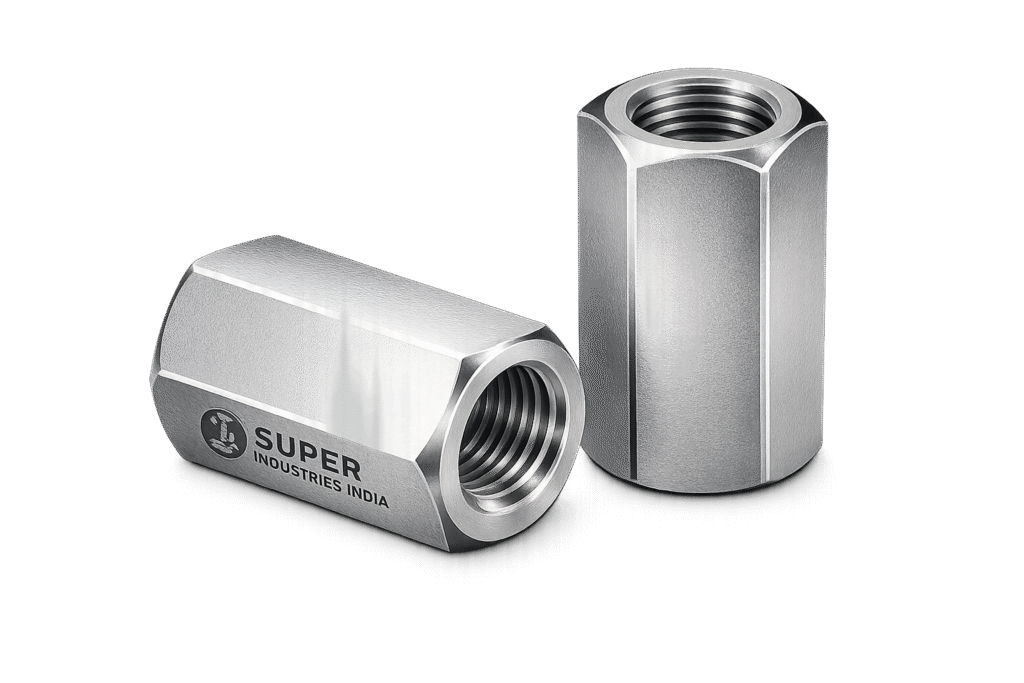
In EPC and export-oriented industrial projects, threaded connections frequently extend beyond simple bolt–nut assemblies. Coupling nuts are engineered specifically to address conditions where:
- Stud lengths must be extended without replacing the base stud
- Two threaded rods or studs must be axially joined
- Alignment corrections are required during site erection
- Modular assemblies demand predictable threaded continuity
Unlike standard hex nuts, coupling nuts are load-transmitting components, not convenience fasteners. Their length, thread engagement, and concentricity directly affect tensile capacity and joint reliability. As a result, EPC specifications treat coupling nuts as functional extensions of the stud, subject to the same mechanical and quality scrutiny as the primary fastener.
2️⃣ Technical Definition
What Coupling Nuts Are and Why Length Matters
A coupling nut—also known as a long nut or extension nut—is an internally threaded fastener with a length significantly greater than its diameter. It is designed to:
- Join two externally threaded components in-line
- Extend the effective length of a stud or threaded rod
- Maintain axial load transfer across the joint
The defining parameter is length, not across-flats size. Length determines:
- Available thread engagement on both sides
- Tensile load continuity
- Resistance to pull-out and thread stripping
A standard hex nut cannot perform these functions reliably because its thickness does not provide sufficient engagement length for stud-to-stud load transfer.
3️⃣ Functional Role in Joint Integrity
Load Transfer, Alignment & Preload Behavior
Coupling nuts operate as tension members within the joint. Their engineering role includes:
- Axial load transfer: Tensile forces pass from one stud, through the coupling nut, into the mating stud
- Alignment control: Concentric internal threads maintain axial alignment, minimizing bending stresses
- Preload continuity: When correctly assembled, preload is maintained across the extended joint
Any deviation in thread quality or alignment introduces eccentric loading, which can significantly reduce fatigue life.
4️⃣ Thread Engagement & Length Logic
Minimum Engagement and Failure Modes
Thread engagement is the primary design variable for coupling nuts. EPC practice generally requires:
- Engagement length ≥ 1.0–1.5 × stud diameter on each side (material and grade dependent)
- Full-depth threads across the entire nut length
- No “dead zones” or partial threads at the center
Common failure modes due to insufficient engagement:
- Thread stripping under tensile load
- Pull-out of one stud under preload
- Progressive loosening under cyclic loading
Length selection is therefore a mechanical design decision, not a procurement shortcut.
5️⃣ Types of Coupling Nuts
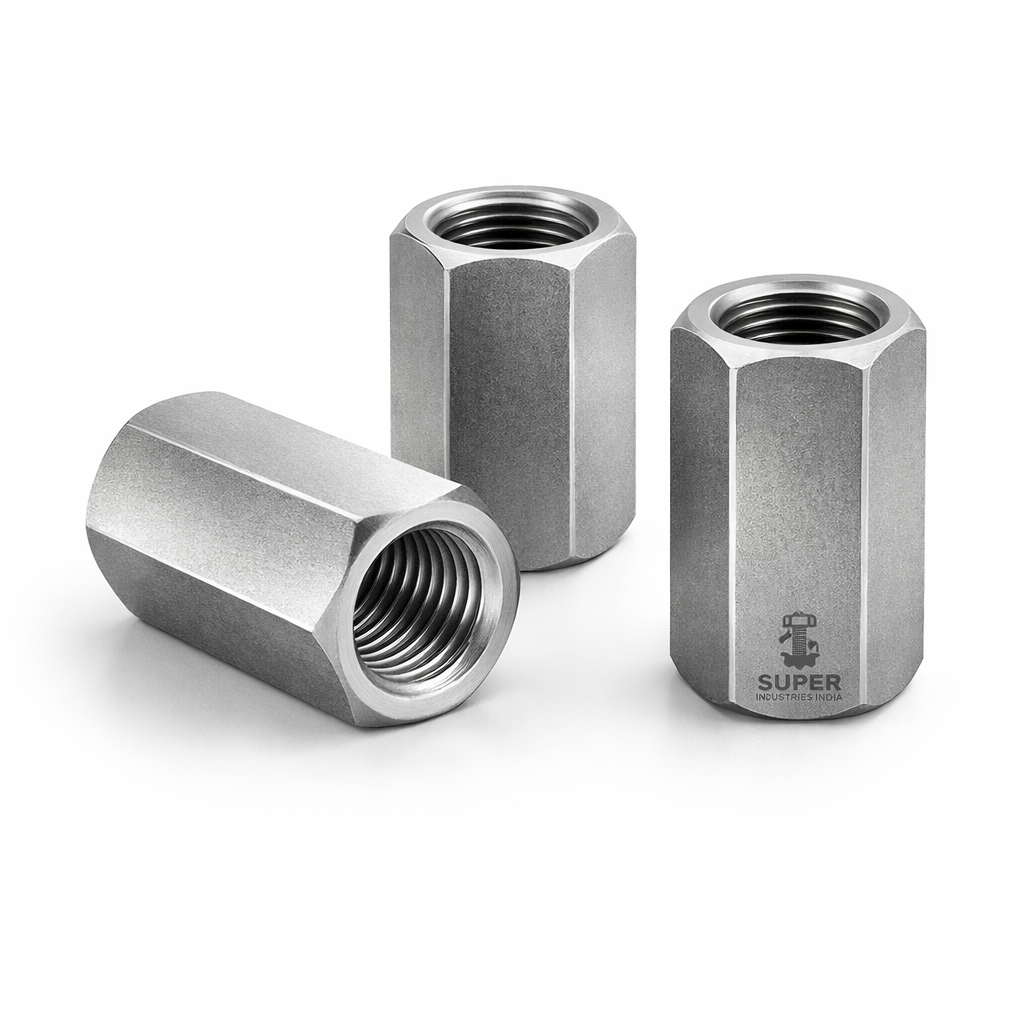
Standard Coupling Nuts
- Uniform hex profile
- Equal engagement on both ends
- General EPC use
Heavy-Duty Coupling Nuts
- Increased outer diameter and wall thickness
- Higher tensile capacity
- Used in structural and high-load systems
Reduced-Hex Coupling Nuts
- Smaller across-flats for space-constrained assemblies
- Requires careful torque and load assessment
Custom-Length Extension Nuts
- Project-specific lengths
- Used for modular skids, LNG modules, and infrastructure assemblies
Selection is driven by load path, available space, and engagement requirements.
6️⃣ Engineering Relevance of Length & Mass
Stress Distribution & Fatigue Considerations
Longer coupling nuts:
- Distribute tensile stress over more threads
- Reduce peak shear stress per thread
- Improve fatigue resistance
However, increased length also:
- Raises bending sensitivity if alignment is poor
- Increases mass, affecting vibration behavior in dynamic systems
Engineering balance is required—longer is not automatically better unless alignment and support conditions are controlled.
7️⃣ Material Selection & Mechanical Properties
Carbon Steel
- Common for general industrial and infrastructure use
- Economical with predictable behavior
Alloy Steel
- Higher strength classes
- Used where preload and tensile demands are elevated
Stainless Steel
- Corrosion resistance priority
- Lower yield strength must be compensated by engagement length
Duplex & Super Duplex
- High strength and corrosion resistance
- Offshore, marine, and chloride environments
Nickel Alloys
- High temperature or aggressive chemical service
- Applied selectively due to cost and galling considerations
Material selection must always be matched to:
- Stud material and grade
- Service environment
- Temperature and corrosion exposure
8️⃣ Standards & Specification Alignment
Coupling nuts used in EPC projects are evaluated against:
- Dimensional standards: thread form, concentricity, length tolerance
- Mechanical standards: proof load, tensile strength
- Material standards: chemistry and heat treatment
ASTM, ISO, DIN, and EN frameworks provide reference points, but EPC specifications often add project-specific requirements for engagement length and inspection.
9️⃣ Manufacturing & Quality Discipline
Forging vs Machining
- Forged coupling nuts: preferred for grain flow and fatigue resistance
- Machined coupling nuts: used for special alloys or tight tolerances
Thread Concentricity
- Critical for axial load transfer
- Misalignment leads to bending stress
Heat Treatment
- Establishes mechanical properties
- Must be uniform along full length
Traceability & Inspection
- Heat number marking
- Dimensional verification
- Thread gauging across full length
Manufacturing discipline directly determines joint reliability, not just compliance.
🔟 Installation, Alignment & Inspection View
Assembly Sequencing
- Studs must be clean and undamaged
- Coupling nut engaged evenly from both sides
- Avoid bottoming-out on one side
Torque Transfer
- Torque applied must account for friction on both thread interfaces
- Lubrication consistency is critical
Inspection Checkpoints
- Minimum engagement verified on both ends
- No visible thread damage or galling
- Alignment confirmed before final tightening
Field errors typically arise from unequal engagement or misuse as a standard nut.
1️⃣1️⃣ EPC Procurement & Consultant Review Perspective
Before approval, EPC teams verify:
- Length and engagement compliance
- Material compatibility with studs
- Mechanical grade alignment
- Manufacturing traceability
Coupling nuts are rejected when treated as commodity items rather than engineered extensions.
1️⃣2️⃣ Application Mapping
Coupling nuts are commonly used in:
- Oil & Gas skid assemblies
- Power plant support structures
- Petrochemical racks and frames
- LNG modular construction
- Infrastructure anchoring systems
They are not substitutes for structural connectors unless explicitly designed and approved.
1️⃣3️⃣ Professional Technical Tables
Thread Sizes & Standards
| Thread System | Typical Range |
|---|---|
| Metric | M8 – M100 |
| Unified | 5/16″ – 4″ |
Coupling Nut Lengths (Indicative)
| Type | Length Range |
|---|---|
| Standard | 3 × diameter |
| Heavy-duty | 4–5 × diameter |
| Custom | Project-defined |
Minimum Engagement Requirements
| Material | Typical Engagement |
|---|---|
| Carbon Steel | ≥ 1.0 × diameter |
| Stainless Steel | ≥ 1.25 × diameter |
| Duplex / Alloy | Project-specific |
Mechanical Grades & Property Classes
| Standard | Example Grades |
|---|---|
| ASTM | A194, A563 |
| ISO | Property Class based |
| DIN | Strength-class based |
Material Grades vs Service Conditions
| Material | Service Environment |
|---|---|
| Carbon Steel | General industrial |
| Alloy Steel | High preload |
| Stainless | Corrosive |
| Duplex | Offshore |
Project-Specific Customization Options
| Option | Availability |
|---|---|
| Custom length | EPC-defined |
| Special alloys | On request |
| Coatings | As specified |
| Full traceability | Mandatory |
1️⃣4️⃣ Manufacturer-Focused Conclusion
Coupling Nuts (Long Nuts / Extension Nuts) are critical threaded load-transfer components, not accessories. Their length, thread quality, material selection, and manufacturing discipline directly influence tensile continuity, preload retention, and fatigue performance.
Super Industries manufactures coupling nuts with strict control over engagement length, concentricity, and metallurgical properties, ensuring alignment with EPC fastening philosophies and consultant approval requirements.
Superior Quality Coupling Nuts: Your Trusted Manufacturer and Supplier in India
Welcome to Super Industries India, a leading manufacturer, exporter, and supplier of high-precision Coupling Nuts (also known as Long Nuts or Extension Nuts) in India. Engineered for robust, reliable, and seamless joining of threaded rods, bolts, and other male-threaded components, our coupling nuts are the essential components for extending length or creating secure, continuous assemblies across diverse industrial sectors.
What is a Coupling Nut? The Ultimate Threaded Rod Coupler
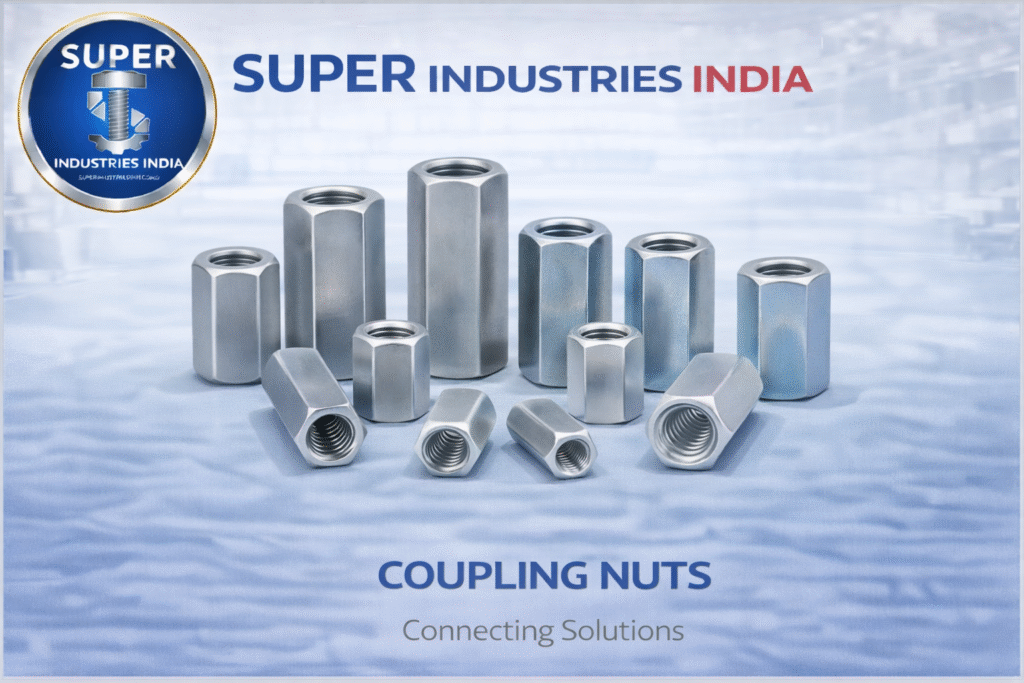
A coupling nut is an elongated fastener, typically hexagonal or round, with internal threads that run its entire length. Its primary function is to join two externally threaded parts (most commonly threaded rods or studs) of the same diameter and thread pitch, effectively extending the overall length of the assembly.
Key Applications and Uses of Coupling Nuts:
The versatility and strength of coupling nuts make them indispensable in numerous heavy-duty and precision applications:
- Structural Construction: Extending the length of anchor bolts and threaded rods used in concrete foundations, scaffolding, and structural framework.
- HVAC and Piping: Joining threaded rods for suspending ductwork, pipes, and electrical trays from ceilings.
- Machinery and Industrial Equipment: Creating custom-length tie-rods, adjustment mechanisms, and structural supports in manufacturing lines and heavy machinery.
- Pre-Engineered Building (PEB) Systems: Connecting components that require long, secure threaded connections.
- Automotive and Marine: Used in various assemblies where corrosion resistance and exceptional strength are required.
Why Choose Super Industries India for Your Coupling Nuts?
As an established Coupling Nut Manufacturer in India, Super Industries India is committed to delivering fastening solutions that exceed industry standards in quality, performance, and durability.
1. Unmatched Quality & Precision Manufacturing
Our state-of-the-art manufacturing facility utilizes advanced machinery and strict quality control protocols to produce coupling nuts with precision threading. This ensures maximum thread engagement, which is critical for the overall strength and load-bearing capacity of the final assembly.
2. Extensive Range of Types, Materials, and Finishes
We stock and custom-manufacture a complete range of coupling nuts to meet the specific demands of any project, ensuring you always find the perfect threaded rod coupler.
| Type of Coupling Nut | Description & Advantage |
| Hex Coupling Nuts | The most common type. Hexagonal body allows easy wrenching for tightening and loosening. |
| Round Coupling Nuts | Cylindrical shape, often used for aesthetic finish or specific tooling requirements. |
| Reducing Coupling Nuts | Features different thread sizes at each end to join threaded rods of varying diameters. |
| Sleeve Coupling Nuts | Extra-long cylindrical nuts designed for maximum engagement in high-stress applications. |
| Custom Coupling Nuts | Manufactured to client-specific length, diameter, and material requirements. |
3. Materials for Every Environment
We are premier Long Nuts Suppliers for all major industrial grades, ensuring optimal performance in any environment, from dry indoor settings to highly corrosive marine applications.
- Stainless Steel Coupling Nuts (SS 304, SS 316, 316L): Excellent corrosion resistance, ideal for outdoor, chemical processing, and marine environments.
- Carbon Steel Coupling Nuts (ASTM A563 Gr. A, B, C, D): High strength and cost-effective for general-purpose structural applications.
- High-Tensile (HT) Alloy Steel (ASTM A194 Gr. 2H): Designed for high-pressure and high-load applications.
- Brass and Exotic Alloys: Available for specialized needs requiring non-magnetic, conductive, or extreme-temperature resistance.
4. Compliant with Global Standards
All our coupling nuts are manufactured in strict compliance with international and national standards, including:
- ASME B18.2.2
- DIN 6334 (Long Hexagon Nuts)
- ISO and IS Specifications
Technical Specifications and Availability
To ensure easy selection, here are the general technical specifications for our standard inventory:
| Feature | Standard Specifications at Super Industries India |
| Diameter Range | M6 to M100 (Metric) |
| Thread Type | UNC, UNF, Metric Coarse, Metric Fine (Class 2B/6H) |
| Material Grades | Mild Steel (MS), SS 304, SS 316, Carbon Steel, Alloy Steel |
| Finishes | Plain, Hot-Dip Galvanized (HDG), Zinc Plated, Black Oxide |
| Length | Standard lengths as per DIN/ASME, plus Custom Extra Long Nuts |
Get a Custom Quote from Super Industries India
Whether you require standard Hex Coupling Nuts for a construction project or a custom-designed Reducing Coupling Nut for specialized machinery, Super Industries India is your reliable partner in India.
Need a Fastener Solution?
Contact us today to discuss your requirements, request a detailed catalog, or get a quick quote. As a premier Coupling Nut Exporter and Supplier, we guarantee timely delivery and competitive pricing across India and globally.
Super Industries India – Connecting Your World with Strength and Precision.
Tags:
- Coupling Nut Manufacturer India
- Long Nuts Supplier
- Hex Coupling Nuts
- Threaded Rod Coupler
- Extension Nuts India
- SS Coupling Nuts Manufacturer
- DIN 6334 Nut Supplier
- High-Tensile Coupling Nuts
- Long Hex Nut
- Fastener Manufacturer India