
Wire Rope Clamp
Table of Contents
Engineering Reference for Lifting, Rigging & EPC Capital Projects
Manufacturer & Global Exporter: Super Industries
Website: https://superindustriesindia.in
Email: Sales@superindustriesindia.in
1️⃣ Industry Context: Why Wire Rope Clamps Are Safety-Critical in EPC Projects
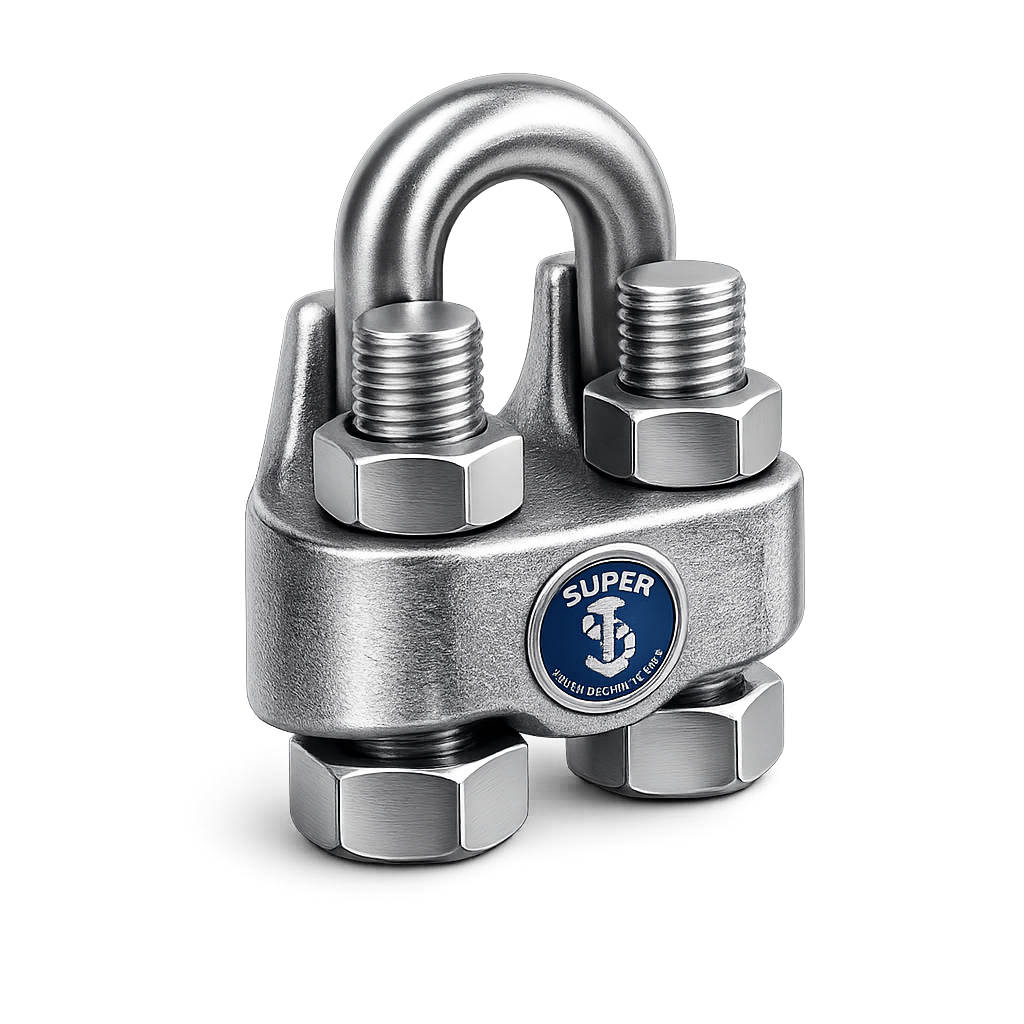
In EPC, shutdown, and capital-project environments, wire rope clamps are classified as load-retention and termination control components. While they are not lifting devices by themselves, they directly influence the integrity of wire rope terminations used in temporary rigging, tailing arrangements, guying systems, and auxiliary lifting assemblies.
In Oil & Gas, Power & Energy, Petrochemical, LNG, Hydrogen, and Infrastructure projects, improper selection or installation of wire rope clamps has repeatedly been identified as a root cause of rope slippage, termination failure, and loss of load control. For this reason, EPC contractors and lifting authorities treat wire rope clamps as safety-critical accessories subject to engineering review, inspection discipline, and procedural control.
A technically correct Wire Rope Clamp specification is therefore required to:
- Maintain rope holding efficiency at terminations
- Control slippage under static and dynamic loading
- Ensure predictable behavior during proof loading and service
- Meet lifting study and method-statement assumptions
- Satisfy consultant and third-party inspection criteria
This page is structured for engineering evaluation and EPC approval, not for retail or ad-hoc rigging use.
2️⃣ Technical Definition: What Wire Rope Clamps Are and How They Function
A wire rope clamp (also referred to as a wire rope clip) is a mechanical fastening device used to form a temporary or semi-permanent eye or termination in a wire rope by clamping the live end and dead end together.
Functional Components
A typical wire rope clamp assembly consists of:
- U-bolt or forged body
- Saddle (bearing surface)
- Nuts (usually hex, sometimes lock-type)
When correctly installed, the clamp applies controlled compressive force on the rope, generating frictional resistance that prevents slippage under load.
Functional Role in EPC Lifting & Rigging
Wire rope clamps are commonly used for:
- Temporary rope eyes for tailing and positioning
- Guy wires and structural restraints
- Non-critical lifting aids (as permitted by standards and procedures)
- Temporary rigging during erection and maintenance
They are not substitutes for swaged, socketed, or spliced slings in primary lifting unless explicitly allowed by the lifting design and governing standard.
3️⃣ Engineering Relevance: Load Control, Safety Factors & Lifecycle Risk
Load Handling Logic
Wire rope clamps do not provide 100% rope efficiency. Their holding capacity is a percentage of the rope’s minimum breaking force (MBF), dependent on:
- Clamp type and geometry
- Rope diameter and construction
- Number of clamps used
- Correct installation orientation and spacing
Engineering calculations must therefore apply appropriate efficiency reduction factors.
Dynamic Loading Considerations
In EPC environments, rope terminations may be exposed to:
- Shock loading during lift take-up
- Vibration and cyclic loading
- Load redistribution during multi-point rigging
Under these conditions, clamp slippage risk increases if installation discipline is poor or clamp selection is incorrect.
Fatigue & Lifecycle Risk
Repeated loading causes:
- Localized wire deformation under saddle pressure
- Progressive loss of frictional holding capacity
- Increased inspection and re-torquing requirements
For this reason, wire rope clamps are treated as temporary or controlled-use components in most EPC lifting philosophies.
4️⃣ Load Capacity & Design Logic
The effective capacity of a wire rope clamp termination is governed by interacting parameters:
Rope Construction
- 6×19 constructions: Higher resistance to crushing, lower flexibility
- 6×36 constructions: Greater flexibility, higher sensitivity to improper clamping
- IWRC vs FC: IWRC ropes provide better clamp performance due to core stability
Rope Diameter
Clamp size must match the nominal rope diameter. Undersized or oversized clamps significantly reduce holding efficiency.
Number of Clamps
Engineering standards specify minimum clamp quantities per rope diameter to achieve acceptable efficiency (typically 75–90% of MBF).
Installation Geometry
- Saddle must be placed on the live rope (“Never saddle a dead horse”)
- Correct spacing between clamps is mandatory
- Uniform torque application is required
5️⃣ Types of Wire Rope Clamp & Performance Characteristics
U-Bolt Wire Rope Clamps
Most common type. Economical, widely standardized. Holding efficiency depends heavily on correct installation and torque.
Forged Wire Rope Clamps
Heavier construction with improved load distribution. Preferred in EPC and industrial applications.
Double-Saddle / Fist-Grip Clamps
Provide symmetrical load distribution. Higher holding efficiency and reduced rope distortion.
Heavy-Duty DIN 741 Clamps
European standard clamps with defined dimensions and material requirements. Widely accepted in EPC inspection regimes.
Each clamp type exhibits different holding efficiency, deformation behavior, and inspection characteristics, which must be considered during lifting design.
6️⃣ Material, Construction & Standard Alignment
Wire rope clamps supplied for EPC projects must align with recognized international standards.
Common Standards Framework
- DIN 741: Wire rope clips (general industrial use)
- EN 13411-5: Steel wire rope terminations – U-bolt clips
- ASME B30 series: Rigging hardware reference
- IS standards: Indian industrial and construction use
Material Considerations
- Carbon steel (for general industrial use)
- Alloy steel (for higher load and durability)
- Surface protection: zinc plated, hot-dip galvanized
Material selection must consider corrosion exposure, temperature range, and inspection intervals.
7️⃣ Manufacturing & Quality Discipline
Material Control
Clamp bodies, U-bolts, and saddles are manufactured from controlled steel grades with defined mechanical properties.
Dimensional Control
Critical dimensions include:
- U-bolt radius and thread engagement
- Saddle curvature and bearing width
- Nut thread class and seating face
Surface Treatment
Coating thickness is controlled to prevent thread interference and ensure predictable torque behavior.
Inspection Philosophy
- Dimensional verification prior to dispatch
- Visual inspection for forging or machining defects
- Batch identification and traceability
For EPC supply, clamps are delivered with inspection-ready documentation.
8️⃣ Procurement, Installation & Inspection View
During Technical Evaluation
EPC engineers and lifting specialists verify:
- Clamp type and applicable standard
- Rope compatibility and diameter match
- Declared holding efficiency assumptions
- Installation and torque requirements
During Incoming Inspection
Inspectors check:
- Dimensional conformity
- Surface finish and coating condition
- Identification and batch traceability
During Site Installation
Lifting authorities verify:
- Correct saddle orientation
- Correct number of clamps
- Proper spacing and torque
- Re-torque after initial loading
9️⃣ Application Mapping Across EPC Sectors
Oil & Gas
Guy wires, temporary rigging, auxiliary lifting arrangements.
Power & Energy
Erection rigging, structural stabilization during installation.
Petrochemical
Maintenance rigging and controlled temporary restraints.
LNG
Construction-phase rigging with documented limitations.
Hydrogen
Emerging installations with conservative temporary rigging controls.
Infrastructure & Construction
Structural guying, temporary suspension systems.
🔟 Professional Technical Tables
Typical Rope Constructions Used with Clamps
| Rope Construction | Suitability |
|---|---|
| 6×19 IWRC | High |
| 6×36 IWRC | Medium |
| Fiber Core ropes | Limited / Controlled |
Indicative Clamp Holding Efficiency
| Clamp Type | Typical Efficiency (% of MBF) |
|---|---|
| U-Bolt (correctly installed) | 75–80% |
| Forged Clamp | 80–85% |
| Double-Saddle Clamp | Up to 90% |
Typical Number of Clamps per Rope Diameter
| Rope Diameter (mm) | Minimum Clamps |
|---|---|
| 10–12 | 3 |
| 16 | 4 |
| 20 | 4–5 |
| 24 | 5 |
Exact values depend on standard and engineering approval.
Factor of Safety Reference (Termination Systems)
| Application Type | Typical FoS |
|---|---|
| Temporary rigging | ≥5:1 |
| Non-lifting restraint | Project-defined |
| Critical lifting | Engineered approval only |
Project-Specific Customization Options
| Parameter | Options |
|---|---|
| Clamp Type | U-bolt, forged, double-saddle |
| Material | Carbon steel, alloy steel |
| Coating | Zinc plated, HDG |
| Identification | Batch marking |
| Documentation | MTC, inspection reports |
Manufacturer-Focused Conclusion
In EPC and capital-project environments, wire rope clamps are risk-control components, not commodity accessories. Their performance depends on controlled manufacturing, correct standard alignment, disciplined installation, and inspection-ready documentation.
Super Industries manufactures wire rope clamps under controlled material, dimensional, and inspection systems aligned with international rigging standards. Our clamps are supplied with defined application limits, traceability, and documentation suitable for EPC lifting studies, consultant review, and site execution control.
This engineering-driven approach supports predictable rope termination behavior, inspection acceptance, and risk mitigation in safety-critical lifting and rigging environments.
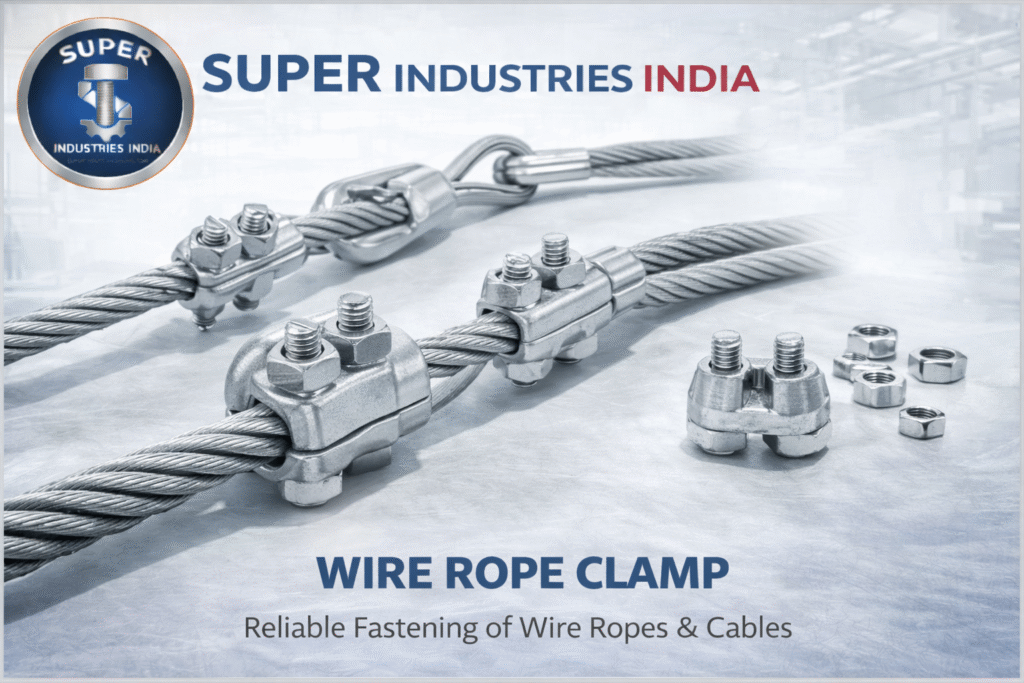
Ultimate Wire Rope Security: Wire Rope Clamps
In any industrial or lifting application, the integrity of the wire rope termination is as critical as the rope itself. The Wire Rope Clamp, or wire rope clip, is a crucial component used to secure the end of a rope, forming a reliable eye or loop.
Super Industries India is a premier manufacturer and supplier of certified rigging hardware, including our high-performance Wire Rope Clamp. Engineered for maximum strength and safety, the clamp ensures your wire rope assemblies maintain their load-bearing capacity even under severe stress and dynamic conditions. For construction, marine, energy, and general industrial sectors across India, wire rope clamps provides the essential, fail-safe connection you can trust.
What is the HTLE Wire Rope Clamp?
The Wire Rope Clamp is a heavy-duty, forged wire rope clamp designed specifically for creating non-permanent eyes or securing tails in steel wire rope. It is characterized by its high-grade material and robust, proven design.
Key Features and Construction
- Forged Construction: Unlike many lower-grade cast clamps, the Wire Rope Clamp is drop-forged. This process aligns the metal’s grain structure, eliminating internal defects and voids, resulting in a clamp with superior strength, impact resistance, and durability.
- Three-Part Assembly: Each clamp consists of three core components:
- U-Bolt: The U-shaped bolt that straddles the wire rope, allowing tension to be applied.
- Saddle (Grip): The main body of the clamp, which holds the rope firmly against the U-bolt.
- Nuts: Two hexagonal nuts used to tightly compress the rope within the assembly.
- Material: Typically manufactured from high-tensile Carbon Steel and often Hot-Dip Galvanized (HDG) for exceptional corrosion resistance, making it suitable for wet, outdoor, and marine environments.
Critical Functions and Applications
The primary function of the Wire Rope Clamp is to safely secure a length of wire rope back onto itself to form a load-bearing loop (eye) or to terminate an end.
Safe Installation and Load Efficiency
It is crucial to note that wire rope clamps are effective only when installed correctly, typically following the “Never saddle a dead horse” rule (the saddle should always be placed on the live or load-bearing end of the rope).
The installation of the Wire Rope Clamp provides an assembly efficiency that is dependent on the number of clamps used, often achieving around 80% of the wire rope’s nominal breaking strength when correctly installed. This makes them ideal for:
- Temporary Lifting Eyes: Creating non-permanent loops for quick rigging changes or prototype lifts.
- Guying Applications: Securing static loads, like guy wires for communication towers or utility poles, where inspection and occasional adjustment are possible.
- Fencing and Barrier Lines: Used extensively in construction and industrial perimeter security.
- Safety Backup: Employed as a secondary safety measure or tail termination alongside a primary swaged fitting.
Compliance and Specifications
When specifying the Wire Rope Clamp, adherence to established standards is paramount to safety and performance.
Key Specifications
| Specification | Details |
| Design Standard | Generally compliant with or exceeding US Federal Specification FF-C-450 Type 1, Class 1 or equivalent international standards DIN or ISO. |
| Material | Forged Carbon Steel, ensuring superior strength over cast iron. |
| Finish | Hot Dip Galvanized (HDG), offering maximum protection against rust and atmospheric corrosion. |
| Application Suitability | Recommended for use with 6*19 and 6*37 Class Wire Ropes (Right Lay). |
| Working Load Limit (WLL) | Clearly marked and certified; varies based on clamp size and rope diameter. |
Why Choose Super Industries India’s Wire Rope Clamp?
As a trusted supplier in India, our commitment to quality guarantees that:
- Traceability: Every batch of HTLE 046 clamps comes with full material certification, ensuring high-grade steel is used.
- Safety Compliance: Our clamps are designed with the dimensional precision necessary to meet safety requirements and achieve the required load efficiency.
- Stock Availability: We maintain extensive stock of the Wire Rope Clamp in all popular sizes to support your project timelines without delay.
For critical rigging and secure wire rope termination, choose the strength and reliability of the Wire Rope Clamp from Super Industries India.
Contact us today for bulk orders and certified technical specifications.