
BODY STUDS (DOUBLE ENDED STUDS)
EPC / EXPORT / MNC-GRADE TECHNICAL REFERENCE
Manufacturer & Global Exporter: Super Industries
Website: https://superindustriesindia.in
1. Industry Context
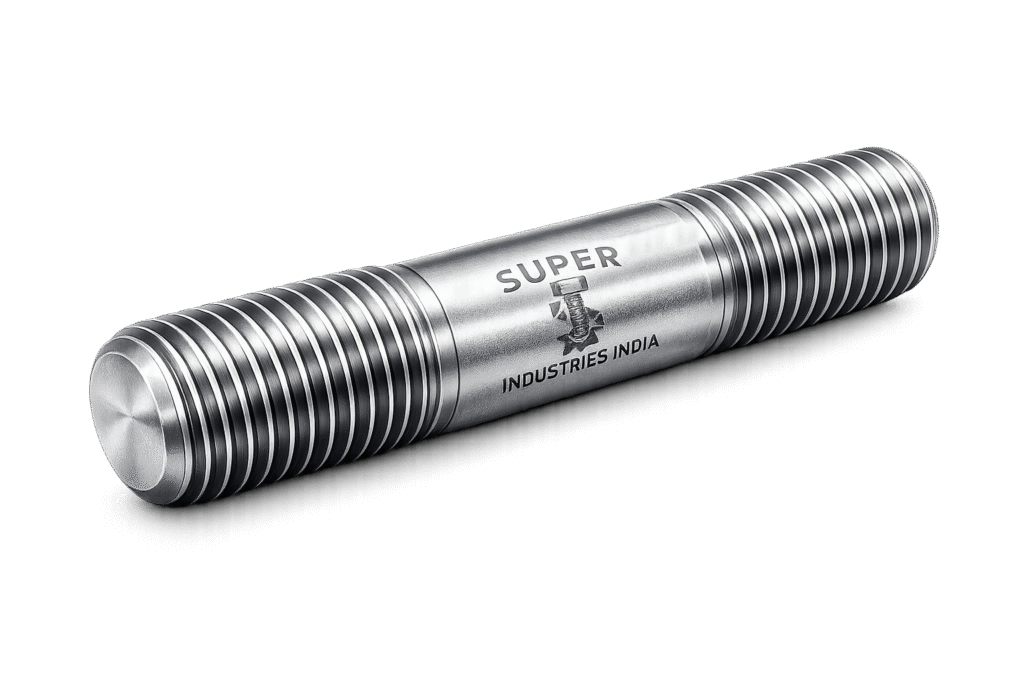
Why Body Studs (Double Ended Studs) Matter in EPC Projects
Across EPC and capital projects, repeatable assembly, controlled preload, and serviceability are non-negotiable requirements. Equipment such as pressure vessels, pumps, valves, compressors, heat exchangers, rotating machinery, and structural interfaces is frequently assembled, dismantled, and reassembled over its operating life. In these applications, Body Studs (Double Ended Studs) are selected over bolts or fully threaded rods because they provide predictable load paths, stable alignment, and reduced wear on parent materials.
Body studs are engineered fasteners, not generic threaded bars. Their geometry—threaded ends with a defined unthreaded body (shank)—is intentional and directly linked to fatigue life, preload consistency, and long-term joint integrity. EPC specifications therefore treat body studs as primary load-bearing fasteners, subject to strict dimensional, metallurgical, and inspection controls.
2. Technical Definition
What Are Body Studs / Double Ended Studs?
Body Studs, also referred to as Double Ended Studs, are cylindrical fasteners with:
- Threads on both ends, and
- A central unthreaded shank of defined length and diameter.
They differ from:
- Tap-end studs – where one threaded end is shorter or of different fit class
- Fully threaded rods – which lack a stress-relieved shank and controlled engagement geometry
The unthreaded body is not a manufacturing convenience; it is a mechanical design feature that:
- Reduces stress concentration
- Improves fatigue resistance
- Provides precise alignment between mating components
3. Functional Role in Mechanical Assemblies
Controlled Thread Engagement
Balanced thread lengths ensure that load is shared between both ends without over-engagement or thread stripping in the parent material.
Alignment Stability
The unthreaded shank acts as a locating element, maintaining concentricity between flanges, housings, or structural members.
Fatigue Resistance
By moving the highest stress zone away from the first engaged thread, body studs significantly improve cyclic load performance, especially in pressure and rotating equipment.
Load Transfer Logic
Axial tensile load is carried primarily through the shank section, not the threads, resulting in predictable elastic behavior under preload.
4. Engineering Relevance of Weight
The weight of a body stud is not a trivial attribute in EPC environments.
Weight directly influences:
- Preload calculations (self-weight effects in large diameter studs)
- Structural load accounting in equipment and skid design
- Handling and installation safety, particularly for large sizes
- Fatigue behavior, as mass distribution affects vibration response
For large-diameter, long-length studs, EPC engineers routinely reference stud weight charts during design and logistics planning.
5. Weight Determination Logic
Body stud weight is a function of:
- Nominal diameter
- Overall length
- Length of threaded sections vs unthreaded body
- Material density (carbon steel, alloy steel, stainless steel, nickel alloys)
- Machining tolerances
- Coating or surface treatment allowance
Accurate weight calculation requires geometry-based volume estimation, not generic “rod weight” assumptions.
6. Body Stud Design & Geometry Characteristics
Thread Length Ratios
Threaded ends are proportioned to ensure:
- Full nut engagement
- Adequate washer seating
- No thread run-out within the shear or bearing zone
Unthreaded Body Purpose
- Acts as the primary load-carrying section
- Minimizes notch sensitivity
- Improves elastic stretch uniformity
Stress Concentration Control
Fillet radii at thread run-out and surface finish quality are critical for fatigue performance.
Nut Engagement Optimization
Designed to work with compatible heavy hex nuts, ensuring uniform bearing pressure and torque transfer.
7. Material & Standard Alignment
Common Governing Standards
- ASTM A193 / A320 – high-temperature and low-temperature pressure service
- ASTM A307 – general structural applications
- DIN / ISO equivalents for metric projects
Typical Material Options
- Carbon steel
- Alloy steel (Cr-Mo grades)
- Stainless steel
- Special alloys for extreme environments
Material selection is driven by pressure class, temperature range, corrosion exposure, and code requirements.
8. Manufacturing & Quality Discipline
Manufacturing Routes
- Controlled forging or bar-machining
- Precision thread rolling
- Heat treatment to specified mechanical properties
Quality Control Focus
- Straightness and concentricity
- Thread profile accuracy and fit class
- Mechanical testing (tensile, hardness, impact where applicable)
- Surface integrity and finish
- Full traceability via heat numbers and batch identification
In EPC service, manufacturing discipline is inseparable from fastener reliability.
9. Procurement, Installation & Inspection View
EPC Procurement Checks
- Dimensional conformity to drawing and standard
- Correct material grade and heat treatment condition
- Matching nuts and washers
- Compliance documentation and MTCs
Inspection Priorities
- Thread fit and surface condition
- Straightness and visual defects
- Marking and traceability
- Coating or surface treatment compliance
Installation Considerations
- Controlled tightening sequence
- Proper lubrication where specified
- Avoidance of thread galling
- Replacement policy during major overhauls
10. Application Mapping
Body Studs (Double Ended Studs) are widely used in:
- Oil & Gas: pressure vessels, flanges, skids
- Power: turbines, boilers, auxiliaries
- Petrochemical & LNG: exchangers, reactors
- Hydrogen: pressure systems and compressors
- Infrastructure: heavy mechanical interfaces
- Pumps, Valves, Compressors, Heat Exchangers
11. Professional Technical Tables
Typical Diameter & Length Range
- Diameters: M6 to M100 and above (metric) / ¼” to 4″ (imperial)
- Lengths: Project-specific, based on joint stack-up
Body Studs (Double Ended Studs) – Indicative Weight Logic
| Parameter | Influence on Weight |
|---|---|
| Diameter | Primary contributor |
| Overall Length | Linear increase |
| Shank vs Thread Ratio | Minor variation |
| Material Density | Significant |
| Coating Thickness | Marginal |
(Exact weight charts are supplied project-wise based on approved drawings and standards.)
Material Grades vs Operating Conditions
| Material Grade | Typical Service |
|---|---|
| ASTM A193 B7 | High-temperature pressure |
| ASTM A320 L7 | Low-temperature service |
| Stainless Steel | Corrosive environments |
| Special Alloys | Extreme duty |
Customization Capabilities
- Non-standard lengths
- Special thread fits
- Controlled shank tolerances
- Project-specific coatings
- Special markings and packaging
12. Manufacturer-Focused Conclusion
Body Studs (Double Ended Studs) are fundamental components in EPC mechanical systems where preload integrity, fatigue life, and repeatable assembly are critical. Their performance depends on geometry control, metallurgical discipline, and inspection rigor, not on generic fastener assumptions.
Super Industries manufactures body studs with:
- Dimensional accuracy aligned to EPC drawings and standards
- Controlled material and heat treatment
- Thread integrity suitable for repeated assembly
- Traceability acceptable to consultants and third-party inspectors
This ensures body studs that are technically safe, mechanically reliable, and EPC-ready.
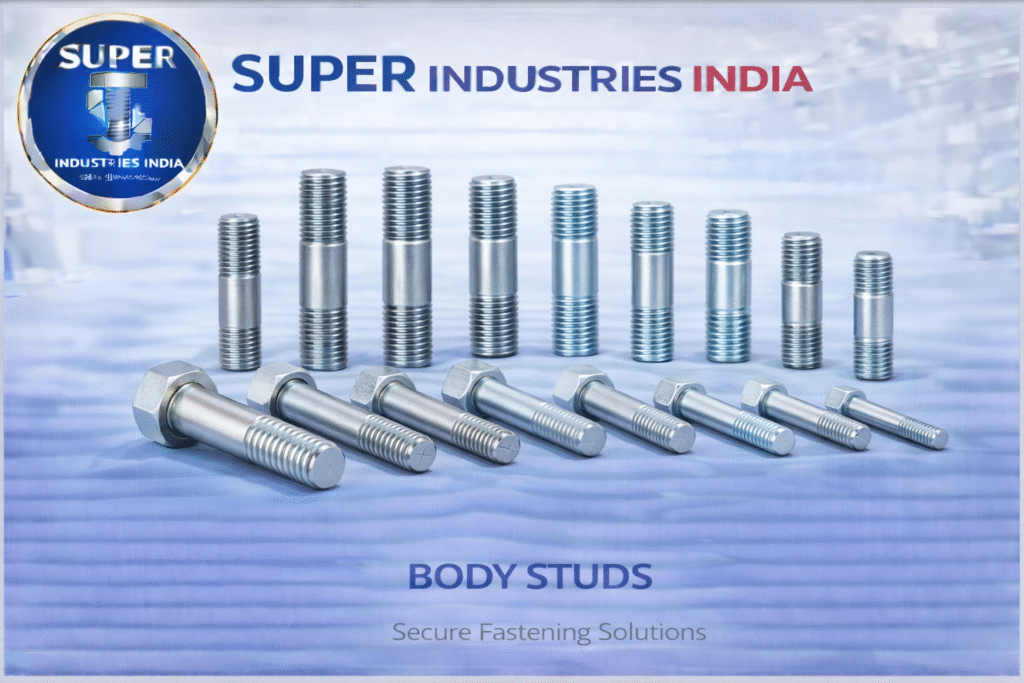
Industrial Body Studs (Double Ended Studs) Manufacturer in India | High Tensile Fasteners Specialist
Engineered for Strength: Precision Body Studs from Super Industries India
Body Studs—also known in the industrial sphere as Double Ended Studs, Waisted Studs, or Reduced Shank Studs—are critical components designed for high-stress, high-temperature, and corrosive environments where absolute joint integrity is paramount. At Super Industries India, we specialize in manufacturing precision-engineered Body Studs that meet and exceed stringent international standards like ASTM and DIN, ensuring superior performance for your most demanding applications.
A true Body Stud features a central shank diameter (body) that is intentionally reduced, making it less than the thread’s major diameter. This design is not a flaw; it is a calculated feature that concentrates strain in the central body, preventing breakage at the thread roots, significantly improving the fastener’s fatigue resistance, and offering a superior solution compared to standard fully-threaded rods.
The Technical Advantage of Reduced Shank Body Studs
The unique geometry of the Body Stud provides significant mechanical and structural benefits:
- Enhanced Fatigue Life: The reduced shank creates a longer, more elastic grip length. Under dynamic loading or cyclical stress, the body absorbs the tensile load over a greater distance, distributing the strain more evenly and drastically increasing the fastener’s resistance to metal fatigue.
- Optimized Stress Distribution: By moving the area of maximum stress away from the thread roots (the weakest point), the stud can handle higher working loads without premature failure.
- Stress Corrosion Resistance: In corrosive environments, the reduced stress concentration at the thread roots minimizes the risk of Stress Corrosion Cracking (SCC), particularly when using high-tensile stainless steel grades.
- Weight Reduction: The reduced material in the shank contributes to overall assembly weight reduction without compromising strength, a factor critical in aerospace and high-performance applications.
Our Comprehensive Body Stud Product Range
We offer a versatile range of Body Stud configurations, manufactured in our state-of-the-art facility in India, catering to various industry-specific requirements.
1. Double Ended Studs (Tap End / Flange Studs)
These studs have threads on both ends with an unthreaded central body.
- Tap End Studs (DIN 835 / DIN 939): Feature a short thread engagement on one end (the “tap end”) designed to be permanently screwed into a tapped hole in the machine component or engine block. The other end (the “nut end”) is typically longer for securing a nut.
- Double Ended Studs (DIN 938 / DIN 940): Feature equal or specified thread lengths on both ends, often used in through-hole flange bolting where two nuts are required for maximum clamping load.
2. Reduced Shank Studs (Waisted Studs)
Specifically manufactured with the shank diameter precisely calculated to be less than the thread pitch diameter (P.D.).
- High Tensile Body Studs: Manufactured using materials like ASTM A193 B7 or equivalent Grade 8.8 / 10.9 / 12.9 material, these are essential for high-pressure valve bodies, pump casings, and internal combustion engine assemblies.
Applications Across Key Industries
Our Body Studs are vital components used in mission-critical fastening across various sectors:
| Industry | Typical Application | Key Grade Requirement |
| Oil & Gas / Petrochemical | High-pressure Flange Bolting, Valve Assemblies, Piping Systems | ASTM A193 B7/B7M, B16 (for high temperature) |
| Power Generation | Turbine and Generator Casings, Boiler Housings, Heat Exchangers | ASTM A193 B8/B8M (Stainless for corrosion) |
| Heavy Machinery | Engine Cylinder Heads, Compressor Housings, Gearboxes | High Tensile Steel (Grades 8.8, 10.9, 12.9) |
| Automotive & Railways | Wheel Hubs, Axle Assemblies, Suspension Components | High-Strength Alloy Steel (e.g., EN Series) |
Materials, Grades, and Protective Coatings
Choosing the right material is crucial for the performance of the Body Stud. We utilize a range of certified raw materials, ensuring traceability and adherence to mechanical property requirements.
Popular Material Grades
| Material Type | ASTM Grade | Metric Grade (Equivalent) | Typical Use Environment |
| High Tensile Alloy Steel | A193 Grade B7 | 8.8, 10.9 | High-pressure, high-temperature service. Standard for pipe flanges. |
| Stainless Steel | A193 Grade B8 (304) | A2 | Corrosion resistance, medium to high temperature. |
| Stainless Steel | A193 Grade B8M (316) | A4 | Excellent resistance to pitting and crevice corrosion (Marine, Chemical). |
| Low Temp Service | A320 Grade L7 | L7 | Applications requiring toughness at sub-zero temperatures. |
Corrosion Protection and Surface Finishes
To ensure maximum service life, especially in India’s coastal and industrial environments, we offer specialized coatings:
- Hot Dip Galvanized (HDG): For superior long-term corrosion protection in structural and outdoor applications.
- PTFE/Teflon Coating: Essential for chemical, marine, and subsea applications. Provides low friction, excellent chemical resistance, and prevents galling, especially on stainless steel.
- Zinc Plating (Electroplated): Standard finish for indoor or less aggressive environments (Yellow/White Passivation).
- Black Phosphate Coating: For moderate corrosion resistance and reduced thread friction during assembly.
Manufacturing Excellence and Quality Assurance
As a premier Body Studs Manufacturer in India, Super Industries India operates on a foundation of precision and quality control:
- Precision Thread Rolling: We use advanced thread rolling techniques to produce threads with superior strength, surface finish, and improved fatigue resistance compared to cut threads.
- Controlled Heat Treatment: Our high-tensile studs undergo precise Quenching and Tempering processes to achieve the exact hardness, yield strength, and tensile strength required by grades like B7, 8.8, and 10.9.
- Customization: We manufacture custom Body Studs to your precise specifications, including non-standard lengths, diameters (Metric M6 to M100; Imperial 1/4″ to 4″), and specialized thread forms (UNC, UNF, BSW, Metric Coarse, Metric Fine).
- Traceability: Full material and manufacturing traceability with 3.1 Mill Test Certificates (MTC) provided for every batch, guaranteeing compliance with IS, DIN, and ASTM/ASME standards.
Trust Super Industries India to supply the structural integrity your projects demand.
Contact our technical sales team today to discuss your Body Stud requirements for high-temperature, pressure, or fatigue-critical applications. Request a quote for standard ASTM A193 B7 Body Studs or custom-engineered fasteners.