
LOCK NUTS
- LOCK NUTS
- 1️⃣ Industry Context
- 2️⃣ Technical Definition
- 3️⃣ Engineering Problem Being Solved
- 4️⃣ Locking Mechanisms Explained
- 5️⃣ Types of Lock Nuts & Performance Characteristics
- 6️⃣ Engineering Relevance in Joint Integrity
- 7️⃣ Material Selection & Service Behavior
- 8️⃣ Standards & Specification Alignment
- 9️⃣ Manufacturing & Quality Discipline
- 🔟 Installation, Torque & Inspection Considerations
- 1️⃣1️⃣ EPC Procurement & Consultant Review View
- 1️⃣2️⃣ Application Mapping
- 1️⃣3️⃣ Professional Technical Tables
- 1️⃣4️⃣ Manufacturer-Focused Conclusion
- Secure Your Assembly with Premium Lock Nuts: Leading Manufacturer & Supplier in India
- What is a Lock Nut? The Mechanics of Anti-Loosening Fasteners
- Our Diverse Range of High-Performance Lock Nuts
- Materials, Grades, and Specifications: Built for Durability
- Industrial Applications: Where Reliability is Non-Negotiable
- Why Choose Super Industries India for Your Lock Nut Requirements?
Joint Integrity Components for Vibration-Prone and Safety-Critical EPC Applications
Manufacturer & Global Exporter: Super Industries
Website: https://superindustriesindia.in
1️⃣ Industry Context
Why Locking Fasteners Are Critical in EPC and Capital Projects
In EPC-executed plants and infrastructure, bolted joints are structural and pressure-retaining systems, not commodity connections. Failure of preload retention is a documented contributor to equipment damage, leakage, vibration-induced fatigue, and safety incidents.
Lock nuts are specified where:
- Vibration and cyclic loading are unavoidable
- Thermal expansion and contraction are present
- Joint access for re-torquing is limited or impossible
- Loss of clamp load directly affects safety or reliability
Typical EPC scenarios include rotating equipment foundations, structural steel, pipe supports, skid assemblies, flanged auxiliaries, offshore modules, and maintenance-critical joints. In these applications, standard nuts relying solely on friction are insufficient.
2️⃣ Technical Definition
What Lock Nuts Are and Why They Exist
A lock nut is a threaded fastener designed to resist self-loosening after installation by introducing an intentional locking mechanism in addition to standard thread friction.
Unlike conventional nuts that rely only on:
- Thread friction
- Surface friction under the nut face
Lock nuts incorporate controlled resistance to rotation, ensuring that applied preload is retained even under adverse service conditions.
Why Preload Retention Matters
Bolted joints function by maintaining clamping force. Loss of preload results in:
- Joint separation or micro-slip
- Accelerated fatigue in bolts and connected parts
- Leakage in pressure systems
- Progressive loosening and failure
Lock nuts are therefore joint-integrity components, not accessories.
3️⃣ Engineering Problem Being Solved
Mechanisms of Self-Loosening in Bolted Joints
Extensive testing and field failures show that self-loosening is driven primarily by transverse vibration, not axial tension alone.
Key contributors include:
- Transverse joint movement causing relative slip
- Dynamic shear loads exceeding friction capacity
- Thermal cycling causing differential expansion
- Embedding and relaxation in joint surfaces
- Cyclic loading reducing effective clamp load
Once clamp force drops below a critical threshold, nut rotation can occur even without external torque. Lock nuts are designed to interrupt this loosening sequence.
4️⃣ Locking Mechanisms Explained
How Lock Nuts Prevent Rotation
Lock nuts employ one or more of the following mechanisms:
Prevailing Torque
A controlled interference in the thread generates resistance independent of clamping force. This resistance must be overcome during tightening and loosening.
Mechanical Deformation
Localized elastic or plastic deformation of threads creates interference with the mating bolt.
Friction Locking
Additional friction elements increase resistance to rotation beyond standard thread contact.
Dual-Nut Systems
Two nuts tightened against each other create a locking effect through opposing forces.
Each mechanism has distinct performance, reuse, and temperature limits, which must be matched to service conditions.
5️⃣ Types of Lock Nuts & Performance Characteristics
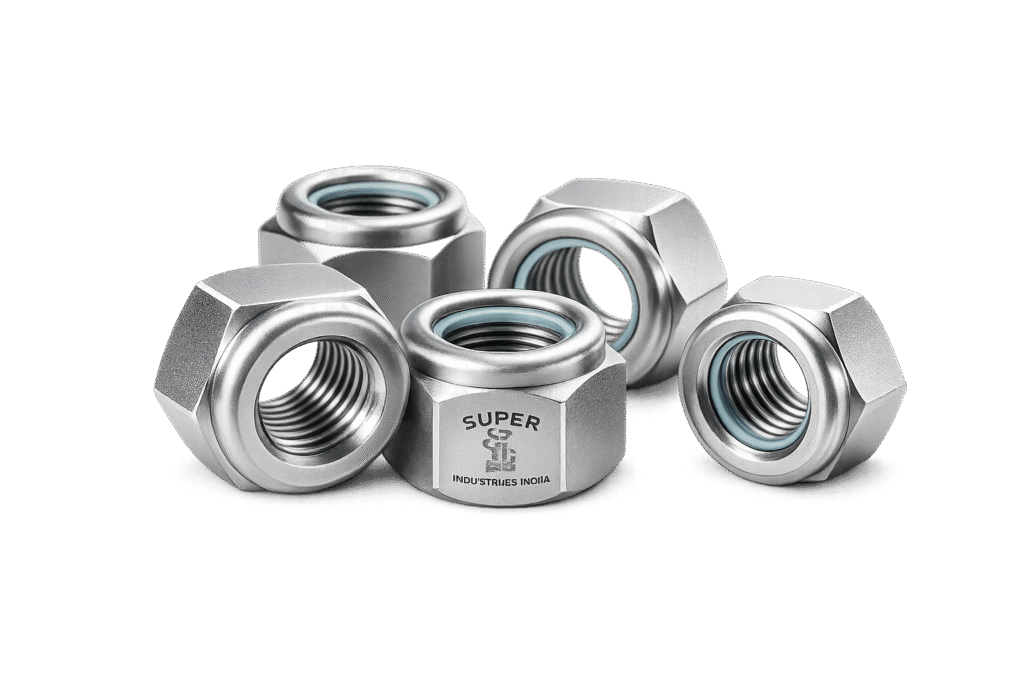
Nylon Insert Lock Nuts
- Locking via polymer insert
- Effective against vibration
- Temperature-limited
- Not suitable for high-temperature or chemical exposure
All-Metal Lock Nuts
- Deformed or slotted threads
- No polymer components
- Suitable for high temperature and aggressive environments
Slotted / Castellated Nuts
- Mechanical locking using cotter pins
- Positive retention
- Require drilled bolts and alignment
Jam Nuts
- Thin secondary nut tightened against primary nut
- Simple locking method
- Requires proper installation discipline
Top-Lock & Side-Lock Nuts
- Localized thread deformation
- Defined prevailing torque
- Common in EPC mechanical assemblies
Heavy Hex Lock Nuts
- Increased bearing area
- Used with structural and pressure bolting
- Improved load distribution
6️⃣ Engineering Relevance in Joint Integrity
How Lock Nuts Support Reliable Bolted Joints
Properly selected lock nuts contribute to:
- Preload retention under vibration
- Reduced risk of fatigue cracking
- Stable clamp force over service life
- Improved reliability of rotating and dynamic systems
Reuse Considerations
- Prevailing torque decreases with reuse
- EPC specifications often limit reuse cycles
- Inspection of locking feature integrity is mandatory
Lock nuts are not universally reusable components; reuse policies must be defined at the design or maintenance stage.
7️⃣ Material Selection & Service Behavior
Lock nuts are manufactured in materials aligned with bolt grades and service conditions.
Carbon & Alloy Steels
- Structural and mechanical applications
- Compatible with high-strength bolting
Stainless Steels
- Corrosion resistance in process environments
- Temperature limits vary by grade
Duplex & Super Duplex
- High strength and chloride resistance
- Offshore and marine suitability
Nickel Alloys
- High temperature or corrosive chemical service
- Used selectively in critical joints
Material compatibility with the mating bolt and environment is essential to prevent galling, corrosion, or differential thermal behavior.
8️⃣ Standards & Specification Alignment
Lock nuts are governed by multiple international standards depending on application:
- ASTM – Material and mechanical requirements
- ISO / DIN / EN – Dimensional and performance standards
- ASME – Pressure and bolting philosophy references
EPC specifications typically enforce:
- Grade matching between bolt and nut
- Heat treatment condition
- Surface finish and coating requirements
- Certification and traceability
9️⃣ Manufacturing & Quality Discipline
Thread Forming
- Controlled tolerances for consistent prevailing torque
Locking Feature Control
- Repeatability of deformation or insert positioning
Heat Treatment
- Achieves required mechanical properties
- Maintains thread integrity
Surface Condition
- Coating compatibility with locking mechanism
- Corrosion protection without impairing function
Traceability & Inspection
- Heat number traceability
- Dimensional verification
- Prevailing torque testing where specified
Manufacturing discipline directly affects locking reliability in service.
🔟 Installation, Torque & Inspection Considerations
Torque Application
- Installation torque = clamping torque + prevailing torque
- Torque scatter must be accounted for in calculations
Prevailing Torque Verification
- Measured without clamp load
- Must fall within specified limits
Reuse Rules
- EPC and OEM guidelines define allowable reuse
- Excessive loss of prevailing torque mandates replacement
Site Inspection
- Visual confirmation of locking feature
- Correct orientation and engagement
- No thread damage or galling
1️⃣1️⃣ EPC Procurement & Consultant Review View
During vendor approval and technical evaluation, EPC teams verify:
- Locking mechanism suitability
- Material and grade compliance
- Compatibility with bolting philosophy
- Installation and maintenance implications
- Certification and test documentation
Lock nuts are reviewed as functional safety components, not interchangeable hardware.
1️⃣2️⃣ Application Mapping
Oil & Gas
Rotating equipment, pipe supports, structural assemblies.
Power & Energy
Turbine auxiliaries, cooling systems, foundations.
Petrochemical & LNG
Skid systems, vibrating equipment, maintenance-critical joints.
Hydrogen
Dynamic systems with pressure and temperature cycling.
Infrastructure
Bridges, modular steel structures, transport systems.
1️⃣3️⃣ Professional Technical Tables
Size Ranges & Thread Standards
| Standard | Typical Sizes |
|---|---|
| Metric | M6 – M100 |
| Inch | 1/4” – 4” |
Lock Nut Types vs Applications
| Lock Nut Type | Typical Use |
|---|---|
| Nylon Insert | Light to moderate vibration |
| All-Metal | High temperature, EPC service |
| Castellated | Safety-critical mechanical joints |
| Jam Nut | Structural locking |
| Top / Side Lock | Rotating equipment |
Material Grades vs Service Conditions
| Material | Service Environment |
|---|---|
| Carbon Steel | Structural, general |
| Alloy Steel | High strength |
| Stainless Steel | Corrosive |
| Duplex | Offshore, marine |
| Nickel Alloy | Extreme service |
Prevailing Torque Considerations
| Factor | Impact |
|---|---|
| Locking method | Torque magnitude |
| Reuse cycles | Torque reduction |
| Surface finish | Consistency |
Reusability Guidelines
| Lock Nut Type | Typical Reuse |
|---|---|
| Nylon Insert | Limited |
| All-Metal | Limited, inspected |
| Castellated | Reusable with pin |
Project-Specific Customization Options
| Parameter | Options |
|---|---|
| Size & thread | EPC-specified |
| Material | Project metallurgy |
| Coating | Zinc, PTFE, etc. |
| Testing | Prevailing torque |
| Certification | EN 10204 3.1 / 3.2 |
1️⃣4️⃣ Manufacturer-Focused Conclusion
Lock Nuts are essential joint-integrity components in EPC and capital projects where vibration, cyclic loading, and safety requirements exceed the capability of standard fasteners.
Their effectiveness depends on locking mechanism selection, material compatibility, manufacturing control, and installation discipline. Treating lock nuts as commodity items introduces avoidable risk into critical assemblies.
Super Industries manufactures lock nuts under controlled processes aligned with EPC bolting philosophies, international standards, and export inspection requirements—supporting reliable preload retention and long-term joint integrity.
Secure Your Assembly with Premium Lock Nuts: Leading Manufacturer & Supplier in India
Premium Lock Nut Manufacturer & Supplier in India | Nylock & All Metal Fasteners
Unrivaled Fastening Security: Introducing Lock Nuts from Super Industries India
In the world of industrial and mechanical applications, connection integrity is paramount. Where standard nuts fail under dynamic stress, lock nuts provide the ultimate solution for vibration-proof and secure fastening. At Super Industries India, a leading lock nut manufacturer and supplier in India, we engineer a comprehensive range of high-performance locking nuts designed to prevent loosening, even in the most severe operating environments like high vibration, extreme temperature, and heavy load applications.
Whether you are in the automotive, construction, railways, or oil & gas sector, our precision-engineered lock nuts ensure the long-term reliability and safety of your critical bolted joints.
What is a Lock Nut? The Mechanics of Anti-Loosening Fasteners
A lock nut, often referred to as a prevailing torque nut, is a specialized type of nut engineered with an integrated mechanism that resists rotation and prevents loosening when subjected to shock and vibration. Unlike a standard hex nut which relies solely on clamping force, a lock nut employs a continuous interference or “prevailing torque” to maintain its position on the bolt thread.
This locking action is achieved through various design features, which define the different types of lock nuts we manufacture at our state-of-the-art facility in India.
Our Diverse Range of High-Performance Lock Nuts
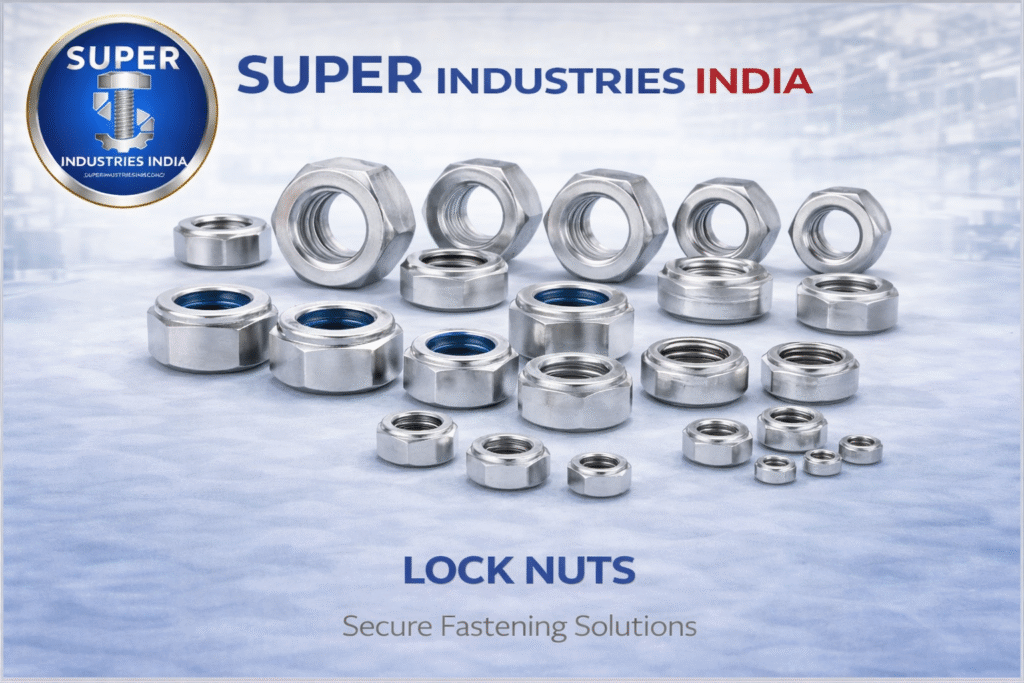
As a comprehensive fastener manufacturer, Super Industries India offers a wide selection of lock nuts to meet every industrial requirement. Our product range includes the most sought-after locking nut types:
1. Nylock Nuts (Nylon Insert Lock Nuts)
- Mechanism: These are perhaps the most popular type of self-locking nut. They feature a non-metallic, typically nylon or polymer, insert located at the top of the nut. As the nut is threaded onto the bolt, the nylon insert deforms around the threads, creating a strong frictional force that resists loosening.
- Key Features: Excellent vibration resistance, cost-effective, reusable (though less so than all-metal types), and act as a seal against liquid seepage.
- Standards: Manufactured as per DIN 985 (Thin Type) and DIN 982 (High Type).
- Best Used For: Automotive parts, domestic appliances, light to medium-duty assemblies where temperatures are not excessively high.
2. All Metal Lock Nuts (Prevailing Torque Lock Nuts)
- Mechanism: These nuts rely on a controlled distortion of the nut’s thread or collar section. The elastic deformation of the metal creates a constant drag or prevailing torque on the bolt, locking the nut in place.
- Types Include:
- Stover Lock Nut / Top Lock Nut: Features a crimped or cone-shaped collar that deforms upon installation.
- Center Lock Nut (Two-Way Lock Nut): The deformation is in the center of the nut, allowing it to be installed from either end.
- Key Features: Superior strength, high reusability, and can withstand significantly higher operating temperatures where nylon inserts would fail.
- Best Used For: Heavy machinery, engine parts, high-temperature furnace applications, and critical heavy-duty assemblies.
3. Serrated Flange Lock Nuts (Flange Lock Nuts)
- Mechanism: Combines a standard hex nut with an integrated, non-spinning flange base. The flange has serrations (teeth) underneath that bite into the mating surface upon final tightening, preventing the nut from rotating and spreading the load over a larger area.
- Key Features: Eliminates the need for a separate washer, superior grip, and excellent load distribution.
- Standards: Often manufactured as per DIN 6923.
- Best Used For: Assemblies involving slotted holes, surfaces that need protection from marring, and high-vibration power transmission systems.
Materials, Grades, and Specifications: Built for Durability
At Super Industries India, our commitment to quality starts with the finest raw materials. We offer lock nuts in materials and grades suitable for both general and highly corrosive/high-stress environments.
| Material Type | Common Grades/Classes | Standards & Coating Options |
| Stainless Steel (SS) | A2 (SS 304), A4 (SS 316), A4-70, A2-70, 18-8 | Passivation, Self-Colour. Excellent for corrosion resistance. |
| Carbon Steel / Alloy Steel | Class 8, Class 10, Grade 8.8, 10.9, 2H, 7 | Zinc Plated (Yellow/Blue), Hot Dip Galvanized (HDG), Black Oxide. |
| Mild Steel (MS) | Class 4, Class 5 | Zinc Plated (BZP), Self-Colour. |
Compliance & Size Range:
- International Standards: DIN, ISO, ASME B18.2.2, ASTM, SAE.
- Indian Standards: IS: 6731 and various parts of IS: 1367.
- Dimensions: Available in Metric (M3 to M60) and Imperial (UNC/UNF) threads.
Industrial Applications: Where Reliability is Non-Negotiable
Lock nuts from Super Industries India are the trusted choice for preventing costly downtime and catastrophic failure across diverse sectors. Our products are indispensable in:
- Automotive Industry: Securing engine components, axle bolts, and chassis assemblies subject to constant vibration.
- Railways & Infrastructure: Fastening tracks, signalling equipment, and critical structural joints where safety is paramount.
- Oil & Gas and Petrochemical: Used in pipeline flange connections, pumps, and offshore structures that require anti-corrosive and vibration-resistant fasteners.
- Heavy Machinery: Securing moving parts in construction equipment, industrial mixers, and manufacturing plant machinery.
- Aerospace & Defense: Precision-engineered all-metal lock nuts for high-stress, high-temperature applications.
- Wind Energy/Power Generation: Ensuring the stability of turbine components and structural elements exposed to dynamic loads.
Why Choose Super Industries India for Your Lock Nut Requirements?
As a premier Lock Nut Exporter and Supplier in India, we stand out through our dedication to quality, precision, and customer service.
- Precision Manufacturing: Utilizing advanced cold forging and CNC machining processes to achieve exacting tolerances and dimensional accuracy in every piece.
- Quality Assurance: All our lock nuts undergo rigorous quality control testing, including proof load, hardness, and metallurgical checks, ensuring compliance with both Indian (IS) and International (DIN, ISO) standards.
- Extensive Inventory & Supply Network: We maintain a large stock of Nylock Nuts, All Metal Lock Nuts, and Flange Lock Nuts ready for immediate shipment across Mumbai, Delhi, Chennai, Bangalore, Ahmedabad, and all major industrial hubs in India.
- Custom Solutions: We specialize in manufacturing custom lock nuts to specific client drawings, materials, and plating requirements for unique project needs.
Looking for reliable, high-tensile lock nuts for your next project?
Contact Super Industries India today for a competitive quote and detailed consultation on the best lock nut solution for your demanding application.