
PLAIN WASHERS (FLAT WASHERS)
EPC / EXPORT / MNC-GRADE TECHNICAL REFERENCE
Manufacturer & Global Exporter: Super Industries
Website: https://superindustriesindia.in
1. Industry Context
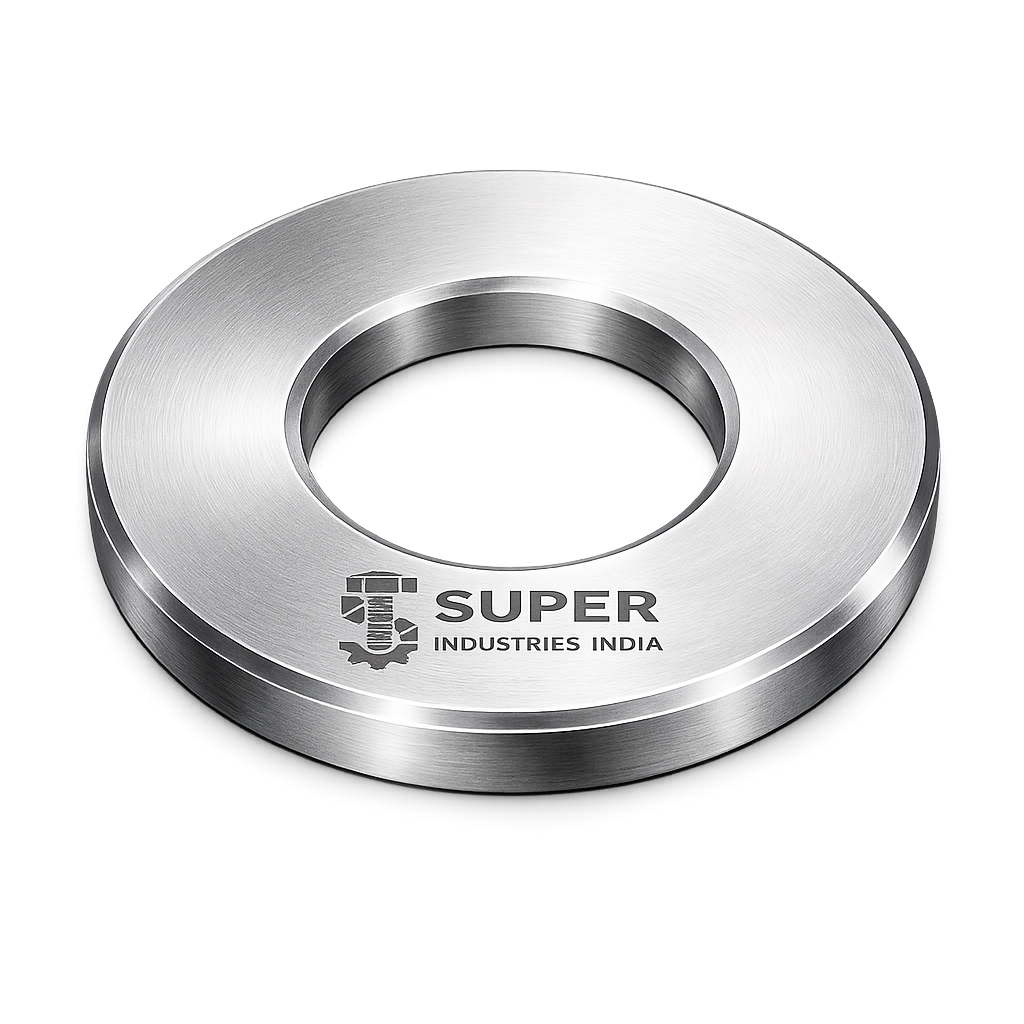
Why Plain Washers (Flat Washers) Are Critical in EPC Bolted Joints
In EPC-driven plants and capital projects, bolted joints are designed to transfer load predictably, maintain preload over time, and protect parent materials from localized damage. Plain Washers (Flat Washers) are fundamental components in this system. Their role is often understated, yet their influence on bearing stress, surface integrity, alignment, and preload stability is decisive.
Across Oil & Gas, Power & Energy, Petrochemical, LNG, Hydrogen, and Infrastructure assets, flat washers are specified to:
- Distribute contact pressure beneath bolt heads and nuts
- Protect coated or softer substrates from embedding and galling
- Provide dimensional correction where bearing surfaces are imperfect
- Stabilize preload by reducing friction variability at the interface
From a consultant and EPC approval standpoint, plain washers are engineered interfaces, not commodity spacers. Their dimensions, flatness, material grade, and surface condition must align with the fastener system and the service environment.
2. Technical Definition
What Are Plain / Flat Washers?
Plain Washers (Flat Washers) are flat, annular metal discs installed between a fastener bearing surface (bolt head or nut) and the joint material. They do not provide elastic locking or load indication. Their function is purely geometric and tribological—to modify the interface conditions of a bolted joint.
They differ from:
- Spring washers: which introduce elastic resistance
- Structural washers: which are thicker and hardened for high-strength structural bolting
- Load-indicating washers: which deform to indicate achieved preload
Plain washers are selected when controlled bearing area and surface protection are required without altering joint stiffness.
3. Functional Role in Bolted Assemblies
Contact Pressure Distribution
By increasing the effective bearing area, a flat washer reduces peak contact stress at the interface. This is critical when:
- Bolting onto softer steels, aluminum, or non-metallic liners
- Protecting painted, plated, or galvanized surfaces
Bearing Stress Reduction
Excessive bearing stress leads to surface embedding, preload loss, and long-term relaxation. Proper washer OD and thickness mitigate this risk.
Alignment & Seating Correction
Washers compensate for:
- Minor surface irregularities
- Oversized holes
- Slight angular misalignment between fastener and joint face
Preload Consistency
Uniform contact conditions beneath the fastener head/nut improve torque-to-tension repeatability, a key EPC concern.
4. Engineering Relevance of Washer Thickness & Weight
Thickness
- Thin washers provide surface protection but limited stiffness
- Thicker washers resist bending, maintain flatness, and improve load distribution
Thickness selection affects:
- Bearing stress
- Washer bending under load
- Long-term preload stability
Outer & Inner Diameter
- OD governs bearing area
- ID must clear the fastener shank without excessive radial play
Flatness & Mass
- Flatness ensures uniform contact
- Mass correlates with thickness and influences vibration response in dynamic assemblies
5. Dimensional & Weight Determination Logic
Correct washer selection is based on:
- Bolt nominal size
- Standard series (DIN / ISO / ASME)
- Joint material hardness
- Design bearing stress limits
Dimensional control includes:
- OD and ID tolerances
- Thickness tolerance
- Parallelism and flatness limits
Weight is derived from material density and dimensions and is relevant for engineering BOM control and logistics planning in large EPC packages.
6. Types of Plain Washers & Engineering Characteristics
Normal Series Washers
- Balanced OD and thickness
- General-purpose EPC use
Large OD (Fender-Type) Washers
- Increased bearing area
- Used on softer materials or oversized holes
Heavy-Duty / Structural Flat Washers
- Greater thickness
- Used with high-strength bolts in structural applications
ISO vs DIN vs ASME Differences
- Variations in OD, thickness, and tolerance philosophy
- EPC specifications typically lock one standard per project to avoid mismatch
7. Material & Standard Alignment
Governing Standards
- DIN 125 / DIN 9021
- ISO 7089 / ISO 7093
- ASME B18.22.1
Material Options
- Carbon Steel: general structural and piping support use
- Alloy Steel: higher bearing stress resistance
- Stainless Steel (A2 / A4): corrosion-resistant environments
Surface Finishes
- Plain/oiled
- Zinc plated
- Hot-dip galvanized
- PTFE or specialty coatings (where specified)
Material and finish must be compatible with the fastener material to avoid galvanic or frictional inconsistencies.
8. Manufacturing & Quality Discipline
Manufacturing Process
- Blanking
- Piercing
- Deburring and edge conditioning
- Heat treatment (for hardened washers, if applicable)
- Surface coating
- Dimensional and flatness inspection
Quality Control Focus
- OD/ID concentricity
- Thickness consistency
- Flatness under inspection load
- Coating thickness and adhesion
- Batch traceability
Poor edge quality or waviness directly affects joint reliability.
9. Procurement, Installation & Inspection View
What EPC Engineers Verify
- Washer standard and series compliance
- Material grade suitability
- Compatibility with bolt/nut system
What Inspectors & Consultants Check
- Dimensional accuracy
- Flatness and surface condition
- Coating conformity
- MTC and traceability
Installation Discipline
- Washer orientation (flat against joint surface)
- No stacking unless specified
- Replacement if damaged or distorted
10. Application Mapping
Plain Washers are used across:
- Oil & Gas: pipe racks, supports, skids
- Power: equipment bases, auxiliaries
- Petrochemical & LNG: structural and secondary steel
- Hydrogen: corrosion-sensitive assemblies
- Infrastructure: bridges, stations, heavy equipment
They are typically mandatory wherever coated surfaces or controlled bearing stresses exist.
11. Professional Technical Tables
Metric Size Range (Indicative)
| Bolt Size | Washer OD | Washer Thickness |
|---|---|---|
| M6–M100+ | Standardized | Series-defined |
Material vs Environment
| Material | Typical Environment |
|---|---|
| Carbon Steel | Dry / controlled |
| Zinc Plated CS | Mild outdoor |
| HDG | Outdoor / marine |
| SS A2 | Corrosive |
| SS A4 | Marine / chemical |
Customization Capabilities
- Non-standard OD/thickness
- Hardened washers
- Project-specific coatings
- Special tolerance classes
12. Manufacturer-Focused Conclusion
Plain Washers (Flat Washers) are integral to bolted joint performance in EPC projects. Their influence on bearing stress, surface protection, and preload stability makes them engineering-critical components, not consumables.
Super Industries supplies plain washers with:
- Standards-aligned dimensional control
- Consistent flatness and surface quality
- Material and coating discipline
- Traceability suitable for EPC and consultant approval
This approach ensures washers perform their intended function reliably across demanding industrial environments.
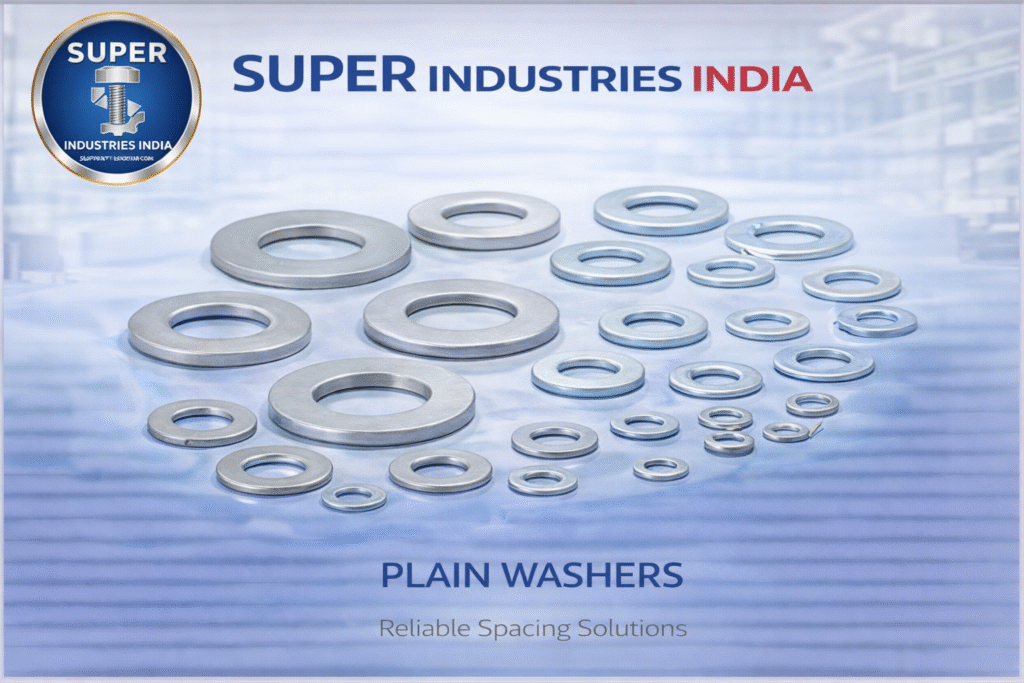
Plain Washers (Flat Washers) Manufacturer in India: IS 2016, DIN 125 & DIN 9021 Specialist
The Foundation of Secure Fastening: Precision Plain Washers from Super Industries India
Often overlooked, the Plain Washer, or Flat Washer, is arguably the most critical component for ensuring the longevity and integrity of any bolted joint. At Super Industries India, we specialize in manufacturing and supplying a comprehensive range of high-quality Plain Washers that serve as the fundamental load-distribution device in construction, automotive, industrial machinery, and infrastructure projects across India.
We understand that a washer is not just a simple metal disk. It is a calculated component engineered to protect the assembly and maximize the performance of the fastener. By choosing our precision-engineered flat washers, you secure the reliability and safety of your most demanding applications.
The Indispensable Role of a Plain Washer
A plain washer performs three essential functions in a bolted or screwed assembly:
- Load Distribution: The primary function is to distribute the load of the threaded fastener (bolt head or nut) over a significantly larger bearing surface area. This distribution reduces the surface pressure, preventing damage, crushing, or brinelling of the component material underneath. This is especially vital when fastening into soft materials like wood, plastics, or aluminum.
- Surface Protection: They provide a smooth, consistent bearing surface, protecting the material from being scratched, marked, or deformed as the nut or bolt head is tightened.
- Spacers and Shims: Plain washers can also function as spacers, providing the necessary clearance between components, or as shims to fine-tune axial alignment or compensate for minor variations in component thickness.
Our Comprehensive Range of Plain Washers
As a premier Plain Washer manufacturer in India, we strictly adhere to both domestic and international quality standards, ensuring dimensional accuracy and material integrity in every piece.
Key Plain Washer Standards and Types
| Washer Type | Primary Standard | Key Feature | Common Use |
| Normal Series Flat Washer | DIN 125-A / ISO 7089 / IS 2016 (Type A) | Standard outside diameter (OD), suitable for general-purpose applications. | Everyday fastening where hole size is standard. |
| Chamfered Flat Washer | DIN 125-B / ISO 7090 | Features a chamfer (beveled edge) on the outer diameter for a smoother finish. | Aesthetic or specific counter-sinking requirements. |
| Large Series Flat Washer | DIN 9021 / ISO 7093 / IS 2016 (Type B) | Features a significantly larger Outside Diameter (OD). Often called Fender Washers. | Fastening to soft materials, covering oversized or slotted holes. |
| Hardened Flat Washers | ASTM F436 (Metric & Imperial) | Heat-treated to a higher hardness (HV 300 minimum) for use with high-strength structural bolts. | Structural steel construction, bridges, and high-tension applications. |
We manufacture washers in a full spectrum of sizes, from miniature M3 plain washers for electronics to heavy-duty washers for major infrastructure projects, and offer both Metric (M) and Imperial (Inch) sizing (e.g., 1/2′′ flat washers).
Material Excellence and Finish Options
The correct material and finish are crucial for a plain washer to withstand its operating environment, be it exposure to moisture, chemicals, or high vibration.
Standard and Specialized Materials
- Mild Steel (MS) / Low Carbon Steel: The most cost-effective solution for general-purpose applications that are not exposed to severe corrosion.
- Carbon Steel (High Tensile): Heat-treated to achieve the necessary hardness (e.g., HV 200 or HV 300) required for use with high-strength fasteners (Grade 8.8, 10.9, 12.9).
- Stainless Steel (SS 304, SS 316): Provides superior corrosion resistance. SS 304 Flat Washers are ideal for food, dairy, and general outdoor use, while SS 316 Flat Washers are essential for marine, chemical processing, and other harsh, corrosive environments.
- Brass, Copper, Aluminum: Used for specialty applications requiring non-magnetic, electrical conductivity, or lighter-weight properties.
Protective Surface Finishes
To enhance longevity and appearance, we offer a range of finishes:
- Zinc Plated (Electro-Galvanized): The most common finish, offering good corrosion resistance in dry environments (available in white, blue, or yellow chromate).
- Hot Dip Galvanized (HDG): Provides an extra thick coating of zinc for maximum, long-term corrosion protection, typically used in outdoor, structural, and construction applications.
- Black Oxide / Black Finish: Provides a dark, anti-glare, mild corrosion-resistant finish.
- Natural/Self Finish: Uncoated, used primarily for stainless steel or in non-corrosive indoor settings.
Industrial Applications of Super Industries Plain Washers
Our high-precision flat washers are foundational to assembly integrity across virtually every industrial sector:
- Construction & Infrastructure: Used in structural steel connections, bridge building, and high-load applications alongside high-tensile bolts (ASTM F436).
- Automotive Industry: Essential in chassis, engine mounts, and body assembly to prevent surface damage and ensure even torque application.
- Heavy Machinery & Manufacturing: Critical for assembly of pumps, compressors, and hydraulic systems where vibration dampening and load spreading are paramount.
- Renewable Energy (Solar & Wind): Stainless steel washers are crucial in solar panel mounting structures and wind turbine components to withstand harsh weather and corrosion.
- HVAC & Plumbing: Used to create seals and protect components during installation of pipes, ducts, and valves.
Why Partner with Super Industries India?
As a trusted Plain Washer supplier in India, our commitment extends beyond quality products:
- Precision Manufacturing: Using high-speed presses and ISO-certified processes, we guarantee washers with consistent flatness, thickness, and burr-free edges.
- Bulk & Custom Orders: We maintain large stock levels for standard DIN and IS washers and offer complete custom manufacturing services based on client drawings, material, and hardness specifications.
- Competitive Pricing: Leveraging efficient production scale, we offer the best quality flat washers at the most competitive price points in the Indian market.
Secure your connections with the dependable strength of Super Industries Plain Washers.
Contact our sales team today for a comprehensive quote or to discuss your custom plain washer requirements. Partner with the Indian specialists in essential fastening hardware.