
SHEET METAL SCREWS
Engineered Fasteners for EPC Fabrication, Industrial Enclosures & Export Assemblies
Manufacturer & Global Exporter: Super Industries
Website: https://superindustriesindia.in
Industry Context
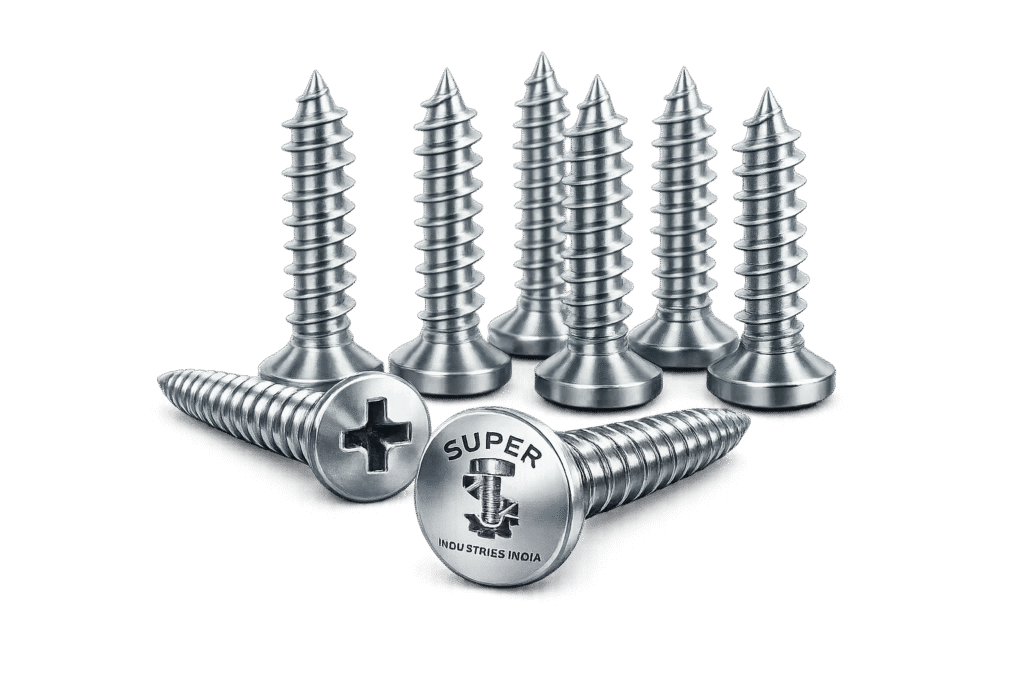
Why Sheet Metal Screws Are Critical in EPC Fabrication, Enclosure Integrity, and Assembly Reliability
In EPC-driven fabrication and export-grade industrial manufacturing, sheet metal assemblies form the backbone of enclosures, panels, housings, HVAC systems, electrical cabinets, skids, and modular equipment. These assemblies are not load-bearing in the structural sense, yet their reliability directly affects equipment protection, vibration resistance, ingress control, maintainability, and lifecycle performance.
Sheet metal screws are specified because they provide:
- Direct fastening into thin-gauge materials without separate nuts
- Rapid, repeatable assembly across large volumes
- Controlled holding strength matched to sheet thickness
- Predictable performance under vibration when correctly selected
From an EPC and consultant perspective, sheet metal screws are not treated as generic hardware. Improper selection—wrong thread type, incorrect point geometry, inadequate coating, or mismatched material—leads to strip-out, loosening, corrosion failure, and enclosure integrity loss. As a result, consultants routinely enforce standardized screw types, material grades, and coating systems, especially for export and infrastructure projects.
This page documents Sheet Metal Screws strictly as engineered fastening components, written for EPC contractors, inspectors, and procurement professionals.
Technical Definition
What Sheet Metal Screws Are and How They Differ from Machine Screws and Self-Drilling Screws
A sheet metal screw is a threaded fastener designed to form or cut its own mating threads when driven into thin metal sheets or light-gauge substrates. Unlike machine screws, sheet metal screws do not require pre-tapped threads, and unlike self-drilling screws, they do not incorporate a drill-bit tip.
Key Characteristics
- Sharp or blunt point depending on type
- Coarse, deep threads optimized for thin material engagement
- Typically used in sheet thicknesses up to a defined limit
- Installed into pre-punched or pilot-drilled holes
Distinction from Related Fasteners
Sheet Metal Screws vs Machine Screws
- Machine screws require tapped holes or nuts
- Sheet metal screws form/cut threads during installation
Sheet Metal Screws vs Self-Drilling Screws
- Self-drilling screws drill and tap in one operation
- Sheet metal screws rely on existing holes or soft penetration
In EPC specifications, these distinctions are enforced to prevent misuse.
Engineering Function & Performance
Pull-Out Strength, Strip Resistance, Vibration Behavior, and Joint Reliability
Pull-Out & Strip Resistance
Sheet metal screws rely on thread flank engagement with thin material. Performance depends on:
- Sheet thickness
- Thread pitch and depth
- Material hardness of the sheet
- Hole size accuracy
Oversized holes or incorrect screw types significantly reduce holding strength.
Vibration Behavior
In enclosures and equipment exposed to vibration:
- Coarse threads provide better resistance than fine threads
- Proper seating torque is essential
- Supplementary locking (washers, thread-forming profiles) may be specified
Joint Reliability
Sheet metal screws are designed for serviceable joints, not permanent structural connections. Correct engineering selection ensures:
- Adequate clamp force without material damage
- Repeatable installation and removal (within limits)
Thread & Point Design Logic
Thread Pitch, Flank Geometry, and Penetration Behavior
Thread Geometry
- Coarse pitch improves holding in thin sheets
- Deep thread depth increases pull-out resistance
- Flank angle affects cutting vs forming behavior
Point Geometry
- Sharp points: rapid engagement in thin sheets
- Blunt points: controlled thread forming in softer metals
Engineering selection balances installation torque, material deformation, and long-term retention.
Types of Sheet Metal Screws & Characteristics
Common Types
- Type A: Coarse threads, sharp point, general-purpose
- Type AB: Finer than Type A, reduced splitting risk
- Type B: Blunt point, requires pre-formed hole
- Type C: Even finer pitch, controlled engagement
Head & Drive Variants
- Pan head
- Flat head
- Truss head
- Hex washer head
- Phillips, slotted, hex, or combination drives
Consultants often specify head and drive combinations based on accessibility and torque control requirements.
Material & Standard Alignment
Material Selection and Service Compatibility
Common Materials
- Carbon steel: General indoor use, cost-effective
- Stainless steel: Corrosion-prone environments
- Coated steels: Balanced cost and corrosion resistance
Standards Framework
Sheet metal screws are typically aligned with:
- DIN and ISO dimensional logic
- ASTM material philosophy (where applicable)
- Project-specific EPC specifications
Compliance is assessed by geometry, coating performance, and consistency, not branding.
Manufacturing & Quality Discipline
Cold Forming, Thread Rolling, Heat Treatment, and Coating Control
High-quality sheet metal screws require:
- Controlled wire chemistry
- Precision cold forming for head and point geometry
- Thread rolling for strength and surface finish
- Heat treatment for consistent hardness
- Coating application with verified thickness
Quality control focuses on:
- Dimensional repeatability
- Thread integrity
- Coating adhesion
- Batch traceability
Procurement, Installation & Inspection View
What EPC Engineers and Inspectors Verify
During approval and site inspection, reviewers typically check:
- Screw type vs specified application
- Material grade and finish
- Dimensional conformity
- Coating condition
- Installation torque behavior
- Documentation and lot control
Improvised substitutions are commonly rejected.
Application Mapping
Typical EPC and Industrial Uses
- Electrical and control panels
- Equipment enclosures and cabinets
- HVAC ducting and housings
- Light-gauge steel fabrications
- Oil & Gas auxiliary systems
- Infrastructure equipment covers
Explicit Exclusions
- Structural load-bearing joints
- Pressure-retaining systems
- High-temperature critical assemblies
Professional Technical Tables
Screw Size vs Sheet Thickness (Indicative)
| Screw Diameter | Typical Sheet Thickness |
|---|---|
| 3.5 – 4.2 mm | Thin gauge panels |
| 4.8 – 5.5 mm | Enclosures & cabinets |
| 6.3 mm | Heavy sheet assemblies |
Head Types & Drive Systems
| Head Type | Typical Use |
|---|---|
| Pan head | General enclosures |
| Flat head | Flush surfaces |
| Hex washer | Higher torque |
Material Grades vs Applications
| Environment | Recommended Material |
|---|---|
| Indoor | Carbon steel |
| Outdoor | Coated steel |
| Corrosive | Stainless steel |
Coating Options vs Corrosion Environment
| Coating | Use Case |
|---|---|
| Zinc plated | Mild exposure |
| Passivated SS | High corrosion |
Customization Capabilities
- Non-standard lengths
- Special head geometries
- Project-specific coatings
- Controlled packaging for EPC sites
Manufacturer-Focused Conclusion
Sheet Metal Screws play a critical role in EPC fabrication quality, enclosure reliability, and equipment protection. While not structural fasteners, their failure directly affects system integrity, maintenance safety, and service life.
Correct performance depends on thread design, point geometry, material compatibility, coating integrity, and disciplined manufacturing control. When misapplied or downgraded, they become a common source of vibration loosening, corrosion failure, and inspection non-conformance.
Super Industries manufactures sheet metal screws with controlled cold forming, consistent threading, verified coatings, and documented traceability, aligned with EPC and export project expectations.
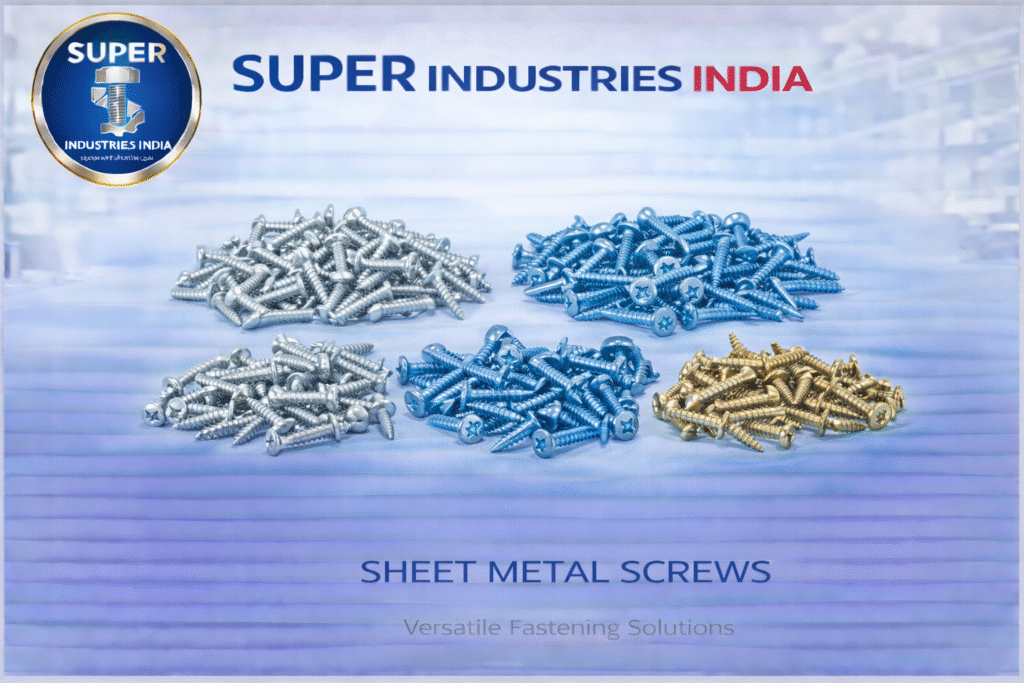
Secure Your Projects with Premium Sheet Metal Screws from Super Industries India
Welcome to Super Industries India, your trusted manufacturer, supplier, and exporter of high-quality Sheet Metal Screws in India. In the world of construction, fabrication, automotive, and HVAC, a secure and durable fastening is non-negotiable. Our precision-engineered sheet metal screws (also known as tapper screws or self-tapping metal screws) are designed to meet the rigorous demands of modern industry, providing unmatched grip and longevity in thin metal applications.
Whether you are working with aluminum, steel, brass, plastic, or wood, our extensive range of sheet metal screws offers the perfect solution for creating strong, reliable, and vibration-resistant joints. Explore our catalog and discover why Super Industries is the preferred choice for industrial fasteners across the nation.
What Makes Sheet Metal Screws Essential for Industrial Applications?
Sheet metal screws are specialized threaded fasteners designed to join sheet metal to metal, or to other materials without the need for a pre-tapped hole (in the case of self-tapping types). Their defining features include:
- Fully Threaded Shank: Provides maximum grip and retention within the material.
- Sharp, Aggressive Threads: Allows the screw to cut its own mating thread as it is driven into a pre-drilled pilot hole or directly into the substrate.
- High Tensile Strength: Built to withstand significant load and vibration, ensuring a long-lasting connection.
Our Diverse Range of Sheet Metal Screw Types
We understand that every project has unique requirements. Super Industries India offers a comprehensive selection of sheet metal screws, categorized by both functionality and head style:
1. By Functionality:
| Screw Type | Key Feature | Best For |
| Self-Tapping Sheet Metal Screws | Requires a pre-drilled pilot hole, but cuts its own threads into the material. | Thin metals, plastics, and non-ferrous castings where an existing hole is present. |
| Self-Drilling Sheet Metal Screws (SDS) | Features a drill-bit point, allowing it to drill, tap, and fasten in a single operation. | Roofing, HVAC ductwork, and steel frame construction to save time and labour. |
| Thread-Cutting Screws | Designed to remove material as it is driven, creating precise threads in harder materials. | Cast aluminum, thicker steel, and materials prone to stripping. |
2. By Head Style (Common Types in Our Inventory):
- Pan Head Sheet Metal Screws: Features a slightly rounded top and a broad bearing surface. Ideal for general applications where a flush finish is not required.
- Flat Head (CSK) Sheet Metal Screws: Designed to sit flush with the surface of the material, offering a clean, snag-free finish.
- Hex Head Sheet Metal Screws: Offers superior torque transfer and is perfect for heavy-duty, high-load applications. Often used with an integrated washer.
- Truss Head Sheet Metal Screws: Features an extra-wide, low-profile head that provides a large load-bearing surface, excellent for securing soft or thin materials.
Materials, Finish, and Corrosion Resistance
Quality starts with the right material. Our sheet metal screws are manufactured using premium-grade materials, ensuring performance in diverse industrial and environmental conditions:
- Stainless Steel Sheet Metal Screws (SS 304, SS 316): Offers outstanding resistance to rust and corrosion, making them mandatory for marine, chemical, outdoor, and high-humidity applications.
- Mild Steel (MS): A cost-effective solution for general indoor applications.
- Carbon Steel: Provides high strength and durability, often enhanced with coatings.
To maximize lifespan and performance, we offer various coatings and finishes:
- Zinc Plated (Clear/Blue/Yellow): Provides excellent corrosion resistance for indoor and semi-outdoor use.
- Black Phosphate: Used primarily in drywall and interior woodworking applications.
- Hot-Dip Galvanized: Superior protection for outdoor and structural applications.
Key Applications Across Industries
The versatility of sheet metal screws makes them indispensable across a multitude of sectors:
- Construction & Infrastructure: Fastening metal roofing sheets, cladding panels, ceiling grids, and securing light-gauge steel framing.
- HVAC Systems: Assembling and securing metal ductwork, ventilation systems, and air conditioning units.
- Automotive & Transportation: Interior and exterior panel assembly, securing trim, and fastening components where vibration resistance is key.
- Electronics & Appliances: Securing chassis, panels, and internal components in machinery and consumer electronics.
- General Fabrication: Attaching metal brackets, signs, hinges, and other fixtures in workshops and fabrication units.
Why Choose Super Industries for Sheet Metal Screws in India?
As a leading sheet metal screw manufacturer in India, Super Industries is dedicated to providing quality and reliability that powers your projects:
- Precision Engineering: Every screw is cold-forged and finished to strict international standards (DIN, ISO, JIS), guaranteeing dimensional accuracy and thread integrity.
- Unmatched Quality Control: Our fasteners undergo rigorous testing for torque, shear strength, and material composition before dispatch.
- Custom Fastening Solutions: Need a specific diameter, length, head type, or coating? We offer bespoke manufacturing to match your exact project specifications.
- Competitive Pricing & Bulk Supply: Leveraging our modern, high-capacity facility, we offer highly competitive pricing for bulk industrial and commercial orders across India.
- Timely Nationwide Delivery: Our robust logistics network ensures prompt and reliable delivery of your sheet metal screws to major industrial hubs, including Mumbai, Delhi, Chennai, Bengaluru, and Pune.
Don’t compromise on the fasteners that hold your projects together. Trust the strength and precision of Super Industries.
Ready to Secure Your Next Project?
Contact Super Industries India today to discuss your sheet metal screw requirements, request a custom quote, or place your bulk order. Our expert technical team is ready to assist you in selecting the perfect fastening solution.