
Wire Rope Slings
Table of Contents
Engineering Reference for EPC Lifting, Rigging & Capital Project Execution
Manufacturer & Global Exporter: Super Industries
Website: https://superindustriesindia.in
1. Industry Context: Why Wire Rope Slings Are Safety-Critical in EPC Projects
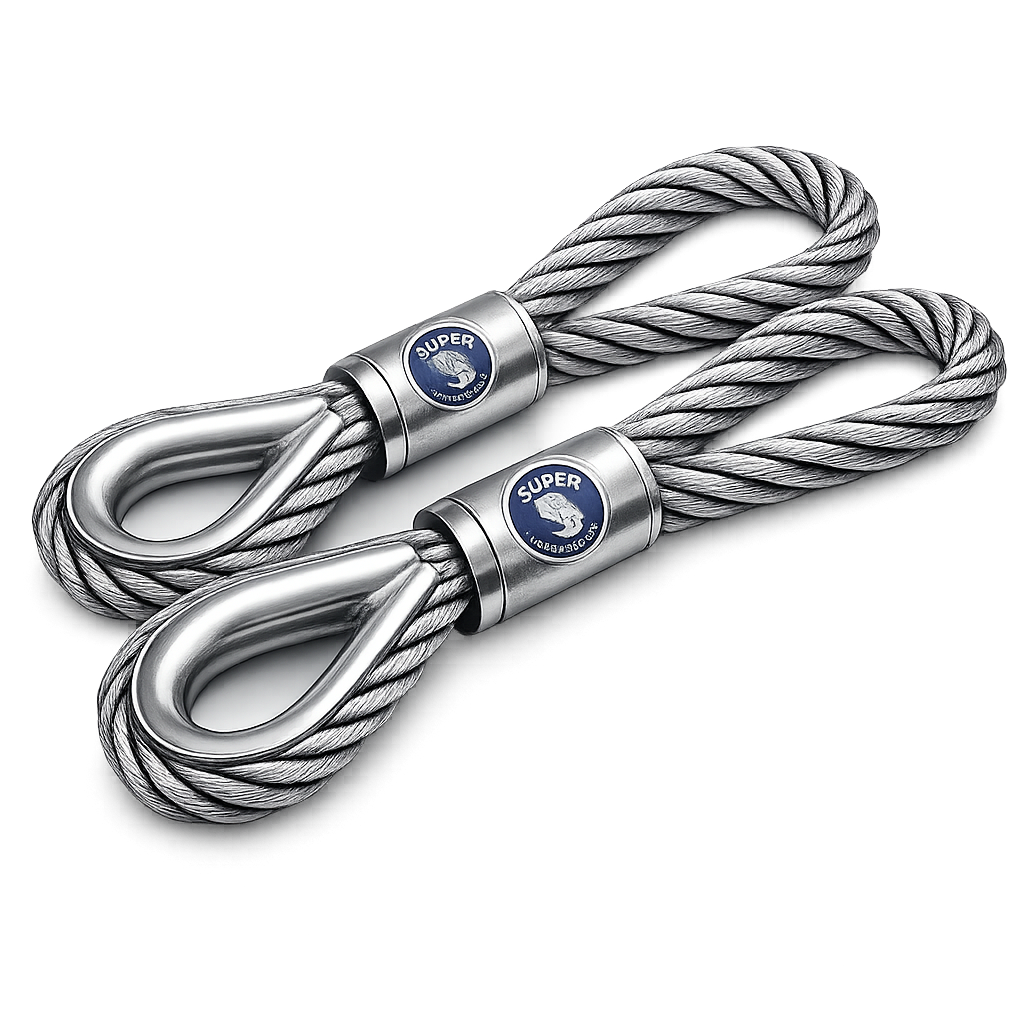
In EPC, shutdown, and capital project environments, wire rope slings are not accessories—they are primary safety-critical load-handling components. Every heavy lift, module erection, equipment installation, or maintenance activity depends on the predictable performance of wire rope slings under static and dynamic loading.
For Oil & Gas, Power & Energy, Petrochemical, LNG, Hydrogen, and Infrastructure projects, wire rope slings are scrutinized because failure consequences are severe:
- Personnel injury or fatality
- Damage to high-value equipment
- Schedule disruption and financial loss
- Regulatory non-compliance and incident investigation
EPC contractors, lifting engineers, and consultants therefore require wire rope slings that are engineered, traceable, standard-compliant, and inspection-defensible. This page is structured to support lifting studies, method statements, technical evaluations, and consultant reviews—not general purchasing.
2. Technical Definition: What Wire Rope Slings Are and How They Function
Wire rope slings are flexible lifting devices manufactured from steel wire ropes configured with specific end terminations to enable safe connection between lifting equipment (cranes, hoists) and loads.
Functional Characteristics
Wire rope slings function by:
- Transmitting tensile load from the lifting device to the load
- Distributing stress through multiple wires and strands
- Accommodating minor misalignment and dynamic movement
- Providing controlled elongation under load
They are preferred for heavy, irregular, or high-temperature loads where chain or synthetic slings may be unsuitable.
Typical EPC Usage
- Pressure vessels, columns, exchangers
- Turbine and generator components
- Structural modules and skids
- Offshore and onshore lifting operations
- Construction and shutdown lifting
3. Engineering Relevance: Load Handling, Safety & Lifecycle Risk
Load Handling Logic
Wire rope slings are designed around Safe Working Load (SWL), derived from minimum breaking force (MBF) divided by an applicable factor of safety. Engineers evaluate slings based on actual lifting configuration, not nominal capacity.
Dynamic Loading
Real lifting operations involve:
- Acceleration and deceleration
- Wind-induced movement
- Load swing and impact
These dynamic effects increase effective load, requiring conservative design and disciplined selection.
Fatigue & Lifecycle Considerations
Repeated loading causes:
- Wire bending fatigue
- Strand wear and abrasion
- Progressive loss of metallic area
Weight, construction, and termination integrity directly affect sling service life and inspection intervals.
4. Load Capacity & Design Logic
The load capacity of wire rope slings is governed by interacting engineering parameters:
Rope Construction
- 6×19 / 6×36 constructions: Balance of flexibility and abrasion resistance
- Rotation-resistant ropes: Used where load spin is critical
- Compacted strands: Higher metallic area and fatigue resistance
Diameter
Rope diameter is the primary determinant of breaking strength and SWL. Small deviations in diameter significantly affect capacity.
Core Type
- Fiber Core (FC): Greater flexibility, lower temperature resistance
- Independent Wire Rope Core (IWRC): Higher strength, better crush resistance
Lay Type
- Regular Lay: Better stability, reduced rotation
- Lang Lay: Improved abrasion resistance, requires controlled handling
Efficiency Factors
Termination type and sling configuration reduce usable capacity relative to straight-line rope strength.
5. Types of Wire Rope Slings & Performance Characteristics
Single-Leg Slings
Used for vertical lifts and simple rigging arrangements. Capacity equals straight-pull SWL.
Multi-Leg Slings (2, 3, 4-Leg)
Allow load stabilization and balance. Effective SWL depends on leg angle and load distribution.
Eye-to-Eye Slings
Loops formed at both ends via splicing or ferrules. Common for general lifting.
Endless Slings
Continuous loop construction. Even load distribution and longer service life.
Grommet Slings
Heavy-duty endless slings with superior fatigue resistance for critical lifts.
6. Material, Construction & Standard Alignment
Wire rope slings supplied to EPC projects must comply with recognized international standards:
Key Standards Framework
- EN 13414: Wire rope slings – safety and testing
- ISO 7531 / ISO 2408: Wire ropes and lifting applications
- ASME B30.9: Slings (lifting devices)
- IS 2762 / IS 2266: Indian standards for wire rope slings
Service Environment Alignment
- Offshore and marine exposure
- High-temperature process areas
- Corrosive chemical environments
- Construction and infrastructure lifting
Standard selection influences factor of safety, inspection criteria, and documentation requirements.
7. Manufacturing & Quality Discipline
Rope Selection
Only certified wire ropes with known construction, tensile grade, and test history are used.
Sling Fabrication Control
- Controlled hand-splicing or mechanical ferruling
- Socketing with resin or molten metal (where specified)
- Dimensional verification of eyes and terminations
Traceability
Each sling is traceable to:
- Rope manufacturer
- Heat / batch number
- Proof load and test records
Inspection Philosophy
- Visual and dimensional checks
- Proof load testing where required
- Documentation aligned with EPC inspection plans
8. Procurement, Installation & Inspection View
During Technical Evaluation
EPC and lifting engineers verify:
- Applicable standard compliance
- Rope construction and diameter
- Declared SWL and factor of safety
- Termination type and efficiency
During Incoming Inspection
Inspectors review:
- Identification tags and markings
- Test certificates and traceability
- Physical condition and workmanship
During Site Use
Lifting authorities ensure:
- Correct sling configuration
- Adequate leg angles
- No shock loading or side loading
9. Application Mapping Across EPC Sectors
Oil & Gas
Onshore and offshore module lifting, vessel erection, turnaround operations.
Power & Energy
Turbines, generators, boilers, heavy auxiliaries.
Petrochemical
Columns, reactors, exchanger bundles.
LNG
Cryogenic equipment, modularized construction.
Hydrogen
New-generation equipment with strict safety oversight.
Infrastructure & Construction
Bridges, precast elements, heavy civil lifting.
10. Professional Technical Tables
Typical Rope Constructions
| Rope Construction | Characteristics | Typical Use |
|---|---|---|
| 6×19 | Abrasion resistant | General lifting |
| 6×36 | Flexible | Complex rigging |
| 8×36 | High fatigue resistance | Dynamic lifts |
Indicative Safe Working Load (SWL) – Single Leg, Vertical Lift
| Rope Diameter (mm) | Approx. SWL (tonnes) |
|---|---|
| 10 | 1.0 |
| 12 | 1.5 |
| 16 | 2.6 |
| 20 | 4.1 |
| 24 | 6.0 |
| 32 | 10.5 |
Values indicative; exact SWL depends on construction, core, and standard.
Typical Factors of Safety
| Standard | Factor of Safety |
|---|---|
| EN 13414 | 5:1 |
| ASME B30.9 | 5:1 |
| IS Standards | 5–6:1 |
Sling Configuration Efficiency Factors
| Configuration | Efficiency Factor |
|---|---|
| Vertical | 1.00 |
| Choker | 0.80 |
| Basket | 2.00 |
| Multi-leg (60°) | 1.00 |
| Multi-leg (45°) | 0.70 |
Project-Specific Customization Options
| Parameter | Options |
|---|---|
| Rope Diameter | Project-defined |
| Construction | 6×19, 6×36, compacted |
| Termination | Spliced, ferrule, socketed |
| Length | As per lifting study |
| Tagging | EPC / asset identification |
| Testing | Proof load, third-party witnessed |
Manufacturer-Focused Conclusion
In EPC and capital projects, wire rope slings represent controlled risk interfaces between lifting equipment and critical assets. Their performance is governed by engineering design, manufacturing discipline, traceability, and inspection readiness.
Super Industries manufactures wire rope slings under controlled selection, fabrication, and inspection systems aligned with international lifting standards. Each sling is supplied with documented capacity, configuration clarity, and traceability suitable for EPC lifting studies, consultant review, and site execution.
This engineering discipline ensures predictable lifting performance, inspection acceptance, and lifecycle reliability in safety-critical environments.
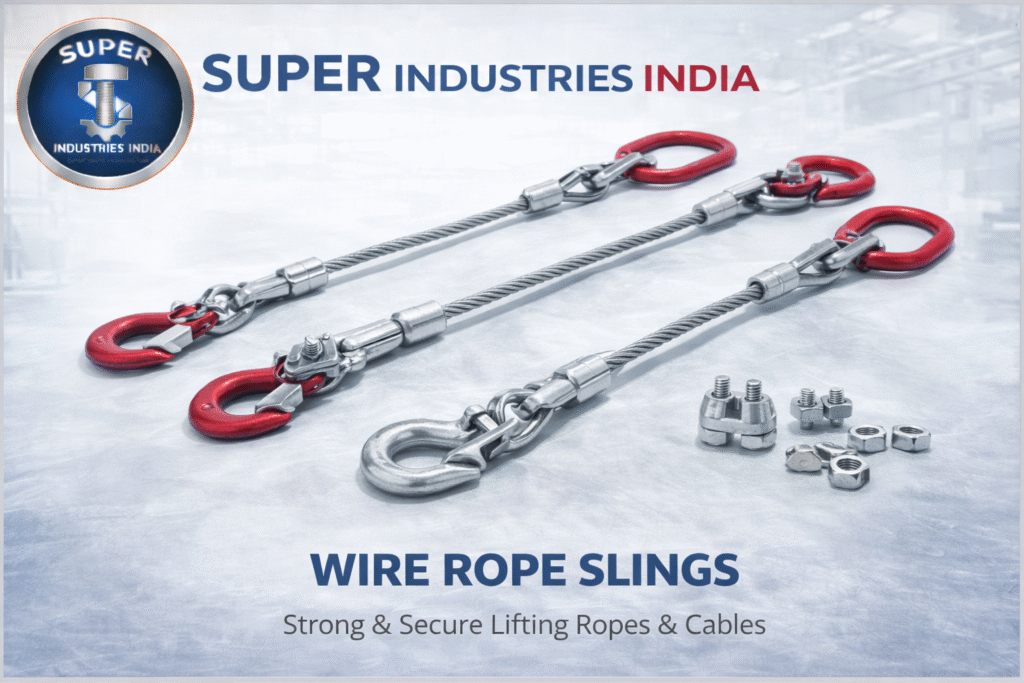
Secure Your Toughest Loads: Certified Wire Rope Slings (HT Series)
For reliable and robust heavy lifting across construction, marine, energy, and manufacturing sectors, Wire Rope Slings are the foundational lifting gear. Renowned for their high tensile strength, exceptional durability, and resistance to abrasion, these slings provide the critical connection between the crane hook and the load.
Super Industries India is a leading manufacturer and supplier of certified, custom-fabricated Wire Rope Slings in India. Our range, featuring various end terminations and leg configurations (like our robust HT Series), is engineered to exceed global safety standards and handle the most extreme lifting challenges with confidence.
The Core Advantage: Why Choose Wire Rope Slings?
A wire rope sling is an assembly built from high-strength steel wire rope, which consists of multiple strands wound around a central core. This construction delivers a unique combination of advantages:
- Superior Strength-to-Weight Ratio: Delivers massive lifting capacity relative to its size, crucial for heavy-duty applications.
- Durability and Abrasion Resistance: The steel construction is highly resistant to crushing, cutting, and wear, ensuring a longer service life compared to synthetic alternatives.
- High Load Stability: The strength and minimal elasticity of the rope ensure the load remains secure and stable during complex lifts.
- Thermal Resistance: Maintains structural integrity in elevated temperature environments.
Our Specialized HT Series: Configurations for Every Lift
Our HT (Heavy-Duty Threaded/Terminated) Series showcases the versatility required for modern rigging, offering reliable bridle sling configurations based on the load stability and number of lifting points needed.
| Product Code | Description | Configuration | Ideal Application |
| HT-91 | Double Leg Sling (Thimble Eyes) | 2 Legs, Master Link, Thimble Eyes | General purpose, balanced lifts, basket hitches. |
| HT-92 | Double Leg Sling (Hooks) | 2 Legs, Master Link, Hook End Fittings | Lifts requiring quick attachment/detachment from the load. |
| HT-93 | Double Leg Sling (Cleavis Hooks) | 2 Legs, Master Link, Clevis Hook Ends | Versatile lifting where the hook can be directly attached to a plate or lug. |
| HT-94 | Triple/Quad Leg Sling (Thimble Eyes) | 3 or 4 Legs, Master Link, Thimble Eyes | Provides stability for non-uniform loads or multi-point vertical lifts. |
| HT-95 | Triple/Quad Leg Sling (Hooks) | 3 or 4 Legs, Master Link, Hook End Fittings | High-stability lifts with quick-connect end points. |
| HT-96 | Triple/Quad Leg Sling (Clevis Hooks) | 3 or 4 Legs, Master Link, Clevis Hook Ends | Securing large, heavy, or complex machinery/structures to multiple points. |
Termination Methods – Ensuring Maximum Strength
The method of securing the eyes or fittings is paramount to sling integrity. We specialize in two primary high-efficiency termination types:
- Mechanically Spliced (Swaged): The wire rope loop is secured using a seamless steel or aluminum ferrule (sleeve) which is hydraulically pressed (swaged) onto the rope. This is the most common method, ensuring consistent and documented holding power.
- Flemish Eye Splice: A highly reliable technique where the rope strands are unlayed, formed into an eye, and then rewoven before being swaged, offering exceptional redundancy and strength.
Safety, Compliance, and Certification
In critical lifting, safety is non-negotiable. Every wire rope sling manufactured by Super Industries India adheres to strict national and international safety standards, including ASME B30.9.
- Working Load Limit (WLL): Every sling is clearly marked with its WLL and is designed with a minimum Safety Factor of 5:1 (Ultimate Breaking Strength divided by WLL).
- Proof Load Testing: We offer optional and required proof load testing, providing certified documentation that the sling has successfully sustained a load greater than its WLL.
- Material Traceability: Full material test certificates (MTCs) are provided for the wire rope, master links, and hooks, guaranteeing the origin and quality of all components.
Whether your project demands a simple HT-91 Double Leg Sling or a complex HT-96 Quad Leg configuration for balanced heavy-duty lifts, Super Industries India delivers certified quality that secures your operation.
Contact Super Industries India today to discuss your specific rigging needs and request a quote on our high-performance, certified Wire Rope Slings.