
WING NUTS
- WING NUTS
- 1️⃣ Industry Context
- 2️⃣ Technical Definition
- 3️⃣ Engineering Intent & Limitations
- 4️⃣ Functional Logic of Wing Design
- 5️⃣ Types of Wing Nuts & Performance Characteristics
- 6️⃣ Load, Vibration & Safety Considerations
- 7️⃣ Material Selection & Service Behavior
- 8️⃣ Standards & Specification Alignment
- 9️⃣ Manufacturing & Quality Discipline
- 🔟 Installation & Inspection View
- 1️⃣1️⃣ EPC & Consultant Review Perspective
- 1️⃣2️⃣ Application Mapping
- 1️⃣3️⃣ Professional Technical Tables
- 1️⃣4️⃣ Manufacturer-Focused Conclusion
- The Ultimate Guide to Wing Nuts: Tool-Free Fastening Solutions by Super Industries India
- Why Choose Super Industries India for Your Wing Nuts?
- Understanding the Types and Specifications of Wing Nuts
- Applications: Where Quick Fastening is Essential
- Get Your Quote from the Wing Nut Experts
Application-Limited, Hand-Tightened Fasteners for Non-Critical Industrial Assemblies
Manufacturer & Global Exporter: Super Industries
Website: https://superindustriesindia.in
1️⃣ Industry Context
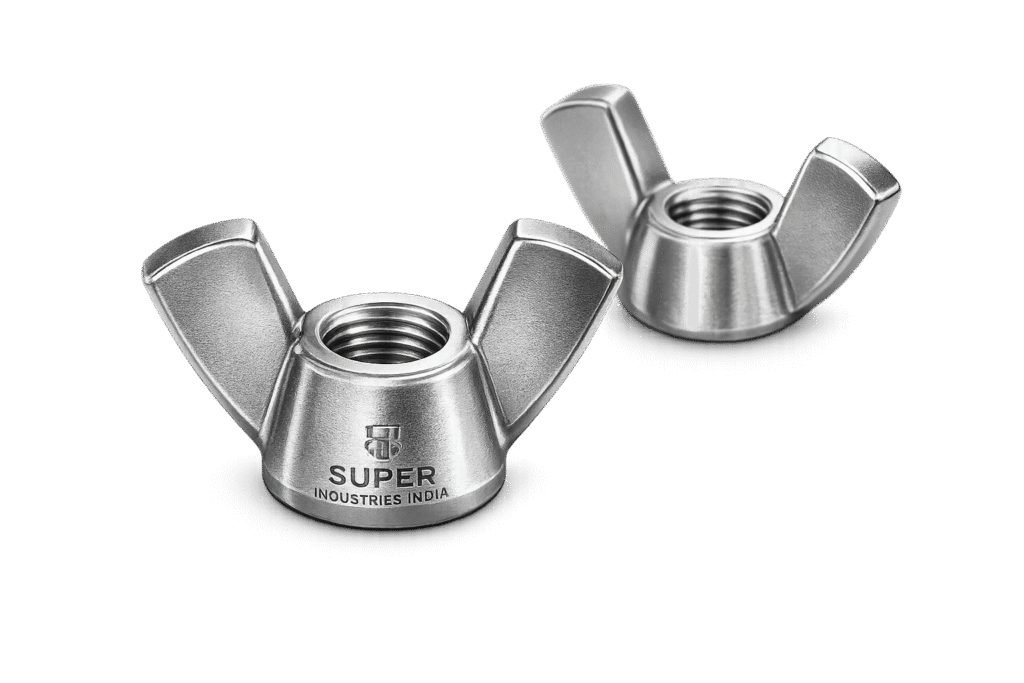
Where Wing Nuts Are Legitimately Used — and Where They Are Explicitly Not Permitted
Within EPC, OEM, and industrial manufacturing environments, wing nuts occupy a very narrow and clearly defined application space. They are intentionally designed for manual, tool-free tightening and frequent access, not for load-bearing, pressure-retaining, or vibration-critical joints.
Correctly specified, wing nuts serve practical roles in:
- Non-critical enclosures and covers
- Utility panels and access doors
- Filters, screens, and guards requiring regular removal
- Temporary fixtures and light industrial attachments
Equally important is where wing nuts must not be used. In EPC-governed projects, they are explicitly excluded from:
- Structural connections
- Pressure systems
- Flanged joints
- Rotating equipment
- Dynamic, vibrating, or cyclic-load assemblies
This distinction is essential. Wing nuts are not “low-cost alternatives” to engineered fasteners; they are purpose-specific components intended for convenience, not joint integrity under load.
2️⃣ Technical Definition
What Wing Nuts Are and How Hand-Tightening Works
A wing nut—also referred to as a butterfly nut—is a threaded fastener featuring two opposed projections (“wings”) that allow tightening and loosening by hand, without tools.
Key defining characteristics:
- Internal thread matching standard bolt threads
- Enlarged wing geometry for finger grip
- Designed for manual preload only
Unlike torque-applied nuts, wing nuts:
- Do not rely on controlled tightening torque
- Do not generate predictable clamp force
- Are not intended to maintain preload under vibration
Their function is positional retention, not structural clamping.
3️⃣ Engineering Intent & Limitations
Manual Preload Limits and Load Boundaries
From a mechanical-engineering standpoint, the preload achievable with a wing nut is constrained by:
- Human grip strength
- Wing geometry and surface finish
- Thread friction
As a result:
- Achievable clamp load is low and inconsistent
- Preload varies significantly between operators
- No repeatable torque value can be specified
This makes wing nuts inherently unsuitable for joints where:
- Load transfer depends on clamp force
- Fatigue life is influenced by preload
- Joint separation must be prevented
Wing nuts are therefore function-limited fasteners, not general-purpose nuts.
4️⃣ Functional Logic of Wing Design
Why Wings Exist and What They Enable
The wing geometry serves three functional purposes:
- Grip Leverage
The wings increase effective finger contact area, allowing higher manual torque than a plain hex nut turned by fingers alone. - Ergonomic Operation
Designed for repeated tightening and loosening without tools, gloves often accommodated. - Rapid Access
Enables fast removal in maintenance or inspection routines where downtime matters.
The design prioritizes accessibility over strength, a trade-off that must be respected in specification.
5️⃣ Types of Wing Nuts & Performance Characteristics
DIN Wing Nuts
- Standardized European geometry
- Consistent dimensions and thread accuracy
- Common in industrial enclosures and panels
American Pattern Wing Nuts
- Broader wings, different proportions
- Typically per inch-based thread systems
Stamped Wing Nuts
- Formed from sheet metal
- Lightweight, economical
- Limited mechanical robustness
Cast Wing Nuts
- Produced via casting or forging
- Thicker wings, higher durability
- Preferred for industrial service
Lightweight vs Industrial-Grade
- Lightweight: enclosures, light fixtures
- Industrial-grade: repeated maintenance access, harsher environments
Each type reflects a balance between cost, durability, and service expectations.
6️⃣ Load, Vibration & Safety Considerations
Why Wing Nuts Are Unsuitable for Critical Joints
Wing nuts offer no inherent locking mechanism. Under vibration or dynamic loading:
- Loss of preload occurs rapidly
- Self-loosening is likely
- Joint separation can occur
Additionally:
- No secondary retention is provided
- No fail-safe behavior exists
- No vibration resistance is designed in
For this reason, EPC specifications typically prohibit wing nuts in:
- Rotating machinery
- Structural steel
- Pressure piping
- Lifting equipment
- Safety-related assemblies
Their correct use is defined as static, low-load, manually serviced joints only.
7️⃣ Material Selection & Service Behavior
Carbon Steel
- General industrial use
- Requires surface protection
- Limited corrosion resistance
Stainless Steel
- Suitable for corrosive or outdoor environments
- Lower galling resistance under repeated use must be considered
Brass
- Electrical and light-duty applications
- Good corrosion resistance
- Low mechanical strength
Material selection is governed by:
- Environment (corrosion, moisture)
- Temperature (manual handling limits apply)
- Frequency of reuse
Wing nuts are not temperature-critical components, but polymer-coated or plated variants may impose additional limits.
8️⃣ Standards & Specification Alignment
Wing nuts are covered by selected dimensional standards, including:
- DIN standards for metric wing nuts
- ISO references for threads and form
- ASTM material specifications (where applicable)
However, it is important to note:
- Standards define geometry and material, not suitability
- EPC consultants rely on application rules, not standards alone
Compliance with a standard does not imply approval for critical service.
9️⃣ Manufacturing & Quality Discipline
Forming Methods
- Stamping for lightweight variants
- Casting or forging for industrial grades
Thread Accuracy
- Correct pitch and fit essential for usability
- Poor thread control leads to jamming or cross-threading
Surface Finish
- Smooth edges for safe handling
- Coatings compatible with manual operation
Dimensional Control
- Wing symmetry and thickness affect grip and durability
Manufacturing quality directly impacts usability and service life, even in non-critical applications.
🔟 Installation & Inspection View
Installation Expectations
- Hand-tightened only
- No tools applied
- No torque specification
Inspection Logic
- Visual confirmation of full thread engagement
- Check for wing deformation or cracking
- Verify free movement without binding
Misuse Indicators
- Tool marks on wings
- Use in vibrating assemblies
- Substitution where lock nuts or hex nuts are specified
Wing nuts should be easy to remove by hand. If not, the application is likely incorrect.
1️⃣1️⃣ EPC & Consultant Review Perspective
From an EPC and consultant standpoint, wing nuts are:
- Accepted for non-critical, utility-level assemblies
- Rejected for any joint affecting safety, pressure, or load transfer
Reviewers typically assess:
- Accessibility requirement justification
- Confirmation of non-critical service
- Absence from vibration or dynamic zones
Wing nuts are approved by exception, not by default.
1️⃣2️⃣ Application Mapping
Legitimate applications include:
- Electrical panels and junction boxes
- HVAC access covers
- Filter housings (non-pressure)
- Guards and screens
- Temporary fixtures during assembly
- Light industrial equipment housings
They are explicitly excluded from:
- Structural steel
- Pressure equipment
- Lifting points
- Rotating machinery
- Safety-related systems
1️⃣3️⃣ Professional Technical Tables
Thread Sizes & Standards
| Standard | Typical Sizes |
|---|---|
| Metric | M4 – M20 |
| Inch | 1/4” – 3/4” |
Material Grades vs Environments
| Material | Typical Environment |
|---|---|
| Carbon Steel | Dry indoor |
| Stainless Steel | Outdoor / corrosive |
| Brass | Electrical / light duty |
Recommended Applications
| Application | Suitability |
|---|---|
| Access panels | Suitable |
| Guards & covers | Suitable |
| Filters (non-pressure) | Suitable |
Explicit Non-Permitted Applications
| Application | Status |
|---|---|
| Structural joints | Not permitted |
| Pressure systems | Not permitted |
| Vibrating equipment | Not permitted |
| Safety-critical assemblies | Not permitted |
Customization & Surface Finish Options
| Parameter | Options |
|---|---|
| Material | CS, SS, Brass |
| Finish | Plain, zinc-plated, passivated |
| Wing form | DIN / American |
| Marking | Project-specific |
1️⃣4️⃣ Manufacturer-Focused Conclusion
Wing Nuts (Butterfly Nuts) are deliberately simple fasteners with clearly defined limits. When used within those limits, they provide convenience, accessibility, and service efficiency. When misused, they introduce unnecessary risk.
Super Industries manufactures wing nuts with clear application boundaries, dimensional discipline, and material control aligned with EPC and industrial expectations. We support their use only where technically appropriate, reinforcing safe specification and responsible procurement.
The Ultimate Guide to Wing Nuts: Tool-Free Fastening Solutions by Super Industries India
Welcome to Super Industries India, your trusted partner and a leading manufacturer, supplier, and exporter of high-quality fasteners in India. We specialize in providing a vast range of industrial components, and our collection of Wing Nuts stands out as a versatile and indispensable fastening solution for countless applications.
Known also as Butterfly Nuts, these unique fasteners are engineered for applications requiring quick, tool-free assembly, adjustment, or disassembly. The distinctive winged design allows them to be effortlessly tightened and loosened by hand, eliminating the need for wrenches or other tools. This feature saves valuable time and simplifies maintenance across various sectors.
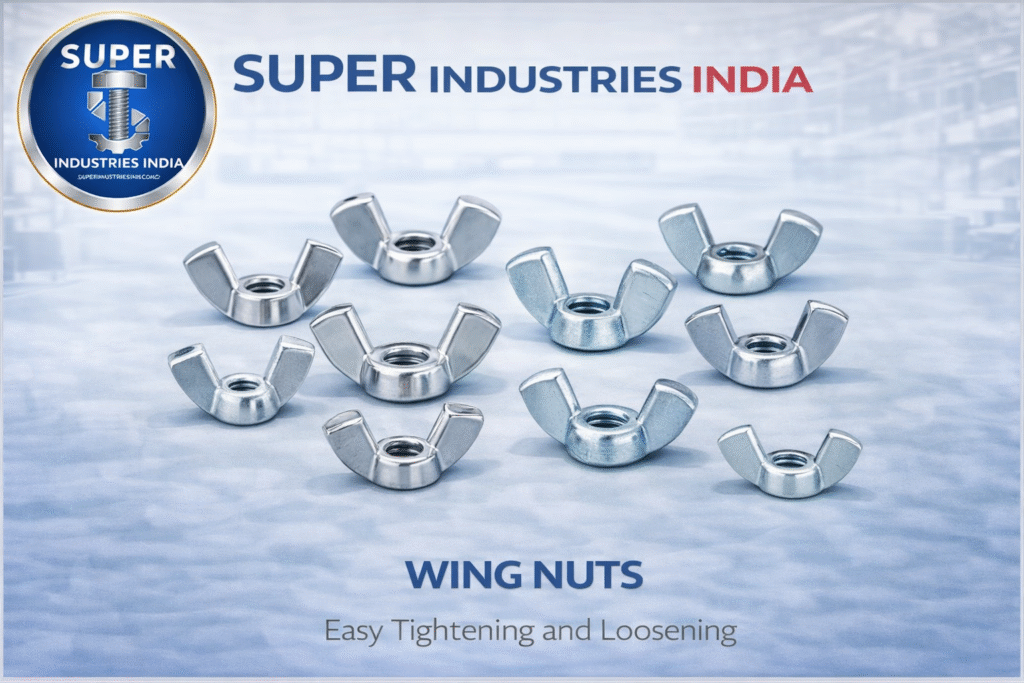
Why Choose Super Industries India for Your Wing Nuts?
As a premier Wing Nut Manufacturer in India, Super Industries India combines decades of experience with advanced manufacturing technology to produce fasteners that meet stringent international quality standards like DIN 316 and ASME B18.17. When you choose us, you get:
- Superior Quality and Precision: Our wing nuts are engineered for dimensional accuracy, ensuring a perfect fit and reliable performance in critical applications.
- Vast Material & Finish Options: We offer a comprehensive selection, including extremely popular Stainless Steel Wing Nuts (SS 304, SS 316) for marine and corrosive environments, as well as Carbon Steel (Zinc Plated, Nickel Plated) and Brass Wing Nuts.
- Customization: Need a non-standard size, thread type, or material? We excel at handling custom orders to meet your specialized project requirements.
- Reliable Pan-India Supply & Export: Whether you’re in Mumbai, Delhi, Chennai, Bangalore, or anywhere globally, our robust logistics network ensures timely delivery of bulk and standard orders.
Understanding the Types and Specifications of Wing Nuts
Wing nuts are classified based on their manufacturing process and design, making them suitable for different levels of strength and appearance.
Key Wing Nut Types & Styles
| Wing Nut Type | Manufacturing Process | Key Characteristics | Typical Standard |
| Cold Forged (Type A / American Style) | Cold-formed/Cold-headed | Smoother finish, better mechanical properties, rounded wings. Ideal for general use. | ASME B18.17 Type A |
| Hot Forged (Type B / German Style) | Hot Forged | More robust, thicker wings, high strength. Suitable for heavy-duty applications. | DIN 316 German Type |
| Stamped (Type C) | Stamped Sheet Metal | Economical, lighter duty, flatter, and sharper wings. Best for low-stress environments. | ASME B18.17 Type C |
| Die Cast (Type D) | Die Cast | Precise dimensions, good aesthetics, often in zinc alloy. Used where appearance matters. | ASME B18.17 Type D |
Standard Specifications & Material Grades
We manufacture to various international standards and offer materials to match every environment:
- Standards: DIN 316, ASME B18.17, IS 4190.
- Materials: Stainless Steel (SS 304, SS 316, SS 316L), Carbon Steel (Low & High Tensile), Brass, Alloy Steel, and more.
- Finishes: Plain, Zinc Plated (Yellow, Blue, White), Hot Dip Galvanized (HDG), Nickel Plated, Chrome Plated.
- Size Range: Metric sizes from M3 to M20 and above; Imperial sizes from #4 to 3/4″ and larger.
Applications: Where Quick Fastening is Essential
The core benefit of a wing nut—tool-free operation—makes it the preferred fastener in applications requiring frequent access, adjustment, or quick breakdown.
| Industry/Application | Wing Nut Function | Recommended Material |
| Construction & Scaffolding | Securing formwork, tie-rods, and temporary structures. | Hot Forged Carbon Steel (often HDG) |
| Machinery & Equipment | Securing machine guards, access panels, or covers for easy maintenance. | Carbon Steel, Stainless Steel (for corrosion resistance) |
| Woodworking & Furniture | Quick assembly and disassembly of flat-pack or modular items. | Zinc Plated Carbon Steel, Brass |
| Marine & Nautical | Securing components on boats and ships exposed to saltwater. | Stainless Steel (SS 316) – best corrosion resistance |
| Electronics & Instrumentation | Securing delicate components or enclosures. | Plastic/Nylon (for non-conductivity and weight) |
| DIY & Home Use | Fastening parts on display stands, lighting rigs, or household repairs. | Cold Forged, Stamped |
Choosing the correct type and material of wing nut is crucial for ensuring the safety and longevity of your application. The corrosive resistance of a SS 304 Wing Nut is perfect for food processing, while the strength of a hot-forged carbon steel nut is vital for heavy-duty construction.
The Stainless Steel Advantage: SS 304 & SS 316 Wing Nuts
For environments prone to moisture, chemicals, or extreme temperatures, Stainless Steel Wing Nuts are the superior choice.
- SS 304 Wing Nuts: Excellent general corrosion resistance and strength. Ideal for outdoor applications, kitchen equipment, and general industrial use.
- SS 316 Wing Nuts: Contains Molybdenum, offering vastly improved resistance to chlorides, making it the industry standard for marine, coastal, and chemical processing environments.
Get Your Quote from the Wing Nut Experts
Whether you need a bulk supply of standard DIN 316 Wing Nuts for a construction project or a customized batch of Stainless Steel Wing Nuts for a specialized machine, Super Industries India is equipped to deliver.
Contact Super Industries India today to discuss your specific requirements, get competitive pricing, and ensure your project is secured with the highest quality, tool-free fasteners available in the Indian market.