
TAP END STUD BOLTS
EPC / CAPITAL PROJECT / EXPORT-GRADE TECHNICAL REFERENCE
Manufacturer & Global Exporter: Super Industries
Website: https://superindustriesindia.in
1. Industry Context
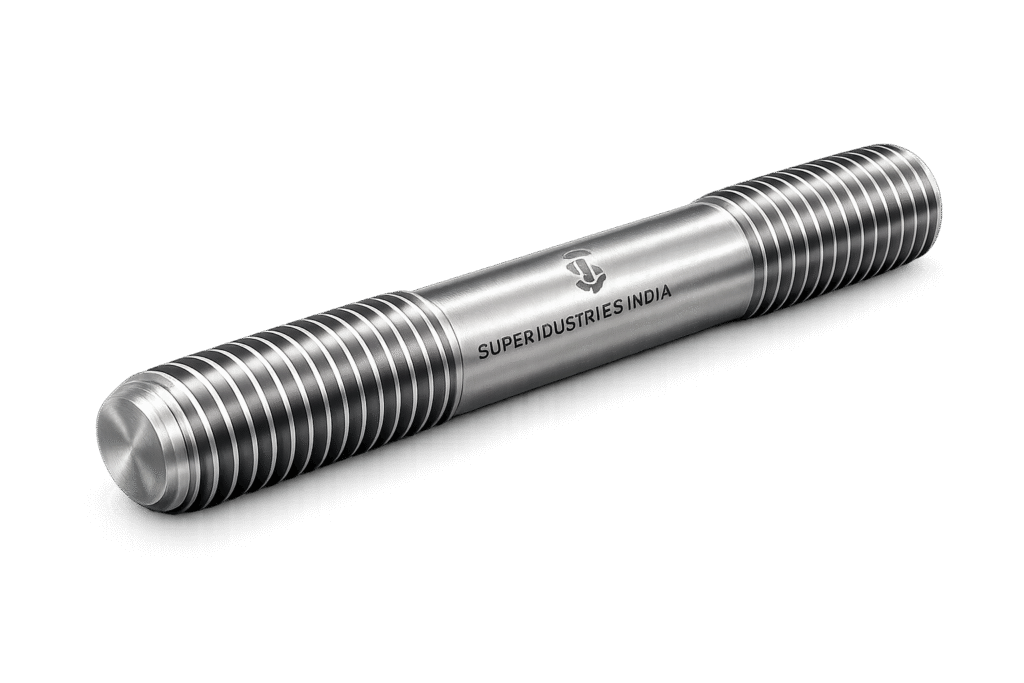
Why Tap End Stud Bolts Are Critical Where Through-Bolting Is Not Possible
In EPC and capital projects, many mechanical and piping connections are executed into blind or threaded holes where access from both sides of the joint is not available. In such cases, Tap End Stud Bolts are the engineered solution. They allow a controlled, high-integrity threaded connection into a parent material while maintaining a removable, serviceable nut interface on the exposed side.
Tap end stud bolts are routinely specified in:
- Pressure equipment and machinery casings
- Pumps, compressors, and rotating equipment
- Skid-mounted systems with restricted access
- Offshore and modular installations where space and access are limited
Their selection is not interchangeable with full-threaded rods or double-end studs; it is dictated by joint geometry, load path, and maintenance philosophy.
2. Technical Definition
What Are Tap End Stud Bolts?
Tap End Stud Bolts are studs with unequal thread lengths:
- Short thread (tap end): Installed permanently or semi-permanently into a tapped hole in a base material
- Long thread (nut end): Receives a nut and washer to clamp the joint
Unlike:
- Stud Full Threaded Rods – which allow adjustment anywhere along the length
- Double Ended (Body) Studs – which rely on symmetric nut engagement
Tap end studs are engineered to anchor into a parent component, creating a repeatable, aligned fastening point.
3. Functional Role in Mechanical Assemblies
Load Transfer
Axial tensile loads are transferred from the nut end through the stud into the tapped hole. Correct thread engagement length at the tap end is critical to avoid pull-out or thread stripping.
Thread Engagement & Pull-Out Resistance
The tapped hole thread must:
- Match the stud thread class
- Provide sufficient engagement length based on material strength
- Be free from damage, galling, or contamination
Alignment Control
Once installed, the stud establishes a fixed reference axis, improving alignment during repeated assembly and disassembly.
Maintenance Advantage
Studs protect the parent material threads from repeated wear, making them preferred over direct bolting in high-maintenance equipment.
4. Engineering Relevance of Weight
The weight of a tap end stud bolt influences:
- Local structural load transfer into equipment housings
- Handling and installation ergonomics, especially in confined spaces
- Dynamic response in vibrating equipment
In rotating or vibrating systems, unnecessary mass can affect fatigue behavior, while insufficient mass may reduce stiffness. Weight is therefore evaluated during equipment and skid design.
5. Weight Determination Logic
Tap end stud weight is a function of:
- Nominal diameter
- Overall length
- Ratio of long thread to short thread
- Material density
- Manufacturing tolerance
- Coating or galvanizing allowance
Because thread lengths are unequal, tap end stud weights differ from full threaded rods of the same length, and must be calculated accordingly.
6. Tap End Stud Bolt Design Characteristics
Long Thread (Nut End)
- Accommodates washer and nut
- Allows controlled preload application
- Designed for repeated assembly
Short Thread (Tap End)
- Optimized for pull-out resistance
- Typically installed finger-tight plus controlled torque (as specified)
- Often installed using double-nut or drive-slot methods
Thread Engagement Rules
General engineering practice (subject to code and material):
- Steel base material: ≥ 1.0 × nominal diameter
- Cast iron / softer alloys: ≥ 1.5 × nominal diameter
7. Material & Standard Alignment
Common Governing Standards
- ASTM A193 – alloy steel, high-temperature service
- ASTM A320 – low-temperature service
- ASTM A307 – general structural applications
- DIN / ISO equivalents for metric projects
Nut Compatibility
Typically paired with ASTM A194 nuts to maintain strength compatibility and traceability.
Material selection is driven by:
- Operating temperature
- Pressure class
- Corrosion environment
- Applicable code (ASME, API, project specification)
8. Manufacturing & Quality Discipline
Manufacturing Process
- Controlled bar selection
- Precision thread rolling (preferred) or cutting
- Heat treatment per standard
- Chamfering and end finishing
- Straightness and concentricity control
Quality Controls
- Thread gauges for both ends
- Dimensional verification of thread lengths
- Mechanical property testing
- Heat number traceability
- Surface and coating inspection
Tap end studs are not commodity fasteners; dimensional discipline is essential to ensure correct engagement.
9. Procurement, Installation & Inspection View
EPC Procurement Verification
- Correct stud type (tap end vs body vs full thread)
- Material grade and standard
- Defined thread lengths
- Matching nuts and washers
- Complete MTCs
Installation Considerations
- Clean, inspected tapped holes
- Proper lubrication or anti-seize where specified
- Controlled installation torque for tap end
- Verified nut engagement on exposed end
Inspection Focus
- Thread integrity on both ends
- Surface finish and damage
- Markings and heat numbers
10. Application Mapping
Tap End Stud Bolts are widely used in:
- Oil & Gas: pumps, valves, pressure housings
- Power: turbines, auxiliary equipment
- Petrochemical & LNG: skid-mounted packages
- Hydrogen: compressors and support equipment
- Offshore & Infrastructure: compact, high-reliability joints
They are preferred wherever blind-hole fastening with repeatable accuracy is required.
11. Professional Technical Tables
Typical Diameter & Length Range
| Parameter | Range |
|---|---|
| Diameter | M8 – M100 / ⅜” – 4″ |
| Overall Length | Project-specific |
| Thread | Metric / UNC / UNF |
Tap End Stud Bolts – Weight Logic (Indicative)
| Variable | Influence |
|---|---|
| Diameter | Primary |
| Length | Linear |
| Thread Ratio | Moderate |
| Material | High |
| Coating | Minor |
(Exact weight charts are generated per project specification and approved drawings.)
Material Grades vs Service Conditions
| Material Grade | Typical Use |
|---|---|
| ASTM A307 | Structural / non-pressure |
| ASTM A193 B7 | High-strength, elevated temperature |
| ASTM A320 | Low-temperature service |
| Stainless Steel | Corrosive environments |
Customization Capabilities
- Non-standard thread length ratios
- Special thread classes or fits
- Coatings: HDG, PTFE, project-specific systems
- Special identification and packaging
12. Manufacturer-Focused Conclusion
Tap End Stud Bolts are a critical fastening solution in EPC and capital projects where threaded base materials, restricted access, and repeatable assembly are required. Their reliability depends on correct design, precise manufacturing, and disciplined inspection.
Super Industries manufactures tap end stud bolts with:
- Accurate thread geometry and defined engagement lengths
- Material compliance aligned to EPC specifications
- Controlled manufacturing and full traceability
- Inspection standards acceptable to EPCs and third-party inspectors
This results in stud bolting that is technically safe, mechanically predictable, and EPC-ready.
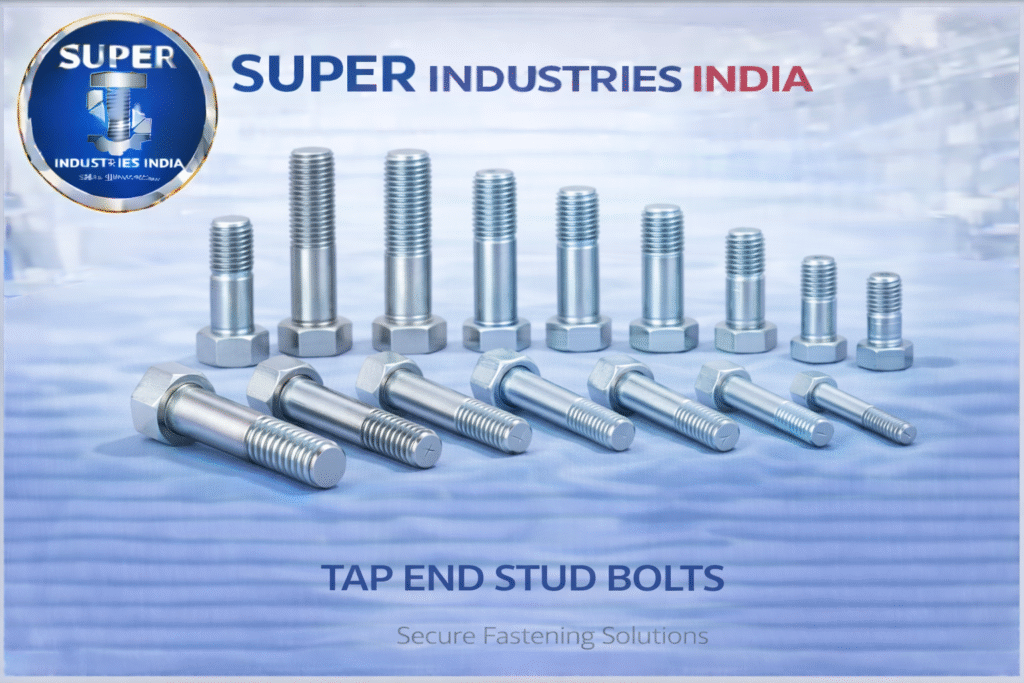
Precision Engineered Tap End Stud Bolts Manufacturer in India | Super Industries
Welcome to Super Industries India, your trusted source for high-quality Tap End Stud Bolts manufactured to stringent international standards, including ASTM, ASME, DIN, and ISO. Engineered for critical applications in the Oil & Gas, Petrochemical, Power Generation, and Heavy Machinery sectors, our tap end studs provide the robust, reliable fastening solutions your projects demand.
What is a Tap End Stud Bolt?
The Tap End Stud Bolt is a specialized, headless fastener designed for connections where one side features a blind tapped hole (a hole that does not pass completely through the component) and the other side requires a standard nut.
Its defining characteristic is its asymmetrical threading:
- Tap End (Short Thread): This end features a shorter thread length, typically conforming to a tighter fit (like Class 5 Interference Fit or UN-3A), specifically designed to be permanently or semi-permanently screwed into the tapped hole of the mating component (e.g., an engine block, valve body, or pump casing).
- Nut End (Long Thread): The opposite end features a longer, standard thread length (like Class UN-2A), allowing for easy installation and tightening of a standard Hex Nut or Heavy Hex Nut and a sufficient amount of thread projection.
This design is crucial for applications that require a robust connection that can be disassembled for maintenance without disturbing the embedded half of the fastener.
Why Choose Super Industries for Tap End Studs?
As a leading Tap End Stud Bolt manufacturer in India, we are committed to precision, quality, and timely delivery. Our facilities utilize advanced Cold and Hot Forging techniques to ensure superior material grain structure and mechanical properties in every piece.
- Industry Compliance: We supply tap end studs fully certified to global standards like ASTM A193 (B7, B16, B8) and ASTM A320 (L7, L43).
- Customization is Our Strength: Need a non-standard length, specific material, or specialized thread profile (UNC, UNF, 8UN, Metric)? Our in-house design and machining capabilities allow us to produce custom Tap End Studs perfectly tailored to your project blueprints.
- Quality & Testing: Every batch undergoes rigorous quality assurance, including Tensile Strength, Hardness, and Proof Load testing, with complete Material Test Certificates (MTC) provided as per EN 10204 3.1 or 3.2.
Applications of Tap End Stud Bolts
The tap end stud is indispensable in applications where through-holes are impractical or impossible, providing a clean, strong, and highly stable connection.
| Industry Sector | Typical Application | Key Benefit of Using Tap End Studs |
| Oil & Gas / Petrochemical | Pump and Compressor Casings, Valve Bodies, Flange Joints | High-pressure integrity; allows for maintenance without drilling out the fastener. |
| Power Generation | Turbine Housings, Engine Blocks, Heat Exchangers | Excellent alignment, superior vibration resistance in high-stress thermal cycling environments. |
| Heavy Machinery | Die Sets, Large Equipment Mounting, Press Frames | Strong, fixed mounting point that simplifies assembly and disassembly of large components. |
| Automotive & Aerospace | Engine Manifolds, Cylinder Heads | Provides reliable, precise clamping force into a tapped material, which is necessary for sealing. |
Available Materials, Grades, and Coatings
Choosing the correct material and finish is critical for the longevity and safety of your bolted joint. Super Industries offers Tap End Stud Bolts in an extensive range of materials to withstand extreme temperatures, pressure, and corrosive environments.
Most Common Material Grades
| Material Type | ASTM/SAE Grade | Application Highlights |
| Alloy Steel | ASTM A193 Grade B7 | High-temperature and high-pressure service (most common flange bolting). |
| Low-Temp Alloy Steel | ASTM A320 Grade L7 | Service down to −150∘F for cryogenic and low-temperature applications. |
| Stainless Steel | ASTM A193 Grade B8 (304), B8M (316) | Excellent general and marine corrosion resistance. |
| High-Temp Alloy | ASTM A193 Grade B16 | Service at temperatures up to 1100∘F (593∘C) in extreme heat applications. |
| Carbon Steel | Grade 8.8, 10.9 (Metric) | General structural, high-strength bolting. |
Industrial Surface Finishes and Coatings
To protect your fasteners against corrosion and environmental factors, we offer various specialized coatings:
- Hot Dip Galvanized (HDG): Thick zinc coating for excellent protection in outdoor and marine environments.
- PTFE (Teflon) Coating: Offers exceptional chemical and corrosion resistance, reduces friction, and allows for easier breakout and re-torquing.
- Zinc Plated (Electroplated): Standard, cost-effective protection for indoor or mild environments.
- Cadmium Plated: Provides high performance in salt atmospheres (often used in defense/aerospace).
- Black Phosphate: Mild corrosion resistance with a low-friction surface.
Technical Specifications and Manufacturing Standards
Our manufacturing process strictly adheres to the dimensional and material requirements of global standards, ensuring interoperability and guaranteed performance.
Key Dimensions & Standards
| Specification Aspect | Common Standards / Codes | Details |
| Dimensional | ASME B18.31.2, DIN 938, DIN 939 | Defines unequal thread lengths and overall stud length (L). |
| Thread Profiles | ASME B1.1 (UNC, UNF, 8UN) | Unified National Coarse (UNC), Fine (UNF), or 8-Thread Series for large diameters. |
| Material | ASTM A193/A320 | Grades dictate the mechanical properties (tensile strength, yield strength) and temperature limits. |
| Fit Class | Tap End: Class 5 (Interference Fit) or Class 3A; Nut End: Class 2A | Ensures tight engagement on the tap end and smooth rotation on the nut end. |
How Tap End Studs are Measured
The overall length (L) of a Tap End Stud is measured from the extreme tip of one end to the extreme tip of the other end, encompassing the tap end thread, the unthreaded shank (if present), and the nut end thread.
Get a Quote from India’s Premier Fastener Manufacturer
Whether you require a standard ASTM A193 B7 Tap End Stud Bolt or a highly specialized item in exotic alloy, Super Industries is ready to meet your needs with competitive pricing and certified quality.
Contact Super Industries India today for your bulk or custom requirements. Our team of fastener experts is here to assist you with specifications, material selection, and project logistics across India and globally.
Tags: Tap End Stud Bolts, Tap End Stud Bolt Manufacturer India, ASTM A193 B7 Tap End Stud, DIN 939 Stud, Flange Stud Bolts, Stud Bolt Supplier India, High Tensile Tap End Stud, Stainless Steel Tap End Stud, PTFE Coated Stud Bolt.