
EYE BOLTS
Table of Contents
Engineered Lifting Points for Safe Load Transfer in EPC Projects
Manufacturer & Global Exporter: Super Industries
Website: https://superindustriesindia.in
1️⃣ Industry Context
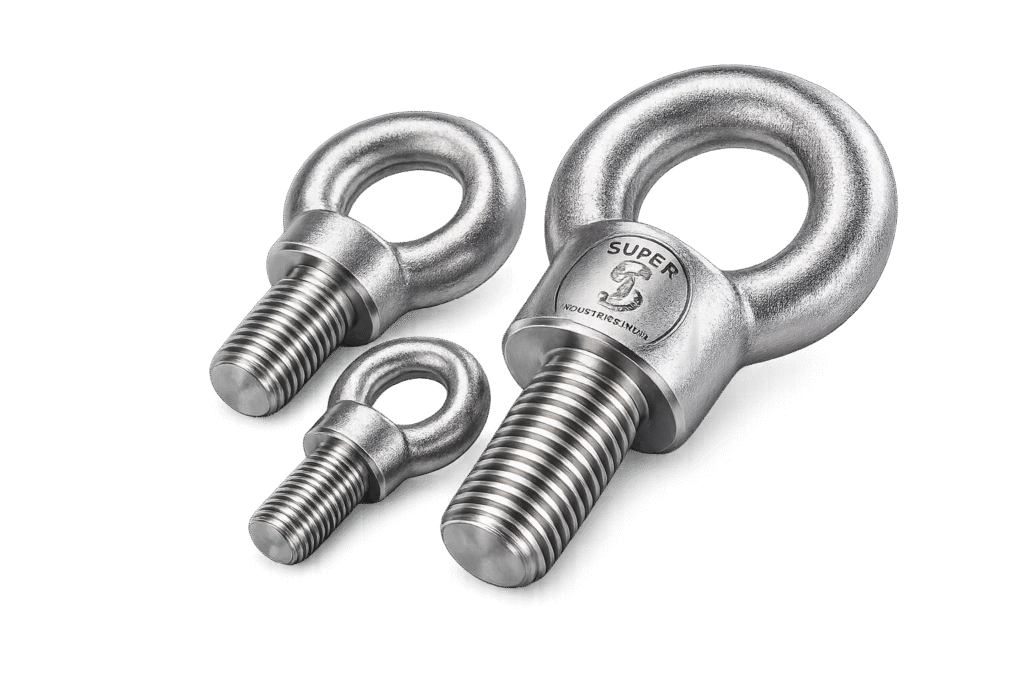
Why Eye Bolts Are Critical Temporary and Permanent Lifting Points in EPC Projects
In EPC, capital construction, shutdown, and maintenance environments, lifting operations are safety-critical activities governed by formal lifting plans, rigging calculations, and third-party approvals. Eye bolts serve as engineered load attachment points that allow forces to be transferred from a component or structure into a rigging system consisting of slings, shackles, and hoisting equipment.
Unlike general fasteners, eye bolts are not designed primarily for joint clamping. They are load-path components, selected and installed specifically to:
- Provide controlled and predictable lifting geometry
- Transfer tensile forces safely into parent material
- Maintain structural integrity during lifting, positioning, and lowering
- Enable repeatable lifting during fabrication, transport, installation, and maintenance
In Oil & Gas modules, power equipment, petrochemical skids, and heavy industrial machinery, the incorrect selection or misuse of eye bolts is a known cause of lifting incidents. As a result, EPC contractors and consultants treat eye bolts as regulated lifting hardware, not generic fasteners.
2️⃣ Technical Definition
What Eye Bolts Are and How They Function as Threaded Lifting Devices
Eye bolts are threaded lifting devices consisting of:
- A forged eye designed to accept hooks, shackles, or slings
- A threaded shank that transfers load into the parent material
- In certain designs, a shoulder that distributes bending stresses
The functional purpose of an eye bolt is to act as an interface between the load and the rigging system, converting lifting forces into tensile stresses within the bolt and bearing stresses within the connected structure.
From an engineering standpoint, eye bolts are designed for tension-dominated loading, not shear or combined structural loading typical of standard bolts.
3️⃣ Functional Engineering Role
Load Transfer from Structure to Rigging System
During a lift, forces are transferred through the following path:
- Load → Eye (ring section)
- Eye → Shank (tension)
- Shank → Thread engagement
- Thread → Parent material (bearing and tensile stresses)
Each interface must be capable of resisting the applied forces with adequate safety margin. Engineering selection therefore focuses on:
- Shank tensile capacity
- Thread engagement length
- Material yield and ductility
- Compatibility with lifting angle and rigging geometry
Failure at any interface compromises the entire lifting system.
4️⃣ Straight Pull vs Angular Loading
Load Reduction Factors and Side-Load Risks
Eye bolts are rated primarily for axial (straight-line) loading, where the applied force is aligned with the bolt axis. In practice, many lifts involve angular loading, which introduces bending stresses at the eye and shank junction.
Key engineering principles include:
- Straight pull (0°): Full rated Safe Working Load (SWL)
- Angular pull (≤45°): Reduced allowable load (typically 30–50% of axial rating)
- Side loading (>45°): Not permitted unless specifically designed and rated
Angular loading creates a bending moment that standard non-shouldered eye bolts cannot safely resist. EPC lifting procedures therefore strictly control allowable angles and mandate the correct eye bolt design.
5️⃣ Shoulder vs Non-Shoulder Eye Bolts
Why Shoulder Design Is Mandatory for Angular Lifts
The shoulder eye bolt incorporates a machined or forged shoulder that:
- Seats flush against the mounting surface
- Distributes bending stresses into the parent material
- Prevents localized stress concentration at the first thread
From a lifting-engineering perspective:
- Non-shoulder eye bolts are permitted only for straight axial lifts
- Shoulder eye bolts are mandatory for any angular or multi-leg sling configuration
Failure to use a shoulder eye bolt in angular loading is a common non-conformance raised during EPC lifting audits and third-party inspections.
6️⃣ Safe Working Load (SWL) Logic
Axial Ratings, Angular Derating, and Safety Factors
Safe Working Load (SWL) is derived from:
- Minimum ultimate tensile strength of the material
- Geometry of the eye and shank
- Thread engagement efficiency
- Applicable safety factor (typically 4:1 or higher for lifting hardware)
For shoulder eye bolts, SWL values are published for:
- Axial loading (0°)
- Angular loading (typically 30° and 45°)
Engineering practice requires that:
- The lowest applicable SWL governs the lift
- Dynamic effects, shock loading, and sling angles are considered
- Eye bolts are never loaded beyond published ratings
7️⃣ Types of Eye Bolts
Engineering Distinction Between Designs
Plain Eye Bolts
- Non-shouldered
- Straight pull only
- Limited to controlled, vertical lifts
Shoulder Eye Bolts
- Reinforced shoulder
- Suitable for angular loading within limits
- Standard choice for EPC lifting
Machinery Eye Bolts
- Integrated into equipment design
- Often permanent lifting points
Lifting Eye Bolts (Hoisting-Rated)
- Manufactured and tested specifically for lifting
- Marked with SWL and standard reference
Selection depends on load magnitude, lifting geometry, and reusability requirements.
8️⃣ Material & Mechanical Properties
Yield Strength and Ductility Relevance
Eye bolts are typically manufactured from:
- Carbon steel: General lifting applications
- Alloy steel: Higher SWL and fatigue resistance
- Stainless steel: Corrosion resistance with lower mechanical capacity
Critical material properties include:
- Yield strength (controls elastic behavior under load)
- Tensile strength (ultimate capacity)
- Ductility (resistance to brittle fracture during dynamic lifting)
Material selection is governed by lifting standards rather than general bolting practice.
9️⃣ Standards & Compliance Alignment
ASME, DIN, and ISO in EPC Lifting Practice
Eye bolts used in EPC projects are aligned with internationally recognized standards, including:
- ASME lifting hardware standards
- DIN 580 for eye bolts
- ISO references for lifting points and proof loading
Compliance ensures:
- Published SWL values
- Defined geometry and tolerances
- Acceptance by consultants, inspectors, and lifting authorities
Non-standard or unmarked eye bolts are typically rejected during EPC audits.
🔟 Manufacturing & Quality Discipline
From Forging to Proof Load Testing
Lifting-rated eye bolts require stringent manufacturing control:
- Closed-die forging of the eye to maintain grain flow
- Heat treatment to achieve required strength and toughness
- Thread rolling for fatigue resistance
- Proof load testing to verify performance
- Batch traceability and material certification
Surface defects, poor grain flow, or incorrect heat treatment directly compromise lifting safety.
1️⃣1️⃣ Installation & Usage Rules
Thread Engagement, Seating, and Orientation
Correct installation is as critical as correct selection:
- Full thread engagement in parent material is mandatory
- Shoulder must seat flush against the mounting surface
- Eye orientation must align with the direction of lift
- Packing washers or spacers under shoulders are not permitted
Eye bolts must be inspected before every lift for deformation, cracking, or thread damage.
1️⃣2️⃣ EPC Procurement & Inspection Perspective
What Engineers and Inspectors Verify
EPC and third-party inspectors typically verify:
- Standard compliance markings
- SWL identification
- Material test certificates (MTCs)
- Proof load test records
- Dimensional conformity
Eye bolts without traceable documentation are generally disallowed in critical lifts.
1️⃣3️⃣ Application Mapping
Typical EPC and Industrial Uses
- Oil & Gas modules and skids
- Power equipment and generators
- Petrochemical vessels and exchangers
- Maintenance and shutdown lifting points
In each case, eye bolts function as controlled, engineered lifting interfaces, not convenience attachments.
1️⃣4️⃣ Professional Technical Tables
Thread Sizes & Engagement (Indicative)
| Thread Size | Minimum Engagement |
|---|---|
| M8–M12 | ≥1.0 × diameter |
| M16–M24 | ≥1.5 × diameter |
| M30+ | Project-specific |
Safe Working Load (Indicative – Shoulder Eye Bolts)
| Size | Axial SWL | 45° Angular SWL |
|---|---|---|
| M12 | Refer standard | ~50% axial |
| M20 | Refer standard | ~50% axial |
| M30 | Refer standard | ~50% axial |
(Actual values governed by applicable standard and material grade)
Material vs Application
| Material | Typical Use |
|---|---|
| Carbon steel | General EPC lifting |
| Alloy steel | High-capacity lifts |
| Stainless steel | Corrosive environments |
Surface Finish Options
| Finish | Environment |
|---|---|
| Plain / black | Controlled indoor |
| Zinc plated | General industrial |
| Stainless | Corrosive / hygienic |
Customization Options
- Non-standard thread lengths
- Special materials
- Project-specific markings
- Export documentation and tagging
1️⃣5️⃣ Manufacturer-Focused Conclusion
Eye Bolts are safety-critical lifting components whose performance depends on engineering geometry, material integrity, and disciplined manufacturing. In EPC environments, they are evaluated not as fasteners but as load-bearing lifting hardware subject to strict standards and inspection regimes.
Super Industries manufactures eye bolts with:
- Controlled forging and heat treatment
- Standard-aligned geometry and markings
- Traceable documentation suitable for EPC approval
This ensures suitability for lifting applications where safety, predictability, and compliance are non-negotiable.
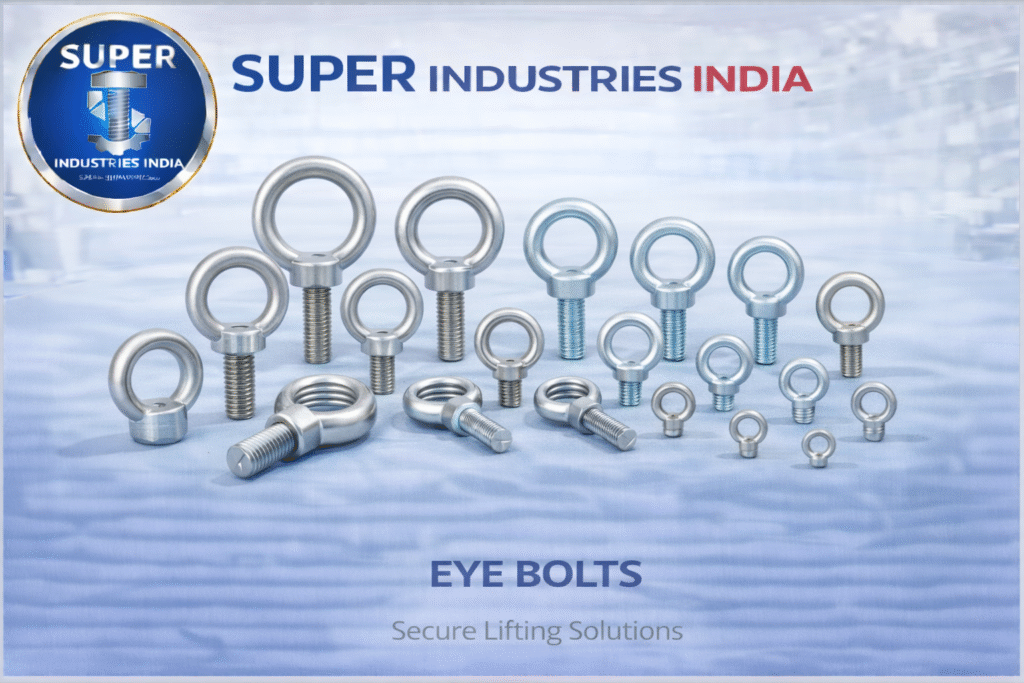
Lifting Made Secure: Leading Manufacturer of High-Strength Eye Bolts in India
Welcome to Super Industries India, your expert manufacturer and supplier of industrial Eye Bolts in India. In manufacturing, rigging, and construction, the secure handling and lifting of heavy loads are paramount. Eye bolts are the essential fasteners that provide a strong, dedicated, and certified connection point for lifting hooks, wire ropes, and chains.
We specialize in producing a complete range of eye bolts—from standard commercial types to high-capacity, load-rated lifting eyes—all engineered for maximum safety and compliance with global standards.
The Essential Role and Types of Eye Bolts
An eye bolt is a threaded fastener with a loop (or “eye”) at one end. This loop is the attachment point for rigging gear, allowing for the safe transfer and positioning of heavy objects.
Key Types of Eye Bolts We Manufacture:
- Forged Lifting Eye Bolts (Shoulder Type):
- Design: These feature a shoulder (a flattened area) beneath the eye.
- Function: The shoulder seats flush against the mating surface, allowing the bolt to be used for angular lifting (up to a 45∘ angle) as well as straight-line (vertical) pulls. This is the preferred type for heavy-duty, load-rated lifting.
- Standards: Typically conform to ASME B18.15 or equivalent ISO/DIN standards.
- Unforged Eye Bolts (Plain/Non-Shoulder Type):
- Design: These lack the load-bearing shoulder. The eye often sits slightly above the mounting surface.
- Function: They are only suitable for vertical, in-line loads. Using them for angular lifting can bend the threads at the root, leading to catastrophic failure. They are primarily used for tie-downs or light-duty applications.
- Eye Nuts:
- Design: These are internally threaded nuts with an integral eye, used in conjunction with a standard threaded stud or bolt.
- Function: Ideal for temporary lifting points on machinery or parts, providing a secure, removable rigging connection.
Material Grades and Load Certification
Safety in lifting is non-negotiable. Our Eye Bolts are manufactured from specific materials and are rated to strict safety standards to ensure performance under load.
Critical Material Grades:
| Material Grade | Standard/Specification | Key Characteristics |
| High Tensile Carbon Steel | Generally Grade 2 or 5 Equivalent | Used for standard industrial and commercial applications. |
| Alloy Steel (Quenched & Tempered) | ASTM F1554 Grade 105 or better | Essential for high-load, structural, and heavy machinery lifting points. |
| Stainless Steel (SS 304 & SS 316) | A2/A4 Grade | Used in marine, offshore, food processing, and chemical environments for superior corrosion resistance. SS 316 Eye Bolts are vital for salt-water exposure. |
Importance of Load Rating (Working Load Limit – WLL)
Every Forged Eye Bolt we supply is rigorously tested and certified with a Working Load Limit (WLL).
- The WLL specifies the maximum safe load that can be applied to the bolt.
- We ensure all lifting eyes are manufactured with a Safety Factor (typically 5:1 or greater) over the WLL to guarantee safety against sudden shock loads or material fatigue.
- Crucial SEO Note: Customers searching for lifting solutions look for terms like “Load-Rated Eye Bolt Supplier” or “Certified Lifting Eye Bolt Manufacturer”.
Surface Finish and Corrosion Protection
Eye bolts are frequently exposed to outdoor and harsh industrial environments. We offer specialized finishes to maximize their longevity and reliability:
- Hot Dip Galvanized (HDG) Eye Bolts: The preferred finish for outdoor infrastructure, utility, and marine environments. The thick zinc coating provides excellent, long-term sacrificial corrosion protection (compliant with ASTM A153).
- Zinc Plated Eye Bolts: A cost-effective finish that provides moderate corrosion resistance for indoor or sheltered industrial use, maintaining a bright, clean appearance.
- Plain/Self-Colour: Used when the bolt will be protected by the surrounding structure or when a subsequent custom coating will be applied.
Key Applications Across different Industries
Our high-strength Eye Bolt supply is crucial for various high-stakes sectors:
- Construction & Cranes: Used on heavy rigging blocks, temporary lifting points on steel beams, and securing safety barriers.
- Power Transmission & Utility: Utilized in anchoring guy wires, suspending insulators, and securing equipment to utility poles and transmission towers.
- Industrial Machinery: Permanently installed on heavy machines, motors, and press tooling to facilitate safe movement and maintenance within the plant.
- Marine and Ports: Stainless Steel Eye Bolts are essential for securing lines, anchors, and safety equipment on docks and vessels due to the extreme corrosive nature of saltwater.
Why Choose Super Industries India for Eye Bolts?
When safety depends on the smallest connection point, you need the assurance of a quality-focused Eye Bolt Supplier in India.
- Forged for Strength: We prioritize forged eye bolts for all load-rated applications, ensuring superior grain structure and ultimate strength compared to cast or bent alternatives.
- Standard Compliance: Our products adhere strictly to dimensional and performance standards, including ASME B18.15, DIN 580 (Lifting Eye Bolts), and DIN 582 (Eye Nuts).
- WLL Certification: Every load-rated eye bolt is supplied with the necessary material and test certification, giving you verifiable proof of safety.
Choose Super Industries India for precision, compliance, and the strongest connection point for your lifting needs.
Contact us today for a comprehensive quote on Eye Bolts for your high-strength lifting requirements!