
Flange Bolts
- Flange Bolts
- Integrated-Washer Fasteners for EPC, Structural & Industrial Assemblies
- 1️⃣Industry Context
- 2️⃣ Technical Definition
- 3️⃣ Functional Engineering Role
- 4️⃣ Serrated vs Non-Serrated Flange Faces
- 5️⃣ Load Behavior
- 6️⃣ Dimensional Parameters
- 7️⃣ Types of Flange Bolts
- 8️⃣ Material & Mechanical Properties
- 9️⃣ Standards & Specification Alignment
- 🔟 Manufacturing & Quality Discipline
- 1️⃣1️⃣ Installation & Torque Control
- 1️⃣2️⃣ EPC Procurement & Inspection Perspective
- 1️⃣3️⃣ Application Mapping
- 1️⃣4️⃣ Professional Technical Tables
- Manufacturer-Focused Conclusion
- Unifying Connections: Your Trusted Flange Bolt Manufacturer in India
- The Power of the Flange: Why Choose Flange Bolts?
- Grades, Standards, and Materials for Critical Applications
- Surface Finish and Corrosion Protection
- Key Industrial Applications We Serve
- Your Reliable Flange Bolt Supplier in India
Integrated-Washer Fasteners for EPC, Structural & Industrial Assemblies
Manufacturer & Global Exporter: Super Industries
Website: https://superindustriesindia.in
1️⃣Industry Context
Why Flange Bolts Are Used in High-Volume, Vibration-Prone, and Assembly-Critical Joints
In modern EPC and capital-project execution, fastening systems are increasingly evaluated not only on strength but on assembly efficiency, joint stability, and long-term preload retention. Within this context, flange bolts have become a preferred solution in many non-pressure and structural applications where conventional bolt + washer combinations introduce variability, installation risk, or excessive part count.
Flange bolts are commonly specified in:
- High-volume repetitive assemblies
- Skid-mounted equipment and modular systems
- Structural and machinery joints exposed to vibration
- Assemblies where washer omission must be controlled by design
Their use is driven by engineering logic—not convenience—particularly where bearing area control, torque repeatability, and resistance to loosening are critical to EPC acceptance.
2️⃣ Technical Definition
What Flange Bolts Are — Integrated Washer Design and Bearing-Surface Logic
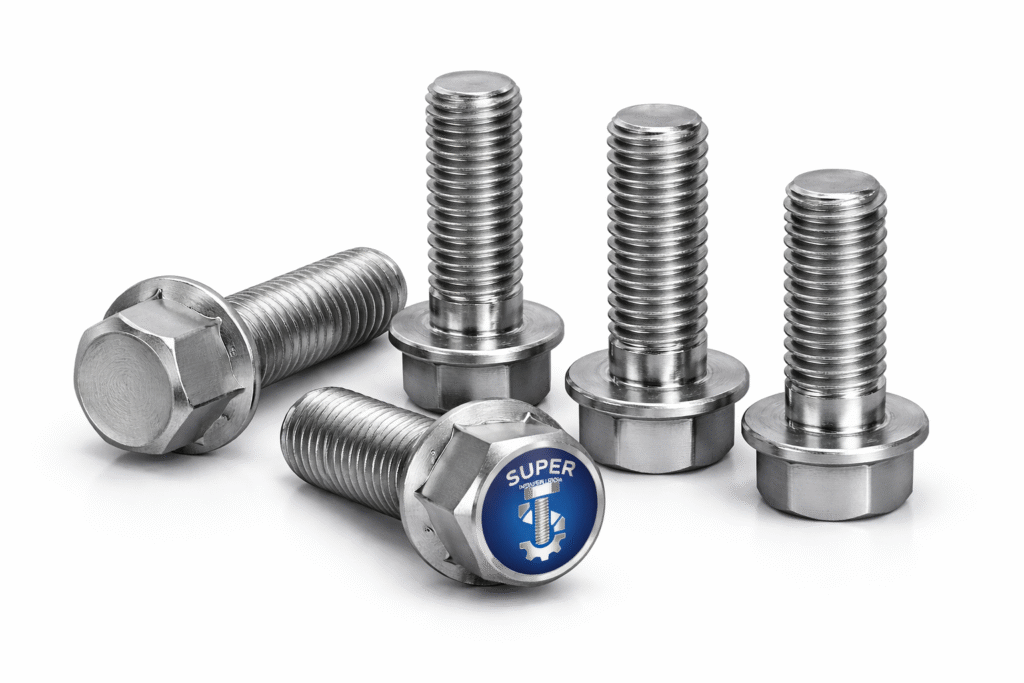
A flange bolt is a hex-head bolt with an integrally formed flange under the head that functions as a built-in washer. The flange may be smooth (plain) or serrated, depending on the intended joint behavior.
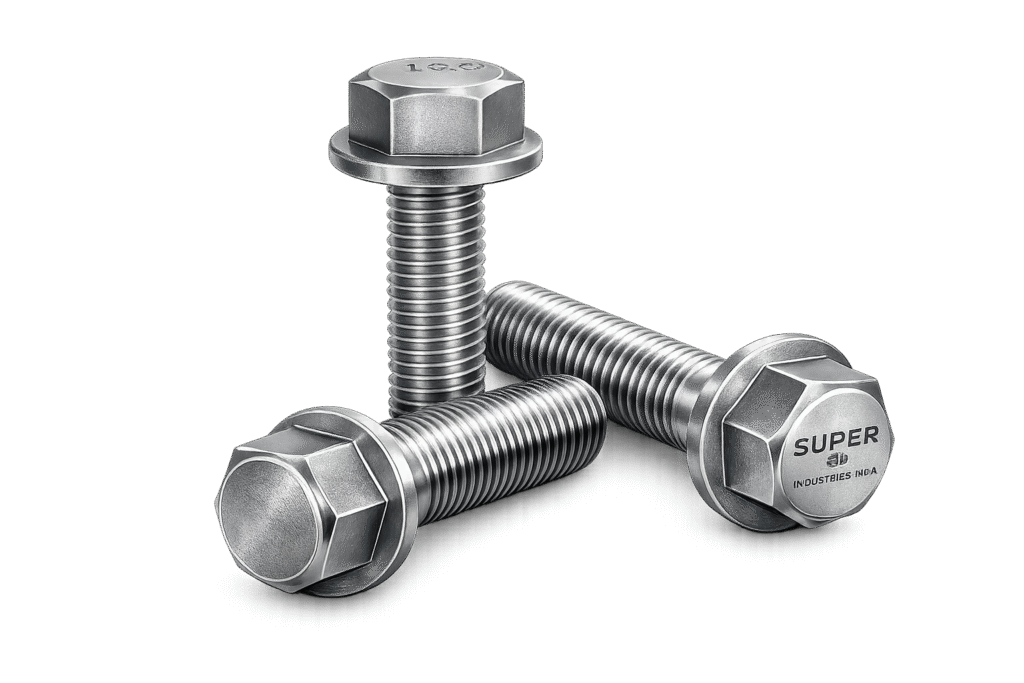
Key defining features include:
- Hexagonal head geometry
- Enlarged bearing surface beneath the head
- Integral flange eliminating the need for a separate washer
- Standard external thread form (metric or inch)
The flange is not decorative. It is a load-distributing interface engineered to reduce bearing pressure, stabilize clamp load, and improve joint consistency.
3️⃣ Functional Engineering Role
Clamp Load Distribution, Surface Pressure Control, and Joint Stability
From a joint-design standpoint, the flange bolt performs three primary functions:
- Distributes clamp load over a larger surface area
- Reduces localized bearing stress on the joint material
- Improves tightening consistency by eliminating washer variability
By integrating the washer into the bolt geometry, EPC engineers remove one uncontrolled variable from the assembly process—particularly important in projects involving large workforces, tight schedules, and repetitive installation tasks.
4️⃣ Serrated vs Non-Serrated Flange Faces
Anti-Rotation Behavior and EPC Acceptance Boundaries
Serrated Flange Bolts
- Feature radial or circumferential serrations under the flange
- Designed to bite into the mating surface
- Provide additional resistance to rotation and loosening
Engineering limitations:
- Serrations damage the mating surface
- Typically not permitted on:
- Painted surfaces
- Soft materials
- Stainless steel or coated assemblies
- Joints requiring reuse
Non-Serrated (Smooth) Flange Bolts
- Rely on friction and preload rather than surface penetration
- Preferred for:
- Structural steel
- Machined surfaces
- EPC applications requiring controlled disassembly
EPC specifications clearly differentiate where serrations are acceptable—and where they are explicitly prohibited.
5️⃣ Load Behavior
Tensile Loading, Shear Resistance, and Vibration Performance
Like all bolts, flange bolts are primarily tension-loaded fasteners. Their role is to generate sufficient preload so that service loads are transferred by friction between clamped parts.
Engineering considerations include:
- Tensile capacity: Governed by bolt diameter and material grade
- Shear behavior: Ideally resisted by friction, not by the bolt shank
- Vibration resistance: Enhanced by:
- Larger bearing surface
- Reduced embedment relaxation
- Serrated flange faces (where permitted)
Flange bolts do not replace structural bolts where slip-critical design or certified preloading methods are mandated unless explicitly approved.
6️⃣ Dimensional Parameters
Geometry That Governs Joint Performance
Critical flange-bolt dimensions include:
- Nominal bolt diameter
- Overall bolt length
- Thread pitch and thread length
- Flange diameter
- Flange thickness
- Bearing-face geometry (serrated or smooth)
Improper flange diameter selection can lead to:
- Excessive bearing pressure
- Inadequate load distribution
- Interference with adjacent components
Dimensional compliance is therefore a functional requirement, not a cosmetic one.
7️⃣ Types of Flange Bolts
Serrated Flange Bolts
Used where vibration resistance is required and surface damage is acceptable.
Non-Serrated Flange Bolts
Used where surface integrity, reusability, and controlled preload are critical.
Heavy Flange Bolts
Larger head and flange dimensions for higher load distribution.
Structural-Grade Flange Bolts
Manufactured to specific structural or automotive standards with controlled properties and markings.
Each type serves a distinct engineering purpose and is not interchangeable without technical review.
8️⃣ Material & Mechanical Properties
Strength Class Selection vs Service Environment
Material selection for flange bolts balances mechanical strength, corrosion resistance, and compatibility with joint materials.
Typical options include:
- Carbon steel: Widely used; requires coating
- Alloy steel: Higher tensile and yield strength for load-critical joints
- Stainless steel: Corrosion resistance with lower yield strength
EPC projects prioritize standardized grades with predictable behavior over unnecessary material upgrades.
9️⃣ Standards & Specification Alignment
ASTM, DIN, ISO — EPC and Export Compliance Logic
Flange bolts are governed by:
- Dimensional standards (head size, flange geometry)
- Mechanical property standards (yield, tensile strength)
- Marking and traceability requirements
Consultants and inspectors verify:
- Standard alignment
- Heat-number traceability
- Head markings
- Coating compliance
Non-standard flange geometry or undocumented serration profiles are common causes of rejection.
🔟 Manufacturing & Quality Discipline
Core Manufacturing Processes
- Forging of bolt head and flange
- Controlled flange forming (serrated or smooth)
- Heat treatment to specified strength class
- Thread rolling for fatigue resistance
- Surface treatment or coating
- Final inspection and marking
Quality Controls
- Dimensional inspection of flange geometry
- Mechanical testing
- Surface condition verification
- Certificate-to-marking correlation
Manufacturing discipline directly influences torque repeatability and joint reliability.
1️⃣1️⃣ Installation & Torque Control
Torque Scatter Reduction, Preload Consistency, and Reuse Limits
Flange bolts generally exhibit lower torque scatter compared to bolt + washer assemblies due to:
- Reduced interface variability
- Stable bearing surface geometry
Engineering cautions include:
- Serrated flange bolts should not be reused
- Lubrication state must match torque calculations
- Over-torque can embed serrations excessively
EPC specifications often limit reuse and mandate inspection after disassembly.
1️⃣2️⃣ EPC Procurement & Inspection Perspective
EPC engineers, inspectors, and consultants typically verify:
- Correct flange type (serrated vs smooth)
- Dimensional compliance
- Material grade and heat treatment
- Head markings and traceability
- Coating thickness and integrity
Flange bolts supplied without clear documentation and marking discipline are rarely approved.
1️⃣3️⃣ Application Mapping
Typical EPC-approved applications include:
- Oil & Gas skids and auxiliary structures
- Power-plant equipment frames
- Structural steel assemblies
- Machinery bases
- Infrastructure and industrial modules
Flange bolts are not pressure-retaining fasteners and must not be substituted for stud bolts or certified structural bolting systems without approval.
1️⃣4️⃣ Professional Technical Tables
Sizes & Length Ranges (Indicative)
| Diameter Range | Typical Use |
|---|---|
| M6–M12 | Light industrial |
| M16–M24 | EPC structural |
| ≥ M27 | Heavy assemblies |
Strength Grades & Standards
| Strength Class | Application |
|---|---|
| Medium strength | General assemblies |
| High strength | Structural joints |
Serrated vs Non-Serrated Usage
| Condition | Recommendation |
|---|---|
| Vibration, no coating | Serrated |
| Painted / coated | Non-serrated |
| Reusable joints | Non-serrated |
Coatings & Surface Treatments
| Coating | Purpose |
|---|---|
| Zinc-based | General corrosion |
| Heavy-duty coatings | Outdoor / marine |
Custom Manufacturing Options
- Project-specific lengths
- Controlled flange diameters
- Special coatings
- Traceability packages
Manufacturer-Focused Conclusion
Flange Bolts are not simply hex bolts with a wider head. They are engineered fastening systems designed to control bearing pressure, improve preload consistency, and reduce assembly variability in EPC environments. Their correct application—particularly the distinction between serrated and non-serrated designs—is essential to joint integrity and consultant approval.
Super Industries manufactures flange bolts with controlled forging, precise flange geometry, verified mechanical properties, and EPC-aligned traceability, supporting safe and repeatable performance in structural and industrial assemblies.
Unifying Connections: Your Trusted Flange Bolt Manufacturer in India
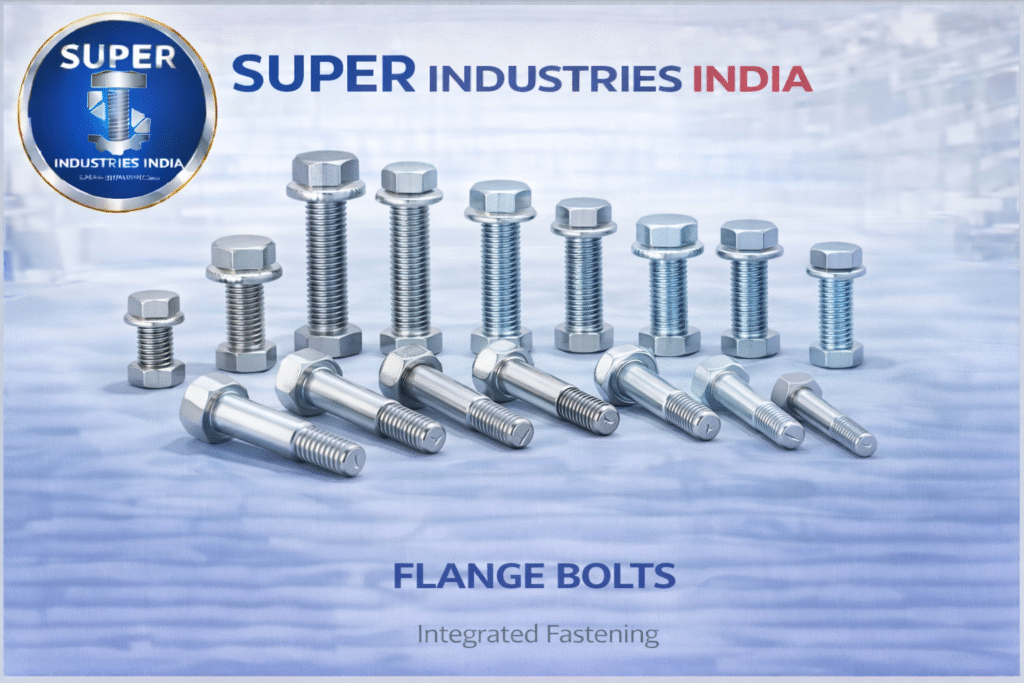
Welcome to Super Industries India, your leading manufacturer and supplier of high-performance Flange Bolts (Hex Flange Bolts) across India. In critical assemblies, particularly in the automotive, heavy machinery, and piping industries, a stable, secure, and evenly distributed clamping load is essential. Our Flange Bolts, featuring an integral washer-like flange, are engineered to provide maximum bearing surface, ensuring joint integrity and superior resistance to loosening from vibration.
A Flange Bolt is a specialized, one-piece fastener that replaces the need for a separate hex bolt and washer combination. This design not only streamlines assembly but significantly enhances the connection’s stability and load distribution.
The Power of the Flange: Why Choose Flange Bolts?
The integrated circular flange below the head is the key feature that sets this fastener apart, offering tangible benefits over a standard hex head bolt:
1. Superior Load Distribution
- Built-in Washer: The wide, unattached flange acts as a built-in washer, distributing the clamping force over a much larger area than the bolt head alone. This is vital when fastening into softer materials or when the bolt holes are oversized or irregular.
- Reduces Surface Damage: By spreading the load, the flange minimizes compressive stress on the bolted component (like a flange or chassis part), preventing damage, yielding, or indentation, which can compromise the joint’s preload.
2. Enhanced Joint Reliability and Vibration Resistance
- Serrated Flange Option: We supply Serrated Hex Flange Bolts where required. The serrations grip the mating surface, providing a mechanical locking feature that is highly effective at resisting loosening caused by external vibrations, making them a staple in automotive and truck chassis.
- Simplified Assembly: Eliminating the need to handle a separate washer saves significant time and reduces inventory complexity, simplifying Bill of Materials (BOM) and speeding up production lines.
Grades, Standards, and Materials for Critical Applications
As a prominent Flange Bolt Supplier in India, our products meet demanding dimensional and mechanical specifications required by high-stress industries.
Material Grades and Strength Classes
We manufacture Flange Bolts in the strength grades most demanded by the engineering and construction sectors:
| Property Class (Metric) | Imperial Grade | Applications & Strength | Compliance Standard |
| Class 8.8 | Grade 5 | Medium strength, general structural, and automotive chassis. | ISO 4162 / DIN 6921 |
| Class 10.9 | Grade 8 | High tensile strength, heavy machinery, engine components, and critical structural joints. | ISO 4162 / DIN 6921 |
| Class 12.9 | Superior Strength | Extremely high tensile strength for maximum stress applications. | ISO 4162 / DIN 6921 |
| Stainless Steel | A2 (304), A4 (316) | Excellent corrosion resistance for food, marine, and chemical environments. | ASTM A193/A320 (for piping) |
Key Dimensional Standards
Our manufacturing ensures strict compliance with the following international and metric standards:
- Metric: ISO 4162 and DIN 6921 for Hex Flange Bolts.
- Imperial: ASME B18.2.1 for Hex Flange Head Cap Screws.
- Piping: Flange bolt and stud bolt requirements for flanged piping connections are often dictated by ASME B16.5 and material grades like ASTM A193 B7 (stud bolts used with flange nuts).
Surface Finish and Corrosion Protection
The operating environment dictates the protective coating required for your Hex Flange Bolts:
- Zinc Plating (Yellow & Blue/White): Our most popular finish for general industrial, indoor, and automotive applications. It offers excellent moderate corrosion resistance and a clean, consistent appearance.
- Hot Dip Galvanized (HDG) Flange Bolts: Applied for outdoor, structural, and infrastructure projects where the fasteners are exposed to harsh weather and require superior, long-term protection (typically conforming to ASTM A153).
- Black Oxide / Black Phosphate: Provides a dark, oil-retaining finish for minor corrosion protection, often used internally on machinery and engine components.
Key Industrial Applications We Serve
Our Flange Bolt supply is crucial across high-volume and safety-critical Indian industries:
- Automotive Manufacturing: Widely used in engine blocks, transmission cases, axles, and truck frames due to their resistance to vibration and easy assembly.
- Heavy Machinery: Employed in the construction of agricultural equipment, earth-moving machinery, and industrial pumps where high clamping force is necessary.
- HVAC and Piping: Used to connect pipe flanges in low-to-medium pressure systems, ensuring a leak-proof seal with efficient installation.
- Renewable Energy: Used in securing mounting components for solar panel structures and wind turbine elements where large bearing surfaces are needed.
Your Reliable Flange Bolt Supplier in India
Choosing Super Industries India means partnering with a manufacturer that understands the nuances of critical fastening.
- Precision Engineering: We use advanced cold and hot forging processes to ensure the flange geometry is perfectly formed, maximizing bearing surface and eliminating sharp edges.
- Mass Production Capability: We maintain a large inventory and have the capacity for high-volume, continuous supply to large-scale manufacturers across the nation.
- Customization: We offer customized solutions for non-standard head sizes, specific serration patterns, and unique material requirements.
For flange bolts that deliver superior load distribution, rapid assembly, and unparalleled vibration resistance, trust the expertise of Super Industries India.
Request a Quick Quote today for high-tensile Flange Bolts for your production line!