
FLANGE NUTS
Table of Contents
Washer-Integrated Fastening Solutions for EPC and Industrial Assemblies
Manufacturer & Global Exporter: Super Industries
Website: https://superindustriesindia.in
1️⃣ Industry Context
Why Flange Nuts Are Used in EPC and Industrial Assemblies
In EPC and capital-project environments, bolted joints are designed to deliver controlled preload, stable load transfer, and predictable long-term behavior. Traditionally, this is achieved through a combination of bolts or studs, standard hex nuts, and separate washers. However, in many industrial assemblies—particularly skid-mounted equipment, auxiliary steelwork, and modular systems—this three-component approach introduces additional variables.
Flange nuts are used where EPC engineers seek to:
- Integrate the bearing function of a washer directly into the nut
- Reduce part count and assembly steps without compromising joint integrity
- Improve load distribution on softer or coated mating surfaces
- Minimize washer loss, misplacement, or incorrect installation
Their adoption is deliberate and application-specific. In EPC practice, flange nuts are not universal replacements for standard nuts and washers, but engineered alternatives used where load paths, surface conditions, and inspection logic permit washer elimination.
2️⃣ Technical Definition
What Flange Nuts Are and How the Integrated Flange Functions
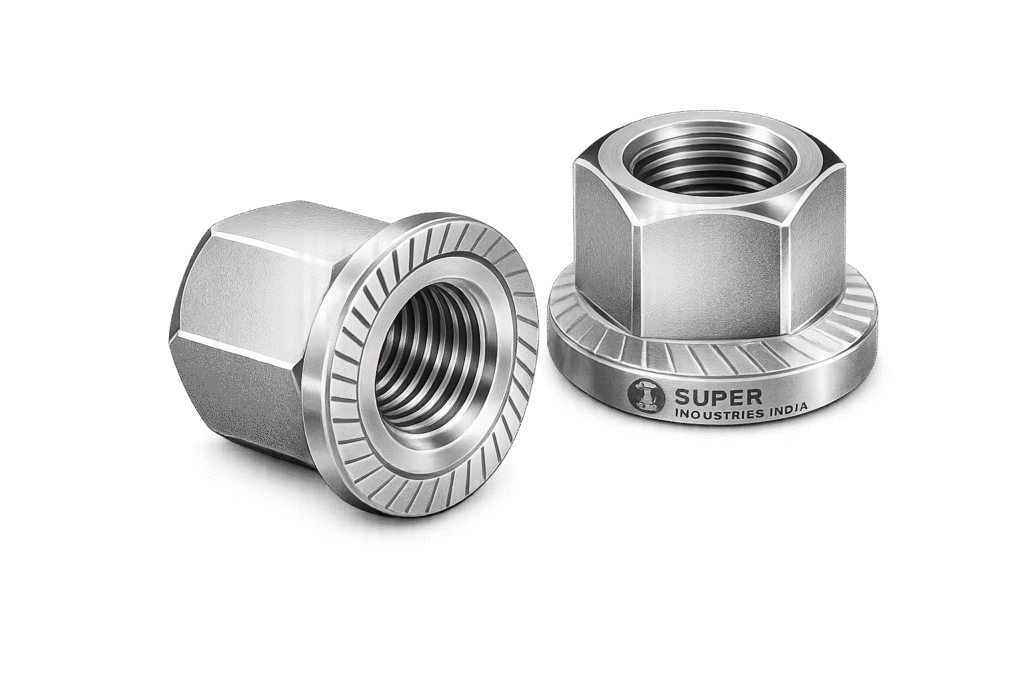
A flange nut is a hex nut with an integral circular flange at the bearing face. This flange acts as a built-in washer by:
- Increasing the bearing area in contact with the joint surface
- Reducing bearing pressure under preload
- Improving load distribution across the joint interface
Unlike a loose washer, the flange is permanently concentric with the nut threads. This ensures consistent load transfer and eliminates alignment variability between nut and washer during tightening.
Flange nuts are therefore classified as washer-integrated fasteners, not merely modified hex nuts.
3️⃣ Role in Joint Integrity
Load Distribution, Bearing Pressure & Anti-Loosening Contribution
From a joint-integrity perspective, flange nuts influence three critical aspects:
Load Distribution
The enlarged bearing face spreads compressive load over a greater area. This is particularly relevant where:
- Base materials are thinner
- Painted or coated surfaces are present
- Localized crushing must be avoided
Bearing Pressure Reduction
Lower bearing pressure reduces:
- Surface embedment
- Early preload relaxation
- Damage to mating components
Anti-Loosening Contribution
While flange nuts are not primary locking devices, certain designs—particularly serrated flange nuts—introduce frictional resistance that can help resist loosening in low-to-moderate vibration environments.
4️⃣ Geometry & Bearing-Face Logic
Flange Diameter, Thickness & Surface Characteristics
The engineering effectiveness of a flange nut depends on flange geometry:
- Flange diameter: Determines bearing area and pressure distribution
- Flange thickness: Affects stiffness and resistance to local deformation
- Bearing-face profile: Smooth or serrated, depending on application
The flange must remain flat under preload. Excessively thin flanges can dish under load, negating the intended bearing advantage.
5️⃣ Types of Flange Nuts
Plain (Smooth) Flange Nuts
- Smooth bearing face
- Used where surface protection must be preserved
- Suitable for coated or machined mating surfaces
Serrated Flange Nuts
- Radial serrations under the flange
- Provide additional resistance to loosening
- Serrations bite into the mating surface
These are not permitted where surface damage, coating integrity, or reusability is critical.
Heavy-Duty Flange Nuts
- Increased thickness and flange mass
- Used in higher-load structural or equipment supports
- Closer to heavy hex nut behavior with integrated bearing face
6️⃣ Engineering Relevance vs Standard Nuts + Washers
Advantages, Limitations & EPC Acceptance Boundaries
Advantages
- Reduced component count
- Faster installation
- Consistent bearing alignment
- Lower risk of missing washers
Limitations
- Not suitable where hardened washers are mandatory
- Serrated variants can damage mating surfaces
- Limited reuse depending on surface condition
EPC Acceptance Boundaries
- Accepted for non-pressure, non-critical structural and equipment joints
- Often excluded from pressure flange bolting and safety-critical connections
- Subject to consultant approval based on joint class
7️⃣ Material Selection & Mechanical Properties
Carbon Steel
- Common for general industrial and infrastructure use
- Balanced strength and cost
Alloy Steel
- Higher mechanical strength
- Used where preload and joint loads are elevated
Stainless Steel
- Corrosion resistance prioritized
- Lower yield strength compensated by flange bearing area
Duplex Stainless Steel
- High strength and corrosion resistance
- Offshore and chloride-rich environments
Material selection must align with:
- Bolt or stud material
- Environmental exposure
- Temperature and corrosion risk
8️⃣ Standards & Specification Alignment
Flange nuts are governed by dimensional and mechanical requirements derived from:
- Thread form and tolerance standards
- Property class or grade specifications
- Surface finish and marking rules
While international standards define baseline requirements, EPC specifications often impose additional constraints, particularly regarding washer substitution and serration acceptance.
9️⃣ Manufacturing & Quality Discipline
Forging vs Machining
- Forged flange nuts: Preferred for grain flow continuity and strength
- Machined flange nuts: Used for special alloys or tight tolerances
Serration Accuracy
For serrated flange nuts:
- Serration depth and angle must be controlled
- Inconsistent serrations lead to uneven preload
Heat Treatment
Ensures required mechanical properties without compromising flange flatness.
Traceability & Inspection
- Heat number marking
- Dimensional checks (AF, thickness, flange diameter)
- Thread gauging
🔟 Installation, Torque & Inspection View
Torque–Tension Behavior
The integrated flange alters friction conditions compared to nut-and-washer assemblies. Engineers must account for:
- Flange-to-surface friction
- Absence of washer slip plane
Surface Condition Effects
Paint, coatings, or galvanizing significantly influence preload accuracy.
Inspection Checkpoints
- Flange seating flatness
- No flange distortion
- Serration condition (if applicable)
1️⃣1️⃣ EPC Procurement & Consultant Review Perspective
EPC engineers and inspectors typically verify:
- Approval of washer-integrated fastening in the project specification
- Flange nut grade compatibility with bolts or studs
- Suitability for vibration and service environment
Flange nuts are rejected where:
- Hardened washers are mandatory
- Joint classification prohibits washer elimination
1️⃣2️⃣ Application Mapping
Flange nuts are commonly applied in:
- Oil & Gas skid structures
- Power-plant auxiliary equipment
- Petrochemical pipe racks (non-pressure joints)
- LNG auxiliary and support systems
- Infrastructure assemblies
They are not substitutes for flange bolting in pressure systems unless explicitly approved.
1️⃣3️⃣ Professional Technical Tables
Thread Sizes & Standards
| Thread System | Typical Range |
|---|---|
| Metric | M8 – M36 |
| Unified | 5/16″ – 1½″ |
Flange Dimensions & Bearing Area (Indicative)
| Nut Size | Flange Ø Range |
|---|---|
| M10 | 20–24 mm |
| M20 | 36–44 mm |
| M30 | 55–65 mm |
Mechanical Grades & Property Classes
| Standard | Example Grades |
|---|---|
| ASTM | A194, A563 |
| ISO | Property Class 8, 10 |
| DIN | Strength-class based |
Material Grades vs Service Conditions
| Material | Typical Use |
|---|---|
| Carbon Steel | General industrial |
| Alloy Steel | High preload |
| Stainless Steel | Corrosive |
| Duplex | Offshore |
Serrated vs Non-Serrated Guidance
| Condition | Recommended |
|---|---|
| Painted surface | Smooth flange |
| Bare steel | Serrated possible |
| Reusable joint | Smooth flange |
| Vibration (low) | Serrated with approval |
Project-Specific Customization Options
| Option | Availability |
|---|---|
| Custom flange Ø | EPC-defined |
| Special alloys | On request |
| Coatings | As specified |
| Full traceability | Mandatory |
1️⃣4️⃣ Manufacturer-Focused Conclusion
Flange Nuts are engineered fastening components that integrate load-bearing and nut functions into a single element. When correctly selected, they improve load distribution, reduce assembly variability, and streamline installation in approved EPC applications.
Super Industries manufactures flange nuts with controlled flange geometry, verified mechanical properties, and full traceability, ensuring alignment with EPC fastening philosophies and consultant approval requirements—without compromising joint integrity.
The Ultimate Guide to Flange Nuts: A Secure and Efficient Fastening Solution from Super Industries India
Flange Nut Manufacturer & Supplier in India | Premium Quality, High-Tensile Fasteners
Welcome to Super Industries India, your trusted partner and leading Flange Nut Manufacturer, Supplier, and Exporter in India. In the world of industrial and automotive assembly, having a secure, vibration-resistant, and efficient fastening solution is non-negotiable. That’s where the flange nut steps in—a critical component engineered for superior performance.
At Super Industries India, we specialize in manufacturing a comprehensive range of high-quality flange nuts, including Serrated Flange Nuts and Non-Serrated Hex Flange Nuts, designed to meet stringent national and international standards like DIN 6923 and ISO 4161.
What is a Flange Nut? The Integrated Washer Advantage
A flange nut is a specialised type of nut that features a wide, circular base or “flange” at one end. This integrated flange serves the purpose of a non-spinning washer, offering several key advantages over a standard nut and washer combination:
- Superior Load Distribution: The enlarged bearing surface of the flange helps to distribute the clamping load over a wider area of the mating surface. This dramatically reduces the risk of damage, prevents marring, and is essential when fastening materials that are softer or prone to deformation.
- Increased Vibration Resistance: By providing a larger contact area, the flange significantly boosts the stability of the joint, making the fastener highly resistant to loosening caused by operational vibrations and dynamic forces. This is particularly crucial in high-stress applications like the automotive and heavy machinery sectors.
- Streamlined Assembly: By combining the nut and washer into a single unit, the flange nut eliminates the need to handle a separate washer, speeding up assembly lines, reducing component inventory, and simplifying maintenance.
Types of Flange Nuts We Manufacture
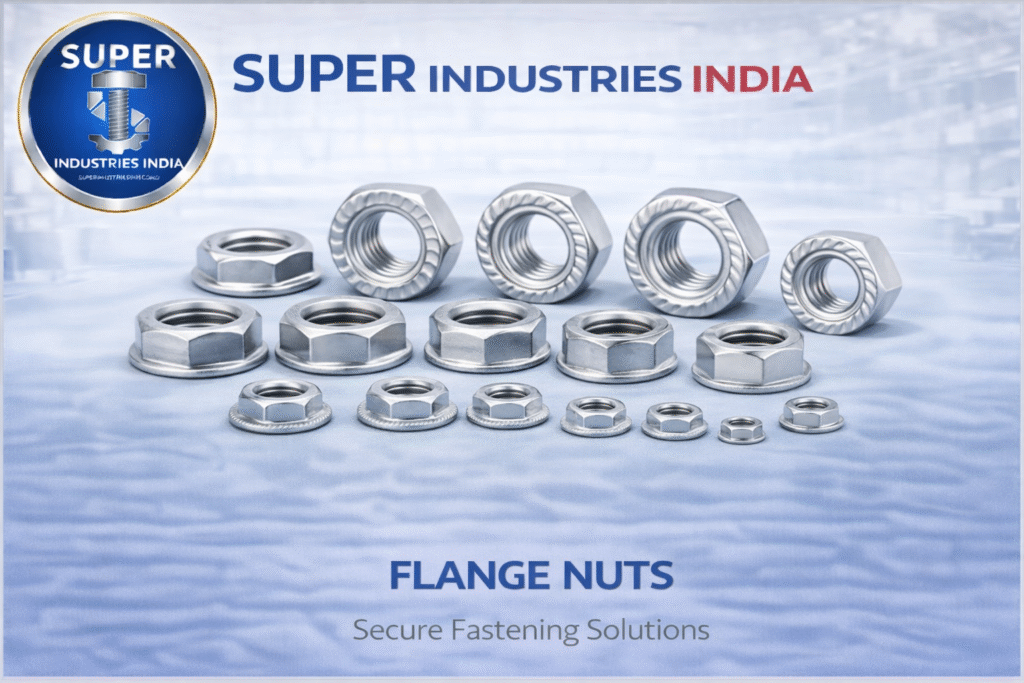
To cater to the diverse needs of the Indian and global markets, Super Industries India produces a variety of flange nuts, each tailored for specific performance requirements:
1. Serrated Flange Nuts
- Key Feature: The underside of the flange has small, radial serrations (teeth).
- Function: When tightened, these serrations bite into the mating surface, creating a powerful, one-way locking action. This makes Serrated Flange Nuts the ideal choice for applications subjected to extreme vibrations, high temperatures, and constant movement, ensuring the fastener remains secure without the need for a separate lock washer.
- Common Standards: DIN 6923
2. Non-Serrated Flange Nuts
- Key Feature: The underside of the flange is smooth.
- Function: These are used in applications where the main goal is load distribution without marking the surface. They are typically paired with materials that are too soft or sensitive to be damaged by serrations, or where the fastener must be frequently removed and reused.
3. Flanged Lock Nuts (Nylock Flange Nuts)
- Key Feature: Combines the load-spreading flange with a non-metallic (typically nylon) insert.
- Function: The nylon insert creates prevailing torque, resisting rotation and offering an extra layer of security against loosening, making them perfect for safety-critical applications.
Technical Specifications: Precision for Every Project
We adhere to the highest international quality standards to ensure our flange nuts deliver consistent, reliable performance.
| Specification | Details |
| Material Grades | Mild Steel (MS), Carbon Steel, Alloy Steel, Stainless Steel (SS 304, SS 316, A2-70, A4-70, etc.), High-Tensile Steel |
| Standards | DIN 6923, ISO 4161, JIS B1190, IS, ASME B18.2.2, and customer-specific drawings |
| Size Range | Metric: M3 to M24 and above |
| Finish & Coating | Zinc Plated (Yellow/Blue/White), Hot Dip Galvanised (HDG), Black Oxide, Dacromet, Phosphating, Self-Colour |
| Strength Class / Grade | Class 4, 6, 8, 10, 12 (for Steel); A2, A4 (for Stainless Steel) |
Industries and Applications of Flange Nuts
The inherent stability and efficiency of flange nuts make them an indispensable fastener across numerous high-demand sectors:
- Automotive Industry: Used extensively in engine mounts, chassis assembly, exhaust systems, wheel fastening, and suspension systems where resistance to road vibration is paramount.
- Heavy Machinery & Equipment: Securing components in construction equipment, agricultural machinery, and industrial pumps.
- Construction & Structural Engineering: Providing reliable connections in steel frameworks, pre-engineered buildings, and metal structures.
- Oil & Gas/Pipeline: Used for flange connections on pipelines, valves, and fittings to ensure leak-proof and vibration-proof joints.
- Electrical & Electronics: Securing control panels, electrical enclosures, and equipment where a broad bearing surface prevents damage to delicate components.
- Appliance Manufacturing: Used in washing machines, refrigerators, and other home appliances to reduce noise and prevent loosening from internal vibrations.
Why Choose Super Industries India for Flange Nuts?
As a premier Flange Nut Supplier in India, Super Industries India is committed to delivering excellence on all fronts:
- Manufacturing Expertise: With decades of experience, we employ advanced cold forging and hot forging technologies to ensure superior dimensional accuracy and mechanical properties in every nut.
- Strict Quality Control: Every batch of flange nuts undergoes rigorous testing for thread integrity, proof load, hardness, and corrosion resistance, complying with global standards.
- Custom Fastening Solutions: We are experts in providing tailored solutions. If your project demands unique materials, special coatings (like PTFE or Dacromet), or non-standard dimensions, our engineering team can manufacture flange nuts to your exact specifications.
- Nationwide & Global Delivery: Based in a prime industrial location, we have established a robust logistics network, making us a reliable Flange Nut Exporter and Supplier to major Indian industrial hubs and international clients.
When your application demands a permanent, secure, and vibration-resistant joint, choose the integrated performance of a flange nut from Super Industries India.
Ready to secure your next project with the highest quality flange nuts?