
Standard Weldolet
- Standard Weldolet
- 1️⃣ Industry Context
- 2️⃣ Technical Definition
- 3️⃣ Engineering Relevance
- 4️⃣ Design & Reinforcement Logic
- 5️⃣ Standard Weldolet vs Other Outlet Fittings
- 6️⃣ Material & Standard Alignment
- 7️⃣ Manufacturing & Quality Discipline
- 8️⃣ Welding, Installation & Inspection View
- 9️⃣ Application Mapping
- 🔟 Professional Technical Tables
- 1️⃣1️⃣ Manufacturer-Focused Conclusion
- Introduction: Understanding Olet Fittings in Modern Piping Systems
- What Is a Standard Weldolet?
- Engineering Design & Stress Distribution
- Why Standard Weldolets Are Preferred Over Tees
- Sizes of Standard Weldolets
- Materials Used in Standard Weldolets
- Applicable Standards & Codes
- Manufacturing Process of Standard Weldolets
- Applications of Standard Weldolets
- Installation Best Practices
- Common Buyer Mistakes to Avoid
- Why Super Industries India for Standard Weldolets
EPC / EXPORT / MNC STANDARD – Integrally Reinforced Branch Outlet Fitting
Manufacturer & Global Exporter: Super Industries
Website: https://superindustriesindia.in
1️⃣ Industry Context
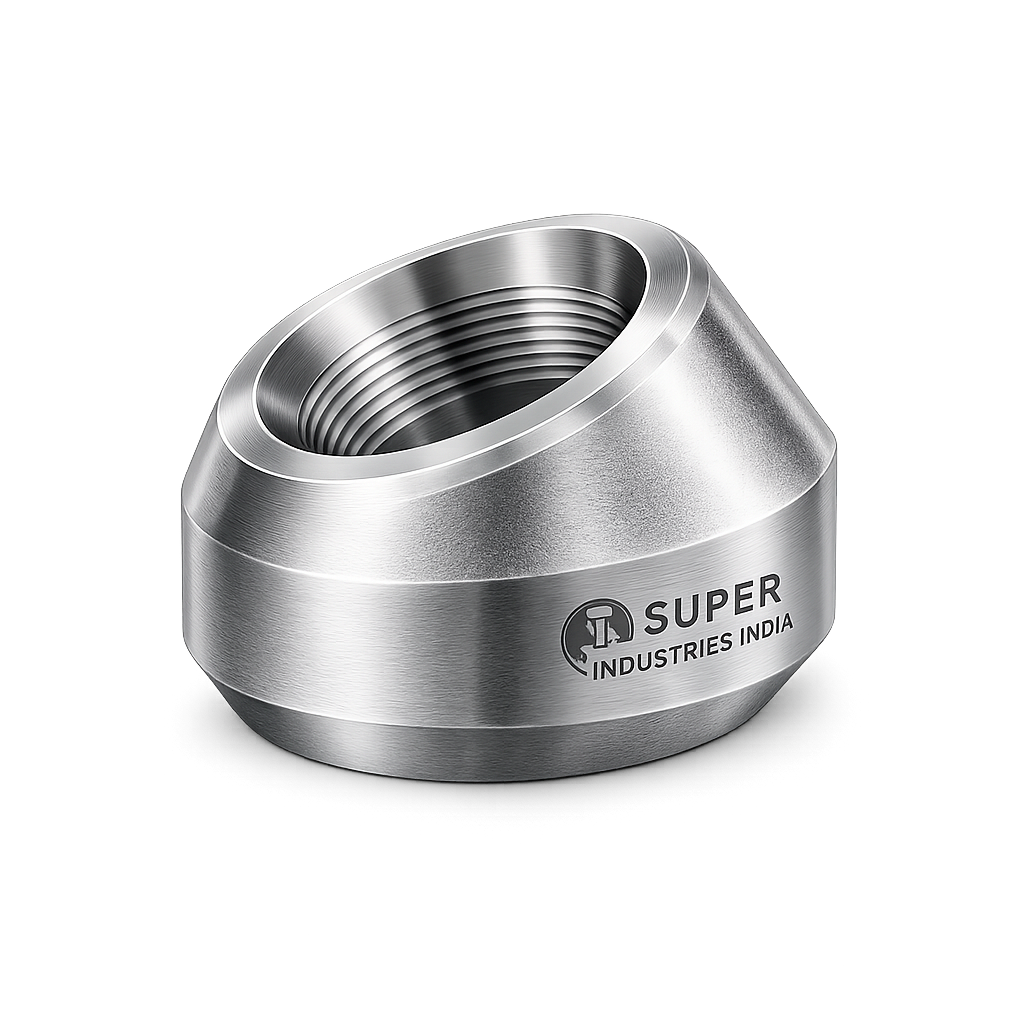
Why Standard Weldolets Are Widely Used Branch Fittings in EPC and Capital Projects
In engineered piping systems, branch connections represent a structurally sensitive discontinuity in the pressure boundary. EPC specifications consistently require branch solutions that are code-recognized, stress-predictable, and inspection-friendly. The Standard Weldolet meets these requirements without introducing the fabrication complexity and inspection risk associated with pad-reinforced stub-ins.
Across Oil & Gas, Power, Petrochemical, LNG, Hydrogen, and Infrastructure projects, Standard Weldolets are specified because they:
- Provide integral reinforcement without separate pads
- Simplify piping stress analysis assumptions
- Reduce weld count and inspection scope
- Improve long-term pressure integrity and fatigue behavior
- Align directly with MSS SP-97 and ASME piping codes
For EPC contractors and consultants, the Standard Weldolet is a baseline, technically conservative branch fitting that supports schedule control and consistent quality across large piping networks.
2️⃣ Technical Definition
What a Standard Weldolet Is and Where It Is Used
A Standard Weldolet is a forged, integrally reinforced branch outlet fitting designed to connect a branch pipe to a run pipe using a full-penetration butt weld at the branch end and a contoured weld to the run pipe.
Key Characteristics
- Forged construction with controlled grain flow
- Contoured base matching run pipe curvature
- Integral reinforcement built into the fitting geometry
- Butt-weld branch end suitable for full-strength joints
Typical Use Locations
- Process headers and manifolds
- Utility and service piping
- Transmission and distribution lines
- Plant interconnecting piping
Standard Weldolets are selected where standard pressure classes and schedules apply, without the need for heavy-wall or special reinforcement solutions.
3️⃣ Engineering Relevance
Stress Distribution, Reinforcement Adequacy & Fatigue Behavior
Stress Distribution at Branch Connections
Internal pressure and external loads create localized stress intensification at branch openings. The Standard Weldolet addresses this by:
- Increasing effective wall thickness locally
- Redistributing hoop and longitudinal stresses
- Providing smooth geometric transitions
Reinforcement Adequacy
The integral reinforcement area of a Standard Weldolet is engineered to replace the metal removed from the run pipe, satisfying code reinforcement requirements without additional calculations for external pads.
Fatigue Performance
In systems subject to thermal cycling or vibration, Standard Weldolets exhibit improved fatigue resistance compared to fabricated stub-ins due to reduced stress concentration factors and uniform load transfer.
4️⃣ Design & Reinforcement Logic
How Standard Weldolets Achieve Code-Compliant Performance
Integrally Reinforced Geometry
Unlike pad-reinforced branches, the Standard Weldolet integrates reinforcement into the fitting body, eliminating:
- Pad-to-pipe crevices
- Additional fillet welds
- Differential stiffness zones
Branch-to-Run Load Transfer
The forged profile ensures continuous load paths from:
- Branch pipe
- Weldolet body
- Run pipe wall
This continuity is critical for accurate stress modeling and predictable in-service behavior.
Pressure Containment Logic
The fitting geometry is designed so that pressure-induced stresses remain within allowable limits defined by ASME B31 piping codes.
5️⃣ Standard Weldolet vs Other Outlet Fittings
Engineering Selection Logic
Standard Weldolet vs Heavy Weldolet
- Standard Weldolet: Used for standard schedules and pressure classes
- Heavy Weldolet: Selected for higher pressure, thicker run pipes, or elevated temperatures
Standard Weldolet vs Sockolet
- Sockolets use socket welds and are limited to smaller sizes and lower pressures
- Standard Weldolets use butt welds and are suitable for critical service
Standard Weldolet vs Threadolet
- Threadolets are restricted to low-pressure, utility service
- Standard Weldolets are preferred for pressure piping
Standard Weldolet vs Latrolet
- Latrolets are used for angled branches
- Standard Weldolets are for 90° branch connections
6️⃣ Material & Standard Alignment
Applicable Standards
- MSS SP-97: Integrally reinforced forged branch outlet fittings
- ASME B31.1 / B31.3 / B31.4 / B31.8: Piping design codes
- ASTM: Material specifications
- ASME Section II: Material properties
- EN / ISO: International project compliance
Typical Materials
- Carbon steel – ASTM A105
- Low-temperature carbon steel – ASTM A350
- Alloy steel – ASTM A182 F11 / F22
- Stainless steel – ASTM A182 F304 / F316
Material selection is governed by pressure, temperature, corrosion allowance, and service media.
7️⃣ Manufacturing & Quality Discipline
Forging Method
Standard Weldolets are hot-forged to ensure:
- Dense, defect-free structure
- Uniform mechanical properties
- Controlled grain flow aligned with load paths
Heat Treatment
Heat treatment is performed to achieve specified strength, toughness, and impact properties.
Machining Accuracy
Critical dimensions controlled include:
- Branch bore diameter
- Contour radius for run pipe fit-up
- Bevel geometry for welding
Traceability & Inspection Philosophy
- Heat number traceability from raw material to finished fitting
- Dimensional verification
- Visual and surface examination
- Documentation aligned with EPC ITP requirements
8️⃣ Welding, Installation & Inspection View
Welding Requirements
- Full-penetration butt weld at branch end
- Qualified WPS/PQR specific to material and thickness
- Controlled heat input to avoid distortion
Installation Discipline
- Accurate marking and cutting of run pipe
- Proper orientation per isometric drawings
- No forced fit-up or misalignment
Inspection Focus Areas
Inspectors typically verify:
- Weld profile and penetration
- NDT results (RT/UT/MT/PT as specified)
- Dimensional conformity
- Material certification and traceability
Standard Weldolets reduce inspection complexity by eliminating reinforcement pads.
9️⃣ Application Mapping
Oil & Gas
Process piping, gathering lines, and headers.
Power
Steam, condensate, and auxiliary systems.
Petrochemical
Reactor feeds, column branches, and cyclic service piping.
LNG
Cryogenic and transition piping.
Hydrogen
Emerging infrastructure requiring conservative design margins.
Chemical & Infrastructure
Utility and industrial distribution piping.
🔟 Professional Technical Tables
Run Pipe Size vs Branch Size (Typical)
| Run Pipe Size (NB) | Branch Size Range |
|---|---|
| 50 | 15 – 40 |
| 100 | 25 – 80 |
| 200 | 25 – 150 |
| 300 | 50 – 250 |
Schedule Compatibility
| Run Pipe Schedule | Branch Compatibility |
|---|---|
| SCH 40 / STD | Standard Weldolet |
| SCH 80 | Standard / Heavy (case-dependent) |
| XS | Engineering review required |
Pressure Class Applicability
| Pressure Class | Typical Application |
|---|---|
| Class 150 | Utilities, low-pressure |
| Class 300 | Process piping |
| Class 600 | Higher-pressure services |
Material Grades vs Service Conditions
| Material | Typical Service |
|---|---|
| ASTM A105 | General hydrocarbon |
| ASTM A350 | Low-temperature |
| ASTM A182 F316 | Corrosive service |
| Alloy steels | High temperature |
Standards & Code References
| Standard | Scope |
|---|---|
| MSS SP-97 | Branch outlet design |
| ASME B31 | Piping systems |
| ASTM | Materials |
| EN / ISO | International EPC |
Project-Specific Customization Options
| Parameter | Options |
|---|---|
| Run / branch size | Project-defined |
| Material | CS, SS, alloy |
| Heat treatment | As specified |
| NDT | RT / UT / PMI |
| Certification | EN 10204 3.1 / 3.2 |
1️⃣1️⃣ Manufacturer-Focused Conclusion
In EPC and export projects, the Standard Weldolet is a foundational branch fitting that balances reinforcement adequacy, fabrication simplicity, and inspection confidence. Its performance is governed by forged geometry, material integrity, machining accuracy, and welding compatibility—not by post-fabrication correction.
Super Industries manufactures Standard Weldolets in alignment with MSS SP-97 and international piping codes, supported by controlled forging, heat treatment, precision machining, and disciplined inspection systems. This engineering-led approach ensures dimensional consistency, predictable stress behavior, and consultant-acceptable documentation for EPC and capital-project applications.
Introduction: Understanding Olet Fittings in Modern Piping Systems
In modern industrial piping systems, the integrity of branch connections plays a critical role in ensuring safety, efficiency, and long-term performance. Traditional solutions such as fabricated tees or welded branch pipes often introduce stress concentration, increased fabrication time, and higher risk of failure—especially in high-pressure or high-temperature environments.
To overcome these challenges, olet fittings were developed. Among them, Weldolets and their related outlet fittings (Sockolets, Threadolets, Elbolets, Latrolets, etc.) have become the industry standard across oil & gas, petrochemical, power generation, chemical processing, and heavy engineering sectors.
As a top manufacturer of weldolet, Super Industries India supplies a complete range of forged outlet fittings that meet international standards and project-specific requirements. This pillar guide explains every major type of Weldolets and outlet fitting, how they function, where they are used, how to select the right type, and how to procure weldolet for domestic or export projects.
What Is a Standard Weldolet?
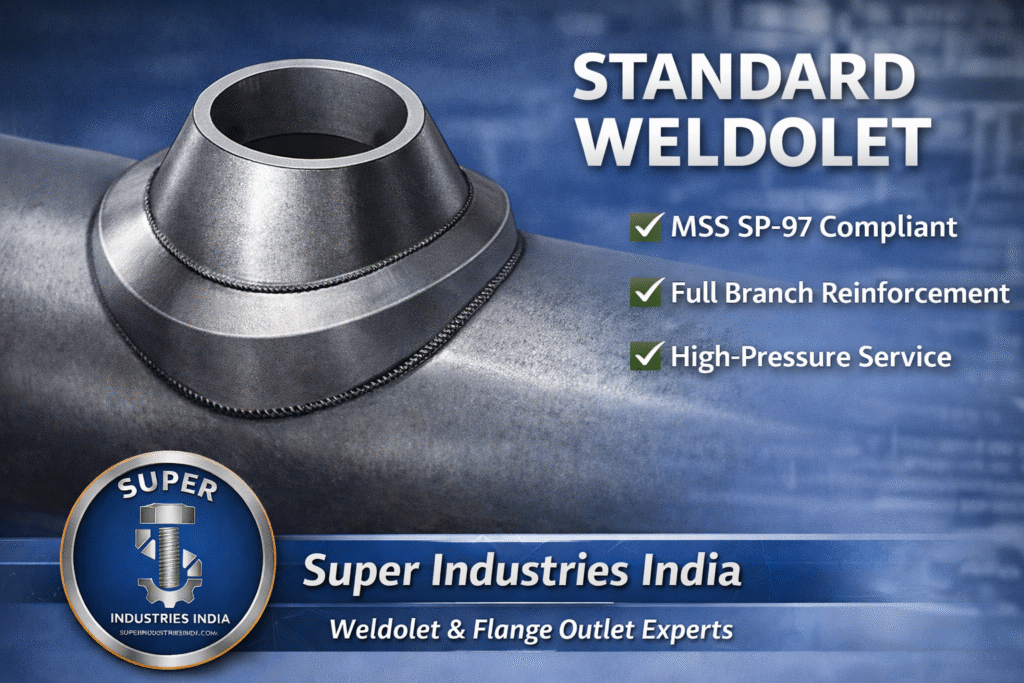
A Standard Weldolet is a forged branch outlet fitting designed to create a 90-degree branch connection from a main (run) pipe to a smaller branch pipe. It is welded directly onto the outer surface of the run pipe, eliminating the need for cutting and installing a tee.
Weldolets are engineered with a self-reinforcing contour, which distributes stress evenly around the branch opening, making them significantly stronger and safer than fabricated branch connections.
Engineering Design & Stress Distribution
The defining feature of a Weldolet is its contoured base. This contoured geometry ensures:
- Even stress transfer from branch to run pipe
- Reduced stress concentration at the weld joint
- Improved fatigue resistance
- Enhanced performance under cyclic loads
In high-pressure pipelines, stress concentration around branch connections is a leading cause of failure. Weldolets are designed using advanced engineering principles to meet ASME pressure design rules, making them suitable for critical services.
Why Standard Weldolets Are Preferred Over Tees
Traditional tees require:
- Cutting the main pipe
- Aligning multiple weld joints
- Additional inspection points
Weldolets, on the other hand:
- Require only one branch hole
- Use a single full-penetration weld
- Maintain the structural integrity of the run pipe
This makes Weldolets:
✔ Faster to install
✔ More reliable
✔ Cost-effective in the long run
Sizes of Standard Weldolets
Standard Weldolets are available in a wide range of size combinations based on:
- Run pipe size
- Branch pipe size
Common Branch Sizes
- 1-inch Weldolet
- 2-inch Weldolet
- 3-inch, 4-inch, 6-inch and above
A 1-inch Weldolet is typically used for:
- Instrumentation lines
- Drain and vent connections
- Sampling points
A 2-inch Weldolet is widely used in:
- Utility piping
- Process lines
- Medium-flow branch connections
As a top manufacturer of weldolet, Super Industries India supplies both standard and custom size combinations based on project drawings.
Materials Used in Standard Weldolets
Material selection depends on operating conditions such as pressure, temperature, and corrosive environment.
Common Materials
- Carbon Steel (ASTM A105)
- Stainless Steel (SS304, SS316, SS316L)
- Alloy Steel (ASTM A182 F11, F22)
- Duplex & Super Duplex Steel
- Nickel Alloys (Monel, Inconel, Hastelloy)
Each material undergoes strict quality checks to ensure compatibility with pipeline specifications.
Applicable Standards & Codes
Standard Weldolets are manufactured according to:
- MSS SP-97 (Outlet Fittings Standard)
- ASME B31.3 / B31.1 (Piping Codes)
- ASME Section IX (Welding)
- ASTM material standards
Compliance with these standards is essential when you procure a weldolet for regulated industries.
Manufacturing Process of Standard Weldolets
- Forging
High-quality billets are hot-forged to achieve grain flow alignment and superior strength. - Machining
CNC machining ensures precise dimensions and proper welding geometry. - Heat Treatment
Normalizing, quenching, or tempering based on material grade. - Inspection & Testing
- Dimensional inspection
- Hardness testing
- PMI testing
- Visual and NDT (on request)
Applications of Standard Weldolets
🛢 Oil & Gas
- Pipelines
- Refineries
- Offshore platforms
🧪 Chemical & Petrochemical
- Process piping
- Utility distribution
- Instrumentation branches
⚡ Power Plants
- Steam lines
- Feedwater systems
- Condensate piping
🏭 Industrial Manufacturing
- Hydraulic systems
- Compressed air lines
- Cooling water pipelines
Installation Best Practices
- Accurate hole cutting on run pipe
- Proper alignment before welding
- Full-penetration welding by certified welders
- Post-weld inspection as per code
Incorrect installation can negate the benefits of even the best-quality Weldolet.
Common Buyer Mistakes to Avoid
❌ Selecting incorrect material grade
❌ Ignoring pressure-temperature ratings
❌ Choosing fabricated outlets over forged Weldolets
❌ Procuring from uncertified suppliers
To avoid these risks, always source from a top manufacturer of weldolet with proven quality systems.
Why Super Industries India for Standard Weldolets
✔ Forged, not fabricated
✔ Full material traceability
✔ Custom sizes available
✔ Export-ready documentation
✔ Trusted global supply experience