
Bolt Safety Anchor Shackles
- Bolt Safety Anchor Shackles
- Industry Context: Why Bolt Safety Anchor Shackles Are Mandatory in Critical Lifts
- Technical Definition: What Bolt Safety Anchor Shackles Are
- Engineering Relevance: Load Path Control & Pin Retention Integrity
- Load Rating & Design Logic
- Bolt Safety vs Screw Pin Shackles: Engineering Selection Logic
- Material & Standard Alignment
- Manufacturing & Quality Discipline
- Procurement, Installation & Inspection View
- Application Mapping Across Industries
- Professional Technical Tables
- Manufacturer-Focused Conclusion
- Maximum Security and Permanence: Bolt Safety Anchor Shackles
- What is a Bolt Safety Anchor Shackle?
- Unmatched Security for Critical Applications
- Certification, Quality, and Materials
Engineering Reference for Critical, Long-Term & High-Risk Lifting Applications
Manufacturer & Global Exporter: Super Industries
Website: https://superindustriesindia.in
Industry Context: Why Bolt Safety Anchor Shackles Are Mandatory in Critical Lifts
In EPC, offshore, marine, and large infrastructure projects, not all lifts are equal. Certain lifting operations are classified as critical or high-risk lifts due to one or more of the following conditions:
- Long-duration or semi-permanent load suspension
- Exposure to continuous vibration, wind, or wave-induced motion
- Offshore or marine environments where access for re-tightening is limited
- Lifts performed over live plant, personnel, or high-value assets
- Regulatory or consultant-mandated safety requirements
In these scenarios, bolt safety anchor shackles are not optional alternatives to screw pin shackles. They are mandatory engineered connectors designed to eliminate the single largest risk associated with screw pin shackles: unintended pin rotation or loosening.
EPC contractors, lifting consultants, and third-party inspectors specify bolt safety anchor shackles because they provide positive mechanical pin retention, independent of friction or operator vigilance. This characteristic alone fundamentally changes the risk profile of the lifting system.
Technical Definition: What Bolt Safety Anchor Shackles Are
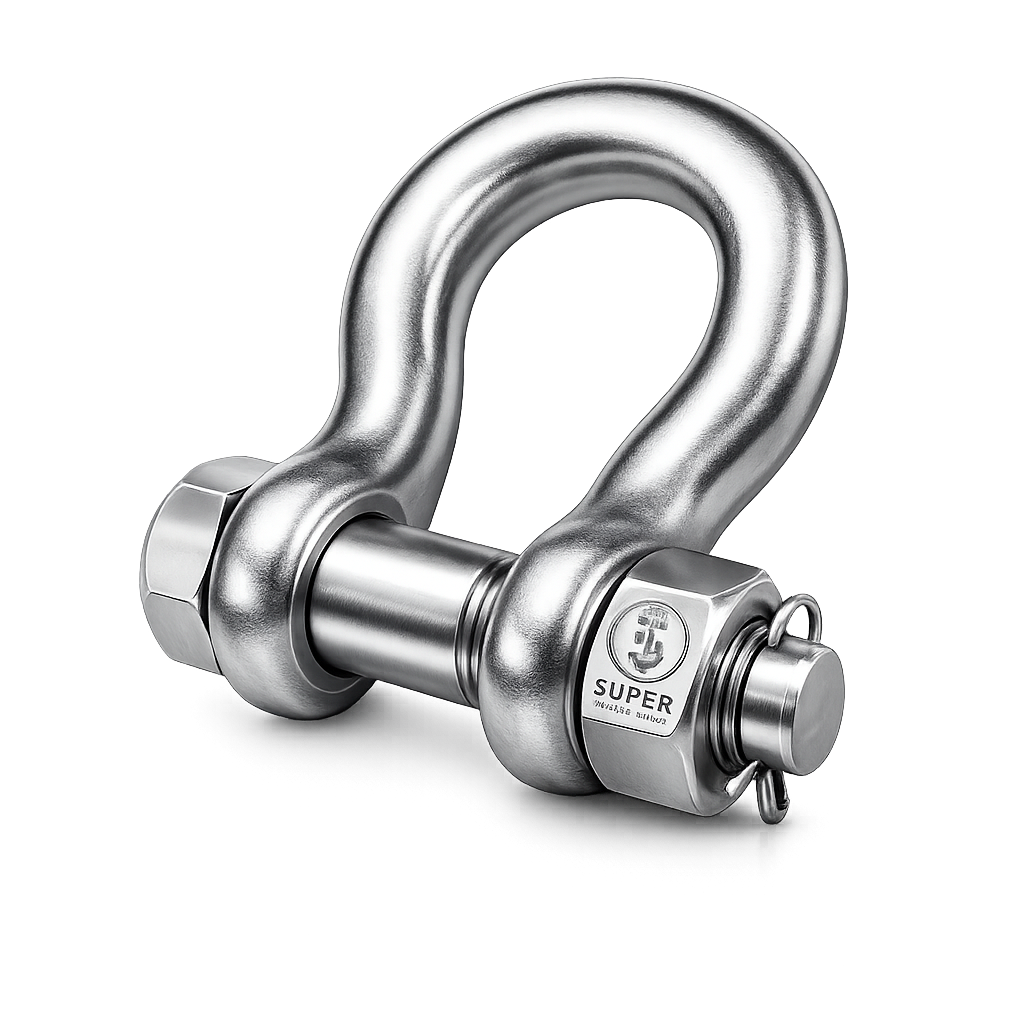
A bolt safety anchor shackle is a forged anchor (bow) shackle that uses a high-strength bolt, nut, and secondary locking device (cotter pin or split pin) instead of a removable screw pin.
Geometry and Construction
- Wide anchor bow: Accommodates angled, multi-leg, or rotating loads
- High-strength bolt: Acts as the primary pin, designed for double-shear loading
- Nut and cotter pin: Provide positive, fail-safe retention
- Forged body: Grain flow aligned to multi-directional load paths
How It Differs from Screw Pin Anchor Shackles
Unlike screw pin shackles, bolt safety anchor shackles cannot loosen due to vibration, rotation, or cyclic movement. The pin is mechanically locked in position until intentionally removed with tools.
This makes bolt safety anchor shackles the preferred—and often mandated—choice for permanent, semi-permanent, offshore, and critical lifts.
Engineering Relevance: Load Path Control & Pin Retention Integrity
Load Path Stability
In engineered lifting systems, stability of the load path is paramount. Bolt safety anchor shackles ensure:
- Consistent pin engagement throughout the lift
- No loss of preload due to vibration
- Predictable stress distribution between body and pin
Pin Retention as a Safety Function
Pin retention is not a convenience feature; it is a primary safety function. In dynamic environments:
- Screw pins rely on friction and operator checks
- Bolt safety pins rely on mechanical locking
From an engineering risk perspective, the latter is always superior for long-duration or unattended lifts.
Lifecycle Safety
Bolt safety anchor shackles are routinely used for:
- Weeks or months of continuous service
- Installations where inspection access is restricted
- Offshore and marine applications with constant motion
Their design directly supports lower lifecycle risk and higher inspection confidence.
Load Rating & Design Logic
Anchor Body Geometry
The wide bow geometry:
- Reduces bending stress under angled loading
- Allows multiple sling legs to seat correctly
- Minimizes localized bearing pressure
Bolt Diameter & Material
The bolt diameter governs shear capacity. Bolts are manufactured from high-strength alloy steel and heat treated to match or exceed body strength.
Nut & Cotter Arrangement
- Nut provides axial retention and preload
- Cotter pin provides secondary positive locking
- Loss of nut rotation does not result in pin loss
Load Ratings
- Working Load Limit (WLL): Maximum permissible service load
- Proof Load: Typically 2× WLL to confirm elastic behavior
- Minimum Breaking Load (MBL): Ultimate capacity with defined safety margin
Safety Factors
Bolt safety anchor shackles are commonly designed to 5:1 or 6:1 safety factors, with offshore projects often specifying the higher margin.
Bolt Safety vs Screw Pin Shackles: Engineering Selection Logic
Bolt Safety Anchor Shackles
- Mandatory for critical, long-term, offshore, or high-vibration lifts
- Positive pin retention via nut and cotter
- Requires tools for assembly and removal
- Preferred by consultants and inspectors
Screw Pin Anchor Shackles
- Suitable for short-duration, attended lifts
- Faster installation
- Requires monitoring for pin rotation
- Not recommended for permanent or offshore service
From an EPC risk-management standpoint, bolt safety anchor shackles are the conservative and preferred solution whenever lift criticality is elevated.
Material & Standard Alignment
Material Selection
Bolt safety anchor shackles are manufactured from:
- High-strength carbon steel for general EPC lifting
- Alloy steel for offshore, marine, and high-WLL applications
Material chemistry and mechanical properties are controlled to ensure:
- High toughness
- Resistance to brittle fracture
- Consistent ductility
Applicable Standards & Codes
- ASME B30.26 – Rigging hardware performance requirements
- EN 13889 – European shackle standard
- ISO 2415 – International reference
- ASTM A148 / A668 – Forged steel material specifications
- DIN standards – Dimensional harmonization
- IACS rules – Offshore and marine acceptance
Compliance with these standards is essential for EPC approval and third-party inspection acceptance.
Manufacturing & Quality Discipline
Forging Integrity
Bodies are hot-forged to achieve continuous grain flow following the anchor bow profile. This significantly improves fatigue resistance and impact performance.
Heat Treatment
Controlled heat treatment ensures:
- Required tensile and yield strength
- Uniform hardness
- Adequate elongation
Bolt, Nut & Cotter Control
- Bolts and nuts are manufactured and tested as load-bearing components
- Thread forms are gauged and verified
- Cotter pins are dimensioned for secure secondary locking
Dimensional Verification & Inspection
- Bow width and internal clearance verification
- Pin fit and alignment checks
- Proof load testing
- Heat and batch traceability
This manufacturing discipline ensures consistent acceptance during EPC audits and inspections.
Procurement, Installation & Inspection View
During Technical Evaluation
EPC engineers and lifting consultants verify:
- Correct shackle type for lift criticality
- WLL, proof load, and MBL
- Compliance with specified standards
- Manufacturer test certificates
During Incoming Inspection
Third-party inspectors typically check:
- Markings (WLL, size, manufacturer ID)
- Bolt, nut, and cotter pin presence
- Thread condition and fit
- Absence of deformation or damage
During Installation & Commissioning
Best practice includes:
- Correct bolt orientation
- Nut fully tightened and cotter pin installed
- Verification against lifting plan
- Removal from service if deformation is observed
Application Mapping Across Industries
Oil & Gas
Critical module lifting, long-duration equipment suspension.
Offshore & Marine
Deck lifting, mooring accessories, permanent rigging.
Power & Energy
Turbine installation, boiler erection, heavy static lifts.
LNG
Skid handling, modular construction lifts.
Infrastructure & Construction
Bridge segments, precast structures, heavy civil works.
Heavy Engineering
Fabrication yards, transport and erection operations.
Professional Technical Tables
Nominal Sizes & Bolt Diameters (Indicative)
| Shackle Size | Bolt Diameter (mm) |
|---|---|
| 1/2″ | ~16 |
| 3/4″ | ~22 |
| 1″ | ~28 |
| 1 1/4″ | ~35 |
| 1 1/2″ | ~38 |
Load Ratings (Indicative)
| Size | WLL (t) | Proof Load (t) | Min. Breaking Load (t) |
|---|---|---|---|
| 1/2″ | 2 | 4 | 12 |
| 3/4″ | 4.75 | 9.5 | 28 |
| 1″ | 8.5 | 17 | 51 |
| 1 1/4″ | 12 | 24 | 72 |
Actual ratings depend on governing standard.
Weight per Piece (Approximate)
| Size | Weight (kg) |
|---|---|
| 1/2″ | ~1.2 |
| 3/4″ | ~3.0 |
| 1″ | ~5.5 |
| 1 1/4″ | ~10.0 |
Material Grades & Surface Finishes
| Material | Finish |
|---|---|
| Carbon steel | Hot-dip galvanized |
| Alloy steel | Painted / galvanized |
| Offshore grade | Project-specified coating |
Standards vs Application Mapping
| Standard | Typical Application |
|---|---|
| ASME B30.26 | EPC & industrial lifting |
| EN 13889 | European projects |
| ISO 2415 | Global reference |
| IACS | Offshore & marine |
Project-Specific Customization Options
| Parameter | Options |
|---|---|
| Size & WLL | Project-defined |
| Bolt & nut | Standard / project-specific |
| Coating | Galvanized, painted |
| Marking | EPC-specific |
| Certification | EN 10204 3.1 / 3.2 |
Manufacturer-Focused Conclusion
In critical and long-term lifting operations, Bolt Safety Anchor Shackles provide the highest level of pin retention and load security available in conventional shackle design. Their use is driven by engineering risk control, not convenience.
Super Industries manufactures bolt safety anchor shackles under controlled forging, heat treatment, and inspection systems aligned with international lifting standards and EPC acceptance requirements. Our engineering discipline, traceability control, and inspection readiness support predictable load behavior, reduced operational risk, and third-party approval in the most demanding lifting and rigging applications.
Maximum Security and Permanence: Bolt Safety Anchor Shackles
In critical lifting and permanent rigging setups, there is no room for error or accidental disconnection. The Bolt Safety Anchor Shackle—often referred to as a Bolt, Nut, and Cotter Pin Shackle—is the highest standard of shackle security available. Its design ensures the pin remains locked in place, even under severe vibration, dynamic loading, or extended immersion.
Super Industries India is a premier manufacturer and supplier of certified, heavy-duty Bolt Safety Anchor Shackles. Forged from high-tensile alloy steel and rigorously tested, our safety shackles provide a virtually foolproof connection for permanent mooring, long-term installations, and high-stakes dynamic lifts across the offshore, mining, construction, and power sectors in India.
What is a Bolt Safety Anchor Shackle?
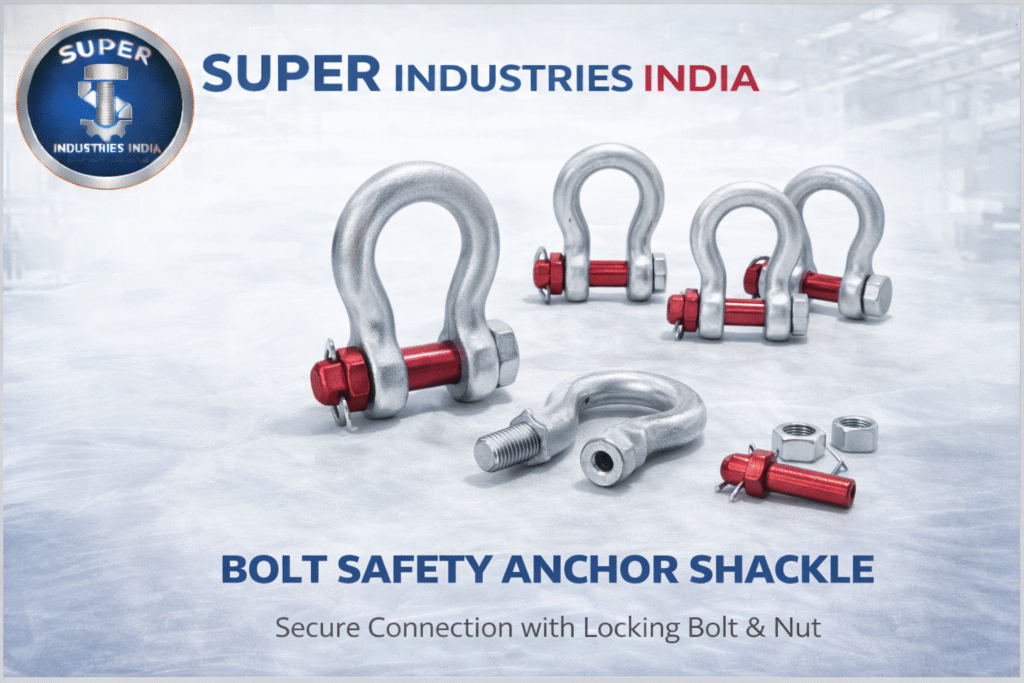
The Bolt Safety Anchor Shackle combines the versatile, wide body of the Anchor (Bow) Shackle with an ultimate security pin mechanism.
It consists of four primary components:
- The Body (Bow): The wide, curved bow allows for angular loading, accommodates multi-leg slings, and attaches easily to bulky items like heavy chain or anchor links.
- The Bolt: A straight, unthreaded bolt that passes through the body’s ears, holding the load.
- The Nut: A hexagonal or round nut that screws onto the end of the bolt, fixing it in place.
- The Cotter Pin: A small, split pin inserted through a hole in the bolt beyond the nut. This pin locks the nut and prevents it from loosening, even if the threads vibrate loose.
This multi-stage security mechanism is why it is specified for the most demanding, long-duration, or vibration-prone applications.
Key Advantages over Screw Pin Shackles
While Screw Pin Shackles are excellent for quick connections, the Bolt Safety Shackle offers unmatched permanence and reliability:
| Feature | Bolt Safety Anchor Shackle | Screw Pin Anchor Shackle |
| Pin Security | Highest. Nut is secured by a locking cotter pin. | Moderate. Pin relies on thread tension; prone to loosening from vibration. |
| Loading Type | Excellent for Dynamic Loads, high vibration, and long-term setup. | Best for Static Loads and frequent changeovers. |
| Permanence | Semi-permanent (Requires tools to disconnect). | Temporary (Quick, tool-less disconnection). |
Unmatched Security for Critical Applications
The secure locking system of the Bolt Safety Anchor Shackle makes it the required hardware for numerous high-risk scenarios:
1. Offshore and Marine Mooring
Used extensively in permanent mooring lines for buoys, semi-submersible rigs, and FPSOs (Floating Production Storage and Offloading) vessels. The cotter pin prevents the nut from backing off under the constant wave action, yawing, and high-frequency vibration common at sea.
2. Long-Term Installations
Ideal for securing static structures or providing permanent tension to systems like bridge cables, tower guy wires, and large machinery tie-downs, ensuring decades of reliable service without inspection concerns caused by loosening pins.
3. Dynamic and Impact Loading
The robust bolted connection is less susceptible to deformation and loosening caused by shock loading or repeated cyclic loading (e.g., in mining hoists or heavy construction pile driving).
4. High-Value Lifts
For lifting extremely heavy or high-value items where connection failure is catastrophic, the added security of the nut and cotter pin is considered the ultimate fail-safe.
Certification, Quality, and Materials
At Super Industries India, our Bolt Safety Anchor Shackles are manufactured to strict international standards to guarantee safety and performance.
- Forged for Strength: We use high-grade Alloy Steel (quenched and tempered) to achieve superior breaking strength and fatigue life.
- Corrosion Protection: The shackles and their components are Hot-Dip Galvanized (HDG), providing deep, long-lasting corrosion resistance essential for exposure to weather and seawater.
- Traceability and WLL: Every shackle is permanently stamped with its certified Working Load Limit (WLL), size, and traceability codes, ensuring easy compliance with $\text{ASME B30.26}$ and other regulatory bodies.
- Expert Assembly: We emphasize the correct assembly procedures: the bolt must be fully inserted, the nut tightened, and the cotter pin fully spread to achieve the certified security level.
For permanent, critical, or high-vibration connections, choose the uncompromising security of the Bolt Safety Anchor Shackle.
Contact Super Industries India today for expert sizing and certified shackles designed for the highest level of rigging integrity.