
SMO 254 (6Mo Alloy)
- SMO 254 (6Mo Alloy)
- 1️⃣ Industry Context
- 2️⃣ Technical Definition
- 3️⃣ Engineering & Corrosion Relevance
- 4️⃣ Chemical Composition & Metallurgical Logic
- 5️⃣ Mechanical Properties & Service Behavior
- 6️⃣ Standards & Specification Alignment
- 7️⃣ Manufacturing & Quality Discipline
- 8️⃣ Procurement, Fabrication & Inspection View
- 9️⃣ Application Mapping
- 🔟 Professional Technical Tables
- 1️⃣1️⃣ Manufacturer-Focused Conclusion
- Superior Corrosion Defense: SMO 254 (6Mo Alloy) Fasteners for Extreme Chloride Environments
- What is SMO 254 (6Mo Alloy)? The Super Austenitic Advantage
- Critical Applications for SMO 254 Fasteners
- Manufacturing Standards and Product Range
- Choose Super Industries India for Certified 6Mo Alloy Supply
High-Alloy Austenitic Stainless Steel for Severe Corrosion Service – EPC / Export Standard
Manufacturer & Global Exporter: Super Industries
Website: https://superindustriesindia.in
1️⃣ Industry Context
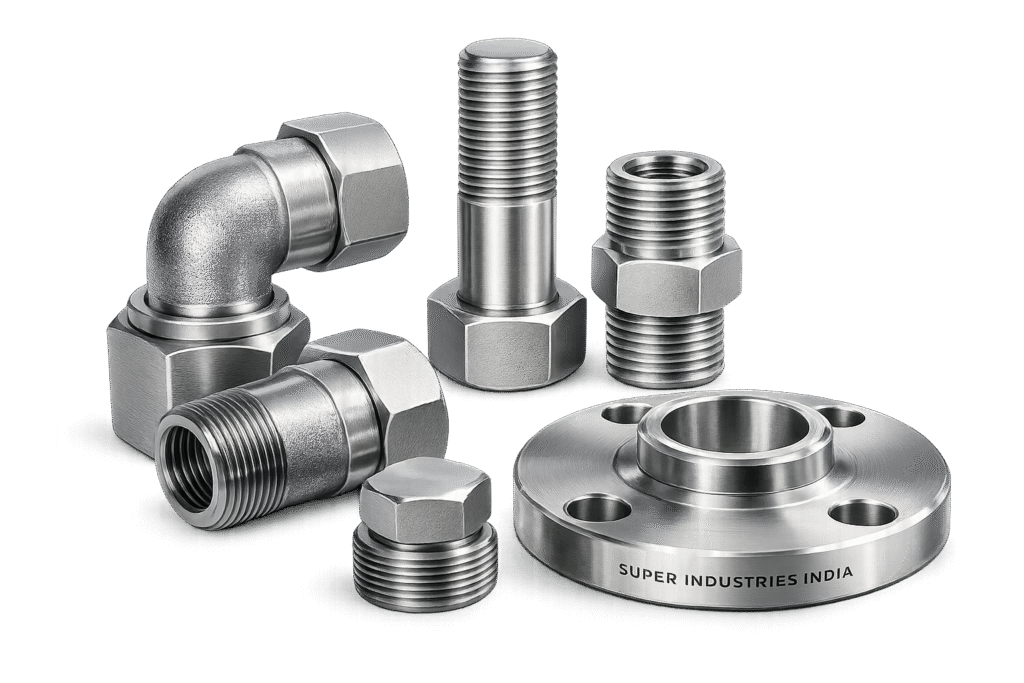
Why SMO 254 (6Mo) Is a Strategic Alloy in EPC and Capital Projects
In modern EPC and capital projects, material selection is no longer driven solely by pressure and temperature. Localized corrosion mechanisms—pitting, crevice corrosion, and chloride-induced stress corrosion cracking—have become the dominant life-limiting factors in offshore, marine, chemical, LNG, desalination, and hydrogen-adjacent environments.
Standard austenitic stainless steels such as 316L reach their performance limits quickly in high-chloride, low-pH, or oxygen-depleted services. Duplex grades improve strength but introduce fabrication and welding constraints. Nickel alloys provide excellent corrosion resistance but at a significantly higher cost and procurement complexity.
SMO 254 (6Mo Alloy) occupies a critical engineering position between duplex stainless steels and nickel alloys. It is specified when EPC engineers require:
- Very high resistance to pitting and crevice corrosion
- Proven performance in chloride-rich environments
- Predictable fabrication and weldability
- Long service life with controlled lifecycle cost
As a result, SMO 254 (6Mo) is routinely approved in EPC material specifications for seawater systems, offshore topsides, chemical processing units, and high-integrity piping networks.
2️⃣ Technical Definition
What SMO 254 (6Mo) Is and How It Differs from Other Alloys
SMO 254, also known as 6Mo alloy, is a high-alloy austenitic stainless steel characterized by approximately 6% molybdenum, elevated chromium, nickel, and nitrogen additions.
Key Metallurgical Identity
- Fully austenitic microstructure
- High molybdenum and nitrogen content
- Designed specifically for resistance to localized corrosion
Comparison with Common Alternatives
- 316L: Insufficient pitting and crevice corrosion resistance in high-chloride service
- Duplex stainless steels: Higher strength but more sensitive to welding heat input and phase balance
- Nickel alloys: Superior corrosion resistance but significantly higher cost and longer lead times
SMO 254 (6Mo) provides near-nickel-alloy corrosion performance with fabrication characteristics familiar to stainless steel processors.
3️⃣ Engineering & Corrosion Relevance
PREN, Localized Corrosion Resistance & Lifecycle Performance
PREN (Pitting Resistance Equivalent Number)
SMO 254 exhibits a PREN typically ≥ 42, placing it well above 316L (≈ 25) and comparable to many duplex grades. PREN=%Cr+3.3×%Mo+16×%N\text{PREN} = \%Cr + 3.3 \times \%Mo + 16 \times \%NPREN=%Cr+3.3×%Mo+16×%N
The high PREN value directly correlates with resistance to pitting and crevice corrosion in chloride-bearing environments.
Crevice Corrosion Behavior
In stagnant or low-oxygen conditions—under gaskets, deposits, or flanges—SMO 254 maintains passive film stability where lower alloys fail.
Stress Corrosion Cracking (SCC)
The alloy shows excellent resistance to chloride-induced SCC under tensile stress, making it suitable for pressurized piping and fastener applications.
Lifecycle Impact
By reducing unplanned corrosion-related failures, SMO 254 lowers:
- Maintenance frequency
- Shutdown risk
- Replacement costs
This lifecycle reliability is a key reason for its selection in capital-intensive projects.
4️⃣ Chemical Composition & Metallurgical Logic
Role of Alloying Elements in SMO 254 (6Mo)
Molybdenum (≈ 6%)
- Primary contributor to pitting and crevice corrosion resistance
- Stabilizes passive film in aggressive chloride environments
Chromium (≈ 20%)
- Supports general corrosion resistance
- Enhances passivation behavior
Nickel (≈ 18%)
- Maintains fully austenitic structure
- Improves toughness and weldability
Nitrogen (≈ 0.2%)
- Increases strength without sacrificing ductility
- Further enhances pitting resistance
The balanced alloying philosophy ensures corrosion resistance without compromising fabrication integrity.
5️⃣ Mechanical Properties & Service Behavior
Strength, Toughness & Fabrication Implications
Mechanical Performance
SMO 254 provides higher yield and tensile strength than conventional austenitic stainless steels while retaining excellent ductility.
Temperature Behavior
- Suitable for sub-zero service when properly processed
- Maintains toughness at low temperatures
- Upper temperature limits governed by design code and service environment
Fatigue Considerations
In cyclic service, SMO 254 benefits from:
- Stable microstructure
- Uniform mechanical properties
- Resistance to corrosion-fatigue interactions
Fabrication Implications
- Requires clean fabrication practices
- Tooling contamination must be strictly controlled
- Welding procedures must preserve nitrogen content
6️⃣ Standards & Specification Alignment
SMO 254 (6Mo) is recognized across major international standards for multiple product forms.
Common Standards
- ASTM: Pipes, fittings, flanges, bars, fasteners
- ASME Section II: Material properties
- EN / ISO: European and international alignment
- DIN: Regional project requirements
These standards provide EPC engineers with confidence in material consistency and compliance.
7️⃣ Manufacturing & Quality Discipline
Melting & Refining Route
High-alloy steels such as SMO 254 require controlled melting routes (AOD / VOD) to achieve:
- Precise chemistry
- Low inclusion content
- Consistent corrosion performance
Forging & Machining Control
- Controlled deformation ratios to avoid segregation
- Optimized machining parameters due to work-hardening tendency
Heat Treatment
Solution annealing ensures:
- Homogeneous austenitic structure
- Maximum corrosion resistance
Contamination Control
Strict segregation from carbon steel processing prevents:
- Iron contamination
- Localized corrosion initiation
Traceability & Inspection
- Heat-wise traceability
- PMI verification
- Dimensional and surface inspection aligned with EPC ITPs
8️⃣ Procurement, Fabrication & Inspection View
What EPC Engineers and Inspectors Verify
During material approval and execution, EPC teams focus on:
- Certified chemical composition
- PREN compliance
- Mechanical property conformity
- Heat treatment records
- PMI and traceability
- Welding procedure qualification
SMO 254 components are typically subjected to enhanced QA/QC scrutiny due to their critical service role.
9️⃣ Application Mapping
Oil & Gas
Offshore piping, seawater injection, produced water systems.
Offshore & Marine
Seawater handling, firewater systems, splash-zone components.
Power
Cooling water circuits, corrosive auxiliary systems.
Petrochemical & Chemical
Acidic and chloride-bearing process streams.
LNG
Utility and support systems exposed to marine environments.
Desalination
Brine handling, high-chloride piping and fasteners.
Infrastructure
Coastal and aggressive environmental exposure.
🔟 Professional Technical Tables
Chemical Composition (Typical Limits)
| Element | Typical % |
|---|---|
| Chromium (Cr) | 19.5 – 20.5 |
| Nickel (Ni) | 17.5 – 18.5 |
| Molybdenum (Mo) | 6.0 – 6.5 |
| Nitrogen (N) | ~0.20 |
| Carbon (C) | ≤ 0.02 |
Mechanical Properties (Indicative)
| Property | Typical Value |
|---|---|
| Yield Strength | ≥ 300 MPa |
| Tensile Strength | ≥ 650 MPa |
| Elongation | ≥ 35% |
PREN Comparison
| Alloy | PREN (Approx.) |
|---|---|
| 316L | ~25 |
| Duplex 2205 | ~35 |
| SMO 254 (6Mo) | ≥ 42 |
| Nickel alloys | 45+ |
Typical Product Forms
| Product | Availability |
|---|---|
| Pipes & Tubes | Seamless / welded |
| Forged Fittings | Elbows, tees, outlets |
| Flanges | All standard ratings |
| Fasteners | Bolts, nuts, studs |
Material Grades vs Service Environments
| Environment | Suitability |
|---|---|
| Seawater | Excellent |
| High chlorides | Excellent |
| Acidic media | Very good |
| High temperature | Case-dependent |
Project-Specific Customization Options
| Parameter | Options |
|---|---|
| Product form | Pipe, fitting, flange, fastener |
| Size & rating | As per EPC MTO |
| Heat treatment | Solution annealed |
| Inspection | PMI, UT, PT |
| Certification | EN 10204 3.1 / 3.2 |
1️⃣1️⃣ Manufacturer-Focused Conclusion
SMO 254 (6Mo Alloy) is a strategic material selected where failure due to localized corrosion is unacceptable. Its performance depends not only on nominal chemistry, but on melting discipline, processing control, contamination avoidance, and rigorous inspection.
Super Industries manufactures and supplies SMO 254 (6Mo) components under controlled metallurgical and quality systems aligned with EPC and consultant expectations. Our materials-engineering approach, traceability discipline, and export-ready documentation support safe material selection and long-term reliability in severe corrosion environments.
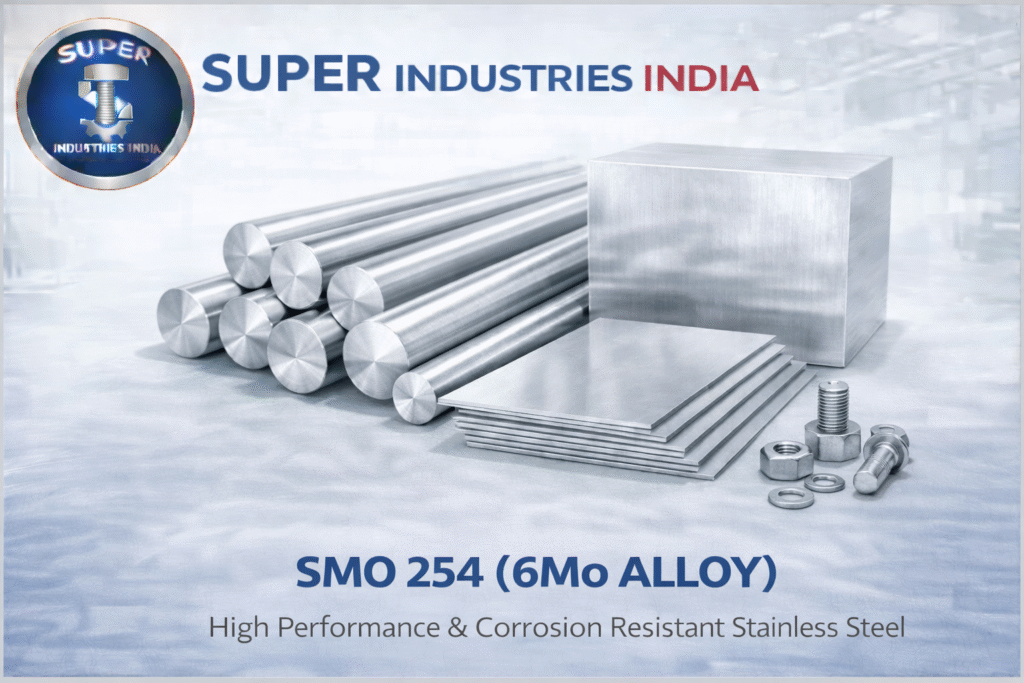
Superior Corrosion Defense: SMO 254 (6Mo Alloy) Fasteners for Extreme Chloride Environments
When industrial demands push beyond the limits of standard high-performance alloys like Duplex and even basic Hastelloys, specialized materials become mandatory. SMO 254 (UNS S31254), often referred to as 6Mo Alloy, is a super-austenitic stainless steel engineered to deliver exceptional resistance to pitting and crevice corrosion in highly concentrated chloride solutions, particularly seawater. Super Industries India, a specialized manufacturer and supplier of advanced superalloy fasteners in India, provides certified SMO 254 bolts, nuts, and studs vital for offshore, chemical processing, and desalination plants worldwide.
What is SMO 254 (6Mo Alloy)? The Super Austenitic Advantage
SMO 254 is a high-alloy stainless steel that belongs to the “6-Molybdenum” family, distinguished by its incredibly high content of corrosion-fighting elements:
- Chromium (≈20%): For general corrosion and oxidation resistance.
- Nickel (≈18%): To stabilize the austenitic structure and improve resistance to stress corrosion cracking (SCC).
- Molybdenum (≈6.1%): The key element that provides the superb resistance to pitting and crevice corrosion in chloride environments.
- Nitrogen (≈0.2%): Significantly boosts yield strength and enhances resistance to localized corrosion.
The performance of an alloy against chloride corrosion is quantified by its Pitting Resistance Equivalent Number (PREN). While SS 316 has a PREN of ≈25 and Duplex 2205 has a PREN of ≈35, SMO 254 boasts a PREN value typically above 43, placing it among the most resistant stainless steels available, often matching the performance of expensive nickel alloys.
Key Performance Benefits of SMO 254 Fasteners:
- Chloride Pitting Immunity: Designed specifically to resist chloride attack, making it ideal for seawater and brine applications.
- High Strength: The addition of Nitrogen provides a yield strength approximately double that of standard SS 304/316 austenitic steels.
- Excellent Ductility and Toughness: Maintains good toughness even at sub-zero temperatures.
- Cost-Effectiveness: Provides performance comparable to Nickel Alloys (like Hastelloy C-276) but is often a more cost-effective solution for aqueous corrosion challenges.
Critical Applications for SMO 254 Fasteners
The unique properties of 6Mo Alloy make it indispensable for infrastructure that deals with high concentrations of chlorides and salts. Super Industries India supplies SMO 254 fasteners primarily for these demanding sectors:
- Offshore & Marine: Fasteners for subsea equipment, pipe clamps, heat exchangers, and platform structural bolting where constant contact with aggressive seawater is unavoidable.
- Desalination Plants: Critical for securing components that handle hot, concentrated brine solutions—the most corrosive part of the process.
- Chemical Processing: Equipment handling concentrated salt solutions, chlorinated bleaching agents (e.g., in the Pulp & Paper industry), and brine cooling systems.
- Flue Gas Desulfurization (FGD): Fasteners for scrubbers and stacks in power plants exposed to corrosive gases and chloride-rich condensates.
Manufacturing Standards and Product Range
Manufacturing super-austenitic steels like SMO 254 requires tight control over raw material chemistry and hot/cold working processes to ensure optimal metallurgical structure and corrosion resistance. Super Industries India guarantees compliance with the most stringent global material specifications.
Key Compliance and Certifications
All our SMO 254 fasteners are certified to meet major international material standards:
- ASTM A276/A479: Standard specifications for stainless steel bars and shapes (raw stock for fasteners).
- ASTM F467 / F468: Covers nonferrous nuts and bolts, ensuring dimensional and mechanical compliance.
- UNS S31254: The universally recognized designation for SMO 254.
- Full Traceability: Every batch comes with a Material Test Certificate (MTC), ensuring verified chemical analysis and mechanical properties.
SMO 254 Fastener Product Line:
We supply custom and standard SMO 254 components ready for immediate deployment:
- SMO 254 Stud Bolts: Essential for flanged pipe joints in seawater lines and pressure vessels.
- SMO 254 Hex Bolts & Cap Screws: Used in structural bolting and equipment assembly.
- SMO 254 Heavy Hex Nuts: To match the high strength of the bolt and ensure proper clamp load.
- SMO 254 Washers: Flat, plain, and spring washers for load distribution and vibration resistance.
Choose Super Industries India for Certified 6Mo Alloy Supply
As a leading SMO 254 Fastener Manufacturer and Supplier in India, Super Industries India combines advanced material knowledge with precision engineering. We understand the cost implications of material failure in critical service and provide components that ensure maximum uptime and operational security.
By choosing our certified 6Mo Alloy fasteners, you are investing in a solution that offers:
- Maximum resistance to pitting and crevice corrosion.
- High mechanical strength from its nitrogen content.
- Reliable performance in seawater and chloride-rich industrial fluids.
Need high-PREN fasteners that won’t compromise under extreme marine or chemical exposure?
Contact Super Industries India today for expert technical advice and a competitive quote on certified SMO 254 (6Mo Alloy) fasteners.