
SPRING WASHERS (LOCK WASHERS)
EPC / EXPORT / MNC-GRADE TECHNICAL REFERENCE
Manufacturer & Global Exporter: Super Industries
Website: https://superindustriesindia.in
1. Industry Context
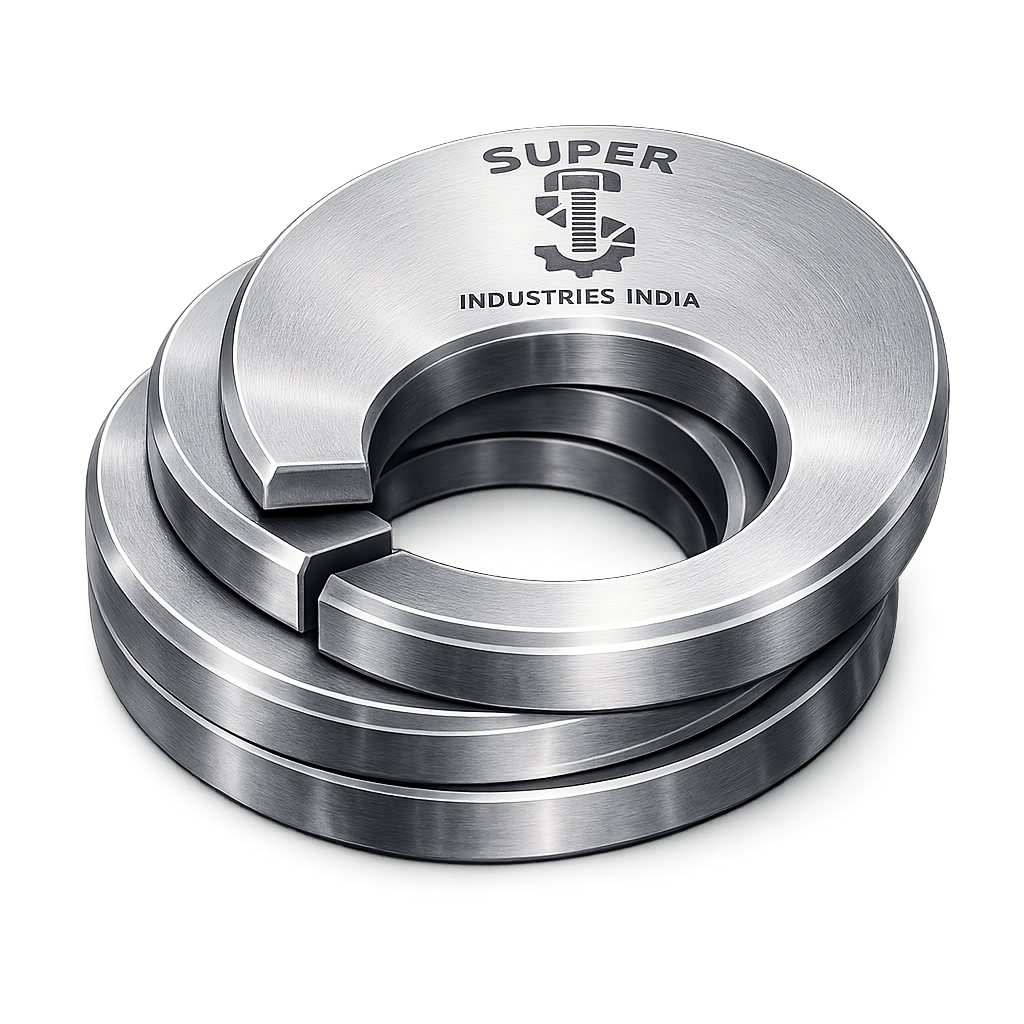
Why Spring Washers (Lock Washers) Are Used in EPC Projects
In EPC assets, bolted joints are exposed to vibration, thermal cycling, transient loads, and installation scatter. Where the joint design, service envelope, or maintenance philosophy permits, Spring Washers (Lock Washers) are introduced to maintain clamp force and frictional resistance as interfaces experience micro-slip and relaxation.
Spring washers are not universal solutions. They are application-specific elastic elements used to compensate for limited loss of preload and to increase resistance to rotation under defined conditions. EPC specifications therefore constrain their use by standard, hardness, geometry, and service environment, and frequently prohibit them in pressure-retaining or primary structural joints.
When correctly selected and installed, spring washers:
- Provide elastic compliance within the joint stack
- Increase interface friction to resist self-loosening
- Compensate for minor embedment and settlement
- Improve short-term preload retention under vibration
When misapplied, they can introduce false confidence. This page therefore defines where spring washers belong—and where they do not.
2. Technical Definition
What Are Spring Washers / Lock Washers?
Spring Washers (Lock Washers) are metal washers with elastic geometry that store energy when compressed. Unlike plain washers, they deflect under load, producing a restoring force that acts against joint relaxation and rotational loosening.
Key distinctions:
- Plain washers: no elastic function; load distribution only
- Disc springs (Belleville): engineered springs with defined load-deflection curves
- Wedge-lock systems: mechanical cams that prevent rotation independent of preload
Spring washers rely on elastic deformation and friction, not positive locking.
3. Functional Role in Bolted Joints
Elastic Compensation
As bolt preload decays due to embedding or thermal effects, a spring washer’s stored energy maintains residual contact pressure, delaying loss of clamp force.
Frictional Retention
Split or profiled geometry increases contact pressure at edges, raising friction at the nut/washer or washer/joint interface.
Limitation Acknowledgement
Spring washers do not create preload and cannot recover large preload losses. Their effectiveness depends on:
- Correct hardness relative to mating surfaces
- Proper installation orientation
- Appropriate joint stiffness ratio
4. Engineering Relevance of Washer Weight & Geometry
Thickness and Free Height
- Determines available elastic travel
- Influences spring rate and load retention
Outer Diameter (OD) and Inner Diameter (ID)
- OD affects bearing area and stability
- ID must clear the fastener shank without excessive play
Split Angle / Profile Geometry
- Governs edge contact pressure and friction
- Excessive split angle can damage mating surfaces
Mass and Inertia
In dynamic assemblies, washer mass influences vibration response and long-term seating behavior.
5. Dimensional & Weight Determination Logic
Selection parameters include:
- Nominal bolt size and standard series
- Washer thickness and free height
- Material modulus and hardness
- Tolerance class per DIN / ISO / ASME
Weight is derived from geometry and material density and is relevant for engineering take-offs and EPC logistics planning.
6. Types of Spring Washers & Performance Characteristics
Split Lock Washers
- Most common form
- Helical split introduces elastic deflection
- Effective for light to moderate vibration
Heavy-Duty Spring Washers
- Thicker section, higher spring force
- Used where greater preload retention is required
Curved Spring Washers
- Single-direction curvature
- Provide smoother load-deflection behavior
Wave Spring Washers
- Multiple waves increase deflection range
- Suitable for limited axial space and controlled loads
DIN vs ISO vs ASME Differences
- Geometry, thickness, and tolerance philosophy vary
- EPC projects typically mandate one standard only
7. Material & Standard Alignment
Governing Standards
- DIN 127 / DIN 7980
- ISO 7088 / ISO 7090
- ASME B18.21.1
Material Options
- Carbon Steel: general industrial use
- Alloy Steel: higher spring force and fatigue resistance
- Stainless Steel (A2 / A4): corrosion-resistant environments
Surface Finishes
- Plain / black
- Zinc plated
- Phosphate
- Specialty coatings where specified
Material hardness must exceed that of the joint surface to prevent flattening and loss of spring action.
8. Manufacturing & Quality Discipline
Manufacturing Stages
- Blanking and forming
- Controlled heat treatment for spring properties
- Surface finishing / coating
- Dimensional and hardness inspection
Quality Control Focus
- Spring deflection consistency
- Hardness range compliance
- Split geometry accuracy
- Surface condition and coating thickness
- Batch traceability
Inconsistent heat treatment directly compromises washer performance.
9. Procurement, Installation & Inspection View
EPC Procurement Checks
- Correct standard and size series
- Material grade and hardness specification
- Compatibility with bolt and nut materials
Inspection Focus
- Visual confirmation of split and profile
- Hardness verification where required
- Coating integrity and coverage
- MTC and traceability
Installation Discipline
- Washer placed directly under nut or bolt head as specified
- No stacking unless explicitly approved
- Replace washers after disassembly where deformation is evident
10. Application Mapping
Spring Washers are typically applied in:
- Oil & Gas: secondary supports, instrumentation
- Power: auxiliaries, enclosures
- Petrochemical & LNG: non-pressure mechanical assemblies
- Hydrogen: carefully controlled, corrosion-sensitive areas
- Infrastructure: equipment frames, access structures
They are generally excluded from:
- Pressure-retaining joints
- Primary structural bolting
- Critical fatigue-loaded connections
11. Professional Technical Tables
Indicative Size Range (Metric)
| Bolt Size | Typical Washer Thickness | Free Height |
|---|---|---|
| M3 – M100 | Standardized by series | Series-defined |
Material vs Service Environment
| Material | Environment Suitability |
|---|---|
| Carbon Steel | Dry / controlled |
| Zinc-Plated CS | Mild outdoor |
| Alloy Steel | High vibration |
| SS A2 | Corrosive |
| SS A4 | Marine / chemical |
Customization Capabilities
- Non-standard thickness or free height
- Project-specific coatings
- Controlled hardness ranges
- Special tolerance classes
12. Manufacturer-Focused Conclusion
Spring Washers (Lock Washers) are conditional components in EPC bolted joints. Their value lies in controlled elastic behavior, not in generic locking claims. Correct performance depends on geometry, hardness, material compatibility, and disciplined installation.
Super Industries supplies spring washers with:
- Standards-aligned geometry
- Controlled heat treatment and hardness
- Consistent elastic performance
- Traceability suitable for EPC and consultant review
This ensures spring washers are used where appropriate, perform as intended, and do not introduce hidden joint risk.
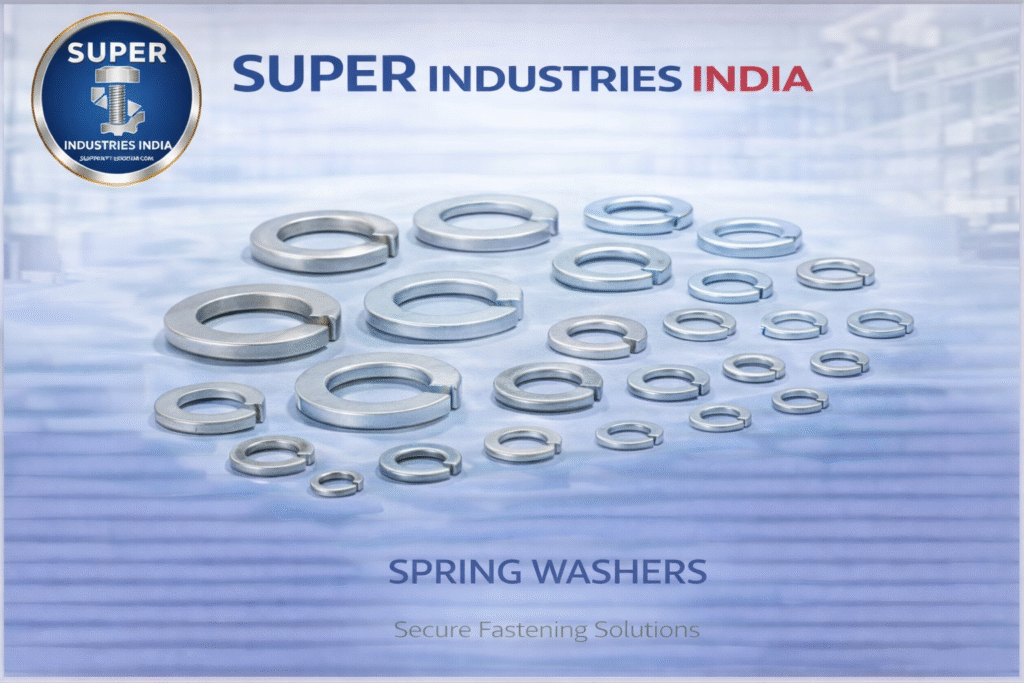
Spring Washers (Lock Washers) Manufacturer in India | DIN 127 & IS 56 Specialist
Vibration-Proof Fastening: High-Performance Spring Washers from Super Industries India
In any mechanical assembly subjected to dynamic loads, vibration, or thermal expansion, fastener security is non-negotiable. Super Industries India is a leading manufacturer and supplier of Spring Washers—also widely known as Lock Washers—in India, engineered specifically to prevent bolted joints from loosening under strenuous operational conditions.
Unlike plain washers, which distribute load, Spring Washers are essential components that introduce a crucial element of tension into the fastener assembly. This tension acts as a compensating force, maintaining the required clamping load and ensuring the nuts and bolts remain securely fastened, drastically improving the reliability and safety of your machinery.
The Critical Function of a Spring Washer
The primary role of a spring washer is to provide a pre-load or a compensating spring action that maintains friction between the nut and the joint material.
- Anti-Loosening Mechanism: The unique coil or wave shape of the washer, when compressed during tightening, exerts an axial spring force. This force resists rotational loosening caused by vibrations, shock, or minor settlement (creep) of the joint material.
- Preventing Relaxation: In assemblies involving soft materials, the material often compresses or “relaxes” over time, reducing the clamping force. The spring washer maintains pressure, filling the gap created by this relaxation.
- Cost-Effective Security: Spring washers are a simple, economical, and highly effective method for securing fasteners compared to specialized self-locking nuts or adhesives.
Our Extensive Range: Coil, Wave, and Curved Washers
We specialize in manufacturing the most widely used types of spring washers, adhering to strict international dimensional and material specifications, including the core Indian standard IS 56 and global standard DIN 127.
1. Split Coil Spring Washers (Helical Lock Washers)
These are the most common type, featuring a single, helical coil cut with a slight twist.
| Type | Standard | Key Feature | Locking Mechanism |
| Normal Spring Washer | DIN 127 Type B / IS 56 | Rectangular cross-section with sharp, digging edges at the split ends. | Provides a spring compensation and bites into the nut and joint surface. |
| Square Spring Washer | DIN 127 Type A | Square cross-section with a thinner width, designed for lighter duties. | Offers spring action and a degree of bite on the joint surfaces. |
Application Focus: General construction, machinery, automotive component assembly, and any application prone to medium vibration.
2. Wave and Curved Spring Washers
These washers are non-contiguous (not split) and are designed to provide lighter, more consistent loads over a smaller deflection range, often used in precision or stacked assemblies.
- Wave Washers (DIN 137): Feature a smooth, continuous wave shape around the circumference. They are ideal for applications requiring a cushioned take-up of minor deflections without excessive force.
- Curved Washers (DIN 137): Feature a simple curved or bowed shape. They provide minimal spring action, typically used for small adjustments or to absorb minor play.
Precision Materials and Corrosion Protection
The efficacy of a spring washer relies entirely on its ability to maintain tension. We achieve this through meticulous material selection and controlled heat treatment.
High-Grade Materials for Resilience
- Spring Steel (Carbon Steel): The industry-standard material (e.g., EN 42J or equivalent) for coil and split washers, achieving maximum elasticity and hardness through a precisely controlled quenching and tempering heat treatment process. This ensures the washer maintains its spring tension under compression.
- Stainless Steel (SS 304, SS 316): Used for Stainless Steel Spring Washers in environments where superior corrosion resistance is mandatory, such as chemical plants, marine structures, and food processing equipment.
- Bronze & Copper: Used for specialized electrical applications where non-magnetic properties or conductivity are required.
Corrosion-Resistant Finishes
To guarantee long-term performance, especially in India’s varied and demanding climatic conditions, we offer various protective coatings:
- Zinc Plated (Electro-Galvanized): Provides standard protection against surface rust in dry or indoor conditions. Available in White/Blue or Yellow Passivation.
- Hot Dip Galvanized (HDG): Essential for large-diameter, heavy-duty washers used in outdoor structural steel, offering superior long-term corrosion resistance.
- Black Phosphate: A cost-effective, aesthetic finish providing mild rust inhibition.
- Mechanical Plating (Zinc): Offers an alternative to HDG, providing a uniform, thick coating without the risk of hydrogen embrittlement sometimes associated with electroplating high-tensile spring steel.
Spring Washer Standards and Technical Specifications
We ensure that all our spring washers conform to the exact dimensional and mechanical properties mandated by industry bodies:
| Standard | Description | Key Dimensions Covered |
| IS 56:2018 (Type B) | Indian Standard for Split Spring Washers (Rectangular section). | Inner Diameter (ID), Outer Diameter (OD), and Thickness (s). |
| DIN 127 (Type A & B) | German (International) standard for Spring Lock Washers. | Defines the geometry, including the coil gap and material hardness. |
| JIS B 1251 | Japanese Industrial Standard for spring washers. | Alternative dimensions sometimes used in machinery imported to India. |
We stock a full metric range from M3 spring washers up to large M64 lock washers, available for immediate dispatch across India.
Why Super Industries India for Lock Washers?
When you choose us as your Spring Washer manufacturer, you are securing:
- Guaranteed Pre-Load: Our controlled heat treatment guarantees the elastic recovery and locking performance necessary to maintain the clamping force.
- Standards Compliance: Every batch is tested to confirm adherence to IS 56 and DIN 127 specifications for reliable interchangeability.
- Custom Solutions: We manufacture non-standard spring washers based on your specific ID, OD, and thickness requirements, including high-tolerance precision washers.
Ensure your critical assemblies never fail under vibration. Partner with Super Industries India for superior quality Spring Lock Washers.
Contact our technical team today to discuss your application’s vibrational load or to request a quote for bulk supply of standard and customized spring washers.