
STAINLESS STEEL
- STAINLESS STEEL
- 1️⃣ Industry Context
- 2️⃣ Technical Definition
- 3️⃣ Stainless Steel Families & Metallurgy
- 4️⃣ Engineering & Service Relevance
- 5️⃣ Grade Selection Logic
- 6️⃣ Mechanical Properties & Service Behavior
- 7️⃣ Corrosion Performance & Environment Matching
- 8️⃣ Standards & Specification Alignment
- 9️⃣ Manufacturing & Quality Discipline
- 🔟 Procurement, Fabrication & Inspection View
- 1️⃣1️⃣ Application Mapping
- 1️⃣2️⃣ Professional Technical Tables
- 1️⃣3️⃣ Manufacturer-Focused Conclusion
- Premium Stainless Steel Fasteners: The Corrosion-Resistant Advantage for Indian Industry
- Why Stainless Steel is the Material of Choice for Industrial Fasteners
- The Key Stainless Steel Grades We Supply (A2, A4, and More)
- Certifications and Fastener Types
- Serving India’s Industrial Hubs with Quality SS Fasteners
Core Engineering Material for EPC, Export & Capital Projects
Manufacturer & Global Exporter: Super Industries
Website: https://superindustriesindia.in
1️⃣ Industry Context
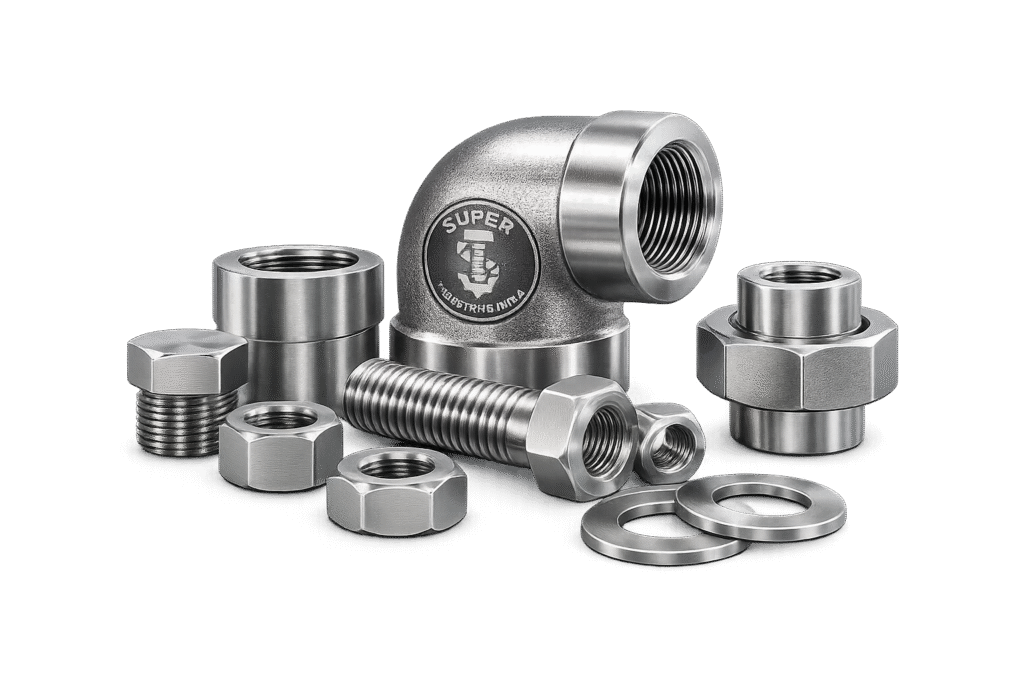
Why Stainless Steel Remains a Core Material in EPC and Capital Projects
Across EPC-driven industries—Oil & Gas, Power, Petrochemical, LNG, Hydrogen, Chemical Processing, and Infrastructure—stainless steel remains the most widely specified corrosion-resistant material family. Its dominance is not driven by cost alone, but by a unique balance of corrosion resistance, mechanical reliability, fabrication flexibility, global code acceptance, and predictable lifecycle behavior.
Unlike carbon steels that require external corrosion protection, stainless steels provide intrinsic corrosion resistance through alloy chemistry and surface passivation. Compared with high-nickel alloys, stainless steels offer a lower total installed cost while meeting the majority of service requirements encountered in process, pressure, and structural systems.
For EPC contractors and consultants, stainless steel is often the baseline material against which all higher-alloy selections are justified. Correct grade selection therefore plays a critical role in:
- Safety and reliability
- Lifecycle cost control
- Inspection and maintenance strategy
- Long-term asset integrity
2️⃣ Technical Definition
What Stainless Steel Is and How Corrosion Resistance Is Achieved
Stainless steel is an iron-based alloy containing a minimum of approximately 10.5% chromium. This chromium content enables the formation of a thin, adherent, and self-healing chromium-oxide passive film on the surface.
Passivation Logic
- When exposed to oxygen, chromium reacts to form Cr₂O₃
- The oxide layer prevents further metal dissolution
- If damaged, the layer reforms automatically in oxygenated environments
This passive behavior differentiates stainless steel from carbon steel, which corrodes continuously once exposed.
Key Implication for EPC Projects
Corrosion resistance is not uniform across all stainless steels. It depends on:
- Chromium content
- Additional alloying elements (nickel, molybdenum, nitrogen)
- Microstructure and heat treatment
- Surface condition and fabrication quality
3️⃣ Stainless Steel Families & Metallurgy
Microstructure, Behavior, and Engineering Implications
Stainless steels are categorized by metallurgical structure, which directly governs strength, corrosion resistance, weldability, and service limits.
Austenitic Stainless Steels
- Structure: Fully austenitic (FCC)
- Examples: 304/304L, 316/316L, 321, 347
- Characteristics:
- Excellent corrosion resistance
- High ductility and toughness
- Non-magnetic (annealed condition)
- Susceptible to chloride stress corrosion cracking
Ferritic Stainless Steels
- Structure: Ferritic (BCC)
- Examples: 430, 444
- Characteristics:
- Good resistance to chloride SCC
- Lower toughness than austenitic grades
- Limited high-temperature strength
Martensitic Stainless Steels
- Structure: Martensitic
- Examples: 410, 420
- Characteristics:
- Higher strength and hardness
- Moderate corrosion resistance
- Heat treatable
Duplex Stainless Steels
- Structure: ~50% ferrite / ~50% austenite
- Examples: 2205
- Characteristics:
- Higher strength than austenitic grades
- Improved resistance to chloride SCC
- Good corrosion resistance
Super Duplex Stainless Steels
- Enhanced duplex chemistry
- Examples: 2507, Zeron-type alloys
- Characteristics:
- Very high strength
- Excellent pitting and crevice corrosion resistance
- Offshore and marine suitability
4️⃣ Engineering & Service Relevance
Why Engineers Specify Stainless Steel
Corrosion Resistance
Stainless steels resist general corrosion in a wide range of environments, reducing reliance on coatings and corrosion allowance.
Mechanical Performance
Different families allow engineers to balance:
- Strength requirements
- Wall thickness optimization
- Weight reduction
Fabrication Behavior
Stainless steels are:
- Weldable with qualified procedures
- Available globally in standardized product forms
- Compatible with automated fabrication processes
Lifecycle Performance
Correctly selected stainless steel grades deliver:
- Long service life
- Predictable degradation behavior
- Reduced inspection burden
5️⃣ Grade Selection Logic
When and Why Engineers Choose Specific Grades
304 / 304L
- General-purpose corrosion resistance
- Non-chloride environments
- Low carbon (L-grade) for weldability
316 / 316L
- Added molybdenum for improved pitting resistance
- Suitable for moderate chloride exposure
- Widely used in Oil & Gas and Chemical plants
321 / 347
- Stabilized grades with titanium or niobium
- Improved resistance to sensitization at elevated temperature
410 / 420
- Higher strength requirements
- Limited corrosion exposure
- Valves, shafts, mechanical components
Duplex (2205)
- Higher strength and improved chloride resistance
- Pressure piping and offshore service
Grade selection is driven by environment, temperature, pressure, fabrication method, and design life—not by nominal corrosion resistance alone.
6️⃣ Mechanical Properties & Service Behavior
Strength, Toughness, and Temperature Limits
Strength
- Austenitic grades: Moderate yield, high ductility
- Duplex grades: Approximately double the yield strength of austenitic grades
Toughness
- Austenitic grades retain toughness at low temperatures
- Ferritic and martensitic grades require careful temperature consideration
Temperature Limits
- Austenitic grades: Good high-temperature oxidation resistance
- Duplex grades: Typically limited to ~300 °C for long-term service
Fabrication Implications
- Work hardening during machining
- Heat input control during welding
- Post-weld cleaning to restore corrosion resistance
7️⃣ Corrosion Performance & Environment Matching
Matching Stainless Steel to Service Conditions
General Corrosion
All stainless steels resist general corrosion better than carbon steel in most environments.
Pitting & Crevice Corrosion
Driven primarily by chloride concentration and temperature. Molybdenum-containing grades (316, Duplex) perform better.
Stress Corrosion Cracking (SCC)
- Austenitic grades are susceptible in hot chloride environments
- Duplex and ferritic grades provide improved resistance
Environment Matching Is Critical
Incorrect grade selection is a leading cause of premature stainless steel failure in EPC projects.
8️⃣ Standards & Specification Alignment
Global Code Acceptance
Stainless steels are covered by all major international standards:
- ASTM: Material specifications for pipes, fittings, flanges, fasteners
- ASME Section II: Allowable stresses for pressure design
- EN / ISO / DIN: European and international harmonization
This universal acceptance simplifies:
- Vendor qualification
- Third-party inspection
- Cross-border EPC procurement
9️⃣ Manufacturing & Quality Discipline
Ensuring Reliable Stainless Steel Components
Melting & Refining
- Controlled chemistry
- Low impurity levels
Forging & Machining
- Grain flow aligned with load paths
- Dimensional accuracy for pressure components
Heat Treatment
- Solution annealing where required
- Controlled cooling to prevent deleterious phases
Surface Condition
- Pickling and passivation to restore corrosion resistance
Traceability & Inspection
- Heat number traceability
- PMI verification
- Mechanical and NDT testing as specified
🔟 Procurement, Fabrication & Inspection View
What EPC Teams Verify
EPC engineers, inspectors, and consultants typically verify:
- Chemical composition and grade compliance
- Mechanical properties
- Heat treatment records
- PMI results
- Welding procedure qualification compatibility
- Dimensional and surface condition compliance
1️⃣1️⃣ Application Mapping
Oil & Gas
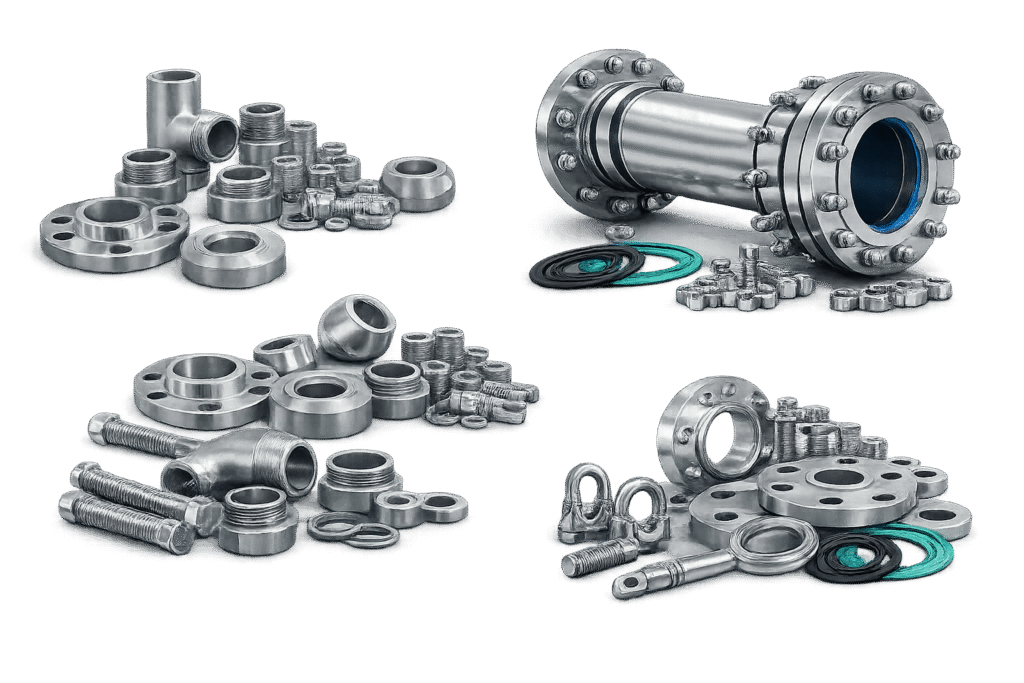
Process piping, pressure vessels, fasteners, structural components.
Power & Energy
Cooling systems, condensers, balance-of-plant piping.
Petrochemical & LNG
Corrosion-resistant piping and fittings.
Hydrogen
High-pressure piping and components with corrosion control.
Chemical & Food-Grade Industrial
Hygienic systems, reactors, storage.
Infrastructure
Bridges, coastal installations, water systems.
1️⃣2️⃣ Professional Technical Tables
Stainless Steel Families & Grades
| Family | Typical Grades |
|---|---|
| Austenitic | 304, 304L, 316, 316L, 321, 347 |
| Ferritic | 430, 444 |
| Martensitic | 410, 420 |
| Duplex | 2205 |
| Super Duplex | 2507 |
Chemical Composition – Indicative
| Grade | Cr % | Ni % | Mo % |
|---|---|---|---|
| 304 | 18–20 | 8–10.5 | – |
| 316 | 16–18 | 10–14 | 2–3 |
| 2205 | 21–23 | 4.5–6.5 | 2.5–3.5 |
Mechanical Properties (Typical)
| Grade | Yield Strength (MPa) | Tensile Strength (MPa) |
|---|---|---|
| 304 | ~215 | ~505 |
| 316 | ~205 | ~515 |
| 2205 | ~450 | ~620 |
Corrosion Resistance Comparison
| Environment | Recommended Grades |
|---|---|
| Mild industrial | 304 |
| Moderate chlorides | 316 |
| High chlorides | Duplex / Super Duplex |
Maximum Typical Service Temperatures
| Family | Approx. Limit |
|---|---|
| Austenitic | ~870 °C (oxidizing) |
| Duplex | ~300 °C |
| Martensitic | ~600 °C |
Typical Product Forms
| Product | Availability |
|---|---|
| Pipes & Tubes | Seamless / Welded |
| Forged Fittings | Elbows, tees, outlets |
| Flanges | All pressure classes |
| Fasteners | Studs, bolts, nuts |
| Custom Forgings | EPC drawings |
Grades vs Applications
| Application | Preferred Grade |
|---|---|
| General piping | 304 / 316 |
| Chloride service | 316 / Duplex |
| High strength piping | Duplex |
| Mechanical parts | 410 / 420 |
Project-Specific Customization Options
| Parameter | Options |
|---|---|
| Grade | EPC-specified |
| Size & rating | As per MTO |
| Heat treatment | Solution annealed |
| Inspection | PMI, UT, PT |
| Certification | EN 10204 3.1 / 3.2 |
1️⃣3️⃣ Manufacturer-Focused Conclusion
Stainless Steel remains the foundation material for EPC and capital projects due to its balance of corrosion resistance, mechanical reliability, fabrication flexibility, and global standardization.
Its successful application depends on correct grade selection, disciplined manufacturing, and rigorous quality control—not on generic material assumptions.
Super Industries manufactures stainless steel components under controlled processes aligned with international standards and EPC expectations. Our focus on metallurgical discipline, traceability, and export-grade inspection supports safe, reliable, and long-term performance across demanding industrial environments.
Premium Stainless Steel Fasteners: The Corrosion-Resistant Advantage for Indian Industry
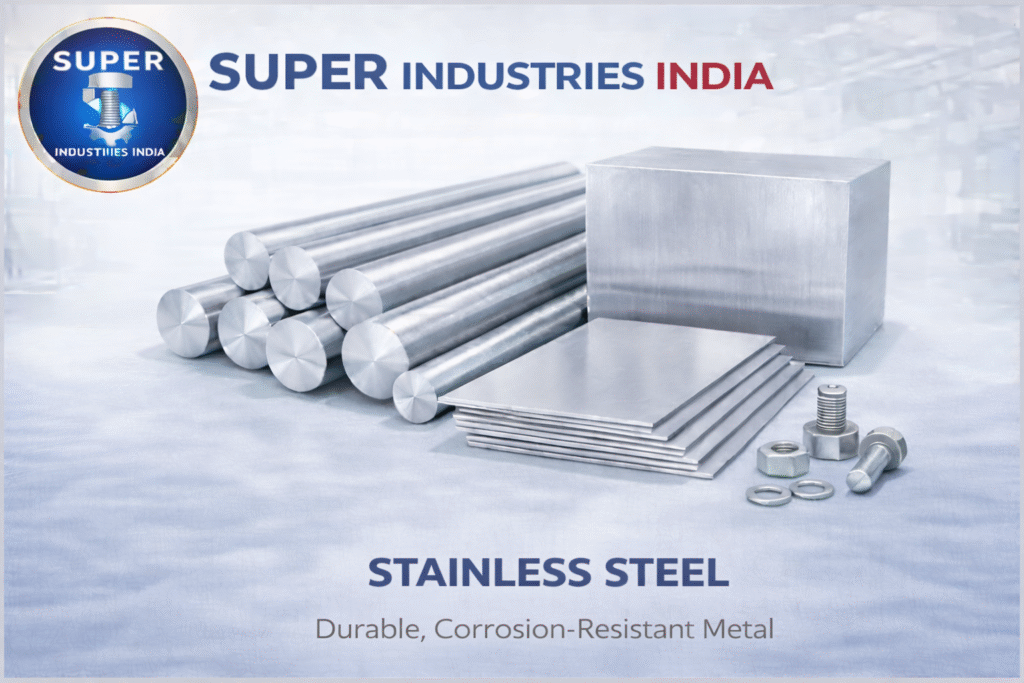
Choosing the right material is crucial for the longevity and reliability of any bolted assembly. At Super Industries India, a leading manufacturer and supplier of fasteners in India, we specialize in high-quality Stainless Steel (SS) fasteners that offer unparalleled performance, especially in demanding environments. Our comprehensive range of SS materials ensures that whether your application involves high humidity, corrosive chemicals, or stringent hygiene standards, you’ll find the perfect solution.
Why Stainless Steel is the Material of Choice for Industrial Fasteners
Stainless Steel is not a single metal but an iron alloy containing a minimum of 10.5% chromium. This chromium layer forms a thin, passive oxide film that automatically self-repairs in the presence of oxygen, providing the material with its defining characteristic: superior corrosion resistance.
Here’s why SS fasteners are essential for your projects:
- Exceptional Corrosion Resistance: Prevents rust and degradation, making it ideal for marine, coastal, and outdoor applications in India’s varied climates.
- High Strength-to-Weight Ratio: Offers excellent mechanical properties without excessive weight.
- Aesthetic Appeal: Provides a clean, bright finish that is often preferred in architectural and visible applications.
- Heat and Fire Resistance: Maintains structural integrity at high temperatures better than standard carbon steel.
- Hygiene and Cleanliness: Easy to sterilize, making it the standard for the food processing, pharmaceutical, and medical industries.
- Full Recyclability: Stainless steel is 100% recyclable, aligning with sustainable industrial practices.
The Key Stainless Steel Grades We Supply (A2, A4, and More)
At Super Industries India, our inventory focuses on the most common and robust stainless steel grades used in critical fastening applications, conforming to international standards like ASTM and ISO.
1. Austenitic Stainless Steel (The Most Popular Choice)
Austenitic grades are non-magnetic, possess excellent weldability, and are highly corrosion-resistant due to their high nickel and chromium content.
| SS Grade (International Standard) | Common Name (Indian/European) | Key Characteristics & Uses |
| SS 304 (A2 Grade) | 18/8 Stainless Steel (18% Chromium, 8% Nickel) | The workhorse of stainless steel. Offers great corrosion resistance to most everyday chemicals and environments. Ideal for: General construction, food processing equipment, and architectural hardware. The most cost-effective SS fastener. |
| SS 316 (A4 Grade) | Marine Grade Stainless Steel | Contains Molybdenum, which significantly boosts resistance to pitting and crevice corrosion, especially against chlorides (salts). Ideal for: Coastal areas, marine applications, chemical plants, and environments exposed to road salt or brine. |
| SS 316L (A4L Grade) | Low Carbon Variant of 316 | Offers even better weldability than 316 due to lower carbon content, reducing the risk of sensitization (weld decay). Ideal for: Welded assemblies and thick components. |
2. Other High-Performance Grades
We also offer specialized grades for extreme mechanical requirements:
- Martensitic Stainless Steel (e.g., SS 410): These are magnetic and can be hardened by heat treatment to achieve high tensile strength (e.g., in self-tapping screws) but offer slightly lower corrosion resistance than Austenitic grades.
- Duplex Stainless Steel: Combines the best properties of Austenitic and Ferritic steels, offering extremely high strength and superior stress corrosion cracking resistance. Ideal for offshore and severe chemical processing applications.
Certifications and Fastener Types
As a trusted Stainless Steel fastener manufacturer in India, every product we supply is traceable and compliant with global quality benchmarks.
Key Material Specifications & Standards
We manufacture SS fasteners to meet specific property classes, which define their strength:
- A2-70 & A4-70: The ’70’ indicates a tensile strength of 700 MPa (MegaPascals). This is the standard high-strength specification for most SS 304 and SS 316 fasteners.
- A2-80 & A4-80: Used for high-strength applications, indicating a tensile strength of 800 MPa.
- ASTM F593: Specifies Stainless Steel Bolts, Hex Cap Screws, and Studs.
- ASTM F594: Specifies Stainless Steel Nuts.
Our Range of Stainless Steel Fasteners Includes:
- SS Bolts: Hex Head Bolts, Carriage Bolts, Flange Bolts.
- SS Nuts: Hex Nuts, Nylock Nuts (DIN 985 SS 304/316), Jam Nuts, Coupling Nuts.
- SS Washers: Plain Washers, Spring Washers, Star Washers.
- SS Screws: Machine Screws, Tapping Screws, Socket Head Cap Screws.
- SS Studs: Threaded Rods, Stud Bolts.
Serving India’s Industrial Hubs with Quality SS Fasteners
Super Industries India understands the critical need for reliable supply across the nation. We are a key Stainless Steel fastener supplier catering to major industrial sectors in Mumbai, Pune, Delhi NCR, Chennai, Ahmedabad, Bangalore, and beyond.
Our commitment is to deliver precision, durability, and compliance, ensuring your structure or machinery remains secure and corrosion-free for decades.
Looking for certified A2 or A4 grade Stainless Steel fasteners for your critical application?
Contact Super Industries India today for the best prices and swift delivery of high-tensile, corrosion-resistant solutions.