
JAM NUTS
- JAM NUTS
- 1️⃣ Industry Context
- 2️⃣ Technical Definition
- 3️⃣ Functional Locking Principle
- 4️⃣ Engineering Intent & Limitations
- 5️⃣ Jam Nut Configurations
- 6️⃣ Joint Integrity Considerations
- 7️⃣ Material Selection & Service Behavior
- 8️⃣ Standards & Specification Alignment
- 9️⃣ Manufacturing & Quality Discipline
- 🔟 Installation & Torque Strategy
- 1️⃣1️⃣ EPC Procurement & Consultant Review View
- 1️⃣2️⃣ Application Mapping
- 1️⃣3️⃣ Professional Technical Tables
- 1️⃣4️⃣ Manufacturer-Focused Conclusion
- The Essential Guide to Jam Nuts: High-Performance Thin Hex Nuts from Super Industries India
- What is a Jam Nut (Thin Nut) and Why is it Essential?
- Technical Specifications & Standards
- Superior Materials for Unmatched Performance
- Why Choose Super Industries India for Your Jam Nut Requirements?
Secondary Locking Elements for Space-Constrained, Non-Critical Industrial Joints
Manufacturer & Global Exporter: Super Industries
Website: https://superindustriesindia.in
1️⃣ Industry Context
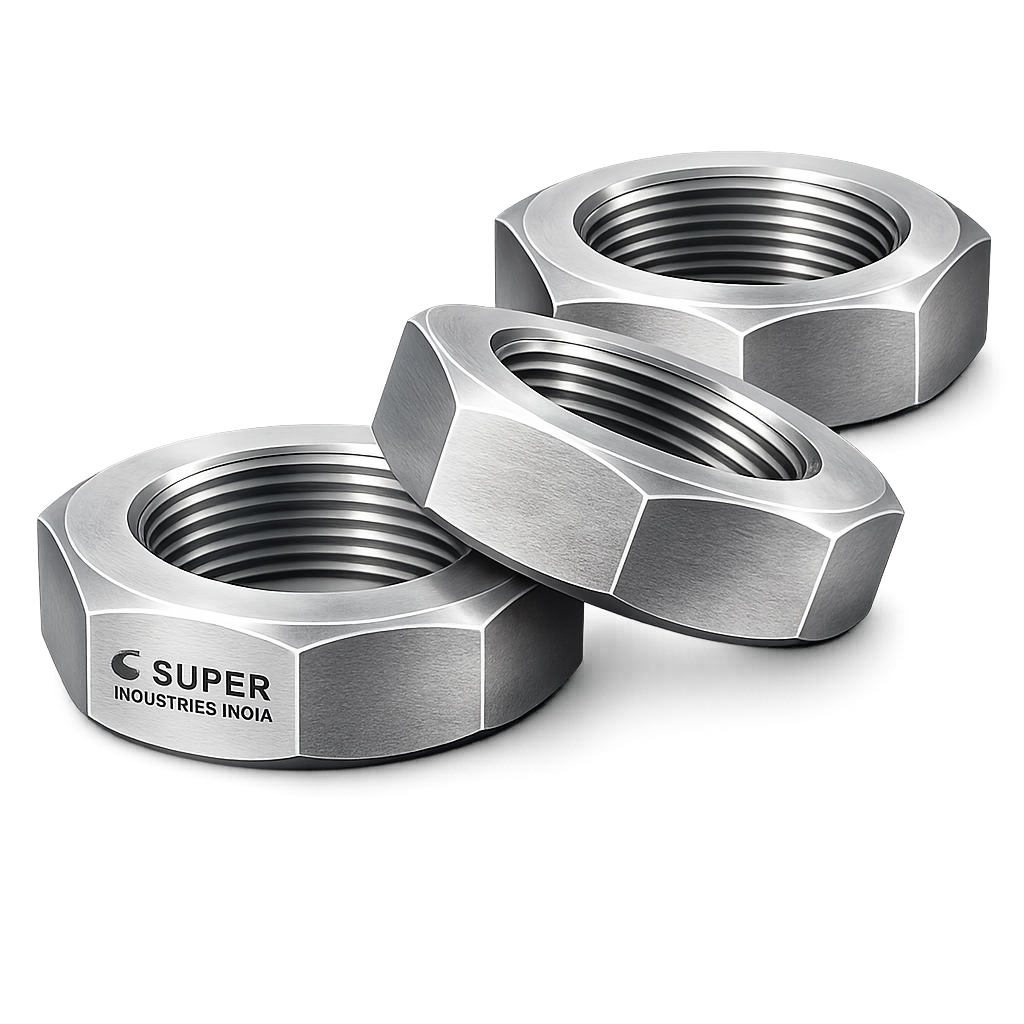
Why Jam Nuts Exist — and Why They Are Not Primary Locking Systems
In industrial fastening, jam nuts exist to solve a specific, narrow problem: how to stabilize an adjusted position or maintain a setting when space constraints prevent the use of larger locking devices. They are secondary locking elements, not substitutes for engineered locking fasteners.
In EPC and export projects, jam nuts appear most often where:
- Adjustment is required and must be held in position
- Space is limited along the threaded length
- Loads are low and largely static
- Joint separation is not safety-critical
Conversely, jam nuts are not approved as primary locking solutions in:
- Structural connections
- Pressure-retaining joints
- Vibration-prone assemblies
- Fatigue-critical bolted joints
Their role is positional locking, not load-bearing joint integrity. Understanding this distinction is fundamental to correct specification and consultant approval.
2️⃣ Technical Definition
What Jam Nuts Are and Why Thickness Matters
A jam nut is a nut with reduced thickness compared to a standard hex nut, intended to be used in conjunction with a second nut on the same threaded fastener. The defining characteristics are:
- Thinner height than a standard nut of the same thread size
- Identical internal thread form
- Used as part of a two-nut locking arrangement, not alone
Thickness is critical because:
- Reduced height lowers load-carrying capacity
- Thread engagement is intentionally limited
- The nut is optimized for locking friction, not preload retention
A jam nut used alone behaves as an under-strength primary nut and is therefore unacceptable in engineered joints.
3️⃣ Functional Locking Principle
How Jam Nuts Actually Lock
Jam nut locking is based on opposing preload and friction, not on mechanical deformation or prevailing torque.
The locking sequence works as follows:
- The primary (standard) nut is tightened to achieve the desired preload or position.
- The jam nut is tightened against the primary nut.
- Opposing axial forces create thread interference and increased friction between the mating threads.
The result is:
- Resistance to relative rotation between the two nuts
- Stabilization of the adjusted position
Importantly, the locking action occurs between the nuts, not between the nut and the joint. This is why jam nuts do not replace engineered locking devices.
4️⃣ Engineering Intent & Limitations
Load Capacity, Vibration Sensitivity, Torque Dependency
From a joint-integrity perspective, jam nuts have inherent limitations:
- Reduced Load Capacity
The thin section provides less thread shear area and lower resistance to tensile load. - Torque-Dependent Performance
Locking effectiveness depends entirely on correct tightening sequence and torque ratio. - Poor Vibration Resistance
Under transverse vibration, friction-based locking can degrade, especially if preload is low. - No Fail-Safe Behavior
If preload is lost, there is no secondary retention mechanism.
For these reasons, EPC specifications treat jam nuts as auxiliary devices, approved only where failure does not propagate risk.
5️⃣ Jam Nut Configurations
Jam Nut + Standard Nut Assembly
The most common and acceptable configuration:
- Standard nut provides preload or positional setting
- Jam nut provides frictional locking
Thin Jam Nuts vs Regular Hex Nuts
- Thin jam nuts: optimized for locking, not load
- Regular hex nuts: used as primary load-bearing element
Same-Hand vs Reverse-Hand Threads
- Same-hand threads: most common, simpler procurement
- Reverse-hand threads: occasionally used for specialized adjustment mechanisms, not common in EPC projects
Configuration choice must be justified by access, space, and service behavior, not convenience.
6️⃣ Joint Integrity Considerations
Preload Distribution, Fatigue Risk, Cyclic Loading
When jam nuts are used, engineers must recognize:
- The majority of load is carried by the primary nut
- The jam nut introduces localized stress concentrations
- Uneven preload distribution can increase fatigue risk
Under cyclic loading:
- Micro-slip between threads can occur
- Friction locking effectiveness may decay over time
As a result, jam nuts are not recommended where fatigue life governs design.
7️⃣ Material Selection & Service Behavior
Carbon Steel
- Common for general industrial use
- Adequate for dry, indoor environments
Alloy Steel
- Higher strength, better wear resistance
- Used where repeated adjustment is expected
Stainless Steel
- Suitable for corrosive environments
- Galling risk must be addressed via lubrication or material pairing
Material choice is governed by:
- Corrosion exposure
- Adjustment frequency
- Compatibility with mating fasteners
Jam nuts are generally not reused indefinitely; inspection after disassembly is essential.
8️⃣ Standards & Specification Alignment
Jam nuts are referenced within:
- ASTM fastener material standards
- DIN / ISO dimensional standards for thin nuts
However:
- Standards define geometry and material only
- They do not approve application suitability
EPC consultants evaluate jam nuts based on:
- Joint criticality
- Load path analysis
- Failure consequence
Compliance with a standard does not guarantee approval.
9️⃣ Manufacturing & Quality Discipline
Thread Accuracy
- Precise pitch and profile required for predictable locking behavior
Thickness Control
- Consistent height ensures uniform friction characteristics
Surface Finish
- Excessively rough finishes increase galling risk
- Over-smooth finishes reduce friction
Traceability & Inspection
- Material verification
- Dimensional inspection
- Visual inspection for edge cracking
Manufacturing discipline directly affects locking reliability, even in secondary applications.
🔟 Installation & Torque Strategy
Correct Sequence and Common Errors
Correct sequence:
- Tighten primary nut to specified preload or position
- Hold primary nut stationary
- Tighten jam nut against primary nut
Torque considerations:
- Jam nut torque is typically lower than primary nut torque
- Over-tightening can reduce effective preload in the primary nut
Common field errors:
- Reversing tightening sequence
- Applying equal torque to both nuts
- Using jam nuts as standalone fasteners
Installation errors are the most common cause of jam-nut failure.
1️⃣1️⃣ EPC Procurement & Consultant Review View
Jam nuts are typically approved for:
- Adjustment screws
- Instrument supports
- Light mechanical linkages
- Non-pressure, non-structural assemblies
They are typically rejected for:
- Pressure systems
- Structural steel
- Rotating equipment
- Safety-critical connections
Consultants look for explicit justification when jam nuts are proposed.
1️⃣2️⃣ Application Mapping
Typical approved uses:
- Instrumentation mounts
- Calibration screws
- Alignment fixtures
- Light brackets
Explicitly excluded uses:
- Flanged joints
- Load-bearing bolting
- Lifting points
- Fatigue-critical assemblies
1️⃣3️⃣ Professional Technical Tables
Thread Sizes & Thickness Ranges
| Thread Size | Typical Jam Nut Thickness |
|---|---|
| M6 – M12 | ~0.4–0.5 × standard nut |
| M16 – M24 | ~0.45 × standard nut |
Jam Nut vs Standard Nut Comparison
| Parameter | Jam Nut | Standard Nut |
|---|---|---|
| Thickness | Reduced | Full |
| Load Capacity | Low | Full |
| Locking Role | Secondary | Primary |
Material Grades vs Service Environments
| Material | Environment |
|---|---|
| Carbon Steel | Dry indoor |
| Alloy Steel | Repeated adjustment |
| Stainless Steel | Corrosive / outdoor |
Recommended Applications
| Application | Suitability |
|---|---|
| Adjustment mechanisms | Suitable |
| Instrument brackets | Suitable |
| Structural joints | Not permitted |
Project-Specific Customization Options
| Option | Availability |
|---|---|
| Material grade | Project-specified |
| Surface finish | Plain, plated, passivated |
| Marking | Heat / lot traceable |
1️⃣4️⃣ Manufacturer-Focused Conclusion
Jam Nuts are deliberate, application-limited components intended for secondary locking only. They do not replace engineered locking systems, nor do they provide inherent joint integrity under load or vibration.
Super Industries manufactures jam nuts with dimensional accuracy, material discipline, and transparent application boundaries aligned with EPC expectations. We support their use only where technically appropriate, reinforcing safe specification, consultant acceptance, and responsible joint-integrity design.
The Essential Guide to Jam Nuts: High-Performance Thin Hex Nuts from Super Industries India
Securing Connections Where Space is Limited: Your Trusted Indian Manufacturer & Supplier of Jam Nuts
In the world of heavy machinery, demanding infrastructure, and critical mechanical assemblies, the integrity of every bolted joint is paramount. When persistent vibration, dynamic loads, or space constraints threaten to loosen standard fasteners, the robust and low-profile Jam Nut is the undisputed solution.
At Super Industries India, we specialize in the precision manufacturing and supply of high-quality Jam Nuts (also known as Thin Nuts, Thin Hex Nuts, or Half-Height Nuts), engineered to provide a secondary, powerful locking mechanism for your most demanding applications. As a leading fastener manufacturer and supplier in India, we ensure superior material quality, precise threading, and compliance with global standards (ASME, DIN, ISO).
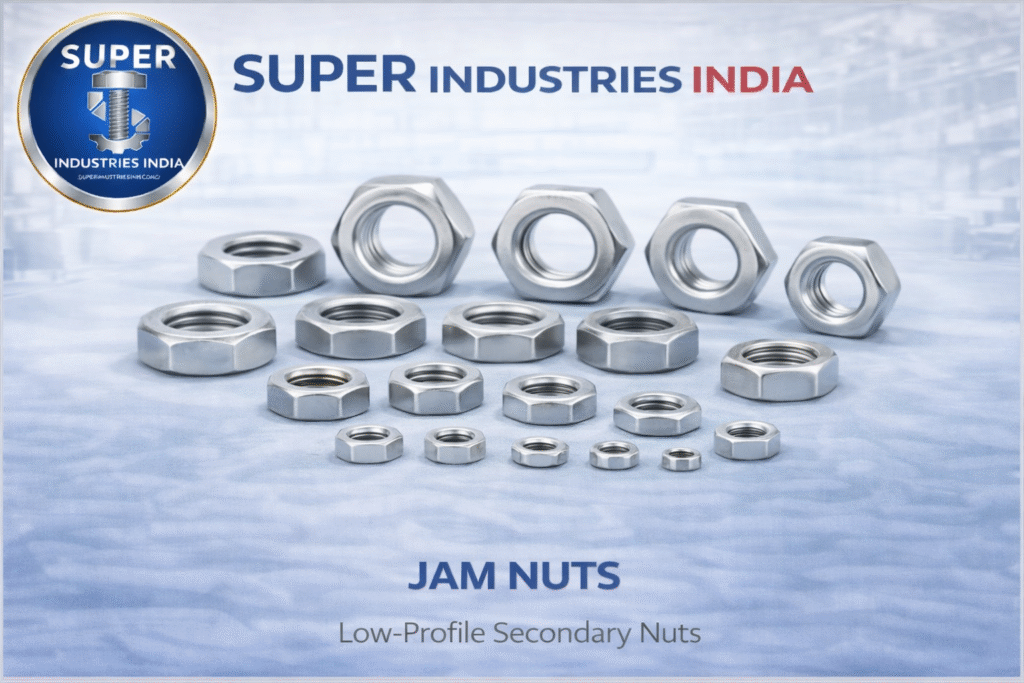
What is a Jam Nut (Thin Nut) and Why is it Essential?
A Jam Nut is a type of hexagonal nut that is significantly thinner—typically about half the height—than a standard hex nut. Its design is not intended to bear the primary load of a joint alone, but to function as a crucial locknut or a compact securing device in tight spaces.
The Lock-Nut Principle (Double-Nutting Technique)
The most common and effective use of a Jam Nut is in the “double-nutting” technique:
- The Jam Nut is threaded onto the bolt first and tightened lightly.
- A standard, full-height hex nut is then threaded on top and tightened to the full required torque.
- Finally, the Jam Nut is held in place with a wrench while the outer nut is tightened against it.
This process jams the two nuts against each other, creating a constant opposing tension on the bolt threads. This tension locks the assembly in place, preventing self-loosening even under extreme vibration and varying thermal conditions.
Key Applications of Super Industries India Jam Nuts
Our precision-engineered Thin Hex Nuts are indispensable across a broad spectrum of industries where reliability and space efficiency are non-negotiable:
| Industry | Typical Application | Benefit of Using Our Jam Nuts |
| Oil & Gas / Petrochemical | Pipe Flange Assemblies, Valve Stem Adjustment, Pump Housing. | Superior corrosion resistance (SS 316/Alloy Steel) and vibration locking. |
| Construction & Infrastructure | Anchor Bolt Assemblies, Bridge Structures, Rail Systems. | Secure locking for high-vibration, high-stress environments. |
| Automotive & Machinery | Engine Mounts, Threaded Rod Assemblies, Machine Adjustment Mechanisms. | Low-profile design fits tight clearances while ensuring component stability. |
| Renewable Energy | Solar Panel Racks, Wind Turbine Blade Adjustment, Heavy Equipment. | Durable materials and robust locking for long-term outdoor exposure. |
| Power Generation | Turbine Fasteners, Boiler Assemblies, Electrical Busbar Connections. | High-strength performance in elevated temperature settings. |
Technical Specifications & Standards
As a trusted Jam Nut Exporter from India, we adhere to the most stringent international dimensional and mechanical standards to guarantee interchangeability and performance.
| Parameter | Super Industries India Specification | Standards & Dimensions |
| Dimensional Standards | Compliance with all major global norms. | ASME B18.2.2 (Inch Series), DIN 439 (Hexagonal Thin Nuts), ISO 4035 (Hexagon Thin Nuts) |
| Thread Type | Coarse & Fine Threads, ensuring a perfect match. | UNC, UNF, ISO Metric Coarse, ISO Metric Fine |
| Size Range | Catering to all industrial requirements, from light to heavy duty. | Metric: M6 to M100 and above. Imperial: 1/4″ to 4″ and larger. |
| Forging Method | Precision controlled for optimal material grain structure. | Hot Forged & Cold Forged |
| Coating / Finish | Enhancing durability and corrosion resistance. | Plain, Zinc Plated (Yellow/Blue), Hot Dip Galvanized (HDG), Black Oxide, PTFE Coated |
Superior Materials for Unmatched Performance
The selection of the right material is critical for the Jam Nut’s long-term performance in corrosive or high-temperature conditions. We manufacture our Jam Nuts from a comprehensive range of materials:
Stainless Steel Jam Nuts (SS Jam Nuts)
- Stainless Steel 304 (A2): Excellent corrosion resistance for general, outdoor, and marine environments.
- Stainless Steel 316 (A4): Superior resistance to chlorides and acids, ideal for marine and chemical processing industries.
High-Strength & Carbon Steel
- Carbon Steel: Available in standard grades like ASTM A563 Grade A, B, C for general-purpose applications.
- High Tensile Steel: Equivalent to SAE J995 Grades 5 and 8 for high proof load and structural integrity.
Exotic & Alloy Materials
- Duplex & Super Duplex Steel: For exceptional strength and corrosion resistance in aggressive environments.
- Nickel Alloys: Including Inconel, Monel, and Hastelloy for extreme high-temperature and highly corrosive applications.
- Brass & Copper: For specialized non-magnetic or conductivity requirements.
Why Choose Super Industries India for Your Jam Nut Requirements?
Choosing the right fastener partner is as critical as choosing the right fastener. Super Industries India stands out as the top Jam Nut supplier in Mumbai, India, offering distinct advantages:
- Guaranteed Precision: Our manufacturing facility utilizes state-of-the-art machinery to ensure all dimensional tolerances (especially height and threading) meet the stringent demands of ASME and DIN specifications.
- Ready Stock & Custom Orders: We maintain a vast inventory of standard M10, M12, M16, and M20 Jam Nuts in Stainless Steel and Carbon Steel, ensuring quick delivery. We also excel in manufacturing custom sizes and non-standard material grades as per your project blueprint.
- Certifications & Quality Assurance: All products are supplied with comprehensive material test reports and certifications, affirming compliance with industry standards and your specified requirements.
- Competitive Pricing: Leveraging our efficient production and strategic sourcing, we offer the best value for high-quality industrial-grade Hex Jam Nuts in the Indian market.
Get a Quote Today
Don’t compromise on the security and stability of your critical assemblies. For reliable, high-performance Jam Nuts and Thin Hex Nuts that meet the toughest standards, trust the expertise of Super Industries India.
Contact us today to discuss your specific requirements, request a detailed technical catalogue, or get a competitive quote.