
THREAD ROLLING DIES
Engineering Tooling for EPC-Grade Fastener Manufacturing & Cold Forming Consistency
Manufacturer & Global Exporter: Super Industries
Website: https://superindustriesindia.in
Industry Context
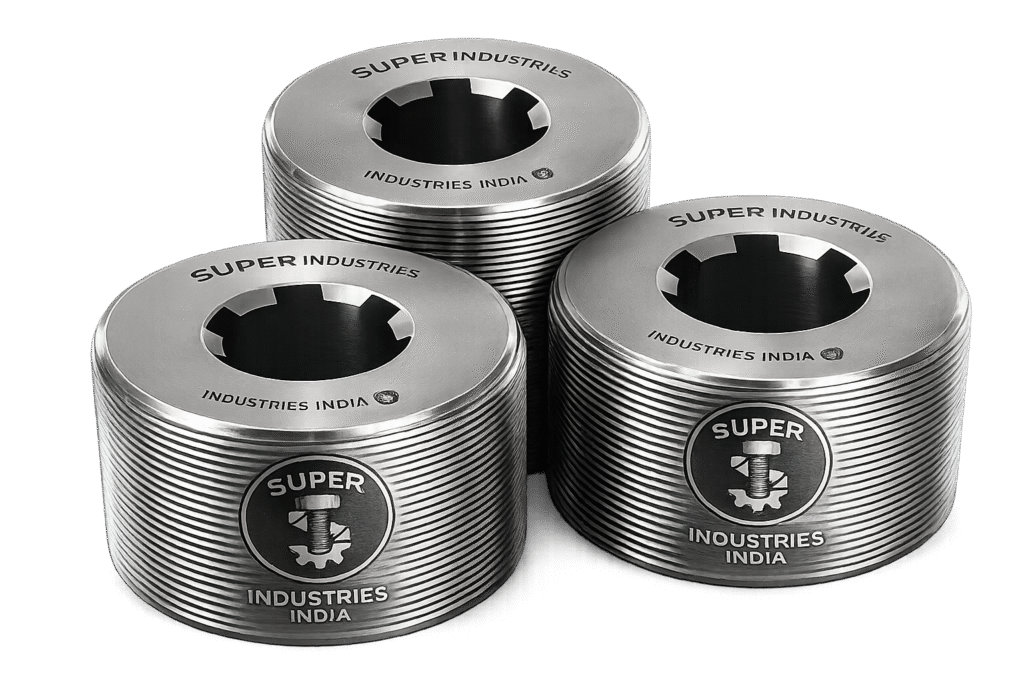
Why Thread Rolling Dies Are Critical in Modern Fastener Manufacturing
In Tier-1 EPC supply chains, the mechanical integrity of fasteners is not evaluated in isolation. Consultants, inspectors, and OEM auditors increasingly assess the manufacturing process itself, including how threads are produced. Thread rolling dies sit at the core of this evaluation because they directly influence fatigue life, dimensional consistency, surface finish, and long-term reliability of bolts, studs, screws, and rods supplied into capital projects.
Thread rolling has replaced thread cutting for most critical fasteners because EPC projects demand:
- Predictable mechanical performance across high volumes
- Repeatable dimensions across production lots
- Improved fatigue resistance in cyclic service
- Process traceability and controllable variability
Thread rolling dies are therefore not consumable accessories. They are precision forming tools whose design, metallurgy, grinding accuracy, and wear behavior directly determine whether a fastener manufacturer is EPC-credible or not.
Technical Definition
What Thread Rolling Dies Are and How They Function
Thread rolling dies are hardened, precision-ground tooling components used to form threads on cylindrical blanks by plastic deformation rather than material removal. During rolling, the blank material flows into the die profile, creating a thread with continuous grain flow.
Key defining features:
- Threads are formed, not cut
- No chips are generated
- The blank diameter is carefully calculated
- Final thread geometry depends on die accuracy and alignment
Unlike cutting taps or chasers, rolling dies rely on controlled compressive forces, making die geometry, surface finish, and hardness absolutely critical.
Engineering Advantages of Thread Rolling
Why EPC-Grade Fasteners Are Almost Always Rolled
Grain Flow Integrity
Rolled threads maintain uninterrupted grain flow following the thread contour. This significantly improves:
- Fatigue resistance
- Crack initiation resistance
- Performance under cyclic and vibratory loads
Surface Finish
Thread rolling produces:
- Lower surface roughness (Ra)
- Compressive residual stresses
- Reduced stress concentration at the thread root
Dimensional Repeatability
With correctly designed dies:
- Pitch diameter variation is tightly controlled
- Thread angle consistency is maintained
- Large production batches remain within tolerance
From an EPC standpoint, this directly reduces joint variability and long-term failure risk.
Die Selection & Design Logic
Engineering Variables That Govern Die Design
Thread rolling dies are not interchangeable commodities. Correct selection requires alignment of multiple parameters:
Thread Parameters
- Thread form (Metric, UNC, UNF, special)
- Pitch and lead accuracy
- Root radius requirements
Blank Characteristics
- Blank diameter tolerance
- Material grade and hardness
- Surface condition prior to rolling
Production Factors
- Production volume (short run vs mass production)
- Machine type and rigidity
- Target cycle time
Incorrect die selection leads to:
- Oversized or undersized pitch diameters
- Excessive die wear
- Surface tearing or folding
- Rejected batches during inspection
Types of Thread Rolling Dies & Characteristics
Flat Thread Rolling Dies
- Used in reciprocating flat-die machines
- Ideal for screws, bolts, and small fasteners
- High productivity with controlled die length
Cylindrical (Round) Dies
- Used on two-roll or three-roll machines
- Suitable for studs, rods, and larger diameters
- Excellent concentricity control
Planetary Thread Rolling Dies
- High-volume, continuous production
- Extremely tight dimensional consistency
- Common in automotive and EPC-linked fastener plants
Specialty Dies
- For step threads, partial threads, or special profiles
- Used in project-specific or non-standard fasteners
Material & Standard Alignment
Tool Steels, Carbides, and Heat Treatment Discipline
Die Materials
- High-alloy tool steels for general applications
- Powder metallurgy steels for extended tool life
- Carbide inserts for abrasive or high-volume production
Heat Treatment Logic
Thread rolling dies require:
- High surface hardness for wear resistance
- Controlled core toughness to prevent cracking
- Stable microstructure under cyclic load
Standards Relevance
While thread rolling dies themselves are not always standardized products, they are designed to produce threads compliant with ISO, DIN, ASTM, and project-specific EPC specifications. Die accuracy must therefore exceed the tolerance requirements of the finished fastener.
Manufacturing & Quality Discipline
What Separates Industrial-Grade Dies from EPC-Grade Dies
EPC-acceptable thread rolling dies require:
- Precision CNC grinding of thread profiles
- Verified pitch accuracy across die length
- Controlled surface finish to prevent material pickup
- Consistent hardness mapping across working faces
Quality control typically includes:
- Profile measurement using optical comparators
- Hardness testing (surface and core)
- Trial rolling validation on representative blanks
- Lot traceability linked to production batches
Procurement, Setup & Inspection View
What Engineers, Inspectors, and Manufacturing Heads Verify
During tooling approval or audits, reviewers evaluate:
- Die type suitability for fastener geometry
- Compatibility with machine configuration
- Expected tool life vs production volume
- Heat treatment records
- Trial output dimensional reports
Improvised or under-specified dies are often flagged during vendor audits, even if finished fasteners appear dimensionally acceptable.
Application Mapping
Where Thread Rolling Dies Support EPC Supply Chains
Thread rolling dies directly support fastener production for:
- Oil & Gas bolting systems
- Power plant fasteners
- Petrochemical and refinery hardware
- LNG and hydrogen infrastructure
- Structural and industrial fasteners for infrastructure
Their performance impacts not only the fastener, but entire joint reliability philosophies used in EPC projects.
Professional Technical Tables
Thread Rolling Die Types vs Applications
| Die Type | Typical Application |
|---|---|
| Flat dies | Screws, bolts |
| Cylindrical dies | Studs, rods |
| Planetary dies | High-volume fasteners |
Compatible Thread Forms & Sizes
| Thread Form | Common Range |
|---|---|
| Metric | M3 – M64 |
| UNC / UNF | 1/4″ – 2″ |
| Special | Project-specific |
Material Hardness Ranges (Indicative)
| Blank Material Hardness | Die Selection Consideration |
|---|---|
| Low carbon steel | Standard tool steel |
| Alloy steel | Enhanced wear-resistant dies |
| Stainless steel | Optimized profile & coating |
Expected Tool Life vs Production Volume
| Production Volume | Recommended Die Strategy |
|---|---|
| Low | Standard precision dies |
| Medium | Enhanced wear-resistant dies |
| High | Carbide or planetary dies |
Custom Die Development Options
- Non-standard thread profiles
- Modified lead-in geometry
- Partial or stepped threads
- Project-specific tolerances
Manufacturer-Focused Conclusion
Thread Rolling Dies are foundational to fastener manufacturing discipline. They determine whether threads exhibit controlled geometry, repeatable mechanical performance, and long-term reliability demanded by EPC, infrastructure, and export projects.
Failures in die design, material selection, or grinding accuracy propagate directly into fatigue failures, dimensional rejections, and audit non-conformances—often long after installation.
Super Industries approaches thread rolling dies with tooling-level engineering discipline, focusing on:
- Profile accuracy
- Metallurgical control
- Wear predictability
- Production traceability
This aligns tooling performance with the expectations of consultants, inspectors, and EPC procurement teams, not just internal production targets.
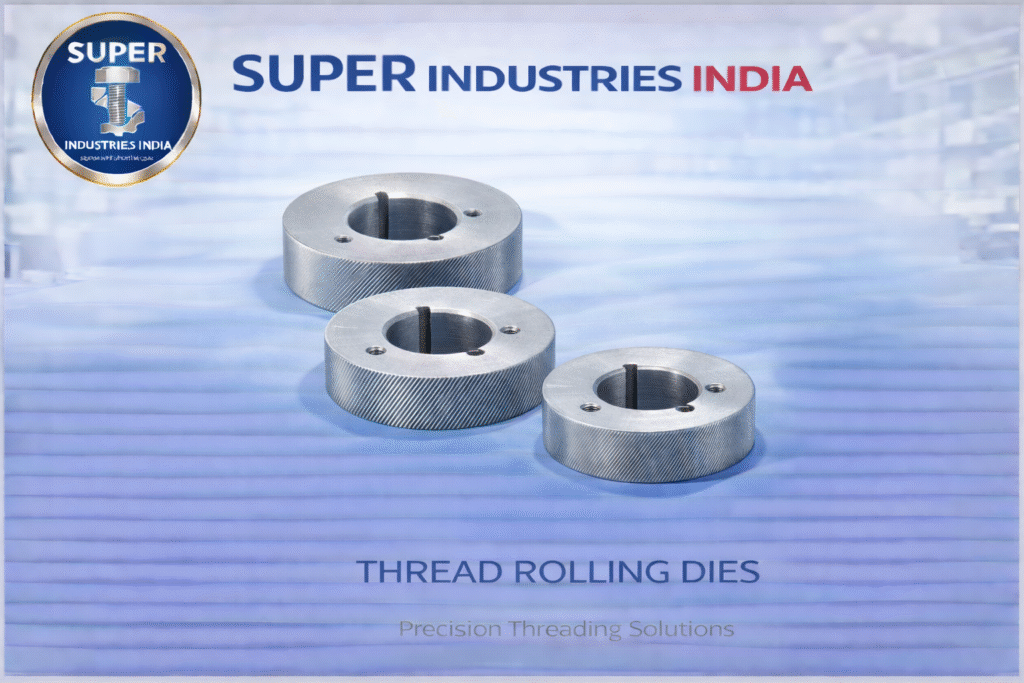
Superior Quality Thread Rolling Dies: Precision Manufacturing | Super Industries India
Welcome to Super Industries India, your trusted partner and a leading manufacturer of high-precision Thread Rolling Dies in India. In the demanding landscape of the automotive, construction, and fastener industries, the quality of your threaded components is paramount. We provide world-class rolling tools that are engineered for exceptional performance, extended die life, and ultimate cost efficiency, ensuring your production line operates at peak potential.
Why Choose Thread Rolling Dies from Super Industries India?
The choice of threading tool directly impacts the strength, finish, and cost-effectiveness of your final product. At Super Industries India, we leverage decades of expertise, advanced material science, and stringent quality control to deliver rolling dies that consistently outperform.
The Inherent Advantage of Rolled Threads
Unlike thread cutting, which removes material and severs the grain structure, thread rolling is a cold-forming process. This results in numerous superior benefits that our dies are specifically designed to maximize:
- Enhanced Strength: The cold-forming process rearranges the material’s grain structure to follow the thread’s contour, not cut across it. This densifies the material and imparts compressive residual stresses at the thread roots, significantly increasing the tensile strength, shear strength, and fatigue resistance of the component (often by 50-75% over cut threads).
- Superior Surface Finish: The rolling process burnishes the thread surface, creating a smooth, unblemished finish free from tears or chatter marks, which reduces friction and susceptibility to corrosion.
- Material Savings (No Chip Waste): Since thread rolling is a metal displacement process, there is no material wastage in the form of chips, leading to higher material utilization and a greener manufacturing process.
- Exceptional Accuracy and Consistency: Our precision-ground dies ensure the thread form is accurately reproduced on every single component, maintaining tight tolerances on pitch diameter and lead throughout long, high-volume production runs.
- Longer Tool Life and Reduced Downtime: Thread rolling dies have a remarkably longer operational life compared to cutting tools, drastically reducing tool changeover time and lowering your overall cost-per-piece.
Our Comprehensive Range of Thread Rolling Dies
Super Industries India manufactures a diverse portfolio of dies to suit every machine and application, from high-speed production of standard fasteners to specialized rolling of high-strength components.
1. Flat Thread Rolling Dies
- Description: Rectangular blocks with a parallel thread form, used primarily on reciprocating flat die thread rolling machines. They are ideal for high-volume production of small to medium-sized fasteners, such as screws, bolts, and self-tapping screws.
- Applications: Standard Fasteners, Self-Tapping Screws, Wood Screws, Lag Bolts, and specialized long-thread rolling.
- Material: Manufactured using premium grade D2, D3, or HSS M2/M42 tool steels, hardened for maximum wear resistance and dimensional stability.
2. Cylindrical (Circular) Thread Rolling Dies
- Description: Round dies used in two-die or three-die cylindrical thread rolling machines. They offer superior accuracy, especially for components requiring better concentricity (less run-out), making them a preferred choice for precision parts.
- Types of Feed:
- In-feed/Plunge Rolls: Used for rolling threads of a length shorter than the die width. The dies move radially into the blank.
- Through-feed Rolls: Used for rolling threads that are longer than the die width, allowing the workpiece to feed axially between the rotating dies.
- Applications: Precision Bolts, Automobile Components (e.g., tie rods, axle parts), ACME threads, Trapezoidal threads, and high-strength studs.
Engineering Excellence: The Super Industries India Difference
High-Grade Material Selection
The foundation of a superior rolling die is the base material. We select certified, premium-grade High-Speed Steel (HSS M2, M35, M42) and Cold Work Tool Steel (D2, D3). These materials are chosen for their exceptional toughness, wear resistance, and ability to hold a precise thread form under high rolling pressure.
Precision Grinding and Heat Treatment
Our manufacturing process involves:
- Accurate Thread Form Generation: Utilizing state-of-the-art CNC grinding technology to achieve impeccable thread profiles, lead accuracy, and helix angles.
- Controlled Heat Treatment: A meticulously controlled vacuum heat treatment process to achieve the optimal hardness (59-64 HRC) and microstructure, ensuring a perfect balance between toughness and extreme wear resistance for maximum die life.
- Special Coatings (Optional): We offer specialized surface treatments and coatings for rolling dies used on challenging materials like stainless steel or components rolled after heat treatment (AHT), further extending their longevity.
Thread Forms We Manufacture
We supply dies for all international and national thread standards, including but not limited to:
- ISO Metric (M)
- Unified (UNC, UNF)
- British Standard Whitworth (BSW)
- ACME & Trapezoidal
- Pipe Threads (BSP, NPT)
- Special Profiles (Worm Shafts, Knurling, Serrations)
Partner with India’s Leading Thread Rolling Die Manufacturer
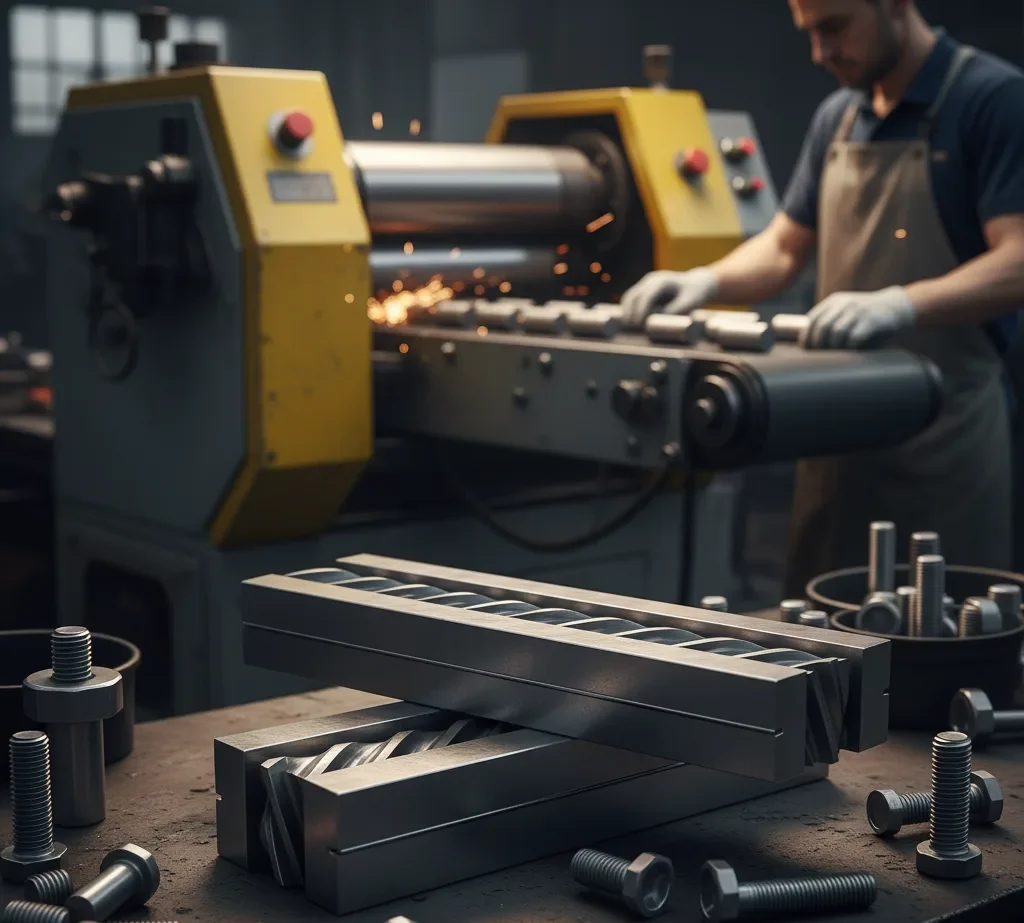
At superindustriesindia.in, we are committed to providing the Indian manufacturing sector with tools that drive efficiency and quality. Whether you are in the automotive, aerospace, construction, hardware, or general engineering industry, our thread rolling dies are engineered to meet your highest performance standards.
Request a Quote Today and let our technical experts help you select the perfect thread rolling die specifications to optimize your production and reduce your cost-per-thread. Trust Super Industries India for precision, durability, and a partnership built on quality.