
Metal Expansion Joints
Table of Contents
Engineering Reference for Piping Flexibility, Stress Control & EPC Capital Projects
Manufacturer & Global Exporter: Super Industries
Website: https://superindustriesindia.in
1️⃣ Industry Context: Why Metal Expansion Joints Are Critical in EPC & Capital Projects
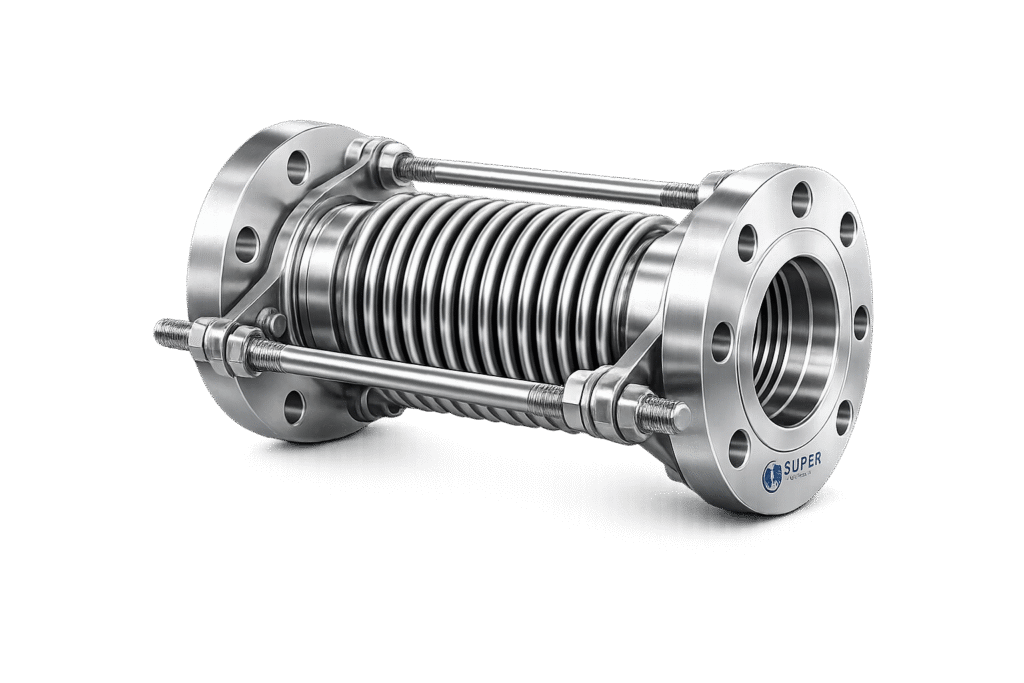
In large-scale EPC and capital projects, piping systems are not static structures. They are subjected to thermal growth, pressure-induced movement, mechanical vibration, settlement, and dynamic operating transients. If these movements are not engineered and controlled, the resulting stresses are transferred directly into piping, equipment nozzles, anchors, and civil foundations.
Metal Expansion Joints are introduced into piping systems to deliberately absorb these movements and isolate stresses. They are therefore classified as stress-mitigating pressure components, not optional accessories.
Across Oil & Gas, Power & Energy, Petrochemical, LNG, Hydrogen, Chemical processing, and Infrastructure projects, metal expansion joints are specified when:
- Thermal expansion exceeds allowable pipe stress limits
- Equipment nozzle loads must be strictly controlled
- Piping flexibility cannot be achieved through routing alone
- High-temperature or cyclic service precludes non-metallic solutions
- Long design life and inspection traceability are mandatory
For EPC contractors and piping stress consultants, expansion joints are explicitly modeled elements within stress analysis software. Their mechanical properties, spring rates, and pressure thrust characteristics directly influence system behavior. This makes metal expansion joints subject to intense consultant scrutiny and third-party inspection.
2️⃣ Technical Definition: What Metal Expansion Joints Are and How They Function
A metal expansion joint is a thin-walled, corrugated metallic bellows assembly designed to absorb dimensional changes in piping systems while maintaining pressure containment.
Core Construction Elements
A typical metal expansion joint consists of:
- Metal bellows – the flexible pressure-containing element
- End connections – welded ends, flanges, or special fittings
- Optional hardware – tie rods, hinges, gimbals, covers, liners
The bellows is manufactured from stainless steel or high-alloy strip and formed into a series of convolutions that allow controlled elastic deformation.
Functional Role in Piping Systems
Metal expansion joints function by:
- Absorbing axial expansion and contraction due to temperature change
- Accommodating lateral and angular movement from piping displacement
- Reducing reaction forces transmitted to anchors and equipment
- Isolating vibration from rotating or reciprocating machinery
They are installed as engineered flexibility devices, not as generic connectors.
3️⃣ Engineering Relevance: Stress Reduction, Pressure & Fatigue Behavior
Thermal Expansion Absorption
In high-temperature systems, even modest pipe lengths can generate significant thermal growth. Metal expansion joints absorb this movement locally, preventing excessive bending stress elsewhere in the system.
Pressure Containment and Thrust
Internal pressure generates pressure thrust proportional to the effective bellows area. If not controlled, this thrust can overload anchors. Expansion joint design must therefore account for:
- Internal pressure
- Bellows geometry
- Restraining hardware (if used)
Stress Reduction in Equipment Nozzles
Expansion joints protect sensitive equipment—such as pumps, compressors, turbines, and heat exchangers—from piping-induced loads that could otherwise lead to misalignment or mechanical failure.
Fatigue Life
Metal bellows are cycle-dependent components. Their fatigue life is determined by:
- Movement amplitude per cycle
- Number of operating cycles
- Pressure and temperature
- Bellows geometry and ply design
For EPC projects, fatigue life is matched to the defined design life of the plant.
4️⃣ Design & Performance Logic
Bellows Geometry
Key geometric parameters include:
- Convolution depth and pitch
- Number of convolutions
- Mean diameter
These parameters directly influence flexibility, spring rate, and fatigue resistance.
Ply Thickness and Construction
- Single-ply bellows: Simpler, used for moderate conditions
- Multi-ply bellows: Improved fatigue life and redundancy
Multi-ply construction is commonly preferred in EPC and continuous-process industries.
Spring Rates
The bellows behaves as a spring. Its axial, lateral, and angular spring rates are critical inputs to piping stress analysis and anchor design.
Pressure Thrust Management
Depending on configuration, pressure thrust is either:
- Absorbed by anchors (axial joints)
- Balanced internally (pressure-balanced joints)
- Restrained by hardware (hinged, gimbal joints)
Correct selection is fundamental to system safety.
5️⃣ Types of Metal Expansion Joints
Axial Expansion Joints
Designed to absorb axial movement only. Simplest design but impose pressure thrust on anchors.
Lateral Expansion Joints
Configured to absorb transverse displacement, often used in pairs or with offsets.
Angular Expansion Joints
Absorb angular rotation. Typically installed in sets to achieve lateral movement.
Universal Expansion Joints
Two bellows separated by a spool piece. Provide lateral movement with reduced thrust.
Pressure-Balanced Expansion Joints
Internally balanced to eliminate pressure thrust on anchors. Used where anchors cannot sustain thrust loads.
Hinged Expansion Joints
Allow angular movement in one plane while restraining axial pressure thrust.
Each type is selected based on piping layout, available anchors, and stress constraints.
6️⃣ Material & Standard Alignment
Material Selection
- SS 304 / 304L: General service, moderate temperatures
- SS 316 / 316L: Improved corrosion resistance, chloride exposure
- Higher alloys (Inconel, Hastelloy, etc.): High temperature or aggressive media
Material selection is aligned with corrosion allowance, temperature, and fatigue requirements.
Applicable Standards & Codes
- ASME Section VIII / ASME B31: Pressure design and piping integration
- ASTM A240 / A240M: Stainless steel strip and plate
- EJMA (Expansion Joint Manufacturers Association): Design methodology and fatigue criteria
- EN / ISO / DIN standards: Dimensional and testing harmonization
- MSS SP series: Industry practices for expansion joints
Compliance ensures acceptance during consultant audits and statutory inspection.
7️⃣ Manufacturing & Quality Discipline
Bellows Forming
Bellows are hydraulically or mechanically formed under controlled conditions to achieve uniform convolution geometry without inducing defects.
Welding Control
Longitudinal and circumferential welds are executed using qualified procedures. Weld integrity is critical for pressure containment and fatigue performance.
Ply Integrity
In multi-ply bellows, ply alignment and bonding are controlled to prevent fretting and stress concentration.
Testing & Inspection
- Dimensional verification
- Visual and surface inspection
- Leak testing (air, helium, or hydrostatic as specified)
- Material traceability and documentation
Manufacturing discipline directly influences EPC acceptance.
8️⃣ Procurement, Installation & Inspection View
During Technical Evaluation
EPC engineers and piping stress consultants verify:
- Expansion joint type and configuration
- Movement capacity and spring rates
- Pressure and temperature ratings
- Compliance with stress analysis assumptions
During Incoming Inspection
Inspectors review:
- Material certificates and traceability
- Bellows geometry and weld quality
- End connections and liners
- Test reports
During Installation
Correct installation is essential. Site teams ensure:
- Proper alignment without pre-stressing
- No torsional loading
- Correct orientation of hinges or tie rods
Installation errors can negate even the best design.
9️⃣ Application Mapping Across Industries
Oil & Gas
High-temperature process piping, compressor stations, offshore modules.
Power & Energy
Boiler connections, turbine piping, flue gas systems.
Petrochemical & Chemical
Reactor lines, columns, cyclic thermal service.
LNG
Cryogenic and thermal transition zones.
Hydrogen
Emerging piping systems with strict stress and leak criteria.
Infrastructure
District heating, utility corridors, constrained layouts.
🔟 Professional Technical Tables
Nominal Sizes & Pressure Classes
| Nominal Size (NB) | Typical Pressure Class |
|---|---|
| 25 – 50 | Class 150–300 |
| 80 – 150 | Class 150–600 |
| 200 – 600 | Project-specific |
Movement Capacity (Indicative)
| Joint Type | Axial | Lateral | Angular |
|---|---|---|---|
| Axial | High | None | None |
| Universal | Limited | High | Limited |
| Hinged | None | None | High |
Temperature & Pressure Limits (Indicative)
| Material | Temp Range (°C) |
|---|---|
| SS 304L | -196 to ~425 |
| SS 316L | -196 to ~450 |
| High alloys | Project-defined |
Material Grades vs Service Conditions
| Service | Recommended Material |
|---|---|
| General process | SS 304L |
| Chlorides | SS 316L |
| High temperature | Alloy steel |
End Connections & Liner Options
| Feature | Options |
|---|---|
| End connections | Welded, flanged |
| Internal liners | Yes / No |
| External covers | Optional |
| Hardware | Hinges, tie rods |
Project-Specific Customization Options
| Parameter | Options |
|---|---|
| Bellows type | Single / multi-ply |
| Material | SS, high alloys |
| Movement capacity | Project-defined |
| Testing | Leak, pressure, NDT |
| Certification | EN 10204 3.1 / 3.2 |
In EPC and capital projects, Metal Expansion Joints are engineered stress-control devices whose performance directly affects piping integrity, equipment protection, and long-term reliability. Their successful application requires disciplined design, controlled manufacturing, and inspection-ready documentation.
Manufacturer-Focused Conclusion
Super Industries manufactures metal expansion joints under controlled bellows forming, welding, and inspection systems aligned with EJMA principles, international standards, and EPC expectations. Our engineering-driven approach supports accurate stress modeling, third-party inspection acceptance, and predictable performance in demanding pressure and thermal service.
Mitigate Stress, Absorb Movement: High-Performance Metal Expansion Joints
Piping systems are the lifelines of industrial plants, but they are constantly under stress from thermal changes, pressure fluctuations, and mechanical movement. Without adequate compensation, these forces can lead to pipe rupture, structural damage, and catastrophic downtime. This is where Metal Expansion Joints (or Metal Bellows) become essential.
Super Industries India is a leading manufacturer and supplier of engineered Metal Expansion Joints designed to absorb critical movements and relieve stress in industrial piping, ducting, and pressure vessel systems. We provide custom-fabricated solutions certified for maximum performance and longevity across vital sectors like power generation, petrochemicals, steel, cement, and HVAC in India.
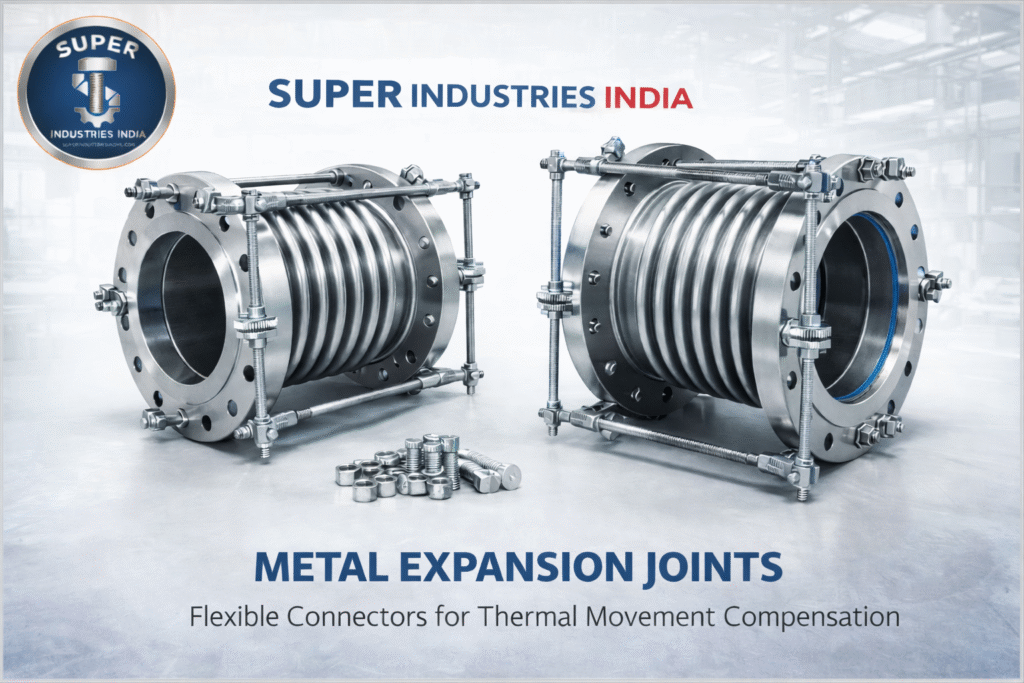
What are Metal Expansion Joints? The Core of System Flexibility
A Metal Expansion Joint is a flexible element—typically a convoluted metallic bellows—inserted into a rigid piping system. Its primary purpose is to absorb dimensional changes caused by:
- Thermal Growth (Axial Movement): Expansion or contraction of the pipe due to temperature changes (hot steam, cold fluids).
- Vibration: Dampening mechanical oscillations from pumps, compressors, and turbines.
- Misalignment (Lateral/Angular Movement): Compensating for non-perfect alignment during installation or settlement of foundations.
The central component, the bellows, is formed from thin-walled, high-strength metal (usually Stainless Steel $\text{304L}$, $\text{316L}$, or $\text{Inconel}$) with precision-rolled convolutions. These convolutions allow the structure to flex, compress, and extend under load while maintaining a pressure-tight seal.
Critical Types and Movement Capabilities
Expansion joints are categorized by their configuration and the type of movement they are designed to manage. Selecting the correct type is crucial for system reliability and performance.
1. Axial Expansion Joints
- Design: Consists of a single bellows element with end fittings (flanges or weld ends).
- Function: Primarily absorbs movement along the centerline (axis) of the piping run—meaning thermal expansion and contraction.
- Application: Straight runs of piping where movement is predominantly linear.
2. Universal Expansion Joints
- Design: Incorporates two bellows elements joined by a central spool piece.
- Function: Designed to absorb large amounts of Lateral Movement (sideways deflection) and Angular Rotation in multiple planes.
- Application: Systems requiring significant flexibility, such as those connecting equipment with inevitable relative movement.
3. Hinged and Gimbal Expansion Joints
- Design: Features a single bellows element fitted with external hardware (hinges or gimbals).
- Function:
- Hinged: Allows only Angular Movement (bending in one plane) and restrains pressure thrust.
- Gimbal: Allows Angular Movement in any plane, ideal for complex $3\text{D}$ movement or where large equipment rotation must be managed.
- Application: Used in sets of two or three to guide movement, often found in high-pressure or large-diameter ducting.
4. Pressure Balanced Expansion Joints
- Design: Incorporates special components like tie-rods or internal bellows to neutralize the static pressure thrust force generated by the line pressure.
- Function: Eliminates the need for massive, expensive anchors in the piping system.
- Application: Critical for large-diameter lines and systems with very high operating pressure, often seen in turbine exhaust and pump suction lines.
Material Excellence and Certification
The performance of an expansion joint is defined by the quality of the bellows material and manufacturing precision. Super Industries India provides:
- Material Grades: Standard materials include Stainless Steel $\text{304}$, $\text{316L}$, $\text{321}$, and specialized alloys like $\text{Inconel}$ for extremely high temperatures (over $700^\circ\text{C}$) or highly corrosive media.
- Design Standards: All our joints are designed, manufactured, and tested in accordance with recognized international standards, including $\text{EJMA}$ (Expansion Joint Manufacturers Association), $\text{ASME}$, and $\text{ISO}$.
- Quality Control: Every joint undergoes rigorous non-destructive testing, including Hydrostatic Pressure Testing and $\text{NDT}$ methods, to ensure the integrity of the bellows and the welded connections.
Key Applications Across Industries
As a specialized supplier of metal bellows in India, Super Industries India addresses critical stress challenges in:
- Power Plants: Absorbing thermal expansion in steam turbine crossover piping, condenser lines, and flue gas ducting.
- Petrochemical and Refineries: Managing movement in high-temperature catalyst lines and boiler feed systems.
- HVAC and Utilities: Dampening vibration at the inlet/outlet of chillers, pumps, and compressors.
- Steel Mills: Handling immense heat and movement in blast furnace and hot air blower connections.
If your critical piping system is suffering from vibration, misalignment, or thermal stress, you need an engineered solution.
Contact Super Industries India today for expert design consultation and certified Metal Expansion Joints tailored to your system’s exact pressure and movement requirements.