
ANCHOR BOLTS
Foundation Fastening Systems for EPC Civil & Structural Applications
Manufacturer & Global Exporter: Super Industries
Website: https://superindustriesindia.in
1️⃣ Industry Context
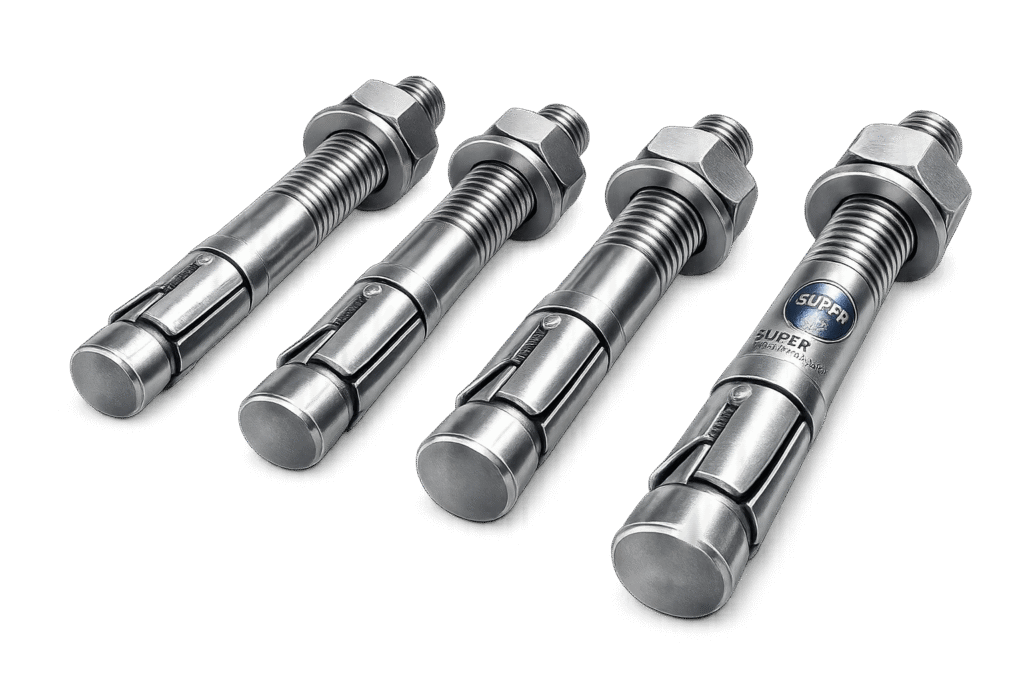
Why Anchor Bolts Are Critical Load-Transfer Elements in EPC Civil and Structural Works
In EPC projects, the transition of load from superstructure to substructure is one of the most scrutinized interfaces in the entire design. Anchor bolts form this interface. They are not accessories; they are primary load-transfer components that connect steel structures, equipment bases, pipe racks, columns, and rotating machinery to reinforced concrete foundations.
Anchor bolts are specified early in the civil–structural design phase because their geometry, material, embedment depth, and layout directly influence:
- Foundation sizing and reinforcement detailing
- Equipment alignment and erection tolerances
- Long-term stability under static, cyclic, and seismic loads
- Constructability and inspection acceptance
In power plants, refineries, LNG facilities, petrochemical complexes, and infrastructure projects, anchor bolts are engineered to perform reliably over decades, often without access for replacement. Their failure is structural, not cosmetic, and therefore EPC contractors and consultants treat anchor bolt design and supply with the same rigor as primary steel members.
2️⃣ Technical Definition
What Anchor Bolts Are and How They Connect Structures to Concrete Foundations
Anchor bolts are steel fastening elements designed to transfer loads from steel or equipment interfaces into concrete foundations. They are typically embedded in concrete (cast-in-place) or installed into hardened concrete (post-installed), with one end anchored in concrete and the other end threaded to accept nuts and washers.
From a functional standpoint, anchor bolts provide:
- Tension resistance (uplift, overturning)
- Shear resistance (lateral loads)
- Positional restraint (alignment and fixity)
Unlike general-purpose fasteners, anchor bolts work in composite interaction with concrete, meaning their performance depends on both steel properties and concrete behavior.
3️⃣ Load Transfer Mechanism
Tension, Shear, Combined Loading, and Load Path into Concrete
Anchor bolts are subjected to three fundamental load conditions:
Tension (Uplift)
Tension forces arise from:
- Equipment overturning moments
- Wind or seismic uplift
- Piping expansion and dynamic loads
The tensile load is transferred through the anchor bolt shank into concrete via bond, bearing, or mechanical anchorage.
Shear
Shear forces result from:
- Horizontal equipment loads
- Seismic base shear
- Pipe rack and structural frame forces
Shear is resisted through:
- Bearing of the bolt against concrete
- Friction at the base plate (if preload is present)
- Combined steel–concrete interaction
Combined Tension and Shear
Most EPC anchor bolts experience combined loading, requiring interaction checks per applicable codes. Proper design ensures that neither the steel nor the concrete governing failure mode is exceeded.
4️⃣ Embedment & Pull-Out Resistance
Embedment Depth, Concrete Strength, Edge Distance, and Spacing Logic
The embedment depth of an anchor bolt is one of the most critical parameters governing its capacity.
Key influencing factors include:
- Concrete compressive strength (f’c)
- Bolt diameter and surface condition
- Presence of hooks or bends
- Edge distance and spacing between anchors
Shallow embedment increases the risk of:
- Concrete cone failure
- Pull-out or bond failure
- Reduced ductility under seismic loads
EPC designs therefore specify embedment depths based on governing codes and often exceed minimum values to provide robustness and constructability margins.
5️⃣ Anchor Bolt Types & Geometry
Common Configurations Used in EPC Projects
L-Bolts
L-shaped anchor bolts rely on bearing of the bent leg to develop resistance. They are widely used for:
- Columns and pipe racks
- Equipment foundations
- General civil works
J-Bolts
J-bolts provide enhanced anchorage compared to straight rods and are commonly used where:
- Higher tension capacity is required
- Pull-out resistance must be improved
Straight Anchor Rods
Straight rods depend on bond, head plates, or mechanical anchorage. They are often used with:
- Anchor plates or welded washers
- Heavy equipment bases
Hooked Anchors
Used where additional mechanical interlock with concrete is required, particularly in dynamic or seismic applications.
Custom-Fabricated Anchors
Large EPC projects frequently require:
- Non-standard bends
- Extended lengths
- Special threading arrangements
- Integrated anchor plates
6️⃣ Failure Modes
Understanding How Anchor Bolts Can Fail
Engineering design aims to ensure ductile steel failure before brittle concrete failure.
Common failure modes include:
- Concrete cone failure: A breakout cone forms around the anchor
- Steel yielding or fracture: Bolt reaches its tensile capacity
- Pull-out failure: Insufficient bond or anchorage
- Bond failure: Loss of adhesion between steel and concrete
- Pry-out failure: Lever action due to insufficient embedment
Understanding these modes is essential for selecting the correct anchor geometry and embedment depth.
7️⃣ Material & Mechanical Properties
Steel Selection and Its Structural Significance
Anchor bolts are typically manufactured from:
- Carbon steel: General structural anchoring
- Alloy steel: Higher strength requirements
- Stainless steel: Corrosive or hygienic environments
Key mechanical properties considered by engineers:
- Yield strength (governs ductility)
- Tensile strength (ultimate capacity)
- Elongation (energy absorption)
Material selection balances strength with ductility, particularly for seismic and fatigue-sensitive applications.
8️⃣ Standards & Code Alignment
ASTM, ASME, DIN, ISO, ACI, and AISC Relevance
Anchor bolt design and manufacture align with multiple standards and codes, including:
- ASTM: Material and mechanical property requirements
- ACI: Concrete anchorage design provisions
- AISC: Structural steel interface considerations
- ISO / DIN: Metric dimensional and material alignment
EPC documentation typically cross-references these standards to ensure global acceptance and consultant approval.
9️⃣ Manufacturing & Quality Discipline
How Anchor Bolts Are Manufactured for EPC Use
Quality anchor bolts require disciplined manufacturing processes:
- Controlled bar selection and straightening
- Thread rolling for improved fatigue resistance
- Precision bending for L- and J-bolts
- Heat treatment where specified
- Dimensional verification of length, bend radius, and thread
Traceability is maintained through:
- Heat number identification
- Batch-wise inspection records
- Material Test Certificates (MTCs)
🔟 Installation Practices
Cast-in-Place vs Post-Installed Anchors
Cast-in-Place Anchors
- Installed before concrete pour
- Positioned using templates
- Offer highest reliability and load capacity
Post-Installed Anchors
- Installed after concrete curing
- Used for retrofits or modifications
- Require strict installation controls
Alignment, verticality, and projection height are critical installation parameters verified during construction.
1️⃣1️⃣ Inspection & EPC Verification
What Consultants and Inspectors Verify
Inspection activities include:
- Verification of anchor layout against drawings
- Measurement of embedment depth and projection
- Review of material certificates
- Thread gauge checks
- Visual inspection for damage or deformation
These checks ensure that installed anchor bolts meet both design intent and code compliance.
1️⃣2️⃣ Application Mapping
Where Anchor Bolts Are Used
Anchor bolts are integral to:
- Power plant equipment foundations
- Refineries and petrochemical units
- Pipe racks and structural frames
- Heavy rotating machinery bases
- Infrastructure and transportation projects
Their performance directly influences plant safety, alignment accuracy, and operational reliability.
1️⃣3️⃣ Professional Technical Tables
Diameter & Length Ranges
| Diameter | Typical Length Range |
|---|---|
| M12 – M64 | 300 mm – 3000 mm |
| ½” – 2½” | 12” – 120” |
Anchor Types & Configurations
| Type | Typical Use |
|---|---|
| L-Bolt | Columns, racks |
| J-Bolt | Equipment bases |
| Straight Rod | Heavy machinery |
| Custom | EPC-specific designs |
Embedment Recommendations (Indicative)
| Diameter | Typical Embedment |
|---|---|
| M20 | ≥ 10–12 × diameter |
| M36 | ≥ 12–15 × diameter |
Material Grades & Coatings
| Material | Environment |
|---|---|
| Carbon steel | General EPC |
| Alloy steel | High load |
| Stainless steel | Corrosive zones |
Applicable Standards
| Category | Reference |
|---|---|
| Material | ASTM / ISO |
| Design | ACI / AISC |
| Threads | ISO / DIN |
Customization Options
- Non-standard bends and hooks
- Integrated anchor plates
- Project-specific marking
- Export packaging and documentation
1️⃣4️⃣ Manufacturer-Focused Conclusion
Anchor Bolts are structural load-transfer elements whose reliability depends on:
- Correct geometry and embedment
- Controlled material properties
- Dimensional accuracy
- EPC-aligned documentation and inspection
Super Industries manufactures anchor bolts with engineering discipline and EPC awareness, ensuring that each anchor supplied is suitable for structural responsibility, consultant review, and long-term service in industrial and infrastructure environments.
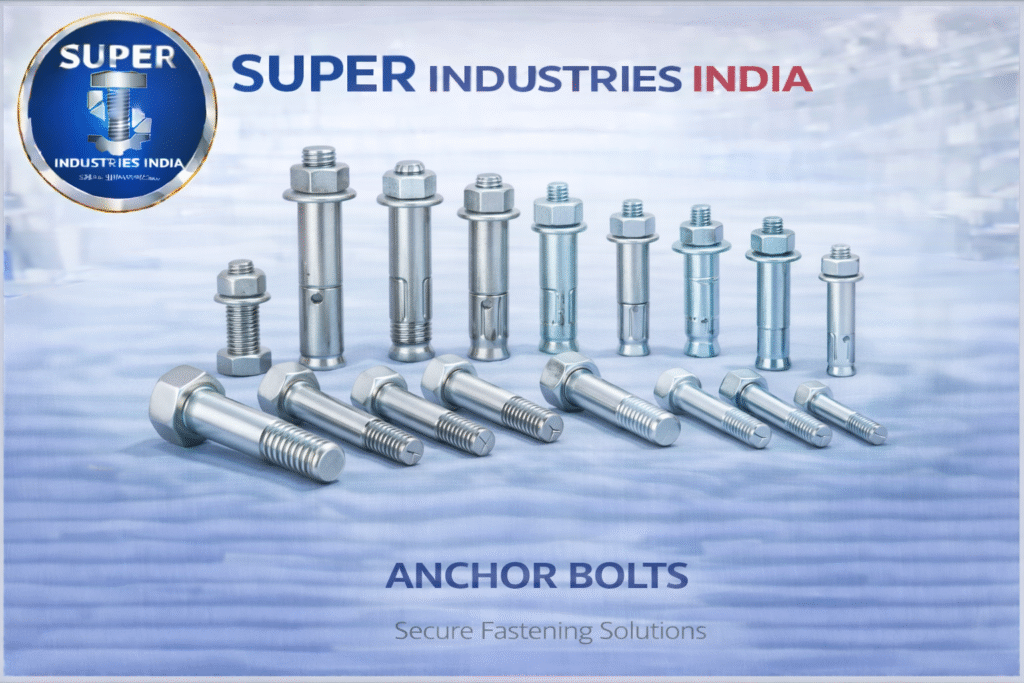
Anchoring Your Success: Leading Manufacturer of High-Quality Anchor Bolts in India
Welcome to Super Industries India, your trusted and reliable Anchor Bolt Manufacturer and Supplier in India. In the world of construction and heavy industry, a solid foundation is everything. Anchor bolts are the unsung heroes that connect non-structural and structural elements to concrete, transferring tension, shear, and compressive loads from structures like steel columns, equipment, and walls directly into the foundation.
For projects demanding the highest level of stability and safety—from massive infrastructure to machinery installation—you need fasteners you can rely on. Our precision-engineered anchor bolts provide the ultimate solution for demanding applications across India.
The Critical Role and Types of Anchor Bolts
An anchor bolt is typically a threaded rod, one end of which is designed to be embedded into concrete (either before or after the pour), while the other is secured with a nut and washer to the structural element.
We specialize in manufacturing all major types of anchor bolts to suit various installation methods and load requirements:
1. Cast-in-Place Anchor Bolts (Pre-Pour)
These bolts are installed before the concrete is poured, offering the strongest connection and are ideal for critical load-bearing structures.
- L-Type & J-Type Anchor Bolts: The most common form. They feature a bent (L or J shape) hook on the embedded end, which provides mechanical keying to securely lock the bolt into the concrete and resist pull-out forces.
- Best for: Steel column bases, heavy equipment foundations, and structural tower bases.
- Headed Anchor Bolts (ASTM F1554 Grade 36/55/105): These use a standard forged hex or heavy hex head on the embedded end (or a square plate welded to the end) to increase the bearing area within the concrete, significantly improving pull-out resistance.
- Best for: Bridge construction and large industrial machinery.
2. Post-Installed Anchor Bolts (After-Pour)
These bolts are installed into pre-drilled holes in cured concrete, offering flexibility and accuracy for alignment correction or retrofit applications.
- Wedge/Expansion Anchor Bolts: These operate by expanding against the sidewalls of the concrete hole when tightened, creating friction and mechanical interlock.
- Chemical/Adhesive Anchor Bolts: These utilize a resin (epoxy or polyester) injected into the hole, bonding the rod to the concrete. This method often achieves strength comparable to cast-in-place bolts and is excellent for close-to-edge applications where expansion anchors could crack the concrete.
Materials and Grades: Engineering for Extreme Conditions
The material grade of an anchor bolt is crucial as it determines its load capacity, durability, and resistance to environmental stress. As a leading Anchor Bolt Manufacturer in India, we adhere strictly to the ASTM F1554 specification, the definitive standard for anchor bolts used in structural applications.
| Material Grade | Tensile Strength (Min) | Applications & Key Features |
| ASTM F1554 Grade 36 | 36 ksi (250 MPa) | Standard carbon steel, widely used for general purposes, lighter loads, and mild seismic zones. |
| ASTM F1554 Grade 55 | 55 ksi (380 MPa) | High-strength low-alloy steel; common for structural steel frames and medium-to-heavy load applications. |
| ASTM F1554 Grade 105 | 105 ksi (725 MPa) | Heat-treated alloy steel; essential for high-stress applications like nuclear power, large bridge structures, and extreme seismic environments. |
| Stainless Steel | Varies (e.g., SS 304, 316) | Used in aggressive, corrosive environments like coastal, chemical, and wastewater treatment plants for superior rust resistance. |
Coating and Corrosion Protection
Anchor bolts often spend their entire service life embedded in concrete or exposed to harsh weather. We offer specialized coatings to ensure maximum longevity:
- Hot Dip Galvanized (HDG) Anchor Bolts: Performed according to ASTM A153/F2329. This process creates a thick, sacrificial zinc coating that is essential for bolts exposed to the atmosphere or located in high-humidity/coastal areas.
- Plain (Black) Finish: Typically used for bolts that will be entirely encased in concrete, as concrete offers natural corrosion protection.
- Zinc Plated (Electroplated): Provides a clean finish and minimal corrosion resistance for indoor or sheltered applications.
Why Choose Super Industries India for Anchor Bolts?
Choosing the right Anchor Bolt Supplier in India is a critical decision that impacts the safety and lifespan of your entire structure.
- Manufacturing Expertise and Capacity: We operate a state-of-the-art facility capable of manufacturing anchor bolts in large diameters (up to 4 inches or M100) and custom lengths, including complex multi-anchor foundation templates.
- ASTM and ASME Compliance: Our rigorous quality control ensures every bolt is manufactured, tested, and certified to meet the specified ASTM F1554 mechanical and chemical properties.
- Custom Fabrication: We excel in supplying non-standard and custom-engineered anchor bolt solutions with specific bends, weld plates, and thread lengths to match unique project drawings.
- Nationwide Project Supply: Whether you need Anchor Bolts in Mumbai for a new factory or in Chennai for a coastal power plant, our logistics network ensures timely and secure delivery across India.
Anchor your project with confidence. Partner with Super Industries India for anchor bolts that deliver unparalleled strength, safety, and compliance.
Contact us today for a detailed quote on L-Type, J-Type, or F1554 Grade 105 Anchor Bolts for your next major construction project.