
- HEX BOLTS
- 1️⃣ Industry Context
- 2️⃣ Technical Definition
- 3️⃣ Functional Engineering Role
- 4️⃣ Tensile vs Shear Load Behavior
- 5️⃣ Thread Configuration Logic
- 6️⃣ Dimensional Parameters
- 7️⃣ Types of Hex Bolts
- 8️⃣ Material Selection & Mechanical Properties
- 9️⃣ Standards & Specification Alignment
- 🔟 Manufacturing & Quality Discipline
- 1️⃣1️⃣ Installation & Torque Control
- 1️⃣2️⃣ EPC Procurement & Inspection Perspective
- 1️⃣3️⃣ Application Mapping
- 1️⃣4️⃣ Professional Technical Tables
- 1️⃣5️⃣ Manufacturer-Focused Conclusion
- Premium Hex Bolts Manufacturer & Supplier in India | Super Industries India
- The Versatility of Hex Bolts: A Fastener for Every Industry
- Uncompromising Quality: Materials, Grades, and Standards
- Hex Bolts vs. Hex Cap Screws: Understanding the Difference
- Why Choose Super Industries India for Your Hex Bolts?
HEX BOLTS
Structural, Mechanical & EPC-Grade Fasteners
Manufacturer & Global Exporter: Super Industries
Website: https://superindustriesindia.in
1️⃣ Industry Context
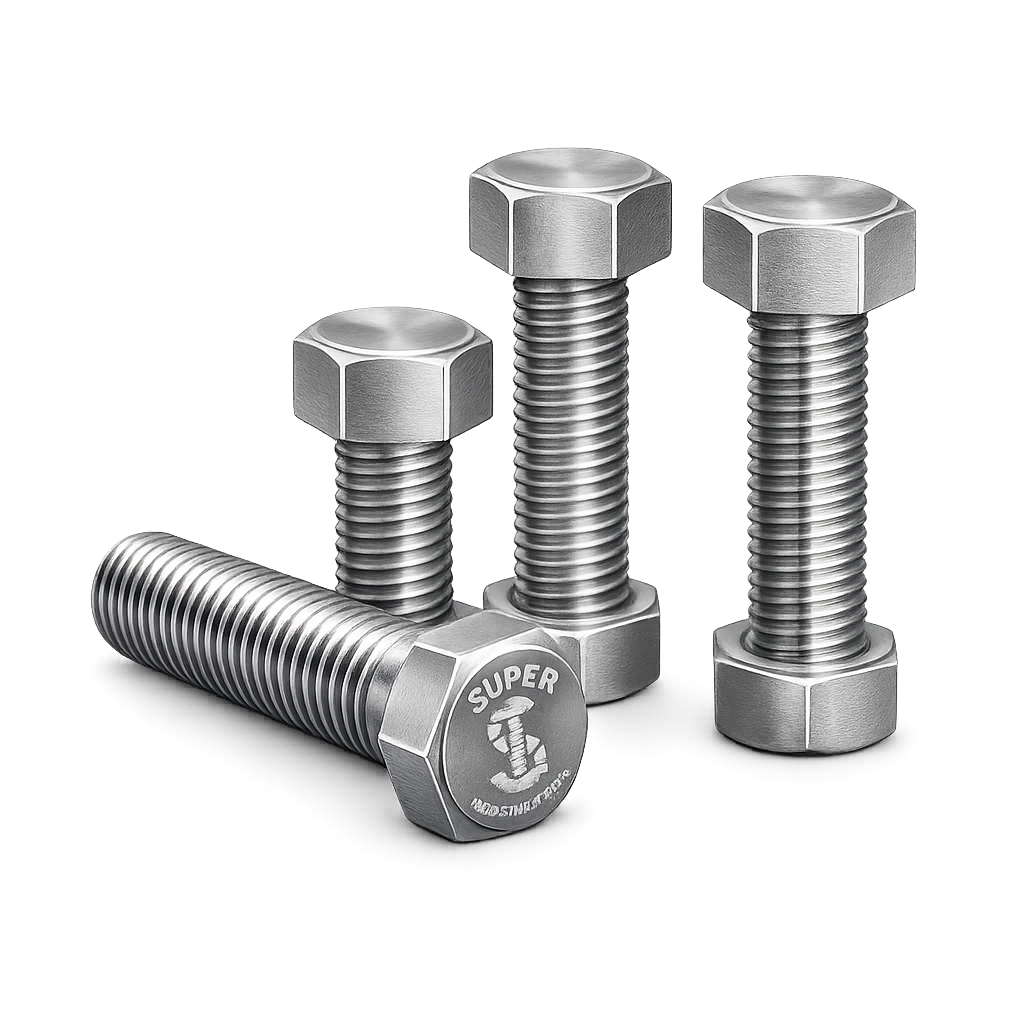
Role of Hex Bolts in EPC, Structural, Mechanical, and Pressure-Retaining Assemblies
Across EPC and capital-project environments, hex bolts are the primary load-bearing fastener used to generate clamping force and maintain joint integrity. They are fundamental to steel structures, machinery bases, pipe supports, equipment skids, and selected pressure-boundary connections where standards permit bolted joints.
From an EPC perspective, hex bolts are not commodities. They are engineered components whose geometry, material grade, heat treatment, and thread configuration directly affect joint behavior, fatigue life, and inspection acceptance. Improper selection—particularly between full-threaded and partially threaded hex bolts—remains one of the most common causes of joint underperformance identified during consultant reviews.
2️⃣ Technical Definition
What Hex Bolts Are — Geometry, Head Design, and Thread Configurations
A hex bolt is a headed fastener characterized by:
- A six-sided (hexagonal) head designed for wrench engagement
- A cylindrical shank (plain or threaded)
- An external thread form conforming to metric or inch standards
Key geometric elements include:
- Head across flats (AF)
- Head height
- Nominal diameter
- Thread pitch
- Thread length
- Grip length (unthreaded portion, where applicable)
Hex bolts are distinguished from screws primarily by use with a nut or through-hole assembly and by their role in load-bearing joints rather than tapped components alone.
3️⃣ Functional Engineering Role
Clamping Force, Joint Integrity, and Load Transfer
The engineering purpose of a hex bolt is to:
- Generate preload through controlled tightening
- Clamp joint members together with sufficient force
- Transfer service loads through friction (preferred) or bearing (when designed)
Correctly designed bolted joints rely on preload dominance, where applied service loads do not exceed the clamping force. Hex bolts therefore function primarily in tension, even when joints experience shear.
4️⃣ Tensile vs Shear Load Behavior
How Hex Bolts Carry Load in Real Assemblies
From an engineering standpoint:
- Tensile load is carried along the bolt axis due to tightening and service forces.
- Shear load should ideally be resisted by friction between clamped parts, not by the bolt shank or threads.
If joint slip occurs:
- Bearing stresses develop on the bolt shank or threads
- Fatigue life reduces significantly
For this reason, EPC standards often require:
- Proper surface condition
- Controlled tightening methods
- Correct grip length selection
5️⃣ Thread Configuration Logic
Full Thread vs Partial Thread — Engineering Implications
Full-Threaded Hex Bolts
- Threads run along the entire shank length
- Common in short bolt lengths and tapped-hole assemblies
- Suitable where grip length variability is required
Engineering considerations:
- Threads in the shear plane increase stress concentration
- Lower fatigue resistance in shear-critical joints
Partially Threaded Hex Bolts
- Defined unthreaded shank (grip length)
- Preferred for structural and shear-sensitive joints
Engineering advantages:
- Smooth shank carries shear load
- Reduced stress concentration
- Improved fatigue performance
EPC engineers typically specify partial-thread bolts wherever the shear plane location can be controlled.
6️⃣ Dimensional Parameters
Geometry That Governs Joint Performance
Critical dimensional parameters include:
- Nominal diameter: Governs tensile capacity
- Bolt length: Determines full engagement without bottoming
- Thread pitch: Affects preload sensitivity
- Grip length: Must match joint thickness
- Head dimensions: Must comply with tool clearance and standard requirements
Incorrect grip length selection—too short or too long—is a frequent cause of EPC site rejections.
7️⃣ Types of Hex Bolts
Standard Hex Bolts
General-purpose fasteners used across mechanical and structural assemblies.
Full-Threaded Hex Bolts
Used where tapped holes or variable grip lengths are required.
Partially Threaded Hex Bolts
Preferred for structural joints and shear-controlled assemblies.
Heavy Hex Bolts
Larger head and bearing area; used in structural steel and pressure flanges where specified.
Structural Hex Bolts
Manufactured to dedicated structural standards with controlled mechanical properties and head markings.
Each type has a distinct engineering justification and is not interchangeable without review.
8️⃣ Material Selection & Mechanical Properties
Strength Class vs Service Environment
Material selection balances mechanical strength, corrosion resistance, and inspectability.
- Carbon steel: Cost-effective, widely used, requires surface protection
- Alloy steel: Higher strength for structural and high-load joints
- Stainless steel: Corrosion resistance with lower yield strength
- Special alloys: Used only where environment demands, not as defaults
EPC projects prioritize standardized grades with traceable mechanical properties over exotic materials.
9️⃣ Standards & Specification Alignment
ASTM, ASME, DIN, ISO — EPC Acceptance Logic
Hex bolts for EPC use are governed by:
- Dimensional standards (head size, thread form)
- Mechanical property standards (yield, tensile strength)
- Testing and marking requirements
Consultants verify:
- Standard compliance
- Heat number traceability
- Head markings vs certificates
Non-standard or mixed-standard fasteners are a common cause of rejection.
🔟 Manufacturing & Quality Discipline
Core Manufacturing Steps
- Hot or cold forging of bolt head
- Heat treatment to achieve required properties
- Thread rolling (preferred) or cutting
- Surface treatment or coating
- Final inspection and marking
Quality Controls
- Dimensional inspection
- Mechanical testing
- Surface integrity checks
- Certificate correlation
Manufacturing discipline determines repeatability, not just nominal compliance.
1️⃣1️⃣ Installation & Torque Control
Preload, Tightening Methods, and Failure Prevention
Correct installation governs actual joint performance.
Key considerations:
- Torque-tension relationship
- Lubrication effects
- Tightening sequence
- Avoidance of over- or under-tightening
EPC specifications often mandate:
- Controlled torque methods
- Defined lubrication state
- Documented tightening procedures
1️⃣2️⃣ EPC Procurement & Inspection Perspective
During vendor approval and site inspection, EPC teams verify:
- Compliance with specified standards
- Correct thread configuration (full vs partial)
- Head markings and certificates
- Dimensional accuracy
- Surface condition and coatings
Hex bolts lacking clear traceability or proper markings are routinely rejected regardless of price.
1️⃣3️⃣ Application Mapping
Approved applications include:
- Structural steel connections
- Equipment bases and frames
- Pipe supports and racks
- Skids and modular assemblies
- Selected pressure-flange connections (where standards permit)
Hex bolts are not interchangeable with stud bolts in pressure-critical flange joints unless explicitly approved.
1️⃣4️⃣ Professional Technical Tables
Sizes & Length Ranges (Indicative)
| Diameter Range | Typical Use |
|---|---|
| M6–M12 | Light mechanical |
| M16–M24 | Structural / EPC |
| ≥ M30 | Heavy equipment |
Strength Grades & Standards
| Grade Class | Typical Application |
|---|---|
| Medium strength | General EPC use |
| High strength | Structural joints |
| Corrosion-resistant | Aggressive environments |
Typical Applications vs Thread Type
| Application | Recommended |
|---|---|
| Shear-critical | Partial thread |
| Tapped holes | Full thread |
| Variable grip | Full thread |
Coatings & Surface Treatments
| Coating | Purpose |
|---|---|
| Plain / black | Controlled indoor |
| Zinc-based | General corrosion |
| Heavy coatings | Outdoor / marine |
Custom Manufacturing Options
- Non-standard lengths
- Special coatings
- Project-specific markings
- Full traceability packages
1️⃣5️⃣ Manufacturer-Focused Conclusion
Hex Bolts are foundational components in EPC and capital projects, but their performance depends entirely on correct engineering selection, dimensional control, material discipline, and inspection rigor. The distinction between full-threaded and partially threaded hex bolts is not cosmetic—it directly affects load transfer, fatigue behavior, and approval status.
Super Industries manufactures hex bolts with controlled forging, verified heat treatment, standard-aligned geometry, and EPC-ready traceability, supporting safe and predictable performance in structural, mechanical, and industrial assemblies.
Premium Hex Bolts Manufacturer & Supplier in India | Super Industries India
Welcome to Super Industries India, your trusted partner and leading manufacturer of high-quality Hex Bolts in India. For decades, we have been delivering superior fastening solutions that are the backbone of construction, engineering, and industrial projects across the globe.
Our commitment to precision engineering, robust materials, and strict adherence to international standards makes our hex bolts the fastener of choice for applications demanding exceptional strength, durability, and reliability.
The Versatility of Hex Bolts: A Fastener for Every Industry
Hex bolts, also widely known as hexagon head bolts or hex head screws, are defined by their distinctive six-sided head, designed for easy and powerful tightening using a wrench or socket. This simple, yet effective design makes them one of the most versatile and essential fasteners used across virtually all major sectors.
Key Applications & Industries:
- Construction & Structural Engineering: Used for assembling steel structures, bridges, buildings, pre-engineered buildings (PEB), and concrete forms where high-tensile strength is critical.
- Heavy Machinery & Equipment: Essential for securing engines, pumps, compressors, and other heavy equipment components that are subjected to high vibration and stress.
- Automotive & Transportation: Employed in vehicle assembly, railway infrastructure, and various heavy-duty transportation applications.
- Energy Sector: Critical in power generation, including wind turbines, solar panel mounting structures, and power plant installations.
- Marine & Coastal Environments: Stainless steel and specialized coated hex bolts are vital for ship construction, docks, and offshore structures where corrosion resistance is paramount.
- Oil & Gas: Used in pipeline assemblies and refinery equipment that require robust, high-pressure, and high-temperature resistant fasteners.
Uncompromising Quality: Materials, Grades, and Standards
At Super Industries India, we understand that the performance of your structure is only as strong as its weakest link. That’s why we manufacture hex bolts from a diverse range of premium materials and strength grades to meet the specific requirements of any challenging environment.
Wide Range of Materials:
- Carbon Steel Hex Bolts: Economical and suitable for general-purpose indoor and light outdoor applications. Available in various strength grades.
- Alloy Steel Hex Bolts: Ideal for high-stress, high-tensile strength applications, often used in heavy machinery and structural connections.
- Stainless Steel Hex Bolts (SS 304, 316, etc.): Offers superior resistance to rust and corrosion, making them the go-to choice for marine, food & beverage, chemical, and outdoor installations.
- Duplex & Super Duplex Steel: For extreme corrosive environments, including offshore and chemical processing.
Grades & Specifications (Meeting Global Demands):
We manufacture hex bolts to comply with leading national and international standards, ensuring seamless integration into your global projects:
| Standard | Description | Common Grades |
| ISO 4014 / DIN 931 | Hexagon Head Bolt (Partially Threaded) | 8.8, 10.9, 12.9 (Metric) |
| ISO 4017 / DIN 933 | Hexagon Head Bolt (Fully Threaded/Tap Bolt) | 8.8, 10.9, 12.9 (Metric) |
| ASME B18.2.1 | Hex Bolts and Heavy Hex Bolts (Inch Series) | ASTM A307, A325, A490 (Imperial) |
| ASTM A193 | Alloy-Steel and Stainless Steel Bolting for High Temperature or High Pressure Service | B7, B8, B8M |
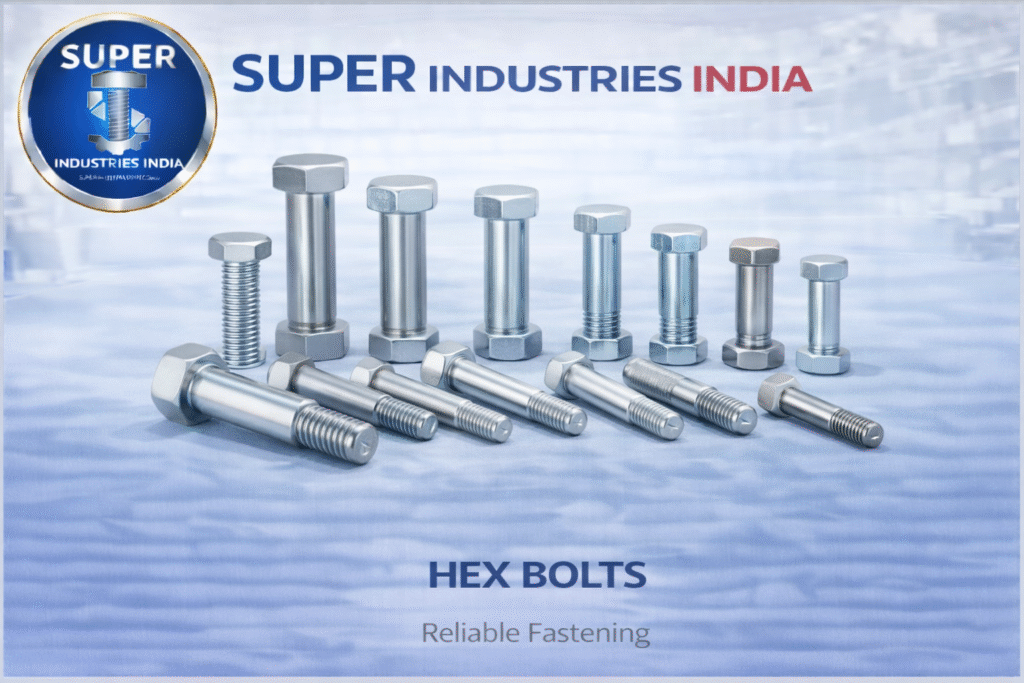
Custom Manufacturing & Surface Finish
We offer both standard and custom hex bolts to match your exact size, threading, and material specifications. Furthermore, we provide a variety of high-performance coatings to enhance corrosion resistance and lifespan:
- Hot Dip Galvanized (HDG) Hex Bolts
- Zinc Plated (Yellow, Blue, Clear)
- Black Oxide
- PTFE Coated
Hex Bolts vs. Hex Cap Screws: Understanding the Difference
While the terms are often used interchangeably, there’s a technical distinction based on application and tolerance:
- Hex Bolts (Typically): Generally used with a nut and often manufactured to looser tolerances, commonly seen in construction and general-purpose assemblies (e.g., ASTM A307).
- Hex Cap Screws (Typically): Designed to be threaded into a pre-tapped hole (without a nut) and manufactured to tighter dimensional tolerances, often featuring a washer face under the head, making them ideal for precision machinery and OEM applications (e.g., SAE J429 Grade 5/8).
Super Industries India supplies both types, ensuring you get the precise fastener your project requires, whether it’s a structural heavy hex bolt or a high-precision hex cap screw.
Why Choose Super Industries India for Your Hex Bolts?
- Leading Manufacturer in India: We combine advanced manufacturing techniques with stringent quality control to produce world-class fasteners.
- Global Quality, Local Service: Our hex bolts meet international standards (ISO, DIN, ASTM, IS) while providing the timely delivery and competitive pricing expected from a top Indian supplier.
- Comprehensive Stock: We maintain a large inventory across all common sizes (M6 to M100) and grades, ensuring quick turnaround times for your urgent requirements.
- Custom Solutions: From specialized materials to non-standard lengths, our engineering team is equipped to provide bespoke fastening solutions.
Ready to secure your next project with the strongest, most reliable hex bolts?
Contact Super Industries India today to discuss your requirements, request a quote, or learn more about our complete range of industrial fasteners.