
HASTELLOY
- HASTELLOY
- 1️⃣ Industry Context
- 2️⃣ Technical Definition
- 3️⃣ Engineering & Corrosion Relevance
- 4️⃣ Chemical Composition & Metallurgical Logic
- 5️⃣ Hastelloy Grades & Selection Logic
- 6️⃣ Mechanical Properties & Service Behavior
- 7️⃣ Standards & Specification Alignment
- 8️⃣ Manufacturing & Quality Discipline
- 9️⃣ Procurement, Fabrication & Inspection View
- 🔟 Application Mapping
- 1️⃣1️⃣ Professional Technical Tables
- 1️⃣2️⃣ Manufacturer-Focused Conclusion
- Conquer Chemical Corrosion: Hastelloy Fasteners for the World's Toughest Jobs
- Nickel-Molybdenum-Chromium superalloys
- What is Hastelloy? The Pinnacle of Corrosion Resistance
- Our Specialized Hastelloy Fastener Grades
- Precision Manufacturing and Compliance Standards
- Hastelloy Fasteners: Securing India's Chemical and Environmental Sectors
Nickel-Based High-Performance Alloys for Extreme Corrosion Service | EPC / Export / MNC Standard
Manufacturer & Global Exporter: Super Industries
Website: https://superindustriesindia.in
1️⃣ Industry Context
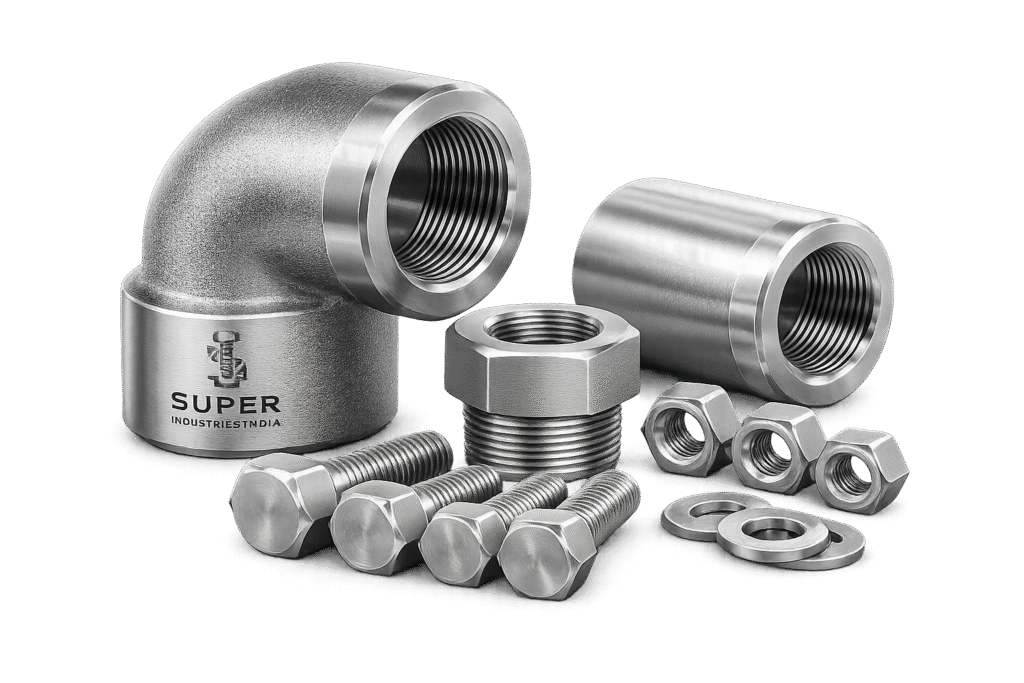
Why Hastelloy Alloys Are Mission-Critical Materials in EPC and Capital Projects
In EPC-driven industries, material failure is rarely tolerated and often catastrophic. As process conditions become more aggressive—higher temperatures, mixed chemical exposure, elevated pressures, and prolonged operating cycles—conventional stainless steels, duplex grades, and even advanced high-molybdenum alloys reach their performance limits.
Hastelloy alloys are specified in EPC and capital projects precisely because they address conditions where:
- Multiple corrosion mechanisms act simultaneously
- Oxidizing and reducing environments coexist
- Chlorides, strong acids, and elevated temperatures are present
- Failure consequences include safety risk, environmental exposure, and major financial loss
For consultants and materials engineers, Hastelloy represents a risk-mitigation alloy family—selected when conservative metallurgy is the only defensible engineering decision. Its use is common in Oil & Gas processing units, petrochemical reactors, chemical plants, LNG facilities, hydrogen service, and high-integrity piping systems.
2️⃣ Technical Definition
What Hastelloy Is and How It Differs from Other Alloy Systems
Hastelloy refers to a family of nickel-based corrosion-resistant alloys engineered to perform in environments that exceed the capabilities of stainless steels, duplex alloys, Monel, and high-molybdenum austenitic grades such as SMO 254.
Nickel-Based Alloy Philosophy
- Nickel forms the base matrix, ensuring stability across wide temperature ranges
- Alloying elements are added to resist specific corrosion mechanisms
- Corrosion resistance is inherent to bulk chemistry, not surface passivation alone
Comparison with Other Materials
- Stainless steels: Limited resistance to mixed acid and chloride environments
- Duplex stainless steels: Strength advantage, but reduced tolerance to complex chemistries
- SMO 254 (6Mo): Excellent chloride resistance, but limited against strong reducing acids
- Monel: Strong in HF and seawater, but less versatile in oxidizing acids
Hastelloy alloys are selected when multiple aggressive mechanisms must be controlled simultaneously.
3️⃣ Engineering & Corrosion Relevance
Localized Corrosion, SCC & High-Temperature Stability
Pitting and Crevice Corrosion
High molybdenum and chromium contents give Hastelloy alloys exceptional resistance to localized corrosion, even in:
- High-chloride environments
- Low-pH and stagnant conditions
- Under-deposit and gasket crevice exposure
Stress Corrosion Cracking (SCC)
Hastelloy alloys exhibit strong resistance to both chloride-induced and caustic SCC, making them suitable for pressurized systems under tensile stress.
Strong Acids and Mixed Media
Many Hastelloy grades are specifically engineered for:
- Sulfuric acid
- Hydrochloric acid
- Mixed acid streams
- Contaminated process fluids
High-Temperature Environments
Certain Hastelloy grades retain mechanical strength and corrosion resistance at elevated temperatures, where other alloys lose stability.
4️⃣ Chemical Composition & Metallurgical Logic
Role of Alloying Elements in Hastelloy
Nickel (Base Element)
- Provides matrix stability
- Enables wide temperature capability
- Ensures resistance to SCC
Chromium
- Enhances resistance to oxidizing environments
- Improves passivation behavior
Molybdenum
- Critical for pitting and crevice corrosion resistance
- Improves performance in reducing acids
Tungsten (Selected Grades)
- Enhances resistance to localized corrosion
- Improves high-temperature strength
Iron (Controlled)
- Adjusts mechanical properties
- Maintained at controlled levels to avoid corrosion compromise
The precise balance of these elements defines the performance envelope of each Hastelloy grade.
5️⃣ Hastelloy Grades & Selection Logic
Matching Alloy Grade to Service Conditions
Hastelloy C-276
- One of the most widely specified grades
- Excellent resistance to both oxidizing and reducing media
- Suitable for mixed acid environments
Hastelloy C-22
- Enhanced chromium content compared to C-276
- Superior resistance to pitting and crevice corrosion
- Preferred in highly oxidizing environments
Hastelloy X
- Strong high-temperature capability
- Good oxidation resistance
- Often used in gas turbine and high-temperature process equipment
Hastelloy B-2 / B-3
- Optimized for strong reducing acids, particularly hydrochloric acid
- Limited resistance to oxidizing environments
- Selected for very specific chemical services
Selection Logic Summary
- Mixed acids: C-276 / C-22
- Highly oxidizing service: C-22
- High temperature: Hastelloy X
- Strong reducing acids: B-2 / B-3
6️⃣ Mechanical Properties & Service Behavior
Strength, Ductility & Fabrication Implications
Mechanical Performance
Hastelloy alloys combine:
- High tensile strength
- Excellent ductility
- Resistance to embrittlement
Temperature Capability
- Many grades perform reliably at elevated temperatures
- Retain mechanical integrity where stainless steels soften
Fatigue and Cyclic Loading
Uniform microstructure and corrosion resistance reduce corrosion-fatigue interaction, critical in cyclic service.
Fabrication Implications
- Higher strength requires controlled forming parameters
- Work hardening necessitates optimized machining
- Welding procedures must be strictly qualified
7️⃣ Standards & Specification Alignment
Hastelloy alloys are covered by major international standards for EPC acceptance.
Common Standards
- ASTM: Pipes, fittings, flanges, bars, fasteners
- ASME Section II: Allowable stresses and properties
- EN / ISO: International project compliance
- DIN: Regional EPC requirements
These standards enable consultant approval and global procurement consistency.
8️⃣ Manufacturing & Quality Discipline
Melting & Refining
Hastelloy alloys require advanced melting routes (VIM / VAR) to achieve:
- Precise chemistry
- Low inclusion content
- Uniform corrosion behavior
Forging & Machining Control
- Controlled deformation to prevent segregation
- Specialized tooling due to high strength
Heat Treatment
- Solution annealing to restore corrosion resistance
- Controlled cooling to avoid detrimental phases
Contamination Prevention
Strict segregation from carbon and low-alloy steels prevents:
- Iron contamination
- Galvanic corrosion initiation
Traceability & Inspection
- Heat-wise traceability
- PMI verification
- Dimensional and surface inspection aligned with EPC ITPs
9️⃣ Procurement, Fabrication & Inspection View
EPC and Consultant Verification Focus
During approval and execution, EPC teams typically verify:
- Certified chemical composition
- Mechanical properties
- Heat treatment records
- PMI and NDT results
- Welding procedure qualification
- Complete traceability documentation
Hastelloy components are subjected to stringent QA/QC due to their safety-critical service.
🔟 Application Mapping
Oil & Gas
High-pressure process piping, sour service, chemical injection systems.
Petrochemical
Reactors, heat exchangers, acid-handling units.
LNG
Process systems with aggressive contaminants.
Chemical Processing
Mixed acid streams, specialty chemical plants.
Hydrogen
Emerging infrastructure with high-purity and aggressive conditions.
Power
High-temperature auxiliary systems.
Offshore & Infrastructure
Marine exposure, corrosive industrial environments.
1️⃣1️⃣ Professional Technical Tables
Chemical Composition – Typical Ranges
| Grade | Ni % | Cr % | Mo % | W % | Fe % |
|---|---|---|---|---|---|
| C-276 | Balance | ~15 | ~16 | ~4 | ≤ 5 |
| C-22 | Balance | ~22 | ~13 | ~3 | ≤ 3 |
| X | Balance | ~22 | ~9 | – | ~18 |
| B-2 / B-3 | Balance | ~1 | ~28 | – | ≤ 2 |
Mechanical Properties (Indicative)
| Property | Typical Range |
|---|---|
| Yield Strength | 280–400 MPa |
| Tensile Strength | 690–790 MPa |
| Elongation | ≥ 30% |
Corrosion Resistance vs Media
| Environment | Suitability |
|---|---|
| Chlorides | Excellent |
| Mixed acids | Excellent |
| Strong oxidizing acids | Grade-dependent |
| Strong reducing acids | B-2 / B-3 |
| High temperature | X / C-series |
Typical Product Forms
| Product | Availability |
|---|---|
| Pipes & Tubes | Seamless / welded |
| Forged Fittings | Elbows, tees, outlets |
| Flanges | All pressure classes |
| Fasteners | Bolts, studs, nuts |
Hastelloy Grades vs Service Environments
| Service Condition | Recommended Grade |
|---|---|
| Mixed acid streams | C-276 |
| Severe pitting risk | C-22 |
| High temperature | Hastelloy X |
| Hydrochloric acid | B-2 / B-3 |
Project-Specific Customization Options
| Parameter | Options |
|---|---|
| Product form | Pipe, fitting, flange, fastener |
| Size & rating | As per EPC MTO |
| Heat treatment | As specified |
| Inspection | PMI, UT, PT |
| Certification | EN 10204 3.1 / 3.2 |
1️⃣2️⃣ Manufacturer-Focused Conclusion
Hastelloy alloys are selected when corrosion risk cannot be mitigated by design margins alone. Their successful application depends on precise metallurgy, controlled processing, contamination prevention, and disciplined inspection.
Super Industries manufactures and supplies Hastelloy components under stringent metallurgical and quality systems aligned with EPC and consultant expectations. Our materials-engineering expertise, traceability discipline, and export-ready documentation enable safe alloy selection and long-term performance in the most demanding industrial environments.
Conquer Chemical Corrosion: Hastelloy Fasteners for the World’s Toughest Jobs
When facing environments with aggressive acids, wet chlorine, and extreme chemical corrosion, standard stainless steel simply dissolves. Hastelloy, a renowned family of Nickel-Molybdenum-Chromium superalloys, is the engineering solution for maintaining structural integrity in these conditions. Super Industries India, a leading manufacturer and supplier of high-performance fasteners in India, provides a precise and certified range of Hastelloy bolts, nuts, and studs vital for the chemical, pharmaceutical, and pollution control industries.
Nickel-Molybdenum-Chromium superalloys
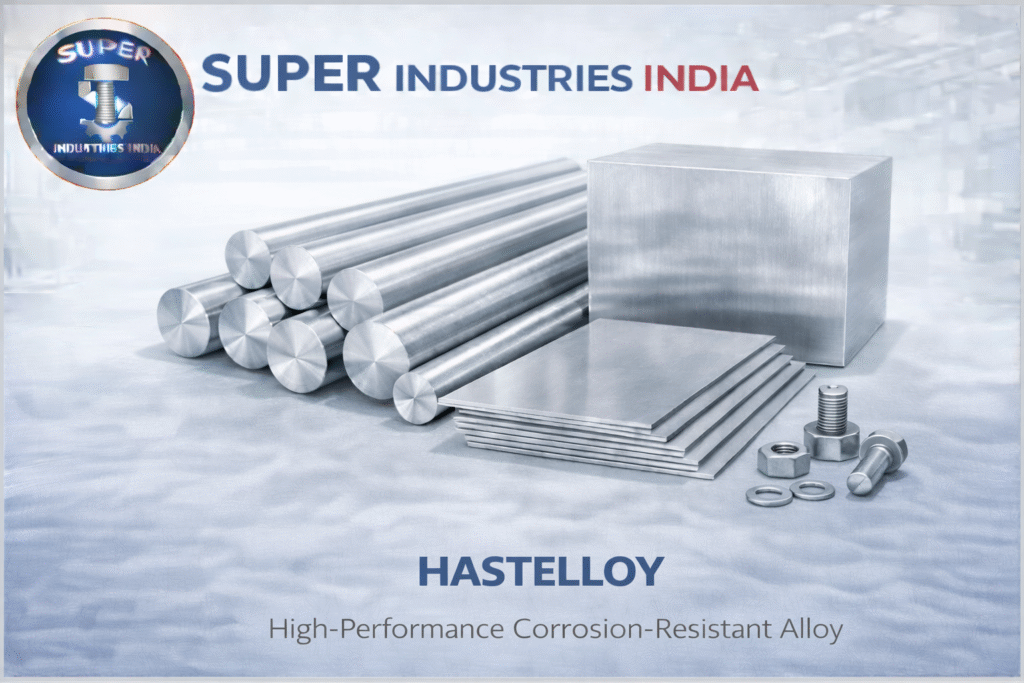
What is Hastelloy? The Pinnacle of Corrosion Resistance
Hastelloy is a brand name for a group of highly specialized nickel-based alloys developed specifically to withstand chemical attack where virtually all other materials fail. The alloys derive their exceptional resistance from a potent combination of elements:
- Nickel: Provides the foundation for resistance to many corrosives.
- Molybdenum: Crucial for resistance to pitting and crevice corrosion and non-oxidizing acids (like Hydrochloric Acid, HCl).
- Chromium: Essential for resistance to oxidizing media (like Nitric Acid, HNO3) and high-temperature oxidation.
This unique composition gives Hastelloy fasteners unmatched stability and a prolonged service life in the most aggressive chemical and thermal environments, reducing maintenance costs and catastrophic failure risks.
Our Specialized Hastelloy Fastener Grades
Super Industries India focuses on manufacturing fasteners from the most versatile and highly specified Hastelloy grades, guaranteeing performance and full material traceability.
1. Hastelloy C276 (UNS N10276)
- The Industry Standard: This is the most widely recognized and utilized corrosion-resistant alloy worldwide.
- Properties: Possesses outstanding resistance to uniform corrosion, excellent resistance to a wide range of chemical process streams, including ferric and cupric chlorides, hot contaminated inorganic acids, solvents, and wet chlorine gas. Crucially, it has high resistance to pitting and stress corrosion cracking.
- Applications: Fasteners for flue gas desulfurization (FGD) systems, chemical reactor vessels, evaporator tubes, and equipment handling wastewater treatment.
2. Hastelloy C22 (UNS N06022)
- The Versatile Performer: An advanced alloy offering broader resistance than C276 in both oxidizing and reducing environments.
- Properties: Offers superior resistance to pitting, crevice corrosion, and stress corrosion cracking compared to C276. It is particularly effective against highly oxidizing aqueous media like wet chlorine and mixtures of nitric acid and ferric chloride.
- Applications: Bolting in pharmaceutical manufacturing, equipment for extreme chemical processes, and high-purity applications where material stability is non-negotiable.
3. Hastelloy B-3 (UNS N10675)
- The Hydrochloric Acid Specialist: This grade is engineered for non-oxidizing applications.
- Properties: Provides exceptional resistance to hydrochloric, sulfuric, and phosphoric acids in non-oxidizing conditions. It has improved thermal stability compared to older B-series alloys.
- Applications: Fasteners for equipment used in the handling and storage of high-concentration mineral acids and highly reducing environments.
Precision Manufacturing and Compliance Standards
The extreme hardness and chemical complexity of Hastelloy require specialized manufacturing techniques to maintain the material’s integrity. Super Industries India’s facility is equipped with advanced machinery for precision forming and machining of these superalloys.
Key Compliance and Certifications
All our Hastelloy fasteners are manufactured and certified to meet the highest global standards:
- ASTM B574: The standard specification for Hastelloy C276 and B-3 Rod, Bar, and Wire.
- ASTM B575: The standard specification for Hastelloy C276 Plate, Sheet, and Strip.
- NACE MR0175 / ISO 15156: Mandatory compliance for sour gas service in the Oil & Gas industry, confirming resistance to sulfide stress cracking.
- ASME Code Case 2225: Allows the use of Hastelloy C276 components in certain pressure vessel applications.
- Material Test Certificates (MTCs): Provided with every critical order, guaranteeing verified chemistry, mechanical properties, and full material traceability.
Hastelloy Fastener Range:
We supply custom and standard Hastelloy fasteners for immediate deployment:
- Hastelloy Stud Bolts & Hex Bolts: Used extensively in flange connections in chemical piping.
- Hastelloy Heavy Hex Nuts: Designed to provide maximum clamping force and security.
- Hastelloy Washers: Plain, flat, and customized for sealing and load distribution.
- Hastelloy Anchors and Tie Rods: For structural support within corrosive environments.
Hastelloy Fasteners: Securing India’s Chemical and Environmental Sectors
As a dedicated Hastelloy Fastener Supplier in India, Super Industries India is a vital partner for national infrastructure where material failure is simply not an option. Our high-performance fasteners are essential for operational security in:
- Chemical Processing Plants: Securing vessels and pipelines handling aggressive acids, chlorides, and mixed-chemical streams.
- Pharmaceutical Industry: Maintaining purity and resisting corrosion in reactors and processing equipment.
- Oil & Gas Refineries: Bolting components in areas exposed to hot, corrosive flue gases and sour gas production.
- Environmental Control: Fasteners for scrubbers and heat exchangers in pollution control equipment to resist corrosive gases and condensates.
Facing an application where corrosion is your biggest enemy? Trust the uncompromising strength of Hastelloy fasteners.
Contact Super Industries India today for a detailed consultation and expert supply of certified Hastelloy C276, C22, and B-3 fasteners.