
Stud Link Chains
Table of Contents
Engineering Reference for Lifting, Anchoring & Offshore EPC Applications
Manufacturer & Global Exporter: Super Industries
Website: https://superindustriesindia.in
1️⃣ Industry Context: Why Stud Link Chains Are Safety-Critical in EPC & Offshore Projects
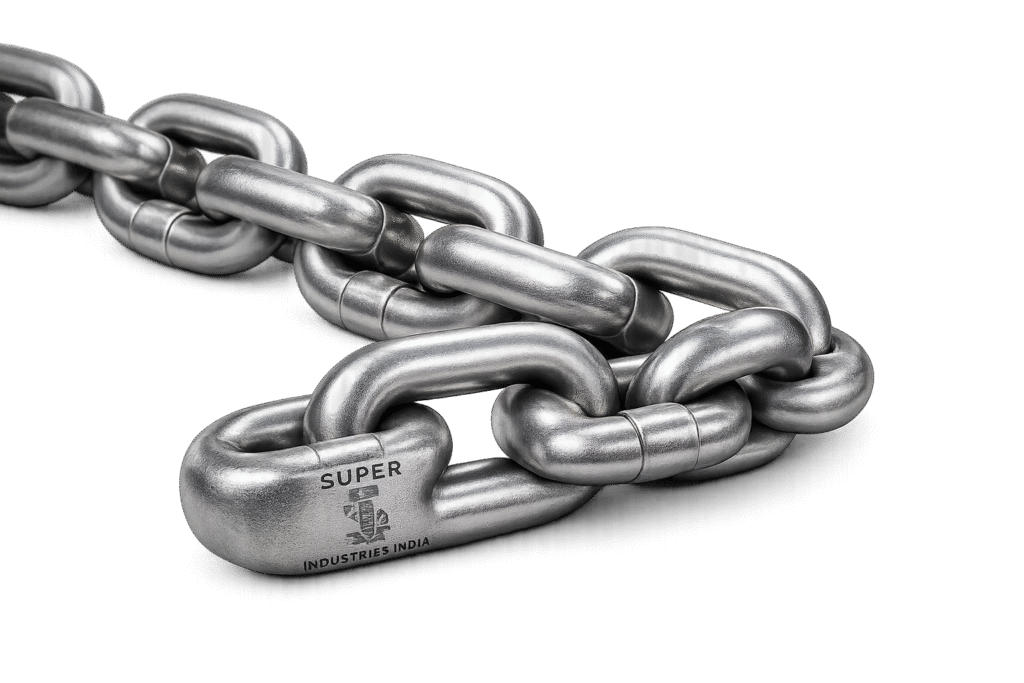
In EPC, offshore, and capital-intensive projects, stud link chains are classified as primary load-bearing and load-retention components. They are not auxiliary hardware. They form an integral part of lifting systems, anchoring arrangements, and mooring configurations where loss of load control directly translates into structural damage, environmental exposure, and personnel risk.
Stud link chains are extensively specified in:
- Offshore platforms and FPSO mooring systems
- Port and harbor anchoring arrangements
- Heavy lifting and temporary load restraint
- Marine construction and subsea deployment
- Infrastructure and energy projects requiring high fatigue resistance
In these environments, conventional open-link chains are unacceptable. EPC contractors and marine consultants specify Stud Link Chains because the central stud fundamentally changes the mechanical behavior of the chain under load, shock, and cyclic conditions.
For this reason, stud link chains are subject to engineering verification, third-party inspection, and classification-society acceptance. This page is written to support those technical evaluations.
2️⃣ Technical Definition: What Stud Link Chains Are and Why the Stud Is Critical
A stud link chain is a steel chain in which each oval link incorporates a forged or welded transverse stud across the center of the link.
Functional Role of the Stud
The stud is not a spacer. It performs critical mechanical functions:
- Prevents link deformation under tensile load
- Distributes compressive forces across the link body
- Maintains consistent pitch under load
- Reduces wear between adjacent links
- Improves fatigue resistance during cyclic loading
Without the stud, links tend to elongate, twist, and flatten under high load, especially in marine and dynamic service. The stud ensures the chain behaves as a dimensionally stable load path, which is essential for predictable performance.
3️⃣ Engineering & Safety Relevance
Load Control and Dimensional Stability
Stud link chains maintain link geometry under sustained and peak loads. This stability ensures:
- Consistent engagement with chain wheels, gypsies, and pockets
- Uniform load transfer across links
- Reduced risk of localized overstress
Deformation Prevention
The stud resists ovalization of the link under tensile force. This directly increases resistance to:
- Plastic deformation
- Progressive elongation
- Premature rejection during inspection
Wear Resistance and Fatigue Behavior
In mooring and offshore service, chains experience:
- Constant movement due to waves and current
- Cyclic loading with varying amplitude
- Abrasive contact between links
Stud link chains exhibit lower internal wear rates and superior fatigue performance compared to open-link designs.
Lifecycle Risk Control
For EPC and offshore projects designed for 20–30 years of service, stud link chains significantly reduce lifecycle risk by delaying wear-driven degradation and inspection failure.
4️⃣ Load Rating & Design Logic
The load capacity of stud link chains is determined by a combination of geometric, material, and metallurgical parameters.
Nominal Diameter
The chain diameter (d) is the primary determinant of strength. All load ratings are referenced to this nominal size.
Pitch and Link Geometry
Controlled pitch ensures compatibility with chain wheels and predictable load sharing. Stud geometry must be proportioned to prevent stress concentration.
Breaking Load and Proof Load
- Proof Load: Applied during testing to verify elastic performance
- Minimum Breaking Load (MBL): Defined by applicable standards
Factor of Safety
Stud link chains are designed and certified with defined factors of safety depending on application:
- Lifting applications: typically ≥4:1
- Mooring and anchoring: standard-specific and class-defined
Engineering calculations always reference certified proof and breaking loads, not nominal values.
5️⃣ Types of Stud Link Chains & Performance Characteristics
Lifting-Grade Stud Link Chains
Used in cranes, hoists, and heavy lifting systems. Designed for controlled environments with defined duty cycles.
Mooring Stud Link Chains
Designed for continuous exposure to marine environments, cyclic loading, and long service life.
Anchoring Stud Link Chains
Optimized for high static loads and abrasion resistance during seabed contact.
Offshore-Grade Stud Link Chains
Manufactured to classification-society standards with enhanced toughness, fatigue resistance, and inspection requirements.
Each type differs in material grade, heat treatment, and acceptance criteria.
6️⃣ Material, Heat Treatment & Standard Alignment
Stud link chains for EPC and offshore use must conform to internationally recognized standards.
Key Standards & Specifications
- EN 818 / EN 13414 (where applicable): Lifting chain references
- ISO 1704 / ISO 1834: Ship and offshore mooring chains
- DIN 5685 / DIN 763: Industrial chain references
- Classification Society Rules: Offshore and marine acceptance
Material Selection
- Carbon-manganese steels for general industrial use
- Alloy steels for offshore and high-fatigue service
Heat Treatment
- Controlled quenching and tempering
- Verified toughness and elongation
- Uniform mechanical properties across the link and stud
Heat treatment quality directly influences crack resistance and fatigue life.
7️⃣ Manufacturing & Quality Discipline
Forging & Link Forming
Links are hot-formed to controlled geometry. Dimensional consistency is critical for load sharing and wear behavior.
Welding Control
Studs and links are welded using qualified procedures. Weld integrity is verified to prevent crack initiation at the most stressed locations.
Heat Treatment Control
Entire chains are heat treated as assemblies to ensure uniform mechanical properties.
Dimensional Control
Critical parameters include:
- Diameter tolerance
- Pitch consistency
- Stud positioning and fit
Traceability & Inspection Philosophy
- Heat and batch traceability from raw material to finished chain
- Proof load testing as per standard
- Visual and dimensional inspection
- Non-destructive examination where specified
This discipline ensures inspection acceptance by EPC clients and third-party surveyors.
8️⃣ Procurement, Installation & Inspection View
During Technical Evaluation
EPC engineers and marine consultants verify:
- Applicable standard and grade
- Certified proof and breaking loads
- Heat treatment and material specification
- Manufacturing and inspection records
During Incoming Inspection
Third-party inspectors check:
- Dimensional conformity
- Weld quality and surface condition
- Markings and traceability
- Test certificates
During Installation
Engineers ensure:
- Compatibility with chain wheels and anchoring systems
- Correct orientation and handling
- No damage during installation
9️⃣ Application Mapping Across EPC & Marine Sectors
Oil & Gas & Offshore Platforms
Mooring systems, riser restraint, subsea deployment.
Ports & Harbors
Anchoring, mooring, and berth restraint systems.
Power & Energy
Heavy lifting and structural restraint during installation.
LNG
Marine terminal mooring and cryogenic infrastructure support.
Hydrogen
Emerging marine and offshore infrastructure with conservative design margins.
Infrastructure
Bridge construction, marine foundations, and heavy civil works.
🔟 Professional Technical Tables
Typical Stud Link Chain Dimensions
| Nominal Diameter (mm) | Typical Pitch (mm) |
|---|---|
| 16 | 48 |
| 20 | 60 |
| 24 | 72 |
| 30 | 90 |
| 36 | 108 |
| 42 | 126 |
Indicative Load Ratings (Reference Only)
| Diameter (mm) | Proof Load (kN) | Min. Breaking Load (kN) |
|---|---|---|
| 20 | ~250 | ~500 |
| 24 | ~360 | ~720 |
| 30 | ~560 | ~1120 |
| 36 | ~800 | ~1600 |
Actual values depend on grade and governing standard.
Grade Classification (Indicative)
| Chain Grade | Typical Application |
|---|---|
| Grade 2 | General industrial |
| Grade 3 | Lifting applications |
| R3 | Offshore mooring |
| R4 | High-performance offshore |
Material Grades vs Service Environment
| Environment | Recommended Grade |
|---|---|
| Industrial lifting | Grade 3 |
| Marine anchoring | R3 |
| Offshore dynamic | R4 |
Project-Specific Customization Options
| Parameter | Options |
|---|---|
| Diameter & Length | Project-defined |
| Grade | Industrial to offshore |
| Heat Treatment | Standard / enhanced |
| Testing | Proof, breaking, NDT |
| Certification | EPC / class-specific |
Manufacturer-Focused Conclusion
In EPC, offshore, and capital projects, Stud Link Chains are safety-critical engineered components, not interchangeable hardware. Their performance depends on controlled geometry, material selection, heat treatment discipline, and inspection readiness.
Super Industries manufactures stud link chains under controlled forging, welding, heat treatment, and inspection systems aligned with international standards and EPC acceptance criteria. Our engineering discipline, traceability control, and inspection-ready documentation support predictable performance, third-party approval, and long-term reliability in demanding lifting, anchoring, and mooring applications.
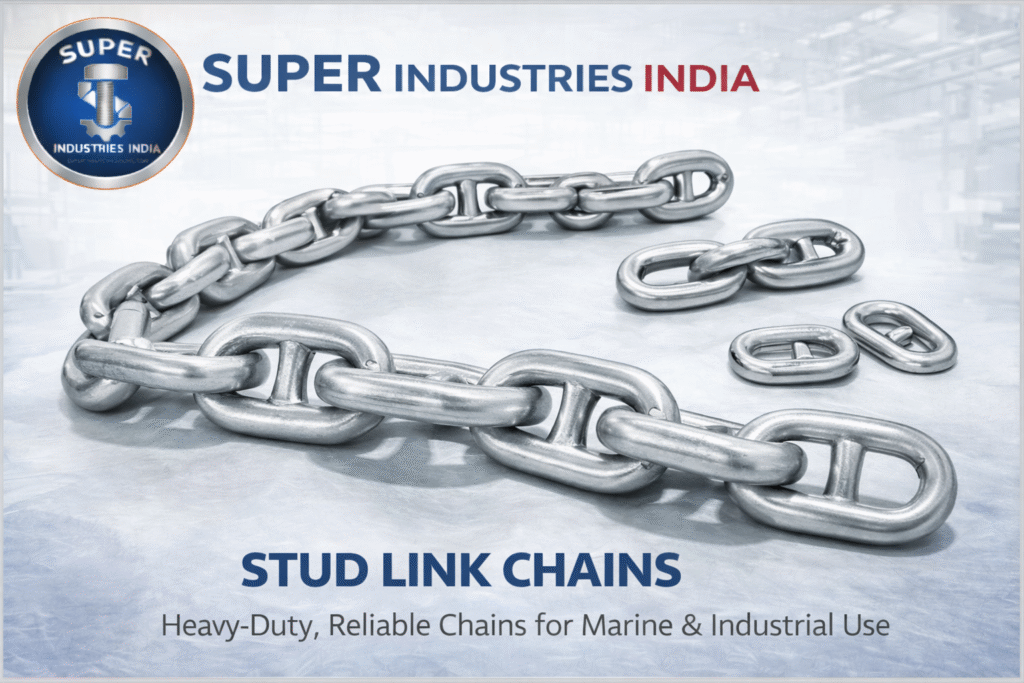
The Anchor’s Lifeline: High-Integrity Stud Link Chains for Marine and Offshore
In the demanding world of marine, offshore, and maritime infrastructure, the security of vessels, platforms, and submerged equipment relies entirely on the strength and integrity of the mooring system. Stud Link Chain is the industry standard for anchoring applications, offering unparalleled weight, bulk, and resistance to deformation. Super Industries India is a premier supplier of certified, high-tensile Stud Link Chain, manufactured to strict international specifications (U1, U2, and U3) to ensure maximum holding power and reliability in the world’s harshest sea conditions.
What is a Stud Link Chain? The Definition of Maritime Strength
A Stud Link Chain is a heavy-duty anchor chain where each link contains a central cross-piece, or stud, welded across its center. This seemingly simple internal stud is what transforms the chain into a highly rigid and reliable component:
- Prevents Kinking and Twisting: The stud keeps the sides of the link parallel, preventing the chain from kinking, bunching, or twisting upon itself under heavy load.
- Resists Deformation: It prevents the sides of the link from collapsing inward or spreading outward, maintaining the original shape and maximizing the chain’s Proof Load and Breaking Load.
- Enhances Fatigue Life: By eliminating sharp internal wear points, the stud increases the chain’s overall fatigue life, which is critical for long-term mooring.
These chains are exclusively used for securing anchors and forming the permanent or temporary mooring systems for ships, buoys, oil rigs, and floating docks.
Technical Specifications: Grades U1, U2, and U3
Chain strength is classified by its grade, which determines the maximum allowed load. Super Industries India supplies Stud Link Chain adhering to major classification society standards, including API, ABS, DNV GL, and Lloyd’s Register.
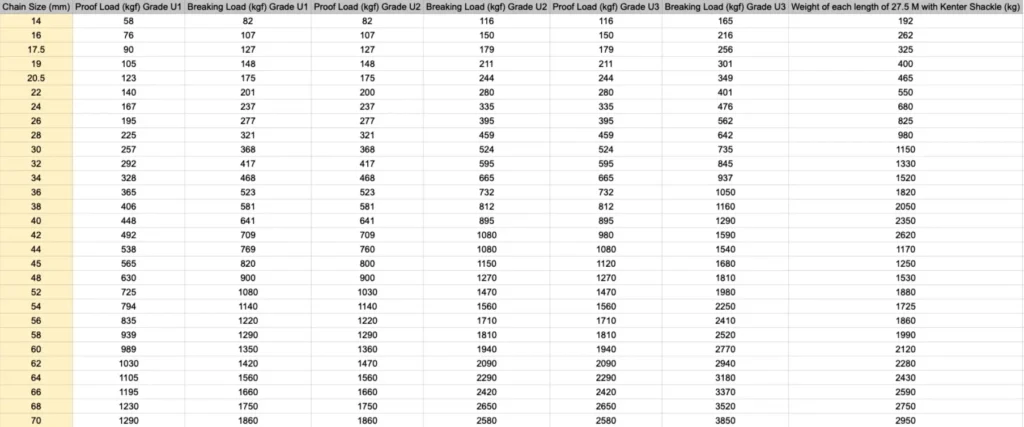
Our chains are categorized by strength and material grade, as detailed in the technical table provided:
Grade U1 (Common Steel)
- Description: This is the lowest strength grade, often used in less critical mooring lines or as lower-stress connections.
- Characteristics: Provides the baseline breaking load for comparison. Suitable for applications where low weight is not essential and loads are moderate.
Grade U2 (High Strength Steel)
- Description: Represents the standard high-strength grade for ship anchoring and general mooring applications.
- Characteristics: Achieves significantly higher Proof Load and Breaking Load capacities compared to U1, using the same chain size. This is the most widely adopted and versatile grade.
Grade U3 (Super High Strength Steel)
- Description: The premium, highest-strength grade available for anchor chain.
- Characteristics: Offers the maximum Proof Load and Breaking Load for a given chain diameter, minimizing the required chain size and weight. Grade U3 chains are essential for deep-water mooring, extreme environmental conditions, and large offshore drilling platforms.
Note: Referencing our technical data, the Breaking Load significantly increases from U1 to U3 (e.g., a 42 mm chain jumps from 709 kgfin U1 to 1, 080 kgf in U2 and up to 1, 590 kgf in U3), showcasing the critical role of material grade.
Manufacturing and Quality Assurance
The manufacturing process for Stud Link Chain is complex, involving drop forging, flash-butt welding, and precision stud insertion to ensure perfect geometric and metallurgical consistency. Our production facility adheres to strict processes to guarantee every link meets the required specifications.
Key Quality and Certification Points:
- Material Purity: Only certified, high-tensile steel billets are used, especially for U2 and U3 grades.
- Flash-Butt Welding: The links are joined using this specialized welding technique to ensure the weld zone is as strong as the base metal.
- Proof Load Testing: Every length of chain (shackle) is subjected to a statutory Proof Load test to verify its integrity before deployment.
- End Terminations: Chains are supplied in standard lengths (shackles) complete with specialized end links, common links, and swivels designed for interconnection.
Technical Specifications: Stud Link Chain
All loads are typically measured in kilo-force (kgf) or kilonewtons (kN), and the values below reflect the raw numerical data for the loads and weight.
Applications for Certified Stud Link Chain
As a reliable Stud Link Chain Supplier in India, Super Industries India supports a vast range of maritime operations:
- Ship Anchoring: Used as the primary anchor chain for commercial vessels, tankers, and cargo ships.
- Permanent Mooring Systems: Securing FPSOs (Floating Production Storage and Offloading), FSOs, and SPMs (Single Point Mooring) in deep water environments.
- Offshore Aquaculture and Energy: Used for securing large tidal energy devices, floating solar farms, and fish farming enclosures.
For certified, high-strength Stud Link Chains in Grades U1, U2, and U3, rely on Super Industries India to secure your assets against the forces of the sea.
Contact us today for expert consultation and detailed quotes on our specialized chain products.