
Wire Rope Thimble
Table of Contents
Engineering Reference for Lifting, Rigging & EPC Capital Projects
Manufacturer & Global Exporter: Super Industries
Website: https://superindustriesindia.in
Email: Sales@superindustriesindia.in
1️⃣ Industry Context: Why Wire Rope Thimbles Are Safety-Critical in EPC Projects

In EPC, shutdown, and capital-project environments, wire rope terminations are treated as primary load-path interfaces. Within these terminations, the wire rope thimble plays a decisive role in controlling load transfer, wear behavior, and long-term integrity of the rope eye.
Across Oil & Gas, Power & Energy, Petrochemical, LNG, Hydrogen, and Infrastructure projects, lifting failures rarely originate from rope breakage alone. They more commonly initiate at termination points, where localized bending stress, abrasion, and deformation accelerate fatigue. The absence, misuse, or incorrect selection of a wire rope thimble materially increases this risk.
For EPC contractors, lifting engineers, and consultants, wire rope thimbles are therefore classified as safety-critical termination components, essential for:
- Preserving rope geometry at the eye
- Controlling bend radius under load
- Preventing crushing, pinching, and abrasion
- Maintaining predictable load transfer during lifting
- Ensuring compliance with lifting standards and inspection regimes
A properly engineered Wire Rope Thimble is not an accessory; it is an integral part of the lifting system that directly affects safety margins and service life.
2️⃣ Technical Definition: What Wire Rope Thimbles Are and How They Function
A wire rope thimble is a formed metal insert placed inside the eye of a wire rope sling or termination. Its primary function is to maintain the correct internal radius of the rope eye and provide a smooth, hardened bearing surface for shackles, hooks, or other connecting hardware.
Functional Role in Lifting Assemblies
Wire rope thimbles function by:
- Distributing bearing pressure evenly across the rope strands
- Preventing excessive bending at the eye termination
- Protecting the rope from direct metal-to-metal contact
- Stabilizing the eye geometry under load and cyclic movement
Thimbles are used in conjunction with hand-spliced eyes, mechanically spliced eyes, socketed terminations, and certain clamp-based assemblies where permitted by standards and lifting design.
3️⃣ Engineering Relevance: Load Handling, Safety Factors & Lifecycle Risk
Load Handling Logic
Wire rope thimbles do not increase the nominal breaking strength of a rope; however, they preserve the effective strength by preventing localized stress concentration. Without a thimble, the rope bends sharply around a shackle or pin, reducing effective strength and accelerating fatigue.
Factor of Safety Preservation
Lifting standards assume the presence of a correctly sized thimble when defining Safe Working Load (SWL) for eye terminations. Omission or incorrect sizing compromises the assumed factor of safety used in lifting studies and method statements.
Dynamic Loading and Fatigue
In real EPC lifting scenarios, terminations experience:
- Load rotation and minor misalignment
- Micro-movements under cyclic loading
- Vibration during hoisting and set-down
A thimble provides a controlled interface that minimizes strand movement and fretting, directly extending service life.
4️⃣ Load Capacity & Design Logic
The performance of a wire rope thimble is governed by its interaction with the rope and connecting hardware.
Rope Construction Compatibility
- 6×19 constructions: Require robust thimbles to manage higher strand stiffness
- 6×36 constructions: More flexible but sensitive to crushing without thimbles
- IWRC ropes: Benefit most from correctly profiled thimbles
Rope Diameter Matching
Thimbles are designed for specific rope diameters. An undersized thimble causes rope pinching; an oversized thimble allows movement and uneven load distribution.
Bend Radius Control
International standards define minimum D/d ratios (sheave or pin diameter to rope diameter). Thimbles are engineered to maintain this ratio at the eye, preserving rope efficiency.
Efficiency Factors
Correctly installed thimbles allow the eye termination to retain near-nominal rope efficiency, typically 90–100% depending on termination type and standard.
5️⃣ Types of Wire Rope Thimbles & Performance Characteristics
Standard Thimbles
Light to medium-duty applications. Used in general lifting slings where loads and cycles are controlled.
Heavy-Duty Thimbles
Thicker cross-section and higher bearing strength. Preferred for EPC lifting, offshore use, and repeated load cycles.
Solid (Closed) Thimbles
Fully enclosed profile. Maximum protection and wear resistance. Used in critical lifting points.
Open Thimbles
Easier installation during splicing. Suitable where inspection access is required.
Galvanized vs Plain Finish
Galvanized thimbles are used in corrosive or outdoor environments; plain finish may be used in controlled indoor conditions.
6️⃣ Material, Construction & Standard Alignment
Wire rope thimbles supplied to EPC projects must align with recognized international standards to ensure compatibility and inspection acceptance.
Common Standards Framework
- EN 13411 (Series): Steel wire rope terminations
- DIN 6899: Thimbles for wire ropes
- ASME B30.9: Slings and lifting devices
- IS standards: Indian industrial lifting applications
Material Selection
- Carbon steel for general industrial lifting
- Alloy steel for heavy-duty and high-cycle applications
- Surface protection: hot-dip galvanized or zinc plated
Material choice is aligned with environmental exposure, load spectrum, and inspection intervals.
7️⃣ Manufacturing & Quality Discipline
Material Control
Thimbles are manufactured from controlled steel grades with defined mechanical properties to resist deformation under bearing loads.
Forming & Dimensional Control
Critical parameters include:
- Groove radius and depth
- Thimble thickness and profile
- Internal bearing surface finish
Dimensional accuracy ensures proper rope seating and uniform load transfer.
Surface Treatment
Galvanizing or coating thickness is controlled to prevent interference with rope seating while providing corrosion protection.
Inspection Philosophy
- Dimensional inspection against standard profiles
- Visual inspection for cracks, laps, or forming defects
- Batch identification for traceability
For EPC supply, thimbles are delivered as inspection-ready components, suitable for third-party verification.
8️⃣ Procurement, Installation & Inspection View
During Technical Evaluation
EPC engineers and lifting specialists verify:
- Thimble type and applicable standard
- Rope diameter compatibility
- Intended termination method (spliced, socketed, etc.)
- Environmental and corrosion considerations
During Incoming Inspection
Inspectors check:
- Dimensional conformity
- Surface condition and coating integrity
- Batch identification and documentation
During Installation & Use
Lifting authorities ensure:
- Thimble fully seated within the eye
- No rope strand pinching or distortion
- Correct interface with shackles or hooks
9️⃣ Application Mapping Across EPC Sectors
Oil & Gas
Offshore and onshore lifting slings, rigging eyes, guy wires.
Power & Energy
Turbine, generator, and boiler component lifting.
Petrochemical
Process equipment handling and maintenance rigging.
LNG
Cryogenic equipment lifting with controlled terminations.
Hydrogen
New-generation installations requiring conservative lifting design.
Infrastructure & Construction
Bridge segments, precast elements, and structural lifting.
🔟 Professional Technical Tables
Typical Rope Constructions Used with Thimbles
| Rope Construction | Thimble Suitability |
|---|---|
| 6×19 IWRC | High |
| 6×36 IWRC | High |
| Fiber Core ropes | Controlled / Limited |
Indicative Rope Diameter vs Thimble Size
| Rope Diameter (mm) | Typical Thimble Size |
|---|---|
| 10 | 10 mm |
| 12 | 12 mm |
| 16 | 16 mm |
| 20 | 20 mm |
| 24 | 24 mm |
| 32 | 32 mm |
Exact sizing per applicable standard.
Termination Efficiency with Thimble
| Termination Type | Efficiency |
|---|---|
| Hand-spliced eye with thimble | 90–95% |
| Mechanically spliced eye with thimble | 95–100% |
| Socketed termination with thimble | Up to 100% |
Factor of Safety Reference
| Application | Typical FoS |
|---|---|
| Lifting slings | ≥5:1 |
| Critical lifts | Project-defined, engineered |
| Temporary rigging | As per method statement |
Project-Specific Customization Options
| Parameter | Options |
|---|---|
| Thimble Type | Standard, heavy-duty, solid |
| Material | Carbon steel, alloy steel |
| Finish | Plain, galvanized |
| Identification | Batch marking |
| Documentation | Inspection reports, certificates |
Manufacturer-Focused Conclusion
In EPC and capital-project lifting operations, wire rope thimbles are essential termination-control components that preserve rope efficiency, manage fatigue risk, and support predictable load behavior. Their correct selection and manufacture are fundamental to lifting safety and inspection acceptance.
Super Industries manufactures wire rope thimbles under controlled material, forming, and inspection systems aligned with international lifting standards. Our thimbles are supplied with defined dimensional compatibility, traceability, and documentation suitable for EPC lifting studies, consultant review, and site execution.
This engineering-driven discipline ensures reliable rope terminations, reduced lifecycle risk, and compliance with safety-critical lifting requirements.
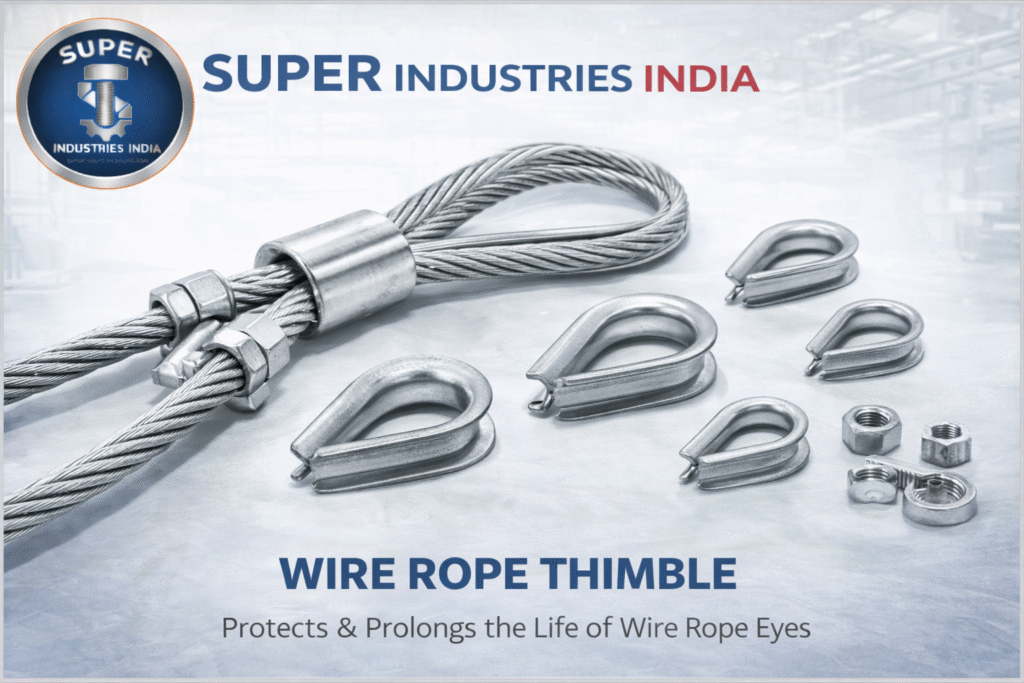
Protecting the Loop: High-Performance Wire Rope Thimbles
The “eye” or loop created at the end of a wire rope assembly is the single most vulnerable point, suffering intense abrasion and wear as it interacts with hooks, shackles, and anchor points. To prevent premature rope failure and maintain the full strength of your lifting system, a high-quality Wire Rope Thimble is essential.
Super Industries India is a trusted manufacturer and supplier of certified rigging hardware, featuring our superior Wire Rope Thimble. Engineered from heavy-duty, corrosion-resistant materials, the Wire Rope Thimble is designed to form, protect, and extend the lifespan of the wire rope eye, ensuring maximum safety and efficiency across marine, construction, and heavy industrial applications in India and worldwide.
What is the Wire Rope Thimble?
The Wire Rope Thimble is a galvanized steel fitting used inside the loop of a wire rope to provide a robust, chafe-resistant surface. The name “thimble” refers to its function of protecting the loop just as a seamstress’s thimble protects a finger.
Key Features and Construction
- Forged or Heavy Pattern Design: Wire Rope Thimble is typically manufactured as a heavy-duty, solid pattern thimble. This means it has a thicker cross-section and more robust construction than standard commercial thimbles, making it better suited for static loads, severe stress, and prolonged exposure in harsh environments.
- Grooved Contour: The outer edge features a precise groove that matches the diameter of the wire rope being used. This snug fit helps cradle the wire rope strands, preventing the eye from collapsing inward under load and maintaining the rope’s original Working Load Limit (WLL).
- Material and Finish: Constructed from high-strength Carbon Steel and finished with Hot-Dip Galvanization (HDG). This process applies a thick, uniform zinc coating that provides outstanding resistance to rust and corrosion, making the Wire Rope Thimble the ideal choice for exposed outdoor and saltwater marine conditions.
Critical Functions and Benefits
The use of the Wire Rope Thimble is not optional—it is a mandatory step in creating a safe, durable wire rope assembly.
1. Protection Against Abrasion (Chafing)
When a wire rope loop is connected directly to a shackle or hook, movement causes the steel strands to chafe against the connection point. This rapid wear can quickly reduce the rope’s diameter and breaking strength. The Wire Rope Thimble provides a smooth, sacrificial surface that bears the load and resists the friction.
2. Prevents Eye Collapse
Under heavy tension, a naked wire rope loop can pinch, distort, and even break its internal strands as the connection point digs into the rope. The rigid, internal shape of the Wire Rope Thimble maintains the natural curvature of the rope eye, ensuring the load is distributed evenly across all strands and preserving up to 95% of the rope’s original strength.
3. Structural Support for Splicing
The thimble acts as the internal template for either the hand splice (Flemish Eye) or the mechanical splice (Swaged Eye). It provides the foundational shape necessary to apply the proper pressing force, leading to a consistently strong and dimensionally correct loop.
Specifications and Compliance
The Wire Rope Thimble is designed for serious, heavy-duty applications, prioritizing longevity and structural integrity.
- Dimensional Standards: The dimensions and tolerances of the Wire Rope Thimble meet or exceed requirements set by standards such as Federal Specification FF-T-276b Type III (Heavy) or equivalent EN/ISO standards, ensuring compatibility with other certified rigging components.
- Compatibility: Designed for use with standard 6*19 and 6*37 class wire ropes, suitable for both steel and fiber cores.
- Corrosion Resistance: The HDG finish makes it vastly superior to electro-plated or un-finished alternatives for any application involving moisture, high humidity, or direct saltwater spray.
Trust Super Industries India for the foundation of your secure wire rope assembly. The Wire Rope Thimble offers the heavy-duty protection your critical lifts require.
Need certified, galvanized thimbles that won’t fail under pressure? Contact Super Industries India today for expert sizing and bulk quotations on the Wire Rope Thimble47 series.