
Stainless Steel Metal Hoses
Table of Contents
Engineering Reference for Flexible Piping Systems in EPC & Capital Projects
Manufacturer & Global Exporter: Super Industries
Website: https://superindustriesindia.in
1️⃣ Industry Context: Why Stainless Steel Metal Hoses Are Critical in EPC & Capital Projects
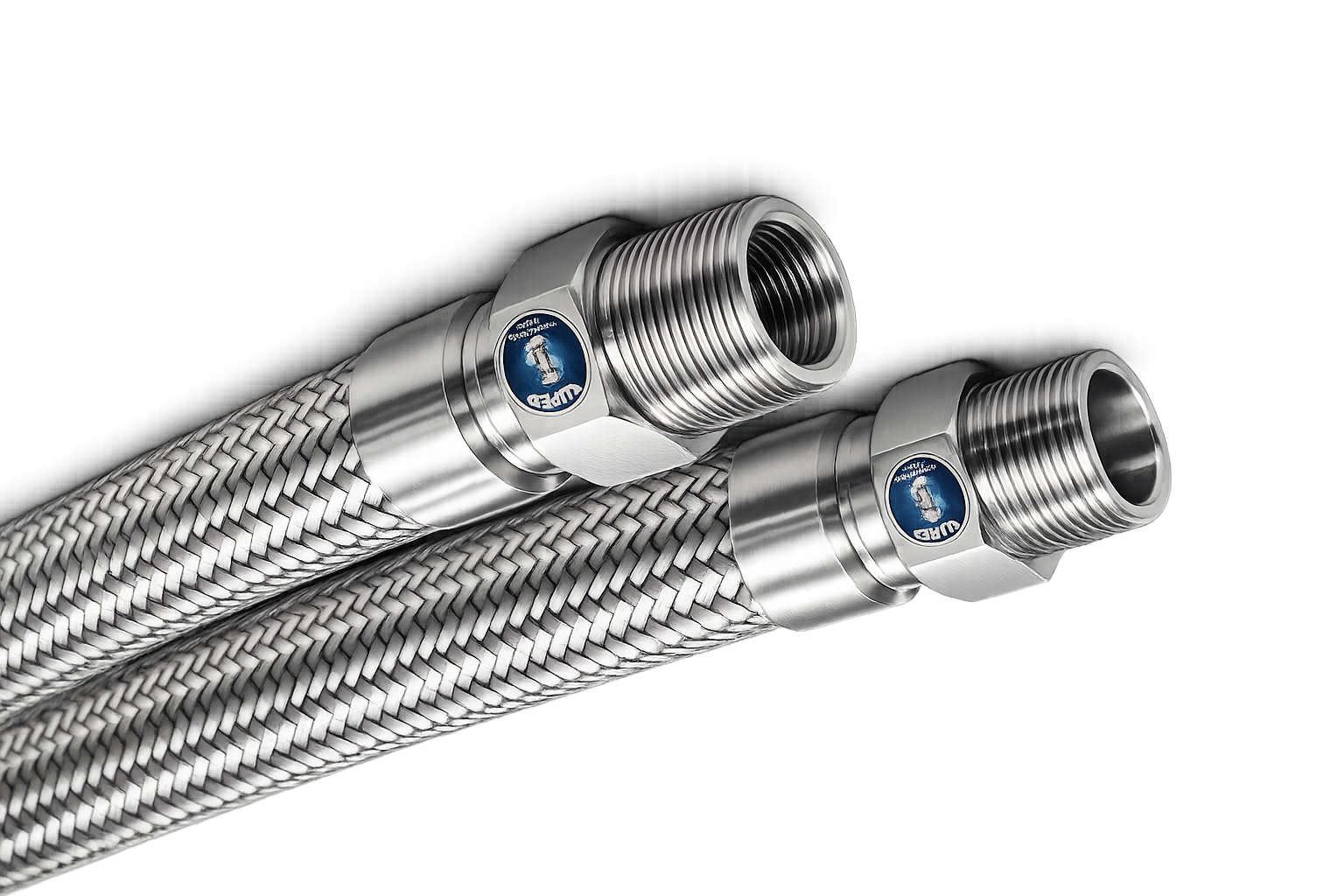
Modern EPC and capital projects are characterized by high-pressure systems, thermal cycling, vibration, constrained layouts, and stringent reliability expectations. Within this environment, stainless steel metal hoses are not convenience items; they are engineered flexibility elements designed to protect piping systems, equipment nozzles, and pressure boundaries from mechanical overstress.
Across Oil & Gas, Power & Energy, Petrochemical, LNG, Hydrogen, Chemical processing, and Infrastructure projects, rigid piping alone cannot accommodate:
- Differential thermal expansion
- Pump- and compressor-induced vibration
- Installation misalignment and settlement
- Pressure pulsation and transient loads
- Modular construction tolerances
Stainless Steel Metal Hoses are therefore specified as functional components within piping stress models, not as accessories. Their selection directly affects system integrity, fatigue life, and long-term maintenance exposure. EPC contractors, consultants, and third-party inspectors treat these hoses as pressure-containing items subject to full technical scrutiny.
2️⃣ Technical Definition: What Stainless Steel Metal Hoses Are and How They Function
A stainless steel metal hose is a thin-walled, corrugated, metallic pressure conduit, typically manufactured from austenitic stainless steel strip and reinforced with one or more layers of stainless steel wire braid. The hose provides flexibility while maintaining pressure containment.
Construction Overview
A standard stainless steel metal hose assembly consists of:
- Corrugated hose core – provides flexibility and pressure boundary
- External wire braid(s) – restrains axial movement and increases pressure capacity
- End fittings – welded or mechanically attached for system connection
Functional Role in Piping Systems
Stainless steel metal hoses function by:
- Absorbing axial, lateral, and angular movement
- Isolating vibration and noise from rotating equipment
- Relieving thermal expansion loads transferred to anchors and nozzles
- Accommodating installation tolerances without inducing stress
They are commonly installed adjacent to pumps, compressors, turbines, heat exchangers, skid connections, and expansion interfaces.
3️⃣ Engineering Relevance: Pressure, Flexibility & Fatigue Behavior
Pressure Containment
The hose core acts as the primary pressure boundary. Pressure rating is governed by:
- Hose diameter and wall thickness
- Corrugation profile and pitch
- Material yield and tensile strength
Flexibility and Movement Absorption
Corrugation geometry allows controlled elastic deformation. Engineers quantify allowable:
- Axial compression and extension
- Lateral offset
- Angular deflection
These movements must remain within design limits to avoid premature fatigue.
Vibration Isolation
Braided metal hoses attenuate mechanical vibration transmitted through rigid piping. This protects:
- Pump and compressor bearings
- Instrument connections
- Welded piping joints
Fatigue Life
Metal hoses are cycle-dependent components. Fatigue life is a function of:
- Movement amplitude
- Pressure fluctuations
- Temperature
- Braid restraint effectiveness
For EPC projects, hose selection must align with the expected number of operating cycles over design life.
4️⃣ Design & Performance Logic
Corrugation Profile
- Annular corrugation: Uniform strength and predictable movement capability
- Helical corrugation: Greater flexibility but directional characteristics
Annular corrugation is generally preferred for EPC applications due to consistent stress distribution.
Braid Layers
- Unbraided: Limited to very low pressure and movement control
- Single braid: Standard pressure containment and flexibility balance
- Double braid: Higher pressure rating and improved fatigue resistance
Hose Diameter
Larger diameters increase flow capacity but reduce flexibility and pressure rating. Diameter selection is coordinated with piping stress analysis.
Pressure Rating
Working pressure is derived from burst pressure divided by an applicable factor of safety, typically 3:1 or higher depending on standard.
Movement Capability
Movement allowances are specified per installation orientation. Incorrect movement mode selection is a common cause of premature failure.
5️⃣ Types of Stainless Steel Metal Hoses
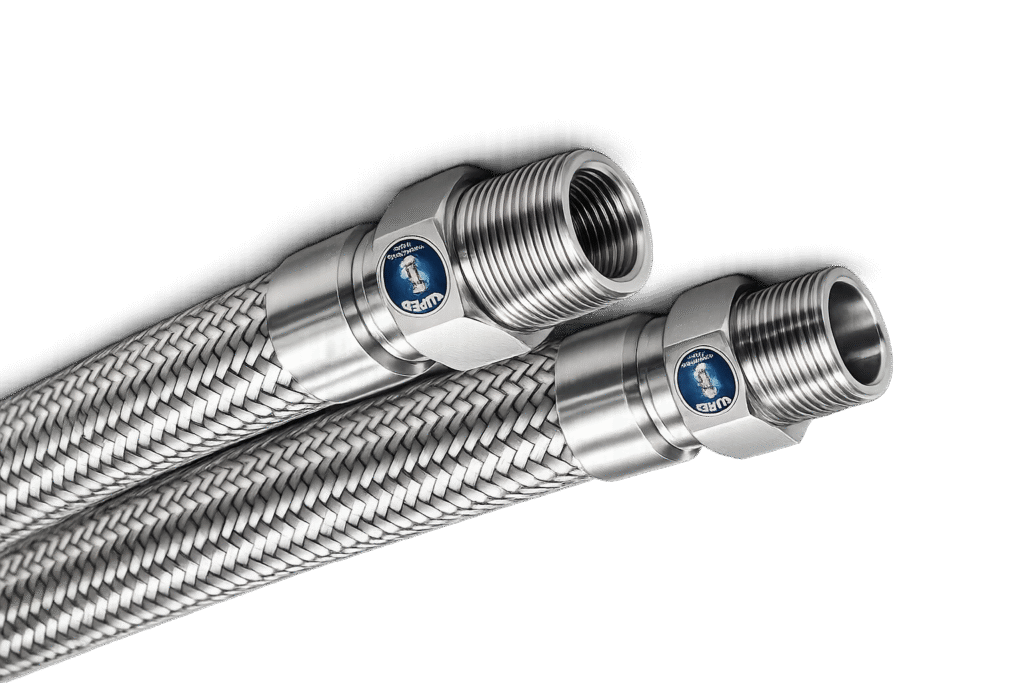
Unbraided Metal Hoses
Used where pressure is minimal and flexibility is required primarily for alignment. Not typical for EPC pressure service.
Single-Braided Hoses
Most common configuration. Suitable for moderate pressures and general vibration isolation.
Double-Braided Hoses
Used for higher pressures, increased safety margin, and extended fatigue life.
Interlocked Metal Hoses
Constructed from mechanically interlocked stainless steel strips. Used primarily for high-temperature, low-pressure applications such as exhaust or insulation conduit, not for pressure containment.
Special Constructions
Includes convoluted hoses with liners, vacuum-rated hoses, or chemically compatible alloy upgrades.
6️⃣ Material & Standard Alignment
Material Selection
- SS 304 / 304L: General service, good formability
- SS 316 / 316L: Improved corrosion resistance, chloride environments
- Higher alloys: Selected for specific chemical or temperature exposure
Applicable Standards & Codes
- ASTM A240 / A240M: Stainless steel strip and plate
- ASTM A269 / A213: Tubular references for fittings
- ASME B31 (Code Series): Pressure piping integration
- ISO / EN standards: Hose construction and testing references
- MSS SP series: Industry practice for flexible connectors
Compliance ensures acceptance during consultant review and third-party inspection.
7️⃣ Manufacturing & Quality Discipline
Strip Forming & Welding
Stainless steel strip is roll-formed and longitudinally welded under controlled parameters. Weld integrity is critical to pressure performance.
Corrugation Control
Corrugation depth, pitch, and uniformity are controlled to achieve consistent flexibility and fatigue behavior.
Braiding Integrity
Wire braid is applied under controlled tension. Uniform braid angle and coverage are essential for pressure restraint.
End Fitting Attachment
End fittings are welded using qualified procedures. Weld quality is verified to prevent leak paths or stress raisers.
Traceability & Inspection
- Heat-wise material traceability
- Dimensional and visual inspection
- Pressure and leak testing where specified
- Documentation aligned with EPC inspection plans
8️⃣ Procurement, Installation & Inspection View
During Technical Evaluation
EPC engineers verify:
- Hose type and braid configuration
- Pressure and temperature ratings
- Movement capability and fatigue assumptions
- Compliance with piping stress analysis
During Incoming Inspection
Inspectors review:
- Material certificates and traceability
- Visual condition and braid integrity
- End connection dimensions and weld quality
During Installation
Site teams ensure:
- No torsional loading during installation
- Proper alignment and support
- Movement limits are not exceeded
Incorrect installation is a leading cause of hose failure, independent of manufacturing quality.
9️⃣ Application Mapping Across Industries
Oil & Gas
Pump suction/discharge, compressor connections, offshore modules.
Power & Energy
Turbine auxiliaries, boiler connections, vibration isolation.
Petrochemical & Chemical
Process piping with thermal cycling and aggressive media.
LNG
Cryogenic-compatible flexible connections with controlled movement.
Hydrogen
Emerging systems requiring leak-tight, fatigue-resistant flexibility.
Infrastructure
Utility connections, expansion compensation in constrained layouts.
🔟 Professional Technical Tables
Hose Sizes & Nominal Diameters
| Nominal Size (NB) | Approx. ID (mm) |
|---|---|
| 15 | 13 |
| 25 | 22 |
| 50 | 50 |
| 100 | 100 |
Indicative Pressure Ratings (Single Braid, SS 316)
| Hose Size | Working Pressure (bar) |
|---|---|
| 15 NB | ~210 |
| 25 NB | ~160 |
| 50 NB | ~90 |
| 100 NB | ~45 |
Values indicative; actual ratings depend on construction and temperature.
Braid Configuration vs Pressure Capability
| Braid Type | Relative Pressure Rating |
|---|---|
| Unbraided | Very low |
| Single braid | Standard |
| Double braid | High |
Movement Capability (Indicative)
| Movement Type | Typical Allowance |
|---|---|
| Axial | ±10–20% of length |
| Lateral | Diameter-dependent |
| Angular | Limited, orientation-specific |
Material Grades vs Service Conditions
| Material | Typical Service |
|---|---|
| SS 304L | General industrial |
| SS 316L | Chloride / marine |
| Higher alloys | Chemical / temperature-specific |
Project-Specific Customization Options
| Parameter | Options |
|---|---|
| Hose diameter & length | Project-defined |
| Braid layers | Single / double |
| End connections | Flanged, threaded, welded |
| Material | 304L, 316L, special alloys |
| Testing | Pressure, leak, NDT |
| Certification | EN 10204 3.1 / 3.2 |
Manufacturer-Focused Conclusion
In EPC and capital projects, Stainless Steel Metal Hoses are pressure-containing, fatigue-sensitive engineered components. Their successful application depends on correct design assumptions, disciplined manufacturing, controlled installation, and inspection-ready documentation.
Super Industries manufactures stainless steel metal hoses under controlled forming, welding, corrugation, and braiding processes aligned with international standards and EPC expectations. Our engineering discipline, traceability control, and inspection readiness support consultant confidence, piping stress compliance, and long-term operational reliability in critical flexible piping applications.
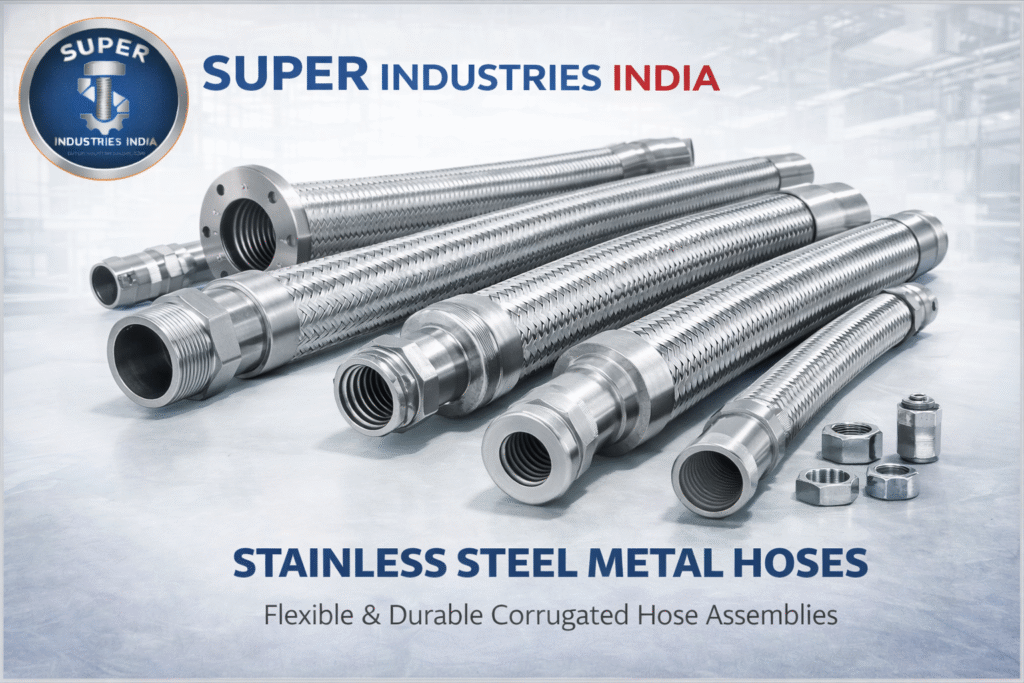
Uncompromising Performance: High-Pressure Stainless Steel Metal Hoses
In the world of extreme industrial processes, where temperatures soar, pressures peak, and corrosive chemicals flow, standard rubber or plastic hoses simply won’t survive. This is where Stainless Steel Metal Hoses become the indispensable, non-negotiable solution. Renowned for their incredible durability, fire resistance, and ability to handle wide temperature and pressure ranges, they are the vital flexible link in critical fluid transfer systems.
Super Industries India is a leading manufacturer and supplier of certified Stainless Steel Flexible Hoses and high-pressure Stainless Steel Hydraulic Hoses in India. We engineer custom hose assemblies that eliminate downtime, mitigate risk, and ensure flawless operation in the most demanding environments, including chemical, oil & gas, power generation, and cryogenic applications.
Why Stainless Steel Metal Hoses Lead the Industry
A metal hose, particularly one made from stainless steel (SS 304, SS 316, SS 321), offers superior advantages over any non-metallic alternative:
- Extreme Temperature Range: Performs reliably from cryogenic lows (down to -196°C) up to high heat (over +600°C), making them ideal for steam, hot oil, and exhaust gas lines.
- Corrosion and Chemical Resistance: Stainless steel grades like SS 316L are highly resistant to acids, alkalis, and aggressive chemicals, ensuring media purity and hose longevity.
- Zero Permeation: Metal hoses are gas-tight, meaning they are essential for transferring sensitive, expensive, or toxic gases (like hydrogen and oxygen) without any media loss or environmental contamination.
- Vibration and Misalignment Absorption: Their inherent flexibility absorbs thermal expansion, mechanical stress, and equipment vibration, protecting expensive connected machinery.
- Fire Safety: Unlike rubber or plastic, a metal hose maintains its structural integrity and can contain media even during a fire, significantly reducing the risk of catastrophic failure.
Types of Stainless Steel Metal Hoses
The construction of the metal hose determines its flexibility, pressure rating, and application suitability. We supply the two primary types of metal hoses:
1. Stainless Steel Corrugated Hoses (The Flexible Core)
This is the foundational element of most metal hose assemblies. A corrugated hose features a series of closely spaced, wave-like convolutions along its length.
- Annular Corrugations: These are a series of parallel, circular rings perpendicular to the hose axis. They offer superior flexibility and are excellent for absorbing axial movement and vibration.
- Helical Corrugations: These feature a single, continuous spiral shape. They provide good self-draining characteristics and are often used where a slightly more rigid structure is acceptable.
The flexibility of the corrugated core allows the hose to bend and flex, but on its own, it has a lower pressure rating.
2. Stainless Steel Braided Hoses (The Pressure Powerhouse)
To enable the corrugated core to handle significant pressure, it is covered with one or two layers of woven Stainless Steel Wire Braid (SS 304 or SS 316).
- Function of the Braid: The braid acts like a “finger trap.” When pressure is applied internally, the corrugated core wants to elongate. The braid resists this elongation, converting the pressure into tension in the braid itself. This allows the assembly to handle drastically higher working pressures.
- Single vs. Double Braid: A Double Braided hose is used for extremely high-pressure applications where a single braid is insufficient, offering the highest strength-to-weight ratio.
Specialized Segment: Stainless Steel Hydraulic Hoses
While standard hydraulic hoses are often made from rubber or thermoplastic and reinforced with spiral wire, there are critical applications that demand the superior strength and heat resistance of stainless steel:
- High-Temperature Hydraulics: Systems near furnaces, kilns, or engines that transfer high-temperature hydraulic oil (e.g., in steel mills or power plants) require stainless steel to prevent the outer cover from melting or the inner liner from degrading.
- Corrosive Fluid Hydraulics: Hydraulic systems operating with non-standard, corrosive hydraulic fluids, where SS 316L material compatibility is essential.
- Fire Safety Critical Lines: In sensitive areas (like offshore platforms or nuclear facilities), stainless steel hydraulic lines are used to eliminate the risk of the hose burning and spraying flammable fluid.
For these specialized needs, the hydraulic hose uses a heavily reinforced, highly compressed Corrugated Stainless Steel core, often with extremely dense wire braiding or interlocked layers, to achieve the necessary high operating pressures (up to 420 bar or more).
Design and Customization from Super Industries India
The reliability of a metal hose assembly depends entirely on the quality of its components and termination. We custom-fabricate complete hose assemblies to meet your exact specifications:
- Materials: Available in SS 304/304L, SS 321, and SS 316/316L to match media compatibility and corrosion resistance needs.
- End Fittings: We provide and weld a full range of fittings, including Flanges (e.g., ANSI, JIS, DIN), Threaded Ends (NPT, BSP), and specialized Quick Disconnects or Camlock fittings.
- Protection: Optional external sleeves (silicone, fire-sleeves, or armor casing) can be added to protect the braid from external mechanical damage or radiant heat.
Do you have an application where reliability under heat, pressure, and corrosion is absolutely vital?
Contact Super Industries India today to consult with our experts on the perfect Stainless Steel Metal Hose assembly for your critical fluid transfer needs.