
Screw Pin Chain Shackles
Table of Contents
Engineering Reference for Load Control, Lifting Safety & EPC Applications
Manufacturer & Global Exporter: Super Industries
Website: https://superindustriesindia.in
1️⃣ Industry Context: Why Screw Pin Chain Shackles Are Safety-Critical in EPC Projects
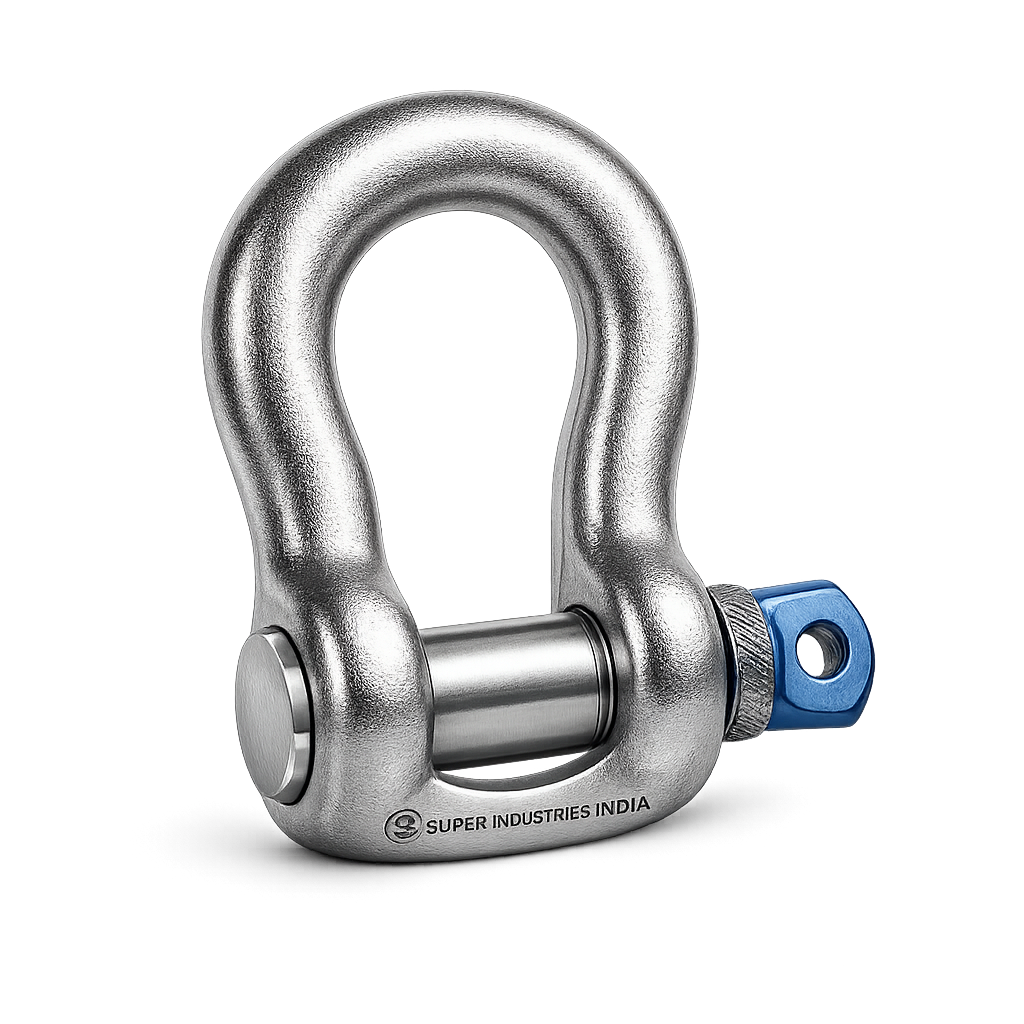
In EPC, offshore, and capital-intensive projects, lifting operations are classified as high-risk, safety-critical activities. Every component in the load path—from crane hook to sling termination—must perform predictably under static, dynamic, and shock loading. Screw pin chain shackles sit directly in this load path and are therefore primary load-bearing connectors, not interchangeable accessories.
Screw Pin Chain Shackles are extensively specified where:
- Temporary or semi-permanent rigging is required
- Frequent connection and disconnection is expected
- Load paths must remain flexible during erection or maintenance
- Third-party inspection and certification are mandatory
In Oil & Gas, LNG, offshore modules, heavy infrastructure, and power projects, shackle selection is governed by engineering logic, not convenience. Improper shackle type, incorrect pin engagement, or non-compliant material can result in load instability, pin bending, or catastrophic release. For this reason, EPC contractors, lifting engineers, and inspectors evaluate screw pin chain shackles with the same rigor applied to slings and cranes.
2️⃣ Technical Definition: What Screw Pin Chain Shackles Are and How They Function
A screw pin chain shackle is a U-shaped forged steel connector with a removable threaded pin designed to connect chains, wire rope slings, synthetic slings, and lifting points.
Core Components
- Shackle body (bow or chain pattern): Forged to transmit load in shear
- Screw pin: Precision-threaded pin providing closure and load retention
- Shoulder interface: Ensures correct seating and alignment
Functional Characteristics
Screw pin chain shackles are designed for:
- Axial load transfer between lifting elements
- Shear-dominated loading across the pin and body
- Ease of assembly and removal without tools (in most sizes)
They are particularly suitable for temporary rigging and erection activities where speed and flexibility are required without compromising safety—provided correct installation discipline is followed.
3️⃣ Engineering Relevance: Load Transfer, Pin Behavior & Lifecycle Safety
Load Transfer Mechanism
In a correctly installed screw pin chain shackle:
- The load is transferred through the body legs
- The pin experiences double shear
- The threads are not primary load-bearing elements
This geometry ensures predictable stress distribution when used within rated limits.
Shear vs Tensile Loading
Screw pin shackles are engineered for shear loading. Tensile loading across the pin threads is undesirable and avoided through proper alignment and selection.
Pin Behavior and Retention
The screw pin must remain fully engaged throughout the lift. Potential risks include:
- Rotation and loosening under vibration
- Partial engagement due to incorrect installation
- Deformation if overloaded
Engineering procedures often require mousing, tie-wiring, or secondary retention in dynamic or offshore environments.
Deformation Control and Rejection Criteria
Permanent deformation of the body or pin is a rejection condition. Properly designed screw pin chain shackles exhibit elastic behavior up to proof load and controlled plastic deformation only beyond rated limits.
4️⃣ Load Rating & Design Logic
Body Geometry
Chain shackles have a narrower jaw width compared to anchor shackles, optimized for chain engagement and controlled load alignment.
Pin Diameter and Thread Form
- Pin diameter governs shear capacity
- Thread form is designed for strength and repeated use
- Threads are not intended to carry tensile load
Proof Load and Minimum Breaking Load
- Proof Load: Applied during manufacturing to verify elastic performance
- Minimum Breaking Load (MBL): Defines ultimate capacity
Factor of Safety
Typical factors of safety for screw pin chain shackles:
- General lifting: 5:1 or 6:1 (depending on standard)
- Offshore / critical lifts: As specified by project or IACS rules
Rated Working Load Limit (WLL) is always derived from certified test data.
5️⃣ Types of Shackles & Performance Characteristics
Screw Pin Chain Shackles
- Best for temporary or frequently adjusted rigging
- Quick installation and removal
- Requires monitoring against pin rotation
Bolt-Type Shackles
- Designed for permanent or long-duration connections
- Pin secured with nut and cotter pin
- Preferred where vibration is continuous
Safety Pin / Round Pin Shackles
- Used where accidental pin removal must be eliminated
- Less convenient for frequent rigging changes
Engineering selection is based on duration of use, vibration exposure, and inspection regime—not operator preference.
6️⃣ Material & Standard Alignment
Material Selection
Screw pin chain shackles are typically manufactured from:
- High-strength carbon steel
- Alloy steel for higher load ratings or offshore service
Material chemistry and mechanical properties are tightly controlled to ensure toughness and resistance to brittle fracture.
Applicable Standards & Specifications
- ASME B30.26: Rigging hardware requirements
- ASTM A148 / A668: Forged steel material references
- EN 13889: European shackle standard
- ISO 2415: International shackle specification
- DIN standards: Dimensional harmonization
- IACS & class rules: Offshore and marine acceptance
Compliance with recognized standards is essential for EPC and third-party inspector approval.
7️⃣ Manufacturing & Quality Discipline
Forging Process
Shackle bodies are hot-forged to achieve continuous grain flow aligned with load paths. This significantly improves fatigue and impact resistance.
Heat Treatment
Controlled heat treatment ensures:
- Required tensile strength
- Adequate ductility
- Resistance to brittle fracture
Threading Control
Pin threads are precision-machined and gauged to ensure:
- Full engagement
- Smooth assembly and disassembly
- Consistent load behavior
Dimensional Verification & Inspection
- Jaw width and pin fit verification
- Surface inspection for laps, cracks, or inclusions
- Proof load testing as per standard
- Heat and batch traceability
This manufacturing discipline ensures inspection-ready hardware for EPC projects.
8️⃣ Procurement, Installation & Inspection View
During Technical Evaluation
EPC engineers and lifting specialists verify:
- Applicable standard and WLL
- Shackle type suitability for the lift
- Material and heat treatment compliance
- Manufacturer’s test certification
During Incoming Inspection
Third-party inspectors check:
- Markings (WLL, size, manufacturer ID)
- Pin fit and thread condition
- Surface quality and absence of deformation
During Use & Installation
Best practices include:
- Full pin engagement with shoulder seated
- Alignment to avoid side loading
- Secondary retention where required
- Removal from service if deformation is observed
Installation discipline is as critical as manufacturing quality.
9️⃣ Application Mapping Across Industries
Oil & Gas
Module lifting, equipment installation, maintenance rigging.
Offshore & Marine
Deck lifting, mooring accessories, temporary rigging.
Power & Energy
Turbine components, boiler erection, balance-of-plant lifts.
LNG
Cryogenic module handling, structural lifts.
Infrastructure & Construction
Bridge segments, precast elements, heavy civil works.
Heavy Engineering
Fabrication yards, shutdown and turnaround activities.
🔟 Professional Technical Tables
Nominal Sizes & Pin Diameters (Indicative)
| Shackle Size | Pin Diameter (mm) |
|---|---|
| 1/2″ | ~16 |
| 3/4″ | ~22 |
| 1″ | ~28 |
| 1 1/4″ | ~35 |
| 1 1/2″ | ~38 |
Load Ratings (Indicative)
| Size | WLL (t) | Proof Load (t) | Min. Breaking Load (t) |
|---|---|---|---|
| 1/2″ | 2 | 4 | 12 |
| 3/4″ | 4.75 | 9.5 | 28 |
| 1″ | 8.5 | 17 | 51 |
| 1 1/4″ | 12 | 24 | 72 |
Actual ratings depend on governing standard.
Weight per Piece (Approximate)
| Size | Weight (kg) |
|---|---|
| 1/2″ | ~0.8 |
| 3/4″ | ~2.3 |
| 1″ | ~4.5 |
| 1 1/4″ | ~8.5 |
Material Grades & Finishes
| Material | Finish |
|---|---|
| Carbon steel | Hot-dip galvanized |
| Alloy steel | Painted / galvanized |
| Offshore grade | Project-specified coating |
Standards vs Application Mapping
| Standard | Typical Application |
|---|---|
| ASME B30.26 | EPC & industrial lifting |
| EN 13889 | European projects |
| ISO 2415 | Global reference |
| IACS | Offshore & marine |
Project-Specific Customization Options
| Parameter | Options |
|---|---|
| Size & WLL | Project-defined |
| Pin type | Standard / secured |
| Coating | Galvanized, painted |
| Marking | EPC-specific |
| Certification | EN 10204 3.1 / 3.2 |
Manufacturer-Focused Conclusion
In EPC and capital-project lifting operations, Screw Pin Chain Shackles are safety-critical connectors whose performance directly affects load stability, personnel safety, and project risk. Their correct behavior depends on forged geometry, controlled material properties, precise threading, and disciplined inspection.
Super Industries manufactures screw pin chain shackles under controlled forging, heat treatment, and inspection systems aligned with international lifting standards and EPC acceptance criteria. Our engineering-driven approach, traceability control, and inspection readiness support predictable performance and third-party approval in demanding lifting and rigging applications.
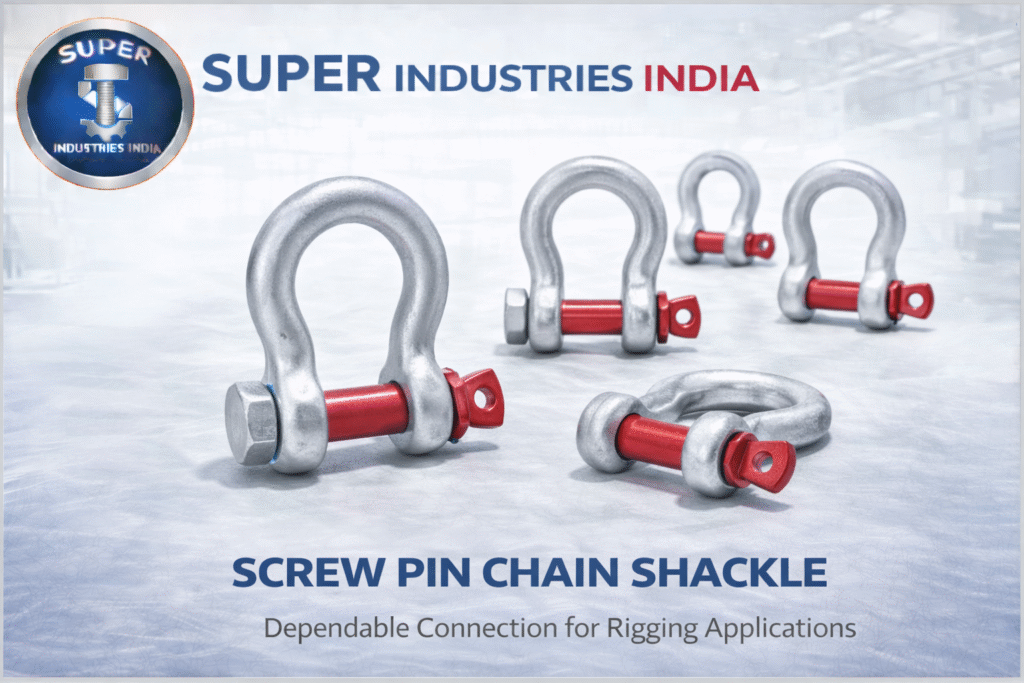
Maximum Security for Medium-Duty Lifting: Screw Pin Chain Shackles
In rigging and lifting applications across construction, marine, and general industry, the shackle is the indispensable link that connects everything—from slings and hoists to anchors and lifting eyes. Among the most popular and versatile types is the Screw Pin Chain Shackle (also known as a D-Shackle).
Super Industries India is a premier manufacturer and supplier of certified, high-tensile Screw Pin Chain Shackles. Our shackles are meticulously forged, proof-tested, and galvanized to ensure maximum load integrity and durability, providing reliable, secure, and easy-to-use connections for your everyday and critical medium-duty lifting operations.
What is a Screw Pin Chain Shackle?
A Screw Pin Chain Shackle consists of two primary components:
- The Body (Bow): The U-shaped, generally narrow profile that gives the shackle its “D” or chain shape. This shape is optimized for in-line lifting applications.
- The Screw Pin: A threaded pin that passes through the body’s ears and is secured by screwing it in. This pin allows for quick and easy removal and reinstallation.
This design makes the Screw Pin Chain Shackle ideal for applications where the shackle is frequently installed and removed.
Key Features of Our Shackles
- Forged Alloy Steel: Our shackles are drop-forged from high-strength alloy steel, ensuring the internal grain structure is aligned for maximum strength and impact resistance.
- Hot-Dip Galvanized (HDG) Finish: Every shackle is hot-dip galvanized to provide a thick, durable zinc coating, offering superior protection against rust, corrosion, and the harsh saltwater environments common in marine and coastal projects.
- Design Factor: Manufactured with a certified Safety Factor (typically 6:1 or 5:1), ensuring the Ultimate Breaking Load is significantly higher than the Working Load Limit (WLL).
The Versatility of the Chain (D) Shackle
The narrow profile of the Chain Shackle makes it best suited for two specific loading conditions:
- In-Line Loading (Straight Pull): The most efficient way to use a D-Shackle is when the load is pulled perfectly straight along the center line of the shackle’s body. This distributes the stress evenly and allows the shackle to perform at its full Working Load Limit (WLL).
- Single Point Connection: Ideal for connecting a single wire rope sling, synthetic sling eye, chain, or anchor point where side loading is minimal or non-existent.
Important Note: Due to the narrow design, Screw Pin Chain Shackles are generally not recommended for side loading (angular pulls). For angular or multi-leg connections, a Screw Pin Anchor Shackle (which has a wider bow) is typically the safer alternative.
Applications and Industries
The quick connection and robust nature of the Screw Pin Chain Shackle make it a staple tool across many sectors:
- Construction: Connecting hoist blocks, pull lines, and static rigging points.
- Marine & Fishing: Used for mooring small vessels, attaching fishing gear, and temporary boat lifting operations.
- General Rigging: Creating temporary eyes or connections on lifting equipment and machinery.
- Transport & Logistics: Securing heavy loads on flatbed trucks and trailers.
Safety and Certification: Why Super Industries India?
When choosing lifting hardware, traceability and certification are non-negotiable for safety. Our commitment ensures:
- Working Load Limit (WLL) Stamping: Every shackle body and pin is clearly and permanently marked with its WLL 1/2 Ton, 1 Ton, 2 Ton, diameter, and manufacturer identification for easy inspection and safety compliance.
- Certification: We supply shackles that meet major international standards (ASME, BS, EN), accompanied by full Test Certificates upon request.
- Quick Disconnect Capability: The screw pin allows rigging teams to quickly set up and dismantle connections without specialized tools, saving valuable time on site.
Searching for certified, durable Screw Pin Chain Shackles with superior corrosion resistance?
Contact Super Industries India today for reliable, high-strength rigging solutions designed to meet your precise WLL requirements.