
FISH BOLTS
“Global Manufacturer of Heavy & Custom Engineered Fasteners for Oil & Gas, Power & EPC Contractors.”
1. INDUSTRY CONTEXT & SYSTEM RELEVANCE
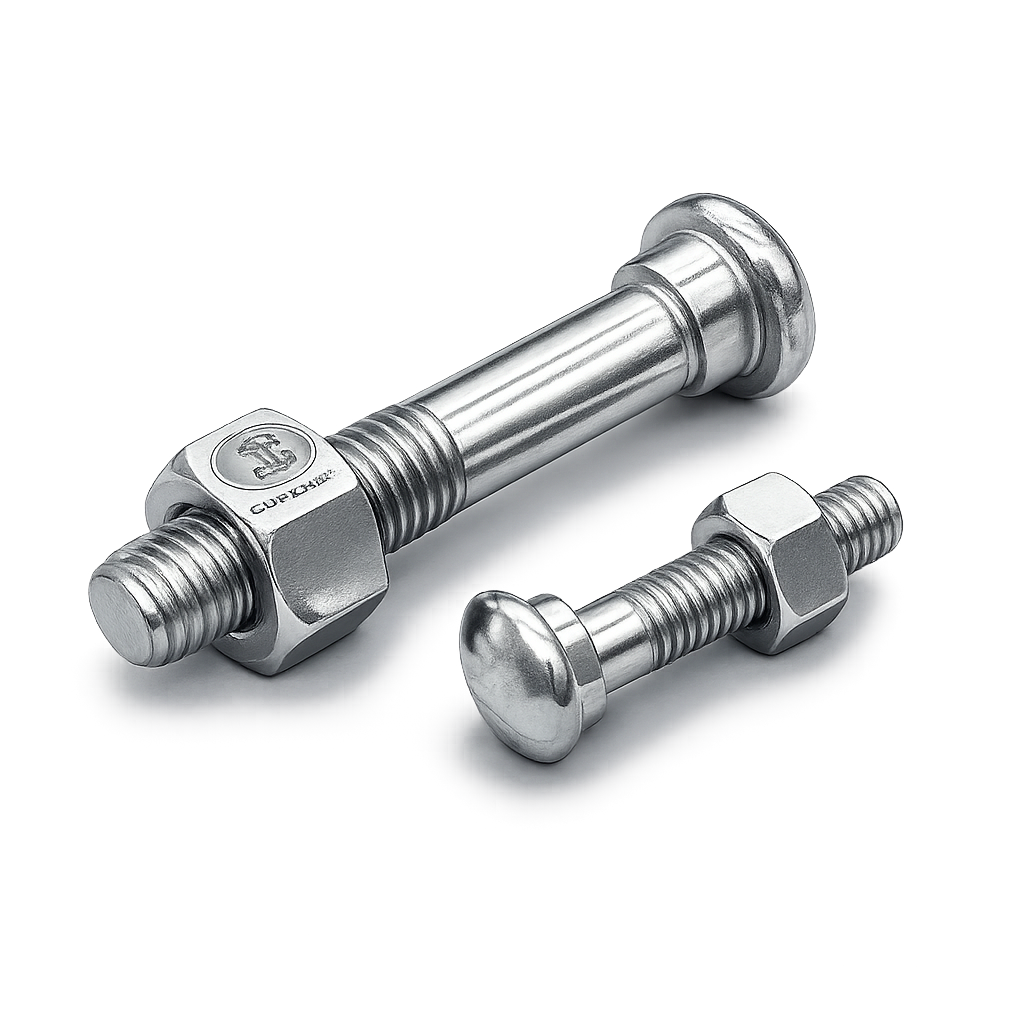
Role of Fish Bolts in Railway Track Systems
Fish Bolts are fundamental mechanical fasteners used in jointed railway track systems to ensure structural continuity between adjacent rail sections. They function in conjunction with fishplates (joint bars) to maintain alignment, load transfer, and operational safety across rail joints.
In a typical jointed track assembly:
- Two rail ends are aligned longitudinally
- Fishplates are placed on either side of the rail web
- Fish Bolts pass through pre-drilled holes in rails and fishplates
- Nuts are tightened to generate clamping force
This assembly creates a semi-rigid mechanical joint, capable of sustaining dynamic train loads while allowing controlled movement due to thermal expansion.
System-Level Importance
Fish Bolts directly influence:
- Track geometry stability
- Load distribution across rail discontinuities
- Joint stiffness and damping behavior
- Fatigue performance of rail ends
- Maintenance frequency and track reliability
Failure or improper tightening of Fish Bolts can lead to:
- Joint gap widening
- Rail misalignment
- Increased impact loading
- Accelerated wear of rails and rolling stock
Application Domains
Fish Bolts are deployed across a wide range of railway and industrial rail systems:
Mainline Railways
- Conventional long-distance passenger and freight networks
- Jointed tracks in low-to-medium speed corridors
- Transitional sections between welded rails
Metro Rail Systems
- Limited use in modern continuously welded rail (CWR) systems
- Applied in:
- Expansion joints
- Depot tracks
- Emergency repair sections
Freight Corridors
- Heavy axle load conditions
- High cyclic loading requiring robust bolt performance
Industrial Rail Tracks
- Steel plants
- Cement plants
- Thermal power stations
Mining Rail Infrastructure
- Harsh environments with abrasive dust and vibration
- Frequent maintenance cycles
Port Rail Connectivity
- Exposure to saline atmosphere
- Requirement for corrosion-resistant fasteners
Why Bolted Fishplate Joints Are Used
Despite the widespread adoption of continuous welded rails (CWR), bolted joints remain critical in specific engineering scenarios.
Flexibility vs Welded Joints
| Parameter | Bolted Joint | Welded Joint |
|---|---|---|
| Flexibility | High | Low |
| Maintenance | Accessible | Complex |
| Installation | Simple | Skilled process required |
| Replacement | Fast | Time-consuming |
Fish Bolts allow controlled flexibility, reducing stress concentration at rail ends.
Maintenance Accessibility
- Bolted joints can be disassembled and reassembled
- Suitable for:
- Emergency repairs
- Temporary track layouts
- Remote locations
Thermal Expansion Accommodation
Railways experience expansion and contraction due to temperature variation.
Fish Bolts enable:
- Controlled longitudinal movement
- Prevention of thermal buckling
- Stress redistribution at joints
Track Alignment Correction
- Misalignment due to settlement or wear can be corrected
- Fish Bolts allow repositioning of rails without cutting or welding
2. TECHNICAL DEFINITION
Engineering Definition
Fish Bolts are:
High-strength threaded fasteners specifically designed for joining railway rails using fishplates, capable of sustaining combined tensile, shear, and cyclic dynamic loads while maintaining rail alignment and structural continuity.
Functional Characteristics
- Operate under combined loading conditions:
- Tensile (clamping force)
- Shear (lateral load transfer)
- Designed for high fatigue resistance
- Provide consistent preload under vibration
- Compatible with standard rail hole configurations
Joint Configurations
Fish Bolts are used in different joint configurations based on rail type and load requirements:
2-Hole Joint System
- Light-duty applications
- Temporary or industrial tracks
4-Hole Joint System
- Standard railway configuration
- Balanced load distribution
6-Hole Joint System
- Heavy-duty applications
- High axle load corridors
- Improved redundancy and safety
Neck Design Types
Oval Neck Fish Bolts
- Prevent rotation during tightening
- Fit into oval-shaped recesses in fishplates
Diamond Neck Fish Bolts
- Provide enhanced anti-rotation locking
- Used in high vibration environments
Integration with Fishplates
- Fish Bolts pass through:
- Rail web holes
- Matching holes in fishplates
- Nut tightening generates:
- Clamping force
- Frictional resistance
Correct dimensional matching is critical for:
- Load transfer efficiency
- Avoidance of bolt bending
- Prevention of hole elongation
Super Industries
Global Manufacturer of Heavy & Custom Engineered Fasteners & Flanges
3. ENGINEERING & LOAD TRANSFER PRINCIPLE
Bolt Preload Mechanics
When a Fish Bolt is tightened:
- Torque is applied to the nut
- This generates axial tension in the bolt
- Resulting in clamping force between fishplates and rail
This preload is essential for:
- Maintaining joint integrity
- Preventing relative movement
- Reducing shear stress on the bolt
Clamping Force Function
Clamping force creates friction between:
- Fishplate surface
- Rail web
This friction:
- Transfers load without direct shear on the bolt
- Reduces wear at contact surfaces
Shear Load Distribution
Under train loading:
- Vertical wheel loads induce bending at the joint
- Shear forces act across bolt cross-sections
Load sharing occurs:
- Across multiple bolts
- Depending on:
- Bolt spacing
- Joint stiffness
- Preload consistency
Frictional Grip vs Bearing Load
Two mechanisms govern load transfer:
Frictional Grip (Preferred Condition)
- Adequate preload ensures load transfer via friction
- Minimizes bolt shear stress
Bearing Load (Secondary Condition)
- Occurs when preload is insufficient
- Bolt shank bears against hole edges
- Leads to:
- Hole elongation
- Increased fatigue risk
Rail Expansion & Contraction Behavior
Rail temperature variation causes:
- Longitudinal expansion in high temperatures
- Contraction in low temperatures
Fish Bolts must accommodate:
- Micro-slippage at joints
- Controlled movement without loss of alignment
Dynamic Loading from Passing Trains
Each wheel passage introduces:
- Impact load at rail joints
- Cyclic stress in bolts
- Vibrational energy transfer
Key effects:
- Load reversal cycles
- Micro loosening of fasteners
- Progressive fatigue damage
Impact Loading at Rail Joints
Rail joints are discontinuities, causing:
- Wheel impact forces
- Localized stress concentration
Fish Bolts must resist:
- Shock loading
- High-frequency stress cycles
LOAD & STRESS ENGINEERING
Types of Loads Acting on Fish Bolts
Axial Loads
- Generated from tightening torque
- Maintain clamping force
Shear Loads
- Due to lateral and vertical rail forces
- Act across bolt cross-section
Vibrational Loads
- Continuous oscillations from train movement
- Lead to loosening if preload is inadequate
Cyclic Loads
- Repeated loading and unloading cycles
- Primary cause of fatigue failure
Impact Loads from Wheel Passage
- Occur at every rail joint
- Magnitude depends on:
- Train speed
- Axle load
- Track condition
Fish Bolts must absorb:
- High-magnitude, short-duration forces
Stress Concentration at Joints
Critical zones:
- Bolt threads
- Transition between shank and head
- Contact edges of holes
Design considerations:
- Smooth geometry transitions
- Proper thread rolling
- Controlled surface finish
Fatigue Life Considerations
Fish Bolts operate in a high-cycle fatigue environment.
Key influencing factors:
- Preload consistency
- Material quality
- Surface finish
- Corrosion presence
Failure modes:
- Crack initiation at threads
- Progressive crack growth
- Sudden fracture
Safety Factor Philosophy
Railway fastening systems adopt conservative safety factors due to:
- Public safety implications
- Unpredictable dynamic loads
- Environmental variability
Typical design considerations include:
- Redundancy (multiple bolts per joint)
- Overdesign for fatigue life
- Strict inspection intervals
DIMENSIONAL & DESIGN LOGIC
Core Dimensions
Fish Bolt design is governed by:
- Diameter → Determines load capacity
- Thread pitch → Influences tightening behavior
- Shank length → Matches rail + fishplate thickness
- Head geometry → Ensures tool engagement and load distribution
- Neck design → Prevents rotation
Dimensional Accuracy Requirements
Critical tolerances include:
- Shank diameter tolerance
- Thread pitch accuracy
- Straightness
- Concentricity
Deviation can result in:
- Improper fit
- Uneven load distribution
- Reduced fatigue life
Fitment with Fishplates
Design must ensure:
- Precise hole alignment
- Minimal clearance without interference
- Uniform load transfer
Hole Alignment Precision
Misalignment leads to:
- Bolt bending
- Stress concentration
- Early failure
Manufacturing and installation must ensure:
- Accurate drilling
- Consistent spacing
Surface Finish Considerations
Surface finish affects:
- Friction coefficient
- Corrosion resistance
- Fatigue strength
Controlled finishes are required for:
- Reliable preload
- Long-term performance
4. APPLICABLE STANDARDS (UIC / IRS / AREMA / DIN / ISO)
Fish Bolts used in railway applications are governed by multiple international and national standards. These standards define mechanical properties, dimensional tolerances, material grades, testing protocols, and performance criteria required for safe operation under railway loading conditions.
Indian Railways Standards (IRS)
Indian Railways Standards (IRS) define requirements specific to Indian railway infrastructure.
Key Aspects Covered:
- Bolt dimensions for standard rail sections
- Material grades and mechanical properties
- Heat treatment requirements
- Thread specifications
- Inspection and acceptance criteria
Application Context:
- Broad gauge railway networks
- Heavy axle load freight corridors
- Mixed traffic routes
IRS standards emphasize:
- Robust fatigue resistance
- Compatibility with legacy rail systems
- Field maintainability
UIC Standards (International Union of Railways)
UIC standards provide harmonized specifications across international railway systems.
Key Features:
- Standardized dimensions for interoperability
- Load-based classification
- Performance under dynamic loading
Application:
- Cross-border rail infrastructure
- High-speed and conventional European rail systems
UIC Fish Bolts are designed to ensure:
- Uniform load distribution
- Interchangeability across networks
- Predictable mechanical behavior
AREMA Specifications (American Railway Engineering and Maintenance-of-Way Association)
AREMA standards are widely used in North America and heavy freight rail systems.
Key Focus Areas:
- High fatigue resistance
- Heavy axle load capacity
- Stringent material requirements
Application:
- Freight-dominant railways
- Mining and industrial rail systems
AREMA emphasizes:
- High-strength alloy steels
- Strict testing protocols
- Long-term durability under cyclic loading
DIN / ISO Fastener Standards
DIN and ISO standards define general fastener characteristics applicable to Fish Bolts.
Relevant Areas:
- Thread geometry (ISO metric threads)
- Mechanical property classes
- Dimensional tolerances
Integration Role:
- Harmonization with global manufacturing practices
- Compatibility with international tooling and gauges
Standards Mapping to Track Conditions
| Track Condition | Standard Preference | Key Requirement |
|---|---|---|
| Heavy Freight | AREMA / IRS | High fatigue strength |
| Passenger Mainline | UIC / IRS | Balanced strength & flexibility |
| Metro Systems | UIC / ISO | Precision & moderate load |
| Industrial Rail | DIN / IRS | Durability & maintainability |
5. MATERIAL & GRADE OPTIONS
Material selection for Fish Bolts is governed by:
- Load requirements
- Fatigue resistance
- Environmental exposure
- Maintenance cycles
Carbon Steel (Primary Use)
Carbon steel is the most widely used material for Fish Bolts.
Characteristics:
- High tensile strength
- Good machinability
- Cost-effective
- Suitable for heat treatment
Typical Grades:
- Medium carbon steels (e.g., C35, C45 equivalent)
- High tensile railway bolt grades
Application:
- Standard railway tracks
- Moderate environmental exposure
Alloy Steel (High Performance Applications)
Alloy steels are used where higher mechanical performance is required.
Characteristics:
- Improved fatigue resistance
- Higher strength-to-weight ratio
- Better toughness
Typical Alloying Elements:
- Chromium
- Molybdenum
- Nickel
Application:
- Heavy axle load tracks
- High-speed corridors
- Mining railways
Stainless Steel (Limited Use)
Stainless steel is used in specific environments where corrosion resistance is critical.
Characteristics:
- High corrosion resistance
- Lower strength compared to alloy steel (in standard grades)
- Higher cost
Application:
- Coastal railways
- Chemical plants
- Port rail infrastructure
Engineering Considerations in Material Selection
| Factor | Influence |
|---|---|
| Strength | Determines load capacity |
| Fatigue resistance | Governs service life |
| Hardness | Affects wear resistance |
| Corrosion resistance | Impacts maintenance frequency |
| Ductility | Prevents brittle failure |
MATERIAL COMPARISON TABLE (MANDATORY)
| Material Grade | Yield Strength (MPa) | Tensile Strength (MPa) | Hardness (HB) | Fatigue Resistance | Typical Railway Use |
|---|---|---|---|---|---|
| Carbon Steel (C45) | 300–400 | 600–800 | 180–250 | Moderate | Standard tracks |
| High Tensile Carbon Steel | 400–600 | 800–1000 | 220–300 | High | Mainline railways |
| Alloy Steel (Cr-Mo) | 600–850 | 900–1200 | 250–350 | Very High | Heavy freight / mining |
| Stainless Steel (AISI 304/316) | 200–300 | 500–700 | 150–200 | Moderate | Coastal / corrosive zones |
HEAT TREATMENT INFORMATION
Heat treatment is essential to achieve required mechanical strength, toughness, and fatigue resistance.
Quenching & Tempering (Q&T)
Process:
- Heating to austenitizing temperature
- Rapid cooling (quenching)
- Controlled reheating (tempering)
Outcome:
- High strength
- Improved toughness
- Controlled hardness
Application:
- High-performance Fish Bolts
- Heavy-duty railway systems
Normalizing
Process:
- Heating above critical temperature
- Air cooling
Outcome:
- Refined grain structure
- Uniform mechanical properties
Application:
- Medium strength bolts
- Pre-treatment before machining
Stress Relieving
Purpose:
- Reduce residual stresses from forging or machining
Benefits:
- Improved dimensional stability
- Reduced risk of distortion
Hardness Control
Typical hardness ranges:
| Application | Hardness Range (HB) |
|---|---|
| Standard rail bolts | 180–250 |
| High tensile bolts | 220–300 |
| Alloy steel bolts | 250–350 |
Microstructure Control
Heat treatment ensures:
- Uniform grain size
- Absence of brittle phases
- Improved fatigue resistance
Fatigue Life Improvement
Proper heat treatment:
- Reduces crack initiation
- Enhances resistance to cyclic loading
- Improves service life under dynamic conditions
6. MANUFACTURING PROCESS
Fish Bolts are manufactured through a controlled, multi-stage process ensuring dimensional accuracy and mechanical reliability.
Raw Material Inspection
Incoming material is verified for:
- Chemical composition
- Mechanical properties
- Surface defects
Methods:
- Spectrometer analysis
- Visual inspection
- Ultrasonic testing (if required)
Hot Forging
Process:
- Heating billets to forging temperature
- Shaping using dies
Advantages:
- Grain flow alignment
- Improved strength
- Reduced internal defects
Thread Rolling
Threads are formed by cold rolling, not cutting.
Benefits:
- Increased fatigue strength
- Compressive surface stresses
- Improved thread accuracy
Heat Treatment
Applied as per required mechanical properties:
- Quenching & tempering
- Normalizing
Ensures:
- Strength consistency
- Hardness control
Surface Finishing
Applied depending on environmental requirements:
- Coating
- Cleaning
- Surface preparation
Marking & Traceability
Each Fish Bolt may include:
- Manufacturer identification
- Grade marking
- Batch number
Ensures:
- Full traceability
- Compliance with inspection requirements
Dimensional Control Discipline
Critical inspections include:
- Diameter measurement
- Thread pitch verification
- Length tolerance
- Straightness
Precision is maintained through:
- Calibrated gauges
- Process control systems
7.SURFACE FINISH OPTIONS
Surface finish selection is based on corrosion exposure, friction characteristics, and maintenance requirements.
Black Oxide Finish
Characteristics:
- Minimal corrosion resistance
- Low cost
- Maintains dimensional accuracy
Application:
- Dry environments
- Indoor or low-corrosion zones
Phosphate Coating
Characteristics:
- Improved corrosion resistance over black finish
- Enhanced lubrication properties
Application:
- Railway environments requiring consistent torque
Zinc Plating
Characteristics:
- Moderate corrosion protection
- Smooth surface finish
Limitations:
- Risk of hydrogen embrittlement (if not controlled)
Hot-Dip Galvanizing (HDG)
Characteristics:
- Thick zinc coating
- High corrosion resistance
Application:
- Coastal regions
- High humidity environments
Surface Finish Comparison
| Finish Type | Corrosion Resistance | Wear Resistance | Typical Use |
|---|---|---|---|
| Black Oxide | Low | Moderate | Indoor / dry |
| Phosphate | Moderate | Good | Railway applications |
| Zinc Plated | Moderate | Moderate | General use |
| Hot-Dip Galvanized | High | Moderate | Coastal / industrial |
8. TECHNICAL DIMENSION TABLES (MANDATORY)
Fish Bolt dimensions are standardized to ensure compatibility with rail sections, fishplates, and joint configurations. The following tables represent commonly used dimensional ranges aligned with IRS / UIC / AREMA practices.
Standard Fish Bolt Dimension Table
| Bolt Size (mm) | Length Range (mm) | Thread Pitch (mm) | Shank Diameter (mm) | Hole Compatibility (mm) | Typical Rail Section |
|---|---|---|---|---|---|
| M16 | 100 – 130 | 2.0 | 15.8 – 16.0 | 18 | Light rail / industrial |
| M20 | 110 – 150 | 2.5 | 19.8 – 20.0 | 22 | Medium rail |
| M22 | 120 – 160 | 2.5 | 21.8 – 22.0 | 24 | Broad gauge (IRS) |
| M24 | 130 – 180 | 3.0 | 23.8 – 24.0 | 26 | Heavy rail |
| M27 | 140 – 200 | 3.0 | 26.8 – 27.0 | 30 | High load freight |
| M30 | 150 – 220 | 3.5 | 29.8 – 30.0 | 33 | Mining / heavy haul |
Rail Section Mapping Guide
| Rail Section | Typical Bolt Size | Joint Type |
|---|---|---|
| 30–40 kg/m | M16 – M20 | 2-hole |
| 52 kg/m | M22 | 4-hole |
| 60 kg/m | M24 | 4-hole / 6-hole |
| Heavy haul (>60 kg/m) | M27 – M30 | 6-hole |
Dimensional Tolerance Guidelines
| Parameter | Typical Tolerance |
|---|---|
| Shank Diameter | ±0.1 mm |
| Length | ±1.0 mm |
| Thread Pitch | As per ISO tolerance |
| Straightness | ≤ 0.2% of length |
LOAD CAPACITY TABLE (MANDATORY)
Load capacity depends on bolt diameter, material grade, and heat treatment condition. Values below represent indicative engineering ranges for high tensile Fish Bolts.
Shear & Tensile Capacity Table
| Bolt Size | Tensile Strength (kN) | Shear Strength (kN) | Recommended Safety Factor | Working Load (kN) |
|---|---|---|---|---|
| M16 | 90 – 120 | 55 – 75 | 2.5 – 3.0 | 30 – 40 |
| M20 | 140 – 180 | 85 – 110 | 2.5 – 3.0 | 50 – 70 |
| M22 | 180 – 230 | 110 – 140 | 2.5 – 3.0 | 70 – 90 |
| M24 | 220 – 300 | 140 – 180 | 2.5 – 3.0 | 90 – 120 |
| M27 | 300 – 380 | 180 – 230 | 2.5 – 3.0 | 120 – 150 |
| M30 | 380 – 480 | 230 – 300 | 2.5 – 3.0 | 150 – 200 |
Engineering Notes
- Shear strength ≈ 0.6 × tensile strength (typical approximation)
- Load distribution across multiple bolts improves system capacity
- Safety factor accounts for:
- Dynamic loading
- Installation variability
- Fatigue effects
9. TORQUE CHART (MANDATORY)
Correct torque application is critical to achieving the required preload in Fish Bolts.
Torque vs Bolt Size Table
| Bolt Size | Property Class | Dry Torque (Nm) | Lubricated Torque (Nm) |
|---|---|---|---|
| M16 | 8.8 | 150 – 180 | 110 – 140 |
| M20 | 8.8 | 300 – 360 | 220 – 280 |
| M22 | 8.8 | 420 – 500 | 300 – 380 |
| M24 | 8.8 | 520 – 620 | 380 – 480 |
| M27 | 10.9 | 800 – 950 | 600 – 720 |
| M30 | 10.9 | 1100 – 1300 | 800 – 1000 |
Torque Application Considerations
- Lubrication reduces friction → increases preload consistency
- Over-tightening can cause:
- Bolt yielding
- Thread damage
- Under-tightening leads to:
- Loss of clamping force
- Increased shear loading
PRELOAD CALCULATION GUIDE (MANDATORY)
Fundamental Relationship
![\[T = K \cdot F \cdot D\]](https://superindustriesindia.in/wp-content/ql-cache/quicklatex.com-211dcfefa73bfa5ffa794f5ae58160b9_l3.png "Rendered by QuickLaTeX.com")
Where:
- (T) = Torque (Nm)
- (K) = Torque coefficient (typically 0.18 – 0.25)
- (F) = مطلوب preload force (N)
- (D) = Nominal bolt diameter (m)
Preload Determination
Typical preload is taken as:
- 70% – 80% of bolt yield strength
Sample Calculation (M24 Bolt)
Assumptions:
- Bolt diameter (D = 0.024 , m)
- Desired preload (F = 120,000 , N)
- Torque coefficient (K = 0.2)
Calculation:
![\[T = 0.2 \times 120000 \times 0.024\]](https://superindustriesindia.in/wp-content/ql-cache/quicklatex.com-bbbdeec862a0aa7ff321b78816a776a5_l3.png "Rendered by QuickLaTeX.com")
![\[T = 576 \, \text{N·m}\]](https://superindustriesindia.in/wp-content/ql-cache/quicklatex.com-09276fc532b0dbdd7b9d5e4b1dad1b27_l3.png "Rendered by QuickLaTeX.com")
This aligns with standard torque values for M24 Fish Bolts.
Engineering Considerations
- Torque-preload relationship is affected by:
- Surface condition
- Lubrication
- Thread quality
- Direct tension measurement methods provide higher accuracy but are rarely used in field railway applications
Safety Margins
- Preload must remain below yield strength
- Allowance required for:
- Relaxation losses
- Embedment losses
- Temperature variation
10. MECHANICAL PROPERTY TABLE (MANDATORY)
| Property Class | Yield Strength (MPa) | Tensile Strength (MPa) | Elongation (%) | Hardness (HB) |
|---|---|---|---|---|
| 4.6 | 240 | 400 | 22 | 120 – 160 |
| 8.8 | 640 | 800 | 12 | 220 – 300 |
| 10.9 | 940 | 1040 | 9 | 300 – 360 |
| 12.9 | 1100 | 1220 | 8 | 350 – 400 |
Engineering Interpretation
- Higher class → higher strength but lower ductility
- Railway Fish Bolts typically use:
- Class 8.8
- Class 10.9
CORROSION RESISTANCE TABLE (MANDATORY)
Environmental Performance Comparison
| Material / Finish | Coastal Environment | Industrial Environment | High Humidity | Maintenance Requirement |
|---|---|---|---|---|
| Carbon Steel (Uncoated) | Low | Moderate | Low | High |
| Phosphate Coated | Moderate | Good | Moderate | Moderate |
| Zinc Plated | Moderate | Moderate | Moderate | Moderate |
| Hot-Dip Galvanized | High | High | High | Low |
| Stainless Steel | Very High | High | Very High | Low |
Engineering Notes
- Corrosion reduces:
- Effective cross-section
- Fatigue life
- Coating selection must match:
- Environment
- Maintenance capability
INSPECTION & QUALITY CONTROL METHODS
Fish Bolts used in railway systems are subject to strict inspection protocols to ensure compliance with standards and performance requirements.
Dimensional Inspection
Measured parameters:
- Diameter
- Length
- Thread pitch
- Head geometry
Tools:
- Vernier calipers
- Micrometers
- Thread gauges
Hardness Testing
Methods:
- Brinell hardness test (HB)
- Rockwell test (HRC)
Ensures:
- Proper heat treatment
- Consistent mechanical properties
Tensile Testing
Purpose:
- Verify yield and ultimate strength
Conducted using:
- Universal Testing Machines (UTM)
Magnetic Particle Inspection (MPI)
Detects:
- Surface cracks
- Subsurface discontinuities
Applicable for:
- Critical applications
- High-stress bolts
Dye Penetrant Inspection (DPI)
Used for:
- Surface defect detection
Advantages:
- Simple
- Effective for fine cracks
Ultrasonic Testing (UT)
Applied where required:
- Detect internal flaws
- Ensure material integrity
Thread Gauge Inspection
Ensures:
- Thread accuracy
- Fitment compatibility
Tools:
- Go/No-Go gauges
Third-Party Inspection (TPI)
Inspection agencies verify:
- Compliance with specifications
- Batch traceability
- Testing records
Certification Standards
- EN 10204 3.1 → Manufacturer test certificate
- EN 10204 3.2 → Third-party verified certificate
Documentation & Traceability
Each batch includes:
- Heat number
- Material certificate
- Inspection reports
- Test records
Ensures:
- Full lifecycle traceability
- EPC compliance
11. INDUSTRIES SERVED
Fish Bolts are deployed across multiple railway-dependent sectors where track integrity, load continuity, and maintainability are critical engineering requirements.
Railway Infrastructure (Mainline Networks)
Application Scope:
- Jointed rail sections
- Transition zones between welded rails
- Maintenance replacement sections
Engineering Requirements:
- High fatigue resistance under cyclic axle loads
- Dimensional compatibility with IRS rail sections
- Consistent preload retention under vibration
Metro Rail Systems
Application Scope:
- Depot tracks
- Expansion joints
- Temporary and emergency installations
Engineering Considerations:
- Precision alignment requirements
- Lower noise and vibration tolerance
- Controlled torque application
Mining Rail Networks
Application Scope:
- Haulage tracks for mineral transport
- Temporary and relocatable track systems
Operating Conditions:
- High dust and abrasive environment
- Heavy axle loads
- Frequent track realignment
Bolt Requirements:
- High-strength alloy steel grades
- Enhanced fatigue resistance
- Robust surface protection
Ports & Logistics Rail Systems
Application Scope:
- Cargo handling rail lines
- Container terminal tracks
Environmental Conditions:
- Saline atmosphere
- High humidity
Engineering Requirements:
- Corrosion-resistant coatings
- Stable preload under environmental exposure
Industrial Rail Tracks
Application Scope:
- Steel plants
- Cement plants
- Thermal power facilities
Operational Characteristics:
- Moderate speed
- High load concentration
Engineering Focus:
- Maintainability
- Standardization
- Cost-effective lifecycle performance
12. EXPORT CAPABILITY & GLOBAL SUPPLY
Super Industries manufactures Fish Bolts for international railway and infrastructure projects, aligning with global compliance, packaging standards, and documentation protocols required for EPC execution.
Export Regions
United States
- AREMA-compliant supply
- Heavy haul freight applications
European Union
- UIC-compliant fasteners
- Interoperable rail systems
Middle East
- High-temperature and desert conditions
- Infrastructure expansion projects
Southeast Asia
- Mixed rail systems (metro + freight)
- Coastal and humid environments
Packaging Standards
Packaging is designed to ensure:
- Mechanical protection during transit
- Corrosion prevention
- Ease of handling at site
Typical Packaging Methods:
- Wooden crates (fumigated)
- Palletized loads
- Bulk containers with moisture barriers
- Segregated batch packing
Export Documentation
Standard documentation includes:
- Commercial invoice
- Packing list
- Certificate of origin
- Material test certificates (EN 10204 3.1 / 3.2)
- Inspection reports
- Third-party inspection clearance (if applicable)
Bulk Supply Capability
Supply configurations:
- Project-based bulk quantities
- Scheduled dispatch aligned with EPC timelines
- Containerized shipments (FCL / LCL)
Compliance & Traceability
- Batch-wise traceability maintained
- Marking aligned with project specifications
- Documentation linked to manufacturing records
PROCUREMENT & INSTALLATION VIEW
Fish Bolts are critical safety components; therefore, procurement and installation must follow structured engineering practices.
Procurement Considerations
Technical Parameters:
- Standard compliance (IRS / UIC / AREMA)
- Material grade and property class
- Surface finish requirement
- Dimensional compatibility with rail section
Documentation Requirements:
- Mill test certificates
- Heat treatment records
- Inspection reports
- Coating specifications
Bolt Tightening Sequence
Proper tightening sequence ensures:
- Uniform clamping force
- Avoidance of joint distortion
Recommended Practice:
- Insert all bolts and hand-tighten
- Apply torque in a diagonal or cross pattern
- Gradually increase torque to specified value
- Final torque verification
Torque Application
- Use calibrated torque wrenches
- Apply torque as per defined torque chart
- Ensure consistent lubrication condition
Re-tightening Schedule
Due to dynamic loading and embedment losses:
- Initial re-tightening after installation
- Periodic inspection based on traffic density
Typical intervals:
- After initial service period
- During scheduled track maintenance
Inspection During Maintenance
Inspection parameters include:
- Bolt loosening
- Corrosion condition
- Thread damage
- Elongation or deformation
Replacement Criteria
Fish Bolts must be replaced when:
- Visible corrosion reduces cross-section
- Threads are damaged
- Bolt shows bending or elongation
- Loss of preload cannot be corrected
13. CUSTOM ENGINEERING CAPABILITIES
Super Industries provides project-specific Fish Bolt configurations aligned with EPC and consultant requirements.
Non-Standard Lengths
Special Coatings
- Enhanced corrosion protection systems
- Multi-layer coatings for aggressive environments
Custom Head Markings
- Project identification
- Grade marking
- Traceability codes
Project-Specific Configurations
- Modified neck designs
- Special tolerances
- Adaptation to non-standard fishplates
ENGINEERING SUMMARY & TECHNICAL CONCLUSION
Fish Bolts function as critical load-bearing and alignment-maintaining components within railway track systems, particularly in jointed rail configurations.
Functional Summary
- Maintain structural continuity across rail joints
- Provide clamping force through preload
- Resist shear and dynamic loads
- Enable controlled rail movement
Engineering Performance Factors
Performance is governed by:
- Material selection
- Heat treatment quality
- Dimensional accuracy
- Surface condition
- Installation practices
System-Level Impact
Properly engineered Fish Bolts contribute to:
- Reduced joint impact forces
- Improved track longevity
- Lower maintenance frequency
- Enhanced operational safety
Compliance & Reliability
Fish Bolts manufactured in accordance with:
- IRS
- UIC
- AREMA
- DIN / ISO
ensure:
- Predictable mechanical behavior
- Compatibility with global rail systems
- Acceptance in EPC and consultant evaluations
Final Engineering Statement
Fish Bolts are not generic fasteners; they are precision-engineered railway components operating under combined tensile, shear, and fatigue loading conditions. Their design, manufacturing, and installation must align with established railway standards and engineering principles to ensure track integrity, safety, and long-term performance.