
SQUARE NUTS
Super Industries “Global Manufacturer of Heavy & Custom Engineered Fasteners for Oil & Gas, Power & EPC Contractors.”
1. INDUSTRY CONTEXT & SYSTEM RELEVANCE
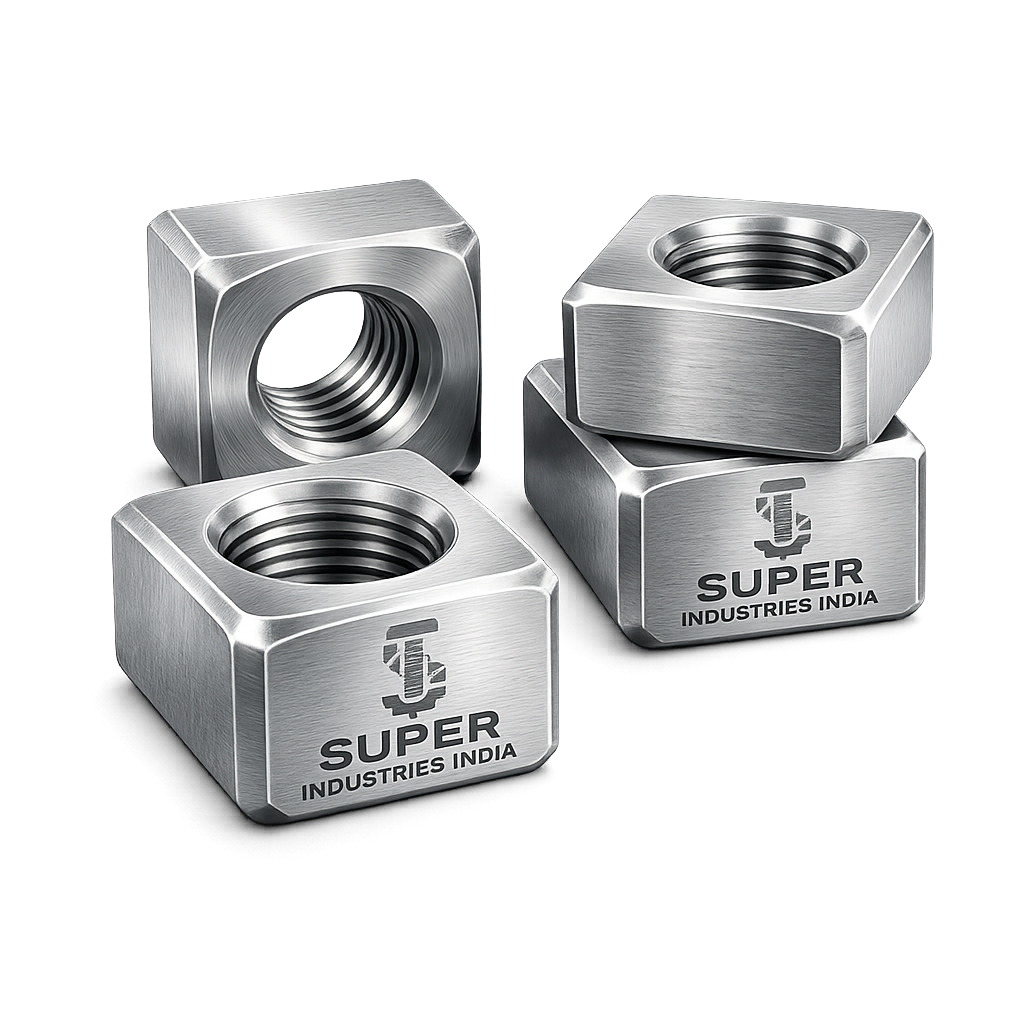
Role of Square Nuts in Industrial Fastening Systems
Square Nuts are fundamental load-bearing components within engineered fastening assemblies where structural stability, load distribution, and anti-rotation characteristics are required. Unlike general-purpose hexagonal fasteners, square nuts are intentionally selected in applications where interface geometry, bearing surface area, and mechanical locking behavior influence joint integrity.
In engineered systems, fastening performance is governed not only by bolt strength but also by the interaction between nut geometry and the contact substrate. Square Nuts provide a broader and more stable interface, making them suitable for structural and heavy-duty mechanical environments.
They function as:
- Load transfer interfaces between threaded elements and structural members
- Bearing stress distributors over wider surface zones
- Anti-rotation elements in constrained or slotted assemblies
- Secondary locking components in legacy or heavy fabrication systems
System-Level Applications
Structural Steel Assemblies
In structural steel frameworks, Square Nuts are commonly used in conjunction with:
- Anchor bolts
- Structural studs
- Base plate connections
Their larger bearing face improves load transfer to structural members, reducing localized compressive stress and minimizing deformation at the interface.
Typical use cases include:
- Column base anchoring
- Beam-to-column secondary connections
- Embedded plate fastening systems
Heavy Machinery & Equipment Fabrication
Square Nuts are widely applied in machinery where:
- Assembly slots or T-sections are present
- Rotational locking is required without additional locking devices
- Maintenance accessibility requires simplified tool engagement
They are frequently integrated into:
- Machine bed assemblies
- Tooling fixtures
- Mechanical guides and adjustable mounts
Railways & Track Systems
Railway infrastructure utilizes Square Nuts due to their compatibility with:
- Slotted rail plates
- Track fastening systems
- Vibration-intensive environments
Their geometry enables stable engagement within rail channels, preventing rotational loosening under cyclic loading.
Power Generation Facilities
In thermal, hydro, and renewable energy installations, Square Nuts are used in:
- Turbine base structures
- Generator housings
- Auxiliary equipment supports
These environments demand fasteners capable of sustaining:
- Continuous vibration
- Thermal expansion cycles
- Long-duration static loads
Oil & Gas Installations
Within upstream, midstream, and downstream systems, Square Nuts are applied in:
- Structural platforms
- Pipe support systems
- Equipment mounting assemblies
Their relevance increases in scenarios where:
- Access constraints limit tool movement
- Anti-rotation is required without secondary locking
- Surface contact area must be maximized
Infrastructure & Civil Projects
Square Nuts are utilized in:
- Bridge structures
- Transmission towers
- Industrial sheds
- Heavy civil anchoring systems
Their ability to distribute load across larger areas contributes to improved long-term structural performance.
Functional Advantage Over Hex Nuts
Bearing Surface Area
Square Nuts inherently provide a larger contact area compared to standard hex nuts of equivalent thread size.
Engineering impact:
- Reduced bearing stress (σ = F/A)
- Lower risk of surface indentation
- Improved load transfer uniformity
Anti-Rotation Characteristics
Due to their geometry, Square Nuts:
- Engage effectively in square recesses or slots
- Resist rotational movement during tightening
- Reduce dependency on secondary holding tools
This is critical in:
- Blind installations
- Embedded systems
- Restricted-access assemblies
Compatibility with Legacy and Structural Systems
Square Nuts are often specified in:
- Older industrial standards
- Heavy fabrication drawings
- Rail and infrastructure specifications
Their continued use is driven by:
- Proven performance history
- Compatibility with existing hardware
- Ease of replacement in maintenance cycles
Vibration Resistance
While not a locking fastener by design, Square Nuts demonstrate:
- Improved stability under lateral vibration
- Reduced tendency for rotation due to flat-face engagement
- Enhanced frictional resistance in constrained geometries
Super Industries
Global Manufacturer of Heavy & Custom Engineered Fasteners & Flanges.
2. TECHNICAL DEFINITION
Fundamental Description
Square Nuts are four-sided internally threaded fasteners designed to mate with external threaded components such as bolts, studs, or threaded rods.
They are characterized by:
- Square external geometry
- Internal threading conforming to standardized pitch profiles
- Flat bearing surface for load distribution
Functional Characteristics
A Square Nut operates as:
- A compressive load distributor
- A threaded locking interface
- A positional stabilizer in structural assemblies
The geometry ensures:
- Equal force distribution across four flat faces
- Enhanced engagement with square or slotted substrates
- Predictable torque-preload behavior
Standard vs Heavy Square Nuts
Standard Square Nuts
Defined under standards such as DIN 557 and DIN 562, standard square nuts are:
- Lower in height
- Used for moderate load applications
- Suitable for sheet metal or light structural work
Heavy Square Nuts
Heavy square nuts are:
- Increased in thickness
- Designed for higher load-bearing applications
- Common in structural and heavy engineering systems
Engineering significance:
- Greater thread engagement length
- Higher proof load capacity
- Improved resistance to stripping
Dimensional Systems
Metric System (ISO / DIN)
Metric Square Nuts follow:
- ISO metric thread profiles
- Designation in millimeters (M6, M8, M10, etc.)
- Coarse and fine pitch variants
Imperial System (UNC / UNF)
Used in ASME/ANSI standards:
- UNC (Unified National Coarse)
- UNF (Unified National Fine)
Applications include:
- Oil & Gas equipment
- American-standard machinery
- Legacy industrial systems
Thread Forms
Square Nuts are manufactured with:
Metric Threads
- ISO 68 profile
- 60° flank angle
- Standardized pitch progression
Unified Threads (UNC/UNF)
- 60° thread angle
- Defined pitch per inch (TPI)
- Used in ASTM/ASME systems
Thread Fit Classes
Thread engagement quality is defined by tolerance classes:
Metric
- 6H (standard internal thread tolerance)
Imperial
- Class 2B (standard fit)
- Class 3B (precision fit)
Functional Compatibility
Square Nuts are compatible with:
- Hex bolts
- Stud bolts
- Threaded rods
- Anchor bolts
Their selection depends on:
- Load requirements
- Environmental conditions
- Installation constraints
3. ENGINEERING & LOAD DISTRIBUTION PRINCIPLE
Load Transfer Mechanism
In a bolted joint involving Square Nuts, load transfer occurs through:
- Bolt tension generation (via applied torque)
- Compressive force between joint members
- Load distribution through the nut’s bearing surface
The Square Nut acts as:
- A compressive interface transmitting force from the bolt to the substrate
- A stabilizing element preventing lateral displacement
Bearing Surface Pressure Distribution
The bearing pressure beneath the nut is defined as:
[
\sigma_b = \frac{F}{A_b}
]
Where:
- ( F ) = Applied preload force
- ( A_b ) = Bearing area
Due to increased surface area in Square Nuts:
- Bearing pressure is reduced
- Material deformation risk is minimized
- Joint longevity improves
Thread Engagement Mechanics
Thread interaction between nut and bolt involves:
- Load sharing across engaged threads
- Maximum load concentration at first engaged thread
- Progressive load reduction across subsequent threads
Engineering implications:
- Nut thickness directly affects load capacity
- Proper thread engagement length is critical
- Overloading leads to thread stripping rather than bolt failure
Frictional Behavior
Torque applied during tightening is distributed into:
- Thread friction (~40–50%)
- Bearing surface friction (~40–50%)
- Useful preload (~10–20%)
Square Nuts influence friction through:
- Larger contact interface
- Increased resistance to rotation
- Stable torque application
Torque vs Preload Relationship
The fundamental relationship:
![\[T = K \cdot F \cdot d\]](https://superindustriesindia.in/wp-content/ql-cache/quicklatex.com-637ae80de10d14a2f4d17cc6dfd9f1fa_l3.png "Rendered by QuickLaTeX.com")
Where:
- ( T ) = Applied torque
- ( K ) = Torque coefficient
- ( F ) = Preload force
- ( d ) = Nominal diameter
Engineering relevance:
- Square Nuts provide consistent torque transfer due to stable seating
- Surface finish significantly affects K-factor
- Lubrication alters preload efficiency
Contact Stress Distribution
Square geometry results in:
- Uniform load spread across flat surfaces
- Reduced edge stress concentration
- Improved interface stability
This is particularly relevant in:
- Soft substrates
- Coated surfaces
- Structural steel interfaces
Anti-Rotation Characteristics
Square Nuts resist rotation due to:
- Flat face engagement
- Increased frictional contact
- Compatibility with square slots
This eliminates the need for:
- Secondary holding tools
- Additional locking mechanisms in certain applications
4. LOAD & STRENGTH ENGINEERING
Tensile Load Capacity
The tensile capacity of a Square Nut is governed by:
- Material grade
- Thread engagement length
- Proof load rating
Failure modes include:
- Thread stripping
- Bolt fracture (if bolt is weaker)
Shear Load Resistance
Square Nuts contribute indirectly to shear resistance by:
- Maintaining clamping force
- Preventing joint separation
Shear is primarily resisted by:
- Bolt shank
- Friction between clamped surfaces
Static vs Dynamic Loads
Static Loads
- Constant load conditions
- Typical in structural anchoring
Square Nuts perform with predictable preload retention.
Dynamic Loads
- Cyclic or fluctuating loads
- Present in machinery and transport systems
Considerations:
- Fatigue resistance
- Preload retention
- Vibration-induced loosening
Vibration Resistance
Square Nuts provide:
- Improved stability in constrained geometries
- Reduced rotational tendency
- Better seating under cyclic loads
However, for critical applications:
- Locking mechanisms may still be required
Fatigue Performance
Fatigue life depends on:
- Preload accuracy
- Material strength
- Surface finish
Square Nuts contribute by:
- Maintaining consistent preload
- Reducing stress concentration
Proof Load Concept
Proof load represents:
- Maximum load a nut can withstand without permanent deformation
Engineering relevance:
- Defines safe operational limits
- Used in design validation
Yield vs Ultimate Strength
- Yield Strength → Onset of permanent deformation
- Ultimate Strength → Maximum load before failure
Design practice:
- Operate below yield strength
- Apply safety factors
Safety Factors in Structural Applications
Typical safety factors:
- 2.0 – 3.0 for static loads
- 3.0 – 5.0 for dynamic loads
Factors depend on:
- Application criticality
- Environmental conditions
- Inspection frequency
5. APPLICABLE STANDARDS (ASTM / DIN / ISO / ASME)
Square Nuts used in EPC-grade applications are governed by internationally recognized standards that define dimensional accuracy, material properties, mechanical performance, and inspection requirements. Selection of the appropriate standard is driven by load conditions, operating environment, and project specification.
ASTM Standards (Material & Mechanical Requirements)
ASTM A563 – Carbon Steel Nuts
Applicable for:
- Structural and general-purpose fastening
- Carbon and alloy steel nuts
- Moderate to high-strength bolting systems
Common Grades:
- Grade A – Low to medium strength applications
- Grade DH – High-strength structural applications
Engineering relevance:
- Defines proof load stress values
- Ensures compatibility with structural bolts
- Used extensively in steel construction and infrastructure
ASTM A194 – High-Pressure / High-Temperature Applications
Applicable for:
- Pressure vessel bolting
- High-temperature service
- Refinery and petrochemical systems
Common Grades:
- Grade 2H – Alloy steel, high strength
- Grade 8 – Stainless steel (304)
- Grade 8M – Stainless steel (316)
Engineering relevance:
- Ensures mechanical stability under thermal cycles
- Suitable for critical bolted joints in pressure systems
- Often paired with ASTM A193 bolting
DIN Standards (Dimensional Control)
DIN 557 – Square Nuts (Standard Height)
- Defines geometry and tolerances for standard square nuts
- Used in light to moderate load applications
- Common in fabrication and mechanical assemblies
DIN 562 – Square Thin Nuts
- Reduced thickness design
- Used where space constraints exist
- Limited load-bearing capability
ISO Standards (Metric System Alignment)
Although ISO primarily defines hex nuts, metric thread systems used in Square Nuts align with:
- ISO 68 (thread profile)
- ISO 261 / ISO 965 (thread tolerances)
Engineering relevance:
- Ensures compatibility with ISO metric bolts
- Standardizes pitch and tolerance classes
ASME Standards (Imperial System)
ASME B18.2.2
- Covers dimensional requirements for nuts in imperial systems
- Used in conjunction with UNC/UNF thread forms
- Applicable in oil & gas and US-based EPC projects
Standard Selection Matrix
| Application Type | Preferred Standard | Reason for Selection |
|---|---|---|
| Structural Steel | ASTM A563 DH | High strength, proof load compliance |
| Pressure Systems | ASTM A194 2H | High temperature & pressure resistance |
| General Fabrication | DIN 557 | Dimensional simplicity |
| Space-Constrained Systems | DIN 562 | Reduced height |
| Oil & Gas (US Projects) | ASME B18.2.2 + A194 | Imperial compatibility |
| Corrosive Environments | ASTM A194 8 / 8M | Stainless steel resistance |
Standard-to-Environment Mapping
| Environment | Recommended Standard | Material Type |
|---|---|---|
| Ambient / Structural | ASTM A563 | Carbon Steel |
| High Temperature | ASTM A194 2H | Alloy Steel |
| Marine / Offshore | ASTM A194 8M | SS316 |
| Chemical Processing | ASTM A194 8M / Duplex | Stainless / Duplex |
| Infrastructure Projects | DIN 557 | Carbon Steel |
6. MATERIAL & GRADE OPTIONS
Material selection directly governs mechanical strength, corrosion resistance, and service life of Square Nuts. Selection must align with load requirements and environmental exposure.
Carbon Steel
ASTM A563 Grade A
- Moderate strength
- Suitable for general structural applications
- Economical for non-critical systems
ASTM A563 Grade DH
- Higher strength variant
- Heat-treated for improved mechanical properties
- Used in structural and heavy engineering
Stainless Steel
ASTM A194 Grade 8 (SS 304)
- Austenitic stainless steel
- Good corrosion resistance
- Suitable for industrial and atmospheric exposure
ASTM A194 Grade 8M (SS 316)
- Enhanced corrosion resistance
- Resistant to chlorides and marine environments
- Used in offshore and chemical plants
Alloy Steel
ASTM A194 Grade 2H
- High-strength alloy steel
- Heat-treated (quenched & tempered)
- Used in high-pressure and high-temperature systems
Duplex Stainless Steel
- Superior strength compared to austenitic grades
- Excellent resistance to stress corrosion cracking
- Suitable for aggressive chemical and marine environments
MATERIAL COMPARISON TABLE
| Grade | Yield Strength (MPa) | Tensile Strength (MPa) | Temperature Range | Corrosion Resistance | Typical Industry Use |
|---|---|---|---|---|---|
| ASTM A563 Gr A | ~250 | ~400–550 | -20°C to 300°C | Low | Structural steel |
| ASTM A563 Gr DH | ~450 | ~700–900 | -20°C to 400°C | Moderate (coated) | Heavy structural |
| ASTM A194 Gr 2H | ~600 | ~800–1000 | -20°C to 500°C | Low (requires coating) | Pressure systems |
| ASTM A194 Gr 8 (304) | ~215 | ~500–700 | -200°C to 400°C | High | Industrial environments |
| ASTM A194 Gr 8M (316) | ~205 | ~500–700 | -200°C to 450°C | Very High | Marine / offshore |
| Duplex SS | ~450 | ~650–900 | -50°C to 300°C | Excellent | Chemical / offshore |
Material Selection Considerations
Selection is based on:
- Load requirements
- Environmental exposure
- Temperature range
- Compatibility with mating bolt material
Engineering principle:
Nut strength must be equal to or greater than the bolt strength to prevent thread stripping.
7. HEAT TREATMENT INFORMATION
Heat treatment processes are applied to enhance mechanical properties, control hardness, and improve durability.
Normalizing
- Heating above critical temperature followed by air cooling
- Refines grain structure
- Improves uniformity
Used for:
- Carbon steel square nuts
- Structural applications
Quenching & Tempering
Process:
- Heating to austenitizing temperature
- Rapid cooling (quenching)
- Reheating to tempering temperature
Results:
- Increased strength
- Controlled hardness
- Improved toughness
Applicable to:
- ASTM A194 Gr 2H
- ASTM A563 DH
Stress Relieving
- Reduces residual stresses after machining or forming
- Prevents distortion during service
Hardness Control
Hardness is maintained within specified limits to ensure:
- Adequate strength
- Prevention of brittleness
- Compliance with ASTM requirements
Microstructural Effects
Heat treatment influences:
- Grain size
- Phase distribution (ferrite, martensite, etc.)
- Crack resistance
Hydrogen Embrittlement Considerations
Critical for:
- High-strength fasteners
- Electroplated components
Preventive measures:
- Controlled plating processes
- Post-plating baking
- Material selection
8. MANUFACTURING PROCESS
Square Nuts are produced through controlled manufacturing processes to ensure dimensional accuracy and mechanical integrity.
Raw Material Inspection
- Chemical composition verification
- Mechanical property validation
- Mill test certificate review
Cutting / Forging / Machining
Forging
- Preferred for high-strength applications
- Improves grain flow
- Enhances mechanical properties
Machining
- Used for precision or custom sizes
- Ensures tight tolerances
Thread Tapping
- Internal threading performed using taps
- Controlled for pitch accuracy and fit class
Inspection includes:
- Go/No-Go gauges
- Thread profile verification
Heat Treatment
Performed as per material grade requirements:
- Ensures mechanical strength
- Achieves specified hardness
Surface Finishing
Applied post-machining to enhance:
- Corrosion resistance
- Surface durability
Marking & Traceability
Each batch may include:
- Grade identification
- Manufacturer marking
- Heat number traceability
Ensures:
- Full documentation compliance
- Inspection traceability
Dimensional Inspection Discipline
Includes:
- Width across flats verification
- Thickness measurement
- Thread depth inspection
Thread Accuracy Control
Maintained through:
- Calibration of tools
- Gauge verification
- Periodic inspection cycles
9. SURFACE FINISH OPTIONS
Surface treatments are applied based on environmental exposure and project requirements.
Zinc Plating
- Electroplated coating
- Provides basic corrosion protection
- Suitable for indoor environments
Hot-Dip Galvanizing (HDG)
- Thick zinc coating
- High corrosion resistance
- Used in outdoor and infrastructure applications
Engineering consideration:
- Thread oversizing required due to coating thickness
Black Oxide
- Minimal corrosion protection
- Used for controlled indoor environments
- Provides uniform appearance
Phosphate Coating
- Improves lubrication
- Enhances paint adhesion
- Used in automotive and machinery
PTFE Coating
- Reduces friction
- Improves corrosion resistance
- Used in chemical and offshore environments
Passivation (Stainless Steel)
- Removes free iron from surface
- Enhances corrosion resistance
- Mandatory for stainless steel fasteners
Coating Thickness Impact on Threads
Engineering consideration:
- Excess coating can affect thread fit
- Standards define allowable thickness
- Post-coating inspection is required
A. DIMENSIONAL TABLE (METRIC REFERENCE – DIN / ISO SYSTEM)
The dimensional integrity of Square Nuts governs load distribution, thread engagement, and assembly compatibility. The following table represents standard proportions aligned with DIN 557 / DIN 562 practices (indicative for engineering reference; project-specific drawings prevail).
| Thread Size (M) | Width Across Flats (mm) | Nut Height (mm) | Thread Pitch (mm) |
|---|---|---|---|
| M6 | 10 | 5 | 1.0 |
| M8 | 13 | 6.5 | 1.25 |
| M10 | 17 | 8 | 1.5 |
| M12 | 19 | 10 | 1.75 |
| M16 | 24 | 13 | 2.0 |
| M20 | 30 | 16 | 2.5 |
| M24 | 36 | 19 | 3.0 |
| M30 | 46 | 24 | 3.5 |
| M36 | 55 | 29 | 4.0 |
Dimensional Engineering Notes
- Width across flats directly influences bearing area and tool engagement
- Nut height determines thread engagement length and load capacity
- Thread pitch affects preload sensitivity and tightening precision
- Dimensional tolerances follow ISO metric tolerance class 6H
B. MECHANICAL PROPERTY TABLE
Mechanical properties are defined by material grade and heat treatment condition. The following table represents typical values aligned with ASTM standards.
| Grade | Yield Strength (MPa) | Tensile Strength (MPa) | Hardness (HB/HRC) | Proof Load (MPa) |
|---|---|---|---|---|
| ASTM A563 Gr A | ~250 | 400–550 | 120–180 HB | ~250 |
| ASTM A563 Gr DH | ~450 | 700–900 | 187–302 HB | ~450 |
| ASTM A194 Gr 2H | ~600 | 800–1000 | 24–35 HRC | ~600 |
| ASTM A194 Gr 8 (304) | ~215 | 500–700 | ≤ 201 HB | ~205 |
| ASTM A194 Gr 8M (316) | ~205 | 500–700 | ≤ 201 HB | ~205 |
| Duplex Stainless | ~450 | 650–900 | 200–300 HB | ~450 |
Mechanical Engineering Notes
- Proof load defines maximum permissible load without permanent deformation
- Hardness range ensures balance between strength and ductility
- Stainless grades prioritize corrosion resistance over high strength
- Alloy grades provide superior performance in pressure applications
C. TORQUE CHART (MANDATORY – ENGINEERING REFERENCE)
Torque values are indicative and depend on lubrication condition, surface finish, and friction coefficient.
| Bolt Size | Property Class | Dry Torque (Nm) | Lubricated Torque (Nm) |
|---|---|---|---|
| M8 | 8.8 | 25 | 18 |
| M10 | 8.8 | 49 | 36 |
| M12 | 8.8 | 85 | 63 |
| M16 | 8.8 | 210 | 155 |
| M20 | 8.8 | 410 | 300 |
| M24 | 8.8 | 710 | 520 |
| M12 | 10.9 | 120 | 90 |
| M16 | 10.9 | 300 | 220 |
| M20 | 10.9 | 600 | 450 |
| M24 | 10.9 | 1000 | 750 |
Torque Engineering Notes
- Lubrication reduces friction and increases preload for the same torque
- Over-torque can lead to thread stripping or bolt yielding
- Under-torque results in insufficient preload and joint loosening
- Torque values must align with project specifications
D. PRELOAD CALCULATION GUIDE
Torque–Tension Relationship
Where:
- (T) = Applied torque (Nm)
- (K) = Torque coefficient (typically 0.15–0.25)
- (F) = مطلوب preload force (N)
- (d) = Nominal bolt diameter (m)
Preload Determination
Recommended preload is typically:
- 60–75% of bolt proof load
Sample Calculation
Given:
- Bolt size: M16
- Nominal diameter (d = 0.016 , m)
- Target preload (F = 120,000 , N)
- Torque coefficient (K = 0.2)
Calculation:
![\[T = 0.2 \times 120{,}000 \times 0.016 = 384 \, \text{N·m}\]](https://superindustriesindia.in/wp-content/ql-cache/quicklatex.com-254acadb18c65aff57b38403f61e3551_l3.png "Rendered by QuickLaTeX.com")
Safety Factor Logic
Engineering practice:
- Apply preload below yield strength
- Maintain safety factor of 2–3 for static systems
- Increase safety margin for dynamic loading
Preload Control Methods
- Torque-controlled tightening
- Turn-of-nut method
- Hydraulic tensioning (critical systems)
E. LOAD CAPACITY TABLE
Indicative tensile and shear capacity based on standard bolt-nut assemblies.
| Size | Tensile Load Capacity (kN) | Shear Load Capacity (kN) | Recommended Working Load (kN) |
|---|---|---|---|
| M8 | 20 | 12 | 10–12 |
| M10 | 32 | 20 | 16–20 |
| M12 | 45 | 28 | 22–28 |
| M16 | 80 | 50 | 40–50 |
| M20 | 125 | 78 | 60–75 |
| M24 | 180 | 110 | 90–110 |
| M30 | 280 | 170 | 140–170 |
| M36 | 400 | 250 | 200–250 |
Load Engineering Notes
- Values depend on material grade and engagement length
- Working load incorporates safety factors
- Shear capacity is influenced by bolt material and joint friction
F. CORROSION RESISTANCE TABLE
Comparison of material performance across different environments.
| Material | Marine | Industrial | Chemical | High Humidity |
|---|---|---|---|---|
| Carbon Steel | Low | Moderate | Low | Low |
| Carbon Steel (HDG) | Moderate | Moderate | Low | Moderate |
| SS304 | Moderate | High | Moderate | High |
| SS316 | High | High | High | Very High |
| Duplex Stainless | Very High | Very High | Very High | Very High |
| Alloy Steel | Low | Moderate | Low | Low |
Corrosion Engineering Notes
- Chloride environments require SS316 or Duplex
- HDG improves carbon steel performance in outdoor conditions
- Chemical exposure demands stainless or coated alloy systems
10. INSPECTION & QUALITY CONTROL METHODS
Square Nuts used in EPC projects undergo structured inspection protocols to ensure compliance with specifications and standards.
Positive Material Identification (PMI)
- Verifies chemical composition
- Confirms material grade
- Conducted using XRF or spectrometry
Thread Gauge Inspection
- Go/No-Go gauges used
- Ensures thread accuracy
- Confirms fit class compliance
Hardness Testing
Methods:
- Brinell (HB)
- Rockwell (HRC)
Purpose:
- Validate heat treatment
- Ensure compliance with ASTM limits
Load Testing
- Proof load testing
- Ensures nut withstands specified load without deformation
Dimensional Inspection
Includes:
- Width across flats
- Nut thickness
- Thread depth
Measured using:
- Vernier calipers
- Micrometers
- Coordinate measuring systems
Coating Thickness Inspection
- Measured using coating thickness gauges
- Ensures compliance with HDG or plating standards
Third-Party Inspection (TPI)
Conducted by:
- Independent inspection agencies
Scope includes:
- Witnessing tests
- Documentation verification
- Batch traceability
Certification Standards
- EN 10204 3.1 – Manufacturer test certificate
- EN 10204 3.2 – Third-party validated certificate
Traceability System
Maintained through:
- Heat number tracking
- Batch identification
- Marking and documentation linkage
11. INDUSTRIES SERVED
Square Nuts are deployed across multiple industrial sectors where fastening reliability, structural integrity, and long-term performance are required. Selection is driven by load conditions, environmental exposure, and compliance with project specifications.
Oil & Gas Industry
Applications include:
- Structural platform assemblies
- Pipe support systems
- Equipment base fastening
- Skid-mounted units
Engineering requirements:
- Compatibility with ASTM A194 and A563 standards
- Resistance to corrosion and temperature variation
- Traceability and third-party inspection compliance
Square Nuts are used where:
- Anti-rotation is required in constrained installations
- Larger bearing surfaces improve load transfer on structural members
Structural Steel Construction
Used in:
- Column base anchoring
- Steel framework connections
- Transmission tower structures
Engineering considerations:
- Load distribution across steel surfaces
- Compatibility with structural bolts
- Compliance with ASTM A563 DH
Power Generation Plants
Applicable in:
- Turbine mounting systems
- Generator base frames
- Auxiliary equipment structures
Performance requirements:
- Resistance to thermal expansion cycles
- Sustained preload under vibration
- Material suitability for elevated temperatures
Railways & Transport Infrastructure
Applications include:
- Rail fastening systems
- Track plate assemblies
- Structural support components
Engineering advantages:
- Stable engagement within slotted sections
- Resistance to cyclic loading and vibration
- Reduced rotational loosening
Heavy Equipment Manufacturing
Used in:
- Machine bed assemblies
- Fabricated equipment structures
- Tooling and fixtures
Requirements:
- Repeatable assembly and disassembly
- Dimensional precision
- Consistent torque-preload behavior
Infrastructure & Civil Engineering Projects
Includes:
- Bridges
- Industrial sheds
- Utility structures
- Anchoring systems
Engineering relevance:
- Load-bearing stability
- Compatibility with galvanized systems
- Long-term corrosion resistance
12. EXPORT CAPABILITY & GLOBAL SUPPLY
Super Industries operates as a manufacturing and export-oriented supplier of Square Nuts for EPC and industrial projects. Supply capability is aligned with international project execution requirements.
Regions Served
Export supply includes:
- United States (ASTM / ASME compliance)
- European Union (DIN / ISO compliance)
- Middle East (Oil & Gas and infrastructure projects)
- Southeast Asia (Industrial and power sectors)
Packaging Standards
Packaging is structured to ensure:
- Protection against corrosion
- Mechanical damage prevention
- Ease of handling and identification
Typical formats:
- Wooden crates (fumigated)
- Export-grade pallets
- Moisture-resistant packaging
- Segregated batch packaging
Export Documentation
Documentation provided includes:
- Commercial invoice
- Packing list
- Mill test certificates (EN 10204 3.1 / 3.2)
- Third-party inspection reports
- Certificate of origin
- Compliance documentation (ASTM / DIN / ISO)
Project Logistics Capability
Supply planning includes:
- Batch-wise production tracking
- Delivery scheduling aligned with EPC timelines
- Bulk shipment coordination
- Containerized and break-bulk logistics
Compliance & Traceability
Maintained through:
- Heat number traceability
- Inspection records
- Material certification
- Batch identification systems
13. PROCUREMENT & INSTALLATION VIEW
Square Nuts must be evaluated and installed based on engineering requirements rather than general-purpose practices.
Procurement Considerations
Engineering teams must verify:
- Applicable standard (ASTM / DIN / ASME)
- Material grade compatibility with bolts
- Dimensional compliance
- Coating or corrosion protection requirements
- Certification level (3.1 / 3.2)
Proper Tightening Practices
Installation must ensure:
- Controlled torque application
- Uniform preload across joints
- Avoidance of over-tightening
Methods include:
- Torque wrench application
- Calibrated tightening tools
- Controlled tightening sequences
Thread Lubrication
Lubrication affects:
- Torque coefficient (K-factor)
- Preload accuracy
- Thread wear
Typical lubricants:
- Molybdenum-based compounds
- Anti-seize lubricants (for stainless steel)
Inspection During Installation
Checks include:
- Thread condition
- Proper seating of nut
- Torque verification
- Alignment of joint components
Storage Conditions
Square Nuts must be stored in:
- Dry, controlled environments
- Corrosion-protected packaging
- Segregated material batches
Avoid:
- Exposure to moisture
- Mixing of different grades
- Damage to threads
14. CUSTOM ENGINEERING CAPABILITIES
Super Industries manufactures Square Nuts beyond standard specifications to meet project-specific requirements.
Non-Standard Dimensions
Capability includes:
- Custom widths across flats
- Increased thickness (heavy square nuts)
- Special dimensional tolerances
Custom Thread Profiles
Options include:
- Fine threads (UNF / Metric fine)
- Special pitch requirements
- High-precision thread classes
Heavy-Duty Square Nuts
Manufactured for:
- High-load structural systems
- Large-diameter bolting
- Infrastructure and EPC applications
Special Coatings
Available coatings:
- PTFE
- Hot-dip galvanizing
- Zinc-aluminum coatings
- Project-specific protective systems
Project-Specific Marking
Includes:
- Grade marking
- Heat number
- Client-specific identification
Ensures:
- Traceability
- Inspection compliance
- Documentation alignment
ENGINEERING CONCLUSION
Square Nuts serve as critical fastening components in structural and industrial systems where:
- Load distribution is a governing factor
- Anti-rotation characteristics are required
- Interface stability influences joint integrity
From an engineering perspective, their performance depends on:
- Material grade selection
- Dimensional accuracy
- Thread engagement quality
- Surface condition and lubrication
- Proper installation practices
Compliance with ASTM, DIN, ISO, and ASME standards ensures that Square Nuts meet:
- Mechanical performance requirements
- Environmental resistance expectations
- Inspection and certification criteria
For EPC and capital projects, evaluation of Square Nuts must consider:
- Load conditions (static and dynamic)
- Environmental exposure
- Compatibility with mating fasteners
- Inspection and traceability requirements
When specified and applied correctly, Square Nuts contribute to:
- Reliable load transfer
- Structural stability
- Long-term joint performance