
ERMETO FITTINGS
DIN 2353 Compression Tube Fittings for Hydraulic & Instrumentation Systems
Manufacturer & Global Exporter: Super Industries
Website: https://superindustriesindia.in
Table of Contents
Industry Context
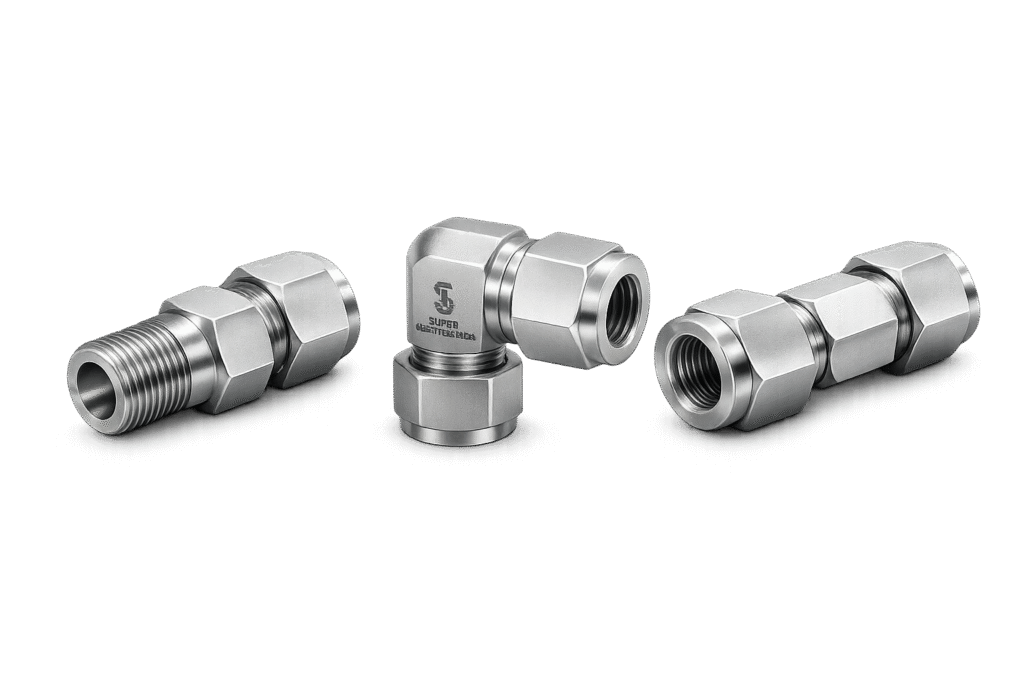
Role of Ermeto Fittings in EPC Hydraulic and Instrumentation Systems
In EPC and capital projects, hydraulic and instrumentation systems operate under high internal pressure, cyclic loading, vibration, and thermal variation. Leakage tolerance is effectively zero: loss of pressure compromises performance, contamination jeopardizes system integrity, and uncontrolled release presents safety risk. Within this context, Ermeto fittings—DIN 2353 compression tube fittings—are specified to create repeatable, metal-to-metal sealing joints between tubes and components.
Unlike welded joints, Ermeto fittings enable serviceability, modular assembly, and controlled rework without sacrificing pressure capability. Unlike elastomer-sealed connectors, they retain sealing performance across temperature ranges and aggressive fluids. For these reasons, Ermeto fittings are a default engineering choice in:
- Hydraulic power units (HPUs) and manifolds
- Instrumentation impulse lines and control tubing
- Skid-mounted process systems
- Offshore and onshore Oil & Gas facilities
- Power generation auxiliaries and balance-of-plant
- Petrochemical, LNG, Hydrogen, and infrastructure assets
EPC contractors and consultants treat Ermeto fittings as pressure components, not accessories. Their selection is governed by DIN/ISO standards, pressure ratings, tube compatibility, and installation discipline.
Super Industries
Global Manufacturer of Heavy & Custom Engineered Fasteners & Flanges
Technical Definition
What Ermeto Fittings Are and How They Function
Ermeto fittings are compression-type tube fittings defined by DIN 2353 (and harmonized with ISO 8434-1). They consist of three primary elements:
- Fitting body (with male or female thread)
- Cutting ring (ferrule)
- Compression nut
When assembled, the cutting ring plastically deforms the outer surface of the tube, creating a controlled bite that forms a metal-to-metal seal. This seal is independent of thread sealing; the thread’s role is to generate axial force during assembly.
Functionally, Ermeto fittings provide:
- Axial tube retention against internal pressure
- Circumferential sealing via tube bite and ring geometry
- Resistance to vibration and pressure impulses
- Reusable joints when properly installed
Sealing & Engineering Principle
Cutting Ring Mechanics and Metal-to-Metal Sealing
The defining feature of Ermeto fittings is the cutting ring. During tightening:
- The nut drives the cutting ring forward
- The ring’s hardened edge cuts into the tube OD
- A primary and secondary sealing surface is formed
- The tube is anchored axially and radially
This process creates a cold-worked sealing zone. Key engineering implications include:
- Seal integrity increases with pressure (self-energizing effect)
- No reliance on elastomers or soft seals
- High resistance to vibration loosening
- Predictable performance when assembly rules are followed
The quality of the seal depends on ring hardness, geometry accuracy, tube material compatibility, and surface finish.
Pressure & Load Relevance
Internal Pressure Ratings, Fatigue, and Safety Margins
Ermeto fittings are designed to withstand:
- Static internal pressure up to the rated limit of the series
- Pressure impulses common in hydraulic systems
- Cyclic fatigue loading over extended service life
Pressure ratings are defined relative to:
- Tube outside diameter (OD)
- Tube wall thickness
- Series classification (L or S)
- Material grade of fitting and tube
Engineering practice requires that the lowest-rated component in the joint—typically the tube—governs allowable pressure. Safety factors embedded in DIN/ISO standards ensure adequate margin for dynamic conditions.
Dimensional & Design Logic
Tube OD, Wall Thickness, and Tolerance Classes
Ermeto fittings are tube-OD-based systems. Correct selection requires alignment across:
- Tube outside diameter (OD)
- Tube wall thickness (pressure class dependent)
- Fitting series (L or S)
- Thread size and pitch
Tolerances are tightly controlled. Excessive tube ovality, incorrect wall thickness, or poor surface finish will compromise the cutting ring bite and sealing performance. For EPC projects, tubes are typically specified to EN 10297 / EN 10305 / ASTM equivalents compatible with DIN 2353 fittings.
Ermeto Fitting Types & Series
Series Classification and Configuration Options
Light Series (L)
- Lower pressure rating
- Thinner tube wall
- Used in instrumentation, lubrication, and low-to-medium pressure hydraulics
Heavy Series (S)
- Higher pressure rating
- Thicker tube wall
- Used in high-pressure hydraulic systems, power units, and process skids
Extra Heavy / Special Series
- Project-specific requirements
- Higher safety margins or non-standard tubes
Configurations
Ermeto fittings are available in a comprehensive configuration range:
- Straight connectors
- Elbows (90°, 45°)
- Tees
- Crosses
- Bulkhead fittings
- Reducers and adaptors
Each configuration maintains the same cutting-ring sealing principle.
Material & Standard Alignment
DIN 2353 / ISO 8434 Compliance and Material Selection
Applicable Standards
- DIN 2353 – Core dimensional and performance standard
- ISO 8434-1 – International harmonized equivalent
Material Options
- Carbon steel (phosphated or zinc plated): standard hydraulic service
- Stainless steel (AISI 316/316L): corrosive environments, offshore, chemical service
Material selection is driven by:
- Fluid compatibility
- Corrosion exposure
- Temperature range
- Project specifications and codes
Surface treatments must not alter cutting ring geometry or hardness.
Manufacturing & Quality Discipline
From Cold Forming to Final Inspection
Ermeto fittings are precision-engineered components. Manufacturing discipline directly affects sealing reliability.
Key processes include:
- Cold forming or machining of bodies with controlled grain structure
- Heat treatment to achieve required hardness and toughness
- Precision machining of sealing cones and threads
- Controlled hardening of cutting rings
- Surface finishing without dimensional distortion
Inspection protocols typically include:
- Dimensional verification
- Hardness testing (especially cutting rings)
- Thread gauging
- Visual and surface inspection
- Batch traceability to raw material
For EPC acceptance, fittings must be supported by material certificates and inspection records.
Procurement, Installation & Inspection View
What EPC Engineers and Inspectors Verify
From a procurement and QA/QC perspective, Ermeto fittings are evaluated on:
- DIN/ISO compliance
- Series identification (L/S)
- Material grade and certification
- Dimensional accuracy
- Surface condition and cleanliness
During installation, inspectors verify:
- Correct tube preparation (square cut, deburred)
- Proper pre-assembly of cutting ring
- Controlled tightening sequence
- No visible tube slippage or over-cutting
Improper installation is the most common root cause of leakage, not fitting design.
Application Mapping
Typical EPC and Industrial Applications
Ermeto fittings are used extensively in:
- Oil & Gas hydraulic control systems
- Power plant turbine and auxiliary hydraulics
- Petrochemical and refinery instrumentation lines
- LNG and cryogenic auxiliary systems
- Hydrogen compression and control skids
- Infrastructure and mobile hydraulic equipment
In each application, the fittings function as pressure-retaining joints within a regulated piping system.
Professional Technical Tables
Tube Size vs Series (Indicative)
| Tube OD (mm) | L Series Wall | S Series Wall |
|---|---|---|
| 6 | 1.0 | 1.5 |
| 12 | 1.5 | 2.0 |
| 25 | 2.5 | 4.0 |
(Refer applicable DIN/ISO tables for exact values)
Pressure Ratings by Series (Indicative)
| Series | Typical Application | Relative Pressure Capacity |
|---|---|---|
| L | Instrumentation | Medium |
| S | Hydraulics | High |
Material Grades vs Applications
| Material | Environment |
|---|---|
| Carbon steel | General hydraulic systems |
| Stainless steel | Corrosive / offshore |
Thread Types
| Thread Standard | Typical Use |
|---|---|
| Metric DIN | Core DIN 2353 systems |
| BSP / NPT (adaptors) | Interface with equipment |
Customization Options
- Non-standard materials
- Special surface treatments
- Project-specific markings
- Export documentation and third-party inspection
Manufacturer-Focused Conclusion
Ermeto fittings are not generic connectors. They are engineered compression joints whose performance depends on dimensional precision, material integrity, and disciplined installation. In EPC hydraulic and instrumentation systems, they form a critical link between design intent and operational reliability.
Super Industries manufactures Ermeto fittings in alignment with DIN 2353 / ISO 8434, supported by controlled processes, inspection discipline, and documentation suitable for EPC procurement and consultant review.
The result is a fitting range that integrates predictably into high-pressure, safety-critical hydraulic systems where leakage, downtime, and non-compliance are unacceptable.