
Types of Hydraulic Fittings
Super Industries
“Global Manufacturer of Heavy & Custom Engineered Fasteners for Oil & Gas, Power & EPC Contractors.”
Types of Hydraulic Fittings – Complete Classification, Design & Applications
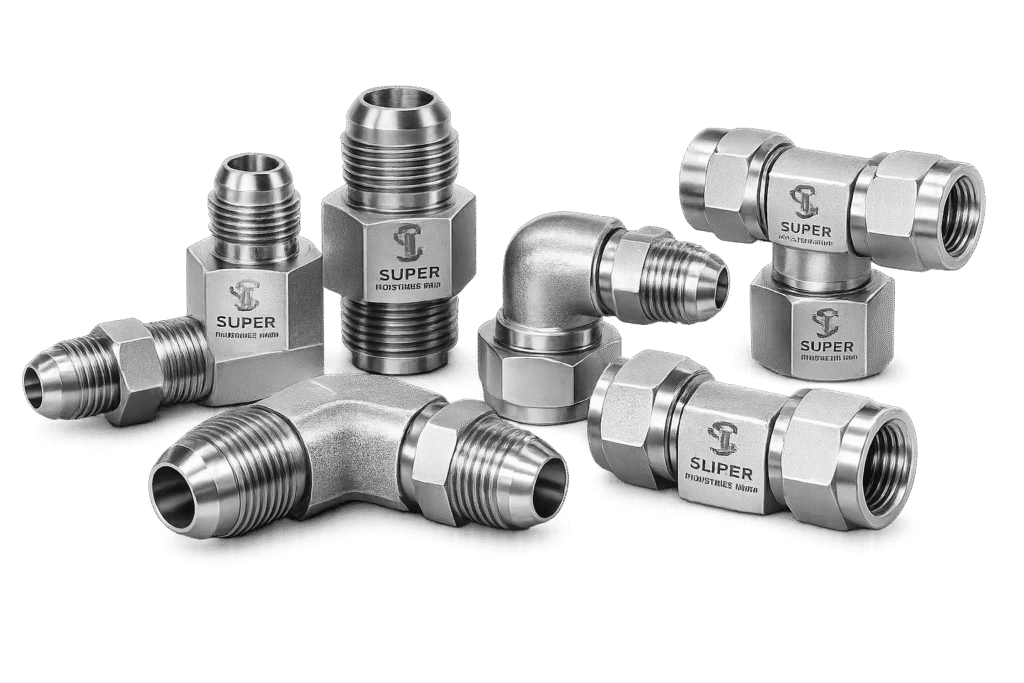
Introduction
After understanding the fundamentals of hydraulic fittings in the previous article, the next logical step is to explore the different types of hydraulic fittings used across industries. Hydraulic systems operate under varying pressures, temperatures, and environmental conditions, which makes fitting selection a critical engineering decision rather than a simple connection choice.
Hydraulic fittings are not “one-type-fits-all” components. They are classified based on:
- Connection method
- Thread type
- Sealing mechanism
- Shape and orientation
- Application requirements
In this article, we provide a complete classification of hydraulic fittings, explain how each type works, and outline where they are commonly used. This serves as a master guide, and each category will be covered in detail in upcoming individual posts.
Why Understanding Hydraulic Fitting Types Is Important
Using the wrong type of hydraulic fitting can lead to:
- Leakage under pressure
- Thread damage
- Seal failure
- System inefficiency
- Unexpected downtime
Each hydraulic fitting type is designed to solve a specific mechanical or sealing challenge. Understanding these differences ensures:
- Proper system compatibility
- Longer service life
- Safer operation
- Lower maintenance costs
Primary Classification of Hydraulic Fittings
Hydraulic fittings can be broadly classified into the following main categories:
- Based on Connection Style
- Based on Thread Standard
- Based on Sealing Method
- Based on Shape & Orientation
- Based on Application Type
Let’s explore each classification in detail.
1️⃣ Hydraulic Fittings Based on Connection Style
a) Threaded Hydraulic Fittings
Threaded fittings are the most widely used type in hydraulic systems. They connect components by screwing into ports or mating fittings.
Key Features:
- Strong mechanical connection
- Suitable for high pressure
- Easy installation and removal
Common Applications:
- Industrial machinery
- Construction equipment
- Power packs
Threaded fittings rely heavily on thread accuracy and sealing method, which we’ll cover in later sections.
b) Compression Hydraulic Fittings
Compression fittings use a compression ring (ferrule) that tightens around the pipe or tube when the nut is tightened.
Key Features:
- No welding required
- Easy to install
- Reliable sealing
Common Applications:
- Instrumentation lines
- Medium-pressure hydraulic systems
- Maintenance-friendly installations
c) Flared Hydraulic Fittings
Flared fittings use a flared tube end that seals against a mating cone.
Key Features:
- Metal-to-metal seal
- High resistance to vibration
- Reusable design
Common Applications:
- Automotive hydraulics
- High-pressure fluid lines
- Mobile equipment
d) Quick-Connect Hydraulic Fittings
Quick-connect fittings allow fast connection and disconnection without tools.
Key Features:
- Reduced downtime
- Spill-resistant options
- Operator convenience
Common Applications:
- Agricultural machinery
- Maintenance equipment
- Temporary hydraulic circuits
2️⃣ Hydraulic Fittings Based on Thread Standards
Thread standards determine compatibility and sealing performance. Mixing thread types is one of the most common causes of hydraulic leakage.
a) BSP Hydraulic Fittings (British Standard Pipe)
BSP threads are widely used in Europe, Asia, and the Middle East.
Types:
- BSPP (Parallel)
- BSPT (Tapered)
Characteristics:
- BSPP uses washers or O-rings
- BSPT seals by thread interference
b) NPT Hydraulic Fittings (National Pipe Thread)
NPT threads are common in North America.
Characteristics:
- Tapered thread design
- Seals through thread deformation
- Often requires sealant
c) Metric Hydraulic Fittings
Metric threads are commonly used in European and Asian hydraulic systems.
Characteristics:
- Precise dimensions
- Often combined with O-ring seals
- High reliability
d) UNF / SAE Threads
Used mainly in SAE and JIC hydraulic fittings.
Characteristics:
- Fine threads
- High mechanical strength
- Excellent sealing performance
3️⃣ Hydraulic Fittings Based on Sealing Method
Sealing method is critical for leak-free operation.
a) O-Ring Face Seal (ORFS) Fittings
ORFS fittings seal using an elastomeric O-ring at the face of the fitting.
Advantages:
- Zero leakage
- Excellent vibration resistance
- High pressure capability
Common Applications:
- Heavy machinery
- Construction equipment
b) Flare Sealed Fittings
These rely on metal-to-metal contact between flared surfaces.
Advantages:
- Durable seal
- No elastomers required
c) Thread-Sealed Fittings
Sealing is achieved by thread interference.
Limitations:
- Higher leakage risk if not installed correctly
- Requires sealant
4️⃣ Hydraulic Fittings Based on Shape & Orientation
Hydraulic systems rarely operate in straight lines. Shape-based fittings help route fluid efficiently.
a) Straight Hydraulic Fittings
Used to connect components in a straight line.
Applications:
- Inline connections
- Simple piping layouts
b) Elbow Hydraulic Fittings
Available in 45° and 90° angles.
Benefits:
- Space saving
- Reduced hose bending
c) Tee Hydraulic Fittings
Used to split flow into two directions.
Applications:
- Branch circuits
- Flow distribution
d) Cross Hydraulic Fittings
Used for four-way connections.
Applications:
- Complex hydraulic circuits
5️⃣ Hydraulic Fittings Based on Application Type
a) Hydraulic Hose Fittings
Designed specifically for flexible hoses.
Features:
- Crimped or reusable design
- High vibration resistance
b) Hydraulic Pipe Fittings
Used with rigid pipes.
Features:
- Strong structural support
- Long-term installations
c) Instrumentation Hydraulic Fittings
Used for pressure gauges and sensors.
Features:
- Smaller sizes
- High precision
Material-Based Classification of Hydraulic Fittings
Hydraulic fittings are also classified by material:
🔩 Carbon Steel Hydraulic Fittings
- High strength
- Most common choice
🔩 Stainless Steel Hydraulic Fittings
- Corrosion resistance
- Marine & chemical industries
🔩 Brass Hydraulic Fittings
- Low-pressure systems
- Instrumentation
Choosing the Right Type of Hydraulic Fitting
Key factors to consider:
- Pressure rating
- Thread compatibility
- Sealing method
- Installation environment
- Maintenance requirements
A correct fitting choice ensures:
- Leak-free operation
- Long service life
- Safe system performance
How This Classification Helps Buyers & Engineers
This classification:
- Simplifies product selection
- Reduces installation errors
- Improves procurement accuracy
- Supports standardization
For manufacturers and exporters, it also helps in:
- Creating structured catalogs
- Building SEO-friendly product pages
Conclusion
Hydraulic fittings come in a wide variety of types, each designed to address specific mechanical, sealing, and application requirements. Understanding these classifications is essential before selecting or specifying individual fittings.