
KEP NUT LOCK WASHER NUTS
Super Industries
“Global Manufacturer of Heavy & Custom Engineered Fasteners for Oil & Gas, Power & EPC Contractors.”
1. Industry Context & System Relevance
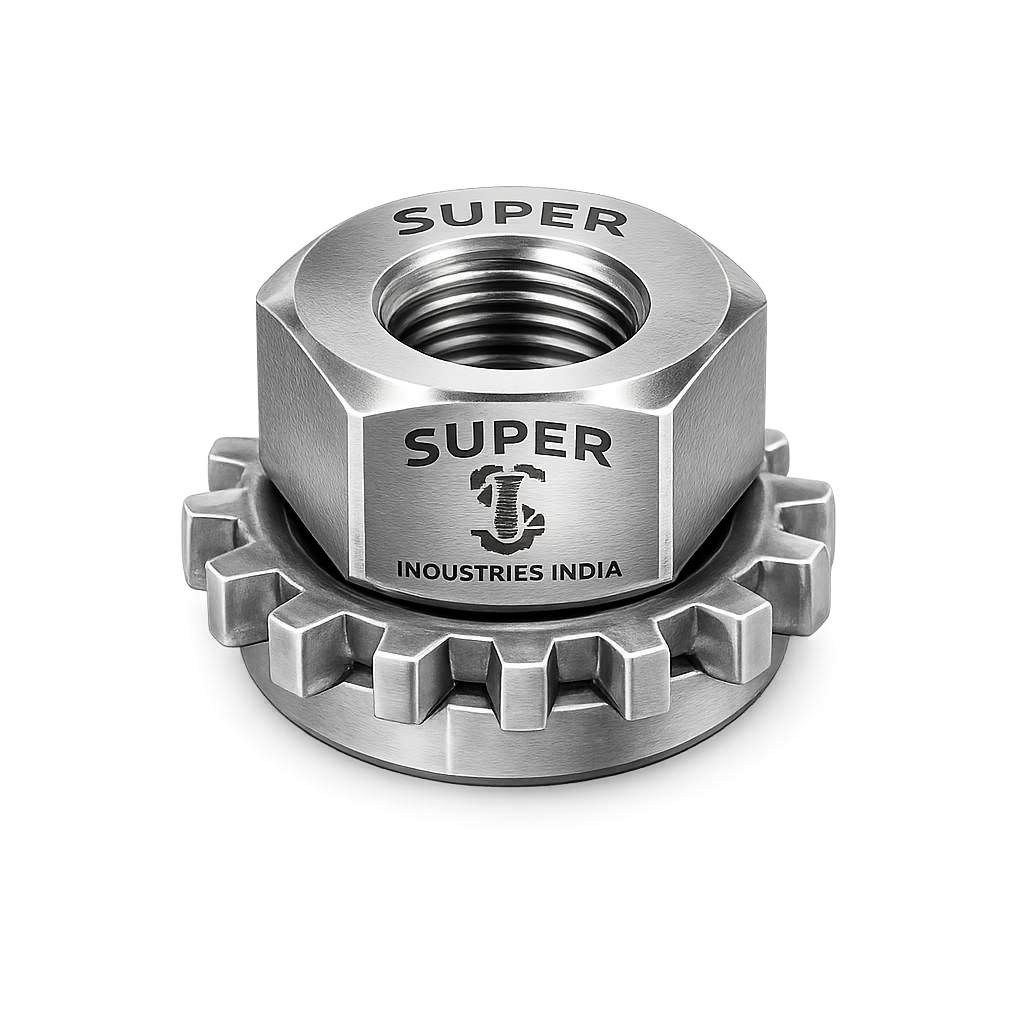
KEP Nut Lock Washer Nuts are deployed in fastening systems where assembly efficiency, vibration resistance, and component consolidation are required within controlled engineering tolerances.
These fasteners are widely specified in:
Anti-Vibration Fastening Systems
In dynamic assemblies subjected to:
- Rotational imbalance
- Mechanical oscillations
- Cyclic load variation
The integrated serrated washer provides surface penetration-based resistance, reducing self-loosening under transverse vibration conditions.
Pre-Assembled Fastening Solutions
KEP nuts eliminate the need for:
- Loose flat washers
- Split lock washers
This reduces:
- Assembly time variability
- Component misplacement risks
- Human error during installation
Used extensively in automated and semi-automated assembly lines.
High-Speed Assembly Environments
Common in:
- Automotive production lines
- Electrical enclosure fabrication
- Sheet metal mass production
Advantages:
- Single-piece handling
- Reduced installation steps
- Improved takt time consistency
Electrical Panels & Enclosures
Used for:
- Grounding connections
- Panel mounting structures
- Busbar fastening
Serrated teeth assist in:
- Breaking paint layers
- Ensuring electrical continuity
Automotive & Rotating Equipment
Applications include:
- Engine bay assemblies
- Transmission housings
- Chassis components
Where:
- Vibration-induced loosening must be controlled
- Space constraints require compact fastening
Industrial Machinery
Deployed in:
- Gearboxes
- Pumps
- Compressors
- Fabrication assemblies
Providing combined bearing surface and locking functionality.
Sheet Metal Assemblies
Used in:
- Thin sheet fastening
- Bracket assemblies
- Structural light-duty connections
Where washer distributes load and prevents material deformation.
Selection Justification vs Alternatives
Compared to Standard Hex Nut + Loose Washer
| Parameter | Standard Nut + Washer | KEP Nut |
|---|---|---|
| Assembly Time | Higher | Reduced |
| Washer Alignment | Manual | Pre-aligned |
| Component Loss | Possible | Eliminated |
| Installation Consistency | Variable | Controlled |
Compared to Split Lock Washers
| Parameter | Split Washer | KEP Nut |
|---|---|---|
| Locking Mechanism | Spring effect | Serrated penetration |
| Vibration Resistance | Limited | Improved |
| Surface Damage | Low | Controlled penetration |
| Reusability | Moderate | Limited |
Compared to Nylon Insert Lock Nuts
| Parameter | Nylon Lock Nut | KEP Nut |
|---|---|---|
| Temperature Resistance | Limited (~120°C) | Higher (metal-only) |
| Reusability | Limited | Limited |
| Locking Type | Friction (polymer) | Mechanical + friction |
| Electrical Conductivity | Insulated | Conductive |
Super Industries
Global Manufacturer of Heavy & Custom Engineered Fasteners & Flanges
2. Technical Definition
Formal Engineering Definition
KEP Nut Lock Washer Nut =
A hexagonal threaded fastener with a permanently assembled, free-spinning washer incorporating serrated or toothed geometry, designed to provide integrated load distribution and anti-loosening capability.
Construction Elements
- Hex Nut Body
- Internal thread (metric or imperial)
- Defined by ISO tolerance classes (e.g., 6H)
- Captive Washer
- Permanently retained
- Free to rotate independently of nut body
- Serrated / External Tooth Profile
- Radial teeth or serrations
- Located on washer bearing face
Captive Washer Mechanism
- Washer is assembled prior to final forming
- Retained via mechanical staking or interference geometry
- Rotates freely during installation
Functional Role:
- Prevents washer separation
- Maintains alignment during tightening
- Ensures uniform load distribution
Tooth / Serration Engagement Principle
- Serrations engage mating surface during tightening
- Penetration occurs under compressive load
- Creates micro-interlocking interface
This results in:
- Increased frictional resistance
- Mechanical anchoring effect
Load Distribution Mechanism
Compared to standard nuts:
- Increased bearing surface area
- Reduced contact stress
- Lower risk of embedding in soft materials
Washer Rotation vs Nut Locking Interaction
During tightening:
- Washer rotates freely initially
- Serrations engage once contact pressure builds
- Nut continues rotation, washer resists sliding
Result:
- Controlled tightening
- Reduced galling (in stainless applications)
- Improved torque consistency
3. Locking & Fastening Engineering Principle
Friction-Based vs Mechanical Locking
Friction-Based Locking:
- Depends on surface friction
- Affected by lubrication and coatings
Mechanical Locking (KEP Nut):
- Serrations create physical interference
- Less dependent on friction alone
KEP nuts utilize a hybrid mechanism:
- Surface friction
- Serration penetration
Serrated Tooth Penetration
When torque is applied:
- Teeth penetrate mating surface
- Create localized deformation
- Resist reverse rotation
Critical factors:
- Tooth hardness
- Surface hardness of mating component
- Contact pressure
Resistance to Loosening Under Vibration
Under transverse vibration:
- Relative motion occurs at interface
- Standard nuts lose preload due to slip
KEP nut behavior:
- Serrations resist lateral movement
- Reduce micro-slip cycles
- Delay loosening initiation
Clamp Load Retention
Clamp load is influenced by:
- Torque applied
- Friction coefficient
- Surface condition
KEP nuts improve retention by:
- Increasing resistance to back-off
- Maintaining interface stability
Prevailing Torque Characteristics
Unlike nylon insert nuts:
- No internal thread interference
- Prevailing torque arises from surface engagement
This results in:
- Lower installation torque variability
- More predictable torque–tension relationship
Comparison with Nylon Insert Lock Nuts
| Parameter | Nylon Insert Nut | KEP Nut |
|---|---|---|
| Locking Mechanism | Polymer interference | Serration + friction |
| High Temperature | Not suitable | Suitable |
| Chemical Resistance | Limited | Material dependent |
| Reusability | Limited | Limited |
| Torque Stability | Variable | More consistent |
Reusability Considerations
KEP nuts:
- Serrations wear with repeated use
- Surface damage reduces locking efficiency
Recommended:
- Limited reuse
- Replace in critical applications
Surface Compatibility
| Surface Type | Compatibility |
|---|---|
| Soft metals (Aluminum) | High penetration |
| Coated surfaces | Breaks coating |
| Hardened steel | Reduced penetration |
| Painted surfaces | Removes coating locally |
4. Load & Stress Engineering
Clamp Load Generation
Clamp load is generated through torque application:
- Converts rotational force into axial tension
- Creates joint compression
Torque–Tension Relationship
Fundamental relation:
![\[T = K \cdot F \cdot d\]](https://superindustriesindia.in/wp-content/ql-cache/quicklatex.com-637ae80de10d14a2f4d17cc6dfd9f1fa_l3.png "Rendered by QuickLaTeX.com")
Where:
- T = Torque
- K = Torque coefficient
- F = Clamp force
- d = Nominal diameter
Bearing Surface Pressure
KEP nuts reduce:
- Localized stress concentration
- Surface indentation
Due to:
- Integrated washer area
Thread Stress Distribution
- Load distributed across engaged threads
- First engaged threads carry highest load
Factors:
- Thread quality
- Material strength
- Engagement length
Shear vs Tensile Loading
KEP nuts primarily resist:
- Tensile loads (through clamp force)
- Shear loads (via joint friction)
Serrations enhance:
- Shear resistance at interface
Vibration Loosening Theory (Junker Concept)
Under cyclic transverse displacement:
- Slip reduces preload
- Fastener rotation initiates
KEP nut response:
- Serrations reduce slip amplitude
- Delay preload loss
Dynamic vs Static Load Performance
| Condition | Behavior |
|---|---|
| Static Load | Stable clamp retention |
| Dynamic Load | Improved resistance vs plain nuts |
| Impact Load | Dependent on material strength |
Fatigue Behavior in Cyclic Loading
- Preload stability influences fatigue life
- Reduced loosening improves joint integrity
- Surface damage may influence long-term performance
Dimensional & Design Logic
Thread Sizes
Available in:
- Metric (M3 to M24 and above)
- UNC / UNF
Washer Diameter
- Larger than nut bearing face
- Designed to distribute load
Tooth Geometry
Includes:
- Radial serrations
- External teeth
Design factors:
- Tooth height
- Tooth pitch
- Hardness
Nut Thickness
Defined based on:
- Strength class
- Thread engagement requirements
Across Flats (AF Dimension)
Standard hex geometry:
- Compatible with standard tooling
- Defined by ISO / DIN standards
Tolerance Classes
- Internal thread: ISO 965 (6H typical)
- Ensures interchangeability
Washer-to-Nut Assembly Tolerances
Critical parameters:
- Washer free rotation clearance
- Axial retention
- Radial concentricity
Concentricity
Ensures:
- Uniform load distribution
- Balanced tightening
Surface Contact Area Design
Optimized for:
- Reduced stress concentration
- Improved joint reliability
5. Applicable Standards (ISO / DIN / ASTM)
The design, manufacturing, and performance validation of KEP Nut Lock Washer Nuts are governed through a reference framework of international fastening standards, as no single unified standard fully defines captive washer serrated nuts. Therefore, compliance is established through mapped equivalence across nut geometry, material properties, and performance requirements.
DIN 6923 – Flange Nut Reference Logic
Although KEP Nut Lock Washer Nuts differ in construction, DIN 6923 provides a relevant baseline for:
- Bearing surface design principles
- Integrated washer geometry logic
- Load distribution characteristics
Engineering relevance:
- Similar load-spreading function
- Comparable tightening behavior
- Equivalent use in vibration-prone assemblies
However:
- DIN 6923 flange is integral, whereas KEP washer is captive and free-spinning
- Serration geometry differs (fixed vs dynamic engagement)
ISO 4032 – Standard Hex Nut Geometry
Used for:
- Across flats (AF) dimensions
- Nut height
- Thread engagement geometry
Ensures:
- Tool compatibility
- Interchangeability in global assemblies
ISO 7040 – Prevailing Torque Nut Reference
While ISO 7040 applies to nylon insert lock nuts, it is referenced for:
- Prevailing torque classification logic
- Reusability criteria
- Torque performance benchmarking
KEP nuts differ by:
- External locking (surface interaction)
- Absence of internal thread interference
ASTM A563 – Carbon Steel Nuts
Defines:
- Mechanical properties
- Material grades for structural applications
Applicable for:
- Carbon steel KEP nuts used in general industrial assemblies
ASTM A194 – High Temperature / Pressure Applications
Applicable where:
- Elevated temperature resistance is required
- Pressure-retaining systems exist
Typical use:
- Power plants
- Petrochemical equipment
ISO 898-2 – Mechanical Properties of Nuts
Critical for:
- Proof load values
- Strength classification (e.g., Class 8, 10)
Ensures:
- Compatibility with bolt strength classes
- Structural integrity under preload
Standard Mapping to Application
| Standard | Function | Application Relevance |
|---|---|---|
| DIN 6923 | Bearing surface logic | Load distribution |
| ISO 4032 | Nut geometry | Dimensional control |
| ISO 898-2 | Mechanical properties | Load capacity |
| ASTM A563 | Carbon steel material | General industrial |
| ASTM A194 | High temp/pressure | Oil & gas / power |
| ISO 7040 | Torque benchmarking | Locking comparison |
6. Material & Grade Options
Material selection for KEP Nut Lock Washer Nuts is based on:
- Load requirements
- Environmental exposure
- Temperature conditions
- Corrosion resistance needs
Carbon Steel
Used in:
- General industrial applications
- Structural assemblies
- Automotive systems
Grades:
- Grade 4 (low strength applications)
- Grade 5 (medium strength)
- Grade 8 (high strength)
- ASTM A563 equivalents
Characteristics:
- High load-bearing capability
- Economical
- Requires protective coating
Stainless Steel
Used in:
- Corrosion-prone environments
- Electrical and outdoor applications
Grades:
- SS 304 (A2)
- SS 316 (A4)
Characteristics:
- Corrosion resistant
- Non-magnetic (austenitic)
- Lower strength compared to alloy steel
- Galling risk (controlled via coatings/lubrication)
Alloy Steel
Used in:
- High-load applications
- Critical mechanical assemblies
Characteristics:
- Higher tensile strength
- Better fatigue resistance
- Suitable for dynamic loading
Material Selection Considerations
Material Comparison Table
| Grade | Yield Strength (MPa) | Tensile Strength (MPa) | Temperature Range | Corrosion Resistance | Typical Industry Use |
|---|---|---|---|---|---|
| CS Grade 5 | ~380 | ~620 | -20°C to 150°C | Low (coated) | Automotive, machinery |
| CS Grade 8 | ~640 | ~800 | -20°C to 200°C | Low (coated) | Structural, heavy equipment |
| SS 304 | ~215 | ~505 | -200°C to 400°C | High | Electrical, HVAC |
| SS 316 | ~205 | ~515 | -200°C to 450°C | Very High | Marine, chemical |
| Alloy Steel (HT) | ~850+ | ~1000+ | -40°C to 400°C | Medium | Oil & gas, power |
7. Heat Treatment Information
Heat treatment in KEP Nut Lock Washer Nuts is critical for:
- Achieving required mechanical properties
- Enhancing serration durability
- Improving wear resistance
Case Hardening (Serration Area)
Applied to:
- Washer serrations
Purpose:
- Increase surface hardness
- Maintain core ductility
Effect:
- Improved tooth penetration
- Reduced wear during tightening
Through Hardening
Applied to:
- Nut body (in high-strength grades)
Purpose:
- Uniform hardness throughout section
- Improved load-bearing capacity
Tempering
Performed after hardening to:
- Reduce brittleness
- Improve toughness
Stress Relieving
Used to:
- Remove residual stresses from forging
- Improve dimensional stability
Hardness Ranges (Typical)
| Component | Hardness Range |
|---|---|
| Nut (Class 8) | 22–32 HRC |
| Nut (Class 10) | 28–36 HRC |
| Serrated Washer | Higher localized hardness |
Tooth Durability Impact
Higher hardness:
- Improves penetration
- Reduces deformation
Excessive hardness:
- May cause brittle fracture
- Reduces fatigue resistance
8. Manufacturing Process
Manufacturing of KEP Nut Lock Washer Nuts follows a controlled multi-stage process ensuring dimensional accuracy, mechanical integrity, and traceability.
Raw Material Inspection
- Chemical composition verification
- Mill test certificate validation
- Visual inspection
Cold Forging / Hot Forging
- Cold forging for precision and surface finish
- Hot forging for larger sizes
Produces:
- Hex shape
- Preliminary geometry
Thread Tapping
- Internal threading using taps
- Controlled tolerance (ISO 965 – 6H)
Ensures:
- Proper engagement with bolt threads
Washer Stamping
- Sheet metal stamping process
- Formation of washer profile
Washer Assembly (Captive Fitting)
- Washer inserted before final forming
- Retained via mechanical deformation
Ensures:
- Permanent attachment
- Free rotational movement
Serration Forming
- Teeth created via stamping or machining
- Controlled geometry and spacing
Heat Treatment
- As per material grade requirements
- Includes hardening and tempering
Surface Coating
Applied based on application:
- Zinc plating
- Galvanizing
- Phosphate coating
Final Inspection
- Dimensional verification
- Thread gauge testing
- Visual inspection
Marking & Traceability
- Batch marking
- Heat number tracking
- Compliance documentation
Surface Finish Options
Surface finishing impacts:
- Corrosion resistance
- Torque characteristics
- Assembly performance
Zinc Plating
- Standard corrosion protection
- Suitable for indoor applications
Hot-Dip Galvanizing (HDG)
- Thick coating for outdoor exposure
- Increased corrosion resistance
Consideration:
- Thread fit adjustments required
Black Oxide
- Minimal corrosion resistance
- Used for controlled environments
Phosphate Coating
- Improves lubrication
- Used with oil coating
PTFE Coating
- Reduces friction coefficient
- Improves torque consistency
Passivation (Stainless Steel)
- Enhances corrosion resistance
- Removes surface contaminants
Coating Impact on Torque
| Coating | Friction Level | Torque Variation |
|---|---|---|
| Zinc | Medium | Standard |
| HDG | High | Requires adjustment |
| PTFE | Low | Reduced torque required |
| Phosphate + Oil | Controlled | Consistent |
A. Dimensional Reference Table — KEP Nut Lock Washer Nuts
The dimensional configuration of KEP Nut Lock Washer Nuts follows a hybrid logic derived from ISO hex nut geometry and integrated washer design parameters. Final dimensions vary based on manufacturer tooling and application-specific requirements.
Standard Dimensional Table (Metric Series)
| Thread Size | Across Flats (AF) (mm) | Nut Thickness (mm) | Washer Diameter (mm) | Washer Thickness (mm) | Property Class |
|---|---|---|---|---|---|
| M3 | 5.5 | 2.4 | 7.0 – 8.0 | 0.5 – 0.8 | 5 / 8 |
| M4 | 7.0 | 3.2 | 9.0 – 10.0 | 0.6 – 1.0 | 5 / 8 |
| M5 | 8.0 | 4.0 | 10.0 – 11.5 | 0.8 – 1.2 | 5 / 8 |
| M6 | 10.0 | 5.0 | 12.0 – 14.0 | 1.0 – 1.5 | 6 / 8 |
| M8 | 13.0 | 6.5 | 16.0 – 18.0 | 1.2 – 1.8 | 8 / 10 |
| M10 | 17.0 | 8.0 | 20.0 – 22.0 | 1.5 – 2.2 | 8 / 10 |
| M12 | 19.0 | 10.0 | 24.0 – 26.0 | 2.0 – 2.5 | 8 / 10 |
| M16 | 24.0 | 13.0 | 30.0 – 34.0 | 2.5 – 3.5 | 10 |
| M20 | 30.0 | 16.0 | 36.0 – 40.0 | 3.0 – 4.0 | 10 |
| M24 | 36.0 | 19.0 | 44.0 – 48.0 | 3.5 – 4.5 | 10 |
Design Observations
- Washer diameter increases proportionally with thread size to maintain bearing stress limits
- Washer thickness is selected to prevent plastic deformation under preload
- Property class aligned with ISO 898-2 compatibility
B. Torque Chart
Torque values for KEP Nut Lock Washer Nuts depend on:
- Bolt diameter
- Property class
- Friction coefficient (coating dependent)
- Lubrication condition
Recommended Torque Values (Metric Threads)
| Thread Size | Property Class | Dry Torque (Nm) | Lubricated Torque (Nm) |
|---|---|---|---|
| M6 | 8 | 10 – 12 | 7 – 9 |
| M8 | 8 | 25 – 30 | 18 – 22 |
| M10 | 8 | 50 – 60 | 35 – 45 |
| M12 | 8 | 85 – 100 | 65 – 75 |
| M16 | 10 | 210 – 250 | 160 – 190 |
| M20 | 10 | 410 – 480 | 300 – 360 |
| M24 | 10 | 700 – 820 | 520 – 600 |
Torque Application Notes
- Values are indicative engineering references, not absolute limits
- Adjust based on:
- Coating friction coefficient
- Joint material
- Load requirement
- Serrated washer increases interface friction variability, requiring calibration in critical assemblies
C. Preload Calculation Guide
Clamp load (preload) is the primary determinant of joint integrity in KEP Nut Lock Washer Nuts.
Torque–Tension Relationship
Where:
- T = Applied torque (Nm)
- K = Torque coefficient (typically 0.15 – 0.25)
- F = Clamp load (N)
- d = Nominal diameter (m)
Clamp Load Calculation
Rearranged:
![\[F = \frac{T}{K \cdot d}\]](https://superindustriesindia.in/wp-content/ql-cache/quicklatex.com-047c3812ff26cb229181955bd579e870_l3.png "Rendered by QuickLaTeX.com")
Sample Engineering Calculation
Given:
- Bolt size: M10
- Torque (T): 60 Nm
- Torque coefficient (K): 0.20
- Diameter (d): 0.01 m
Calculation:
F = 60 / (0.20 × 0.01)
F = 60 / 0.002
F = 30,000 N
Engineering Interpretation
- Clamp load = 30 kN
- Adequate for medium-duty structural joint
- Must be compared with:
- Proof load of nut
- Yield strength of bolt
Safety Factor Considerations
Typical preload selection:
- 70–75% of proof load
Ensures:
- Avoidance of yielding
- Adequate fatigue resistance
Influence of Serrated Washer
- Increases friction variability (affects K factor)
- May reduce actual preload if not calibrated
- Requires controlled torque application in critical systems
D. Mechanical Property Table
Mechanical properties are defined based on ISO 898-2 and corresponding ASTM equivalents.
Mechanical Properties
| Property Class | Proof Load (MPa) | Yield Strength (MPa) | Tensile Strength (MPa) | Hardness (HRC) |
|---|---|---|---|---|
| Class 5 | ~500 | ~300 | ~500 | 10–20 |
| Class 8 | ~800 | ~640 | ~800 | 22–32 |
| Class 10 | ~1000 | ~900 | ~1040 | 28–36 |
Engineering Notes
- Proof load defines maximum usable preload
- Hardness correlates with:
- Wear resistance
- Serration effectiveness
E. Corrosion Resistance Table
Material selection for KEP Nut Lock Washer Nuts must consider environmental exposure.
Corrosion Resistance Comparison
| Environment | Carbon Steel (Coated) | SS 304 | SS 316 |
|---|---|---|---|
| Indoor Dry | Acceptable | Excellent | Excellent |
| Humid | Moderate | Excellent | Excellent |
| Marine | Poor | Moderate | Excellent |
| Industrial (Polluted) | Moderate | Good | Excellent |
| Chemical Exposure | Limited | Moderate | High |
Engineering Observations
- Carbon steel requires coating for protection
- SS316 preferred for:
- Marine
- Chemical environments
9. Inspection & Quality Control Methods
Inspection of KEP Nut Lock Washer Nuts follows multi-stage verification protocols aligned with EPC and third-party inspection requirements.
Thread Gauge Inspection
- GO / NO-GO gauges
- Verifies compliance with ISO 965
Torque Testing
- Verifies tightening performance
- Confirms torque vs preload consistency
Prevailing Torque Testing
- Evaluates resistance to loosening
- Conducted before and after tightening cycles
Hardness Testing
- Rockwell hardness measurement
- Confirms heat treatment effectiveness
Coating Thickness Testing
- Magnetic thickness gauge
- Ensures coating uniformity
Salt Spray Testing
- Accelerated corrosion testing (ASTM B117)
- Evaluates coating durability
PMI (Positive Material Identification)
- Required for stainless steel
- Confirms material grade
Dimensional Inspection
- AF dimension
- Thread pitch
- Washer diameter
- Concentricity
Certification & Documentation
| Certification | Description |
|---|---|
| EN 10204 3.1 | Manufacturer test certificate |
| EN 10204 3.2 | Third-party validated certificate |
| Mill Test Certificate | Raw material traceability |
Third-Party Inspection (TPI)
Inspection agencies:
- Verify compliance with project specifications
- Witness testing and documentation
Includes:
- Stage inspection
- Final release inspection
- Documentation audit
10. Industries Served
KEP Nut Lock Washer Nuts are deployed across industries where assembly efficiency, vibration resistance, and controlled preload retention are required within engineered fastening systems.
Automotive Industry
Applications:
- Engine compartment assemblies
- Body panel fastening
- Chassis sub-assemblies
- Electrical grounding points
Engineering relevance:
- Supports high-speed production lines
- Reduces assembly cycle time
- Maintains joint integrity under vibration
Electrical & Panel Board Systems
Applications:
- Panel enclosures
- Busbar mounting
- Earthing connections
- Switchgear assemblies
Technical function:
- Serrated washer breaks surface coatings
- Ensures electrical continuity
- Provides stable clamping in thin sheet structures
Industrial Machinery
Applications:
- Pumps and compressors
- Gearboxes
- Fabricated machine structures
Functional role:
- Reduces need for separate washer components
- Maintains preload under moderate dynamic loads
HVAC Systems
Applications:
- Duct supports
- Equipment mounting frames
- Ventilation assemblies
Advantages:
- Suitable for sheet metal assemblies
- Improves installation consistency
Railways & Transportation
Applications:
- Interior panel fastening
- Equipment housing assemblies
- Auxiliary systems
Engineering considerations:
- Resistance to vibration
- Controlled loosening characteristics
Renewable Energy Systems
Applications:
- Solar module mounting (light-duty sections)
- Electrical enclosures in wind systems
- Control panel assemblies
Selection basis:
- Corrosion-resistant materials (SS 304 / SS 316)
- Reduced maintenance requirements
Sheet Metal Fabrication Industry
Applications:
- Brackets and frames
- Light structural assemblies
- Industrial enclosures
Engineering relevance:
- Washer distributes load over thin materials
- Prevents localized deformation
11. Export Capability & Global Supply
Super Industries supplies KEP Nut Lock Washer Nuts in compliance with international project specifications, supporting EPC contractors and OEMs across multiple regions.
Export Regions
- United States
- European Union
- Middle East (UAE, Saudi Arabia, Qatar)
- Southeast Asia
Packaging Standards
Packaging is structured based on:
- Product size and finish
- Transportation mode (air / sea)
- Project-specific requirements
Types:
- Bulk packaging (HDPE bags, cartons)
- Palletized shipments
- Export-grade fumigated wooden crates
Protection measures:
- Moisture barrier packing
- Anti-corrosion wrapping (VCI)
Bulk vs Kitted Supply
Bulk Supply:
- High-volume industrial orders
- Standard packaging
Kitted Supply:
- Project-specific packaging
- Pre-sorted fastening sets
- Assembly-line integration support
Export Documentation
Provided as per EPC and international trade requirements:
- Commercial invoice
- Packing list
- Certificate of origin
- EN 10204 3.1 / 3.2 certification
- Material test certificates
- Inspection release notes
Project Logistics
Capabilities include:
- Scheduled dispatch aligned with project timelines
- Multi-location shipment coordination
- Container optimization
- Compliance with international shipping regulations
12. Procurement & Installation View
Procurement Considerations
EPC and procurement teams evaluate:
- Compliance with ISO / ASTM standards
- Mechanical property certification
- Coating specifications
- Batch traceability
- Third-party inspection readiness
Fastener Selection Criteria
| Parameter | Consideration |
|---|---|
| Load requirement | Property class selection |
| Environment | Material and coating |
| Assembly speed | KEP nut advantage |
| Vibration exposure | Serration effectiveness |
Surface Preparation
Before installation:
- Remove oil, dust, and debris
- Ensure flat mating surfaces
- Avoid excessive coating buildup
Tightening Sequence
For multi-bolt joints:
- Apply cross-pattern tightening
- Ensure uniform preload distribution
- Avoid localized overloading
Torque Application Practices
- Use calibrated torque tools
- Apply torque gradually
- Avoid impact tightening in precision assemblies
Consider:
- Coating friction variation
- Serration engagement
Reusability Considerations
KEP nuts are generally:
- Not recommended for repeated reuse in critical joints
Reasons:
- Serration wear
- Reduced locking capability
- Surface damage accumulation
Inspection Checkpoints During Installation
- Verify correct size and grade
- Check washer integrity
- Confirm torque application
- Inspect seating condition
13. Custom Engineering Capabilities
Super Industries supports project-specific customization of KEP Nut Lock Washer Nuts based on engineering and EPC requirements.
Non-Standard Washer Sizes
- Increased diameter for load distribution
- Reduced diameter for confined spaces
Special Serration Patterns
- Modified tooth geometry
- Controlled penetration profiles
- Surface-specific designs
High-Strength Custom Nuts
- Higher property classes
- Alloy steel variants
- Application-specific mechanical properties
Coating-Specific Projects
- PTFE-coated fasteners
- High corrosion-resistant coatings
- Marine-grade protection systems
OEM-Specific Designs
- Custom dimensions
- Part marking requirements
- Packaging and traceability integration
Engineering Conclusion
KEP Nut Lock Washer Nuts represent a functional consolidation of fastening components, integrating:
- Load distribution
- Anti-loosening capability
- Assembly efficiency
From an engineering perspective, their selection is justified where:
- Assembly speed is critical
- Washer misalignment must be eliminated
- Moderate vibration resistance is required
- Thin or coated surfaces require controlled penetration
Functional Summary
| Feature | Engineering Outcome |
|---|---|
| Captive washer | Reduced assembly variability |
| Serrated interface | Improved loosening resistance |
| Integrated design | Fewer components |
| Standard geometry | Global compatibility |
Limitations
- Not suitable for highly critical vibration joints without validation
- Limited reusability
- Serrations may damage soft or coated surfaces
Application Positioning
KEP nuts are positioned between:
- Standard nut + washer systems
- Advanced locking fasteners (e.g., wedge-lock systems)
They provide a balanced solution for:
- Cost
- performance
- installation efficiency
Engineering Assessment
For EPC and design evaluation:
- Suitable for medium-duty mechanical and electrical assemblies
- Requires torque calibration for critical preload control
- Must be selected with material and coating compatibility
Final Technical Position
A correctly specified and manufactured KEP Nut Lock Washer Nut provides:
- Predictable tightening behavior
- Controlled clamp load distribution
- Enhanced resistance to loosening under operational conditions
When evaluated against international standards, material properties, and application requirements, it meets the expectations of:
- Mechanical design engineers
- Procurement specialists
- Third-party inspectors
- EPC project consultants