
CROSS DOWEL NUTS
Super Industries
“Global Manufacturer of Heavy & Custom Engineered Fasteners for Oil & Gas, Power & EPC Contractors.”
1. Industry Context & System Relevance of Cross Dowel Nuts
Role in Structural Fastening Systems
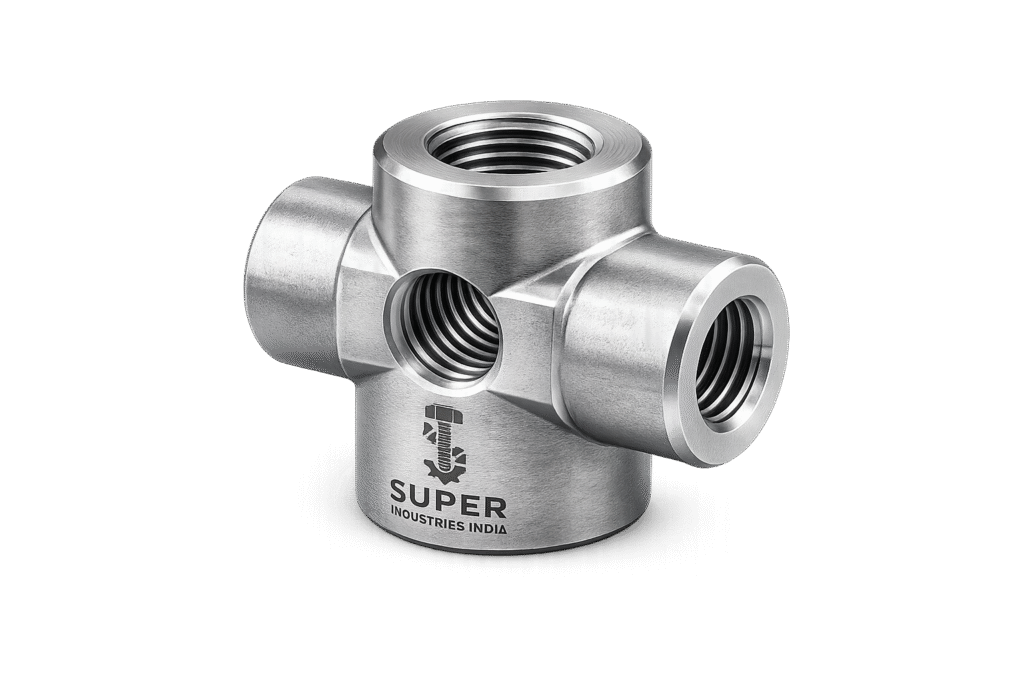
Cross Dowel Nuts function as transverse load-bearing internal threading elements within mechanically constrained assemblies. Unlike conventional hex nuts that operate along the same axis as the bolt, cross dowels enable perpendicular engagement, allowing fasteners to operate in orthogonal planes.
This configuration is particularly relevant in:
- Panel-to-panel structural connections
- Frame-to-member assemblies
- Confined joint geometries where rear access is restricted
- Knock-down systems requiring internal anchoring
The system typically consists of:
- A bolt (or connector screw) inserted axially
- A cross dowel nut embedded perpendicular to the bolt axis
- A host material (wood, composite, metal, or hybrid panel) acting as the load transfer medium
Application in Modular and Engineered Systems
Cross dowel systems are extensively used in:
Modular Construction Systems
- Pre-engineered structural panels
- Demountable building systems
- Containerized infrastructure modules
Industrial Furniture Systems
- Load-bearing cabinetry
- Workstations and technical enclosures
- Heavy-duty shelving systems
OEM & Equipment Assemblies
- Machine housings
- Access panels
- Structural frames
Heavy Equipment Enclosures
- Electrical control cabinets
- Acoustic enclosures
- Generator and compressor housings
Rail & Transport Interiors
- Seat mounting assemblies
- Panel fastening systems
- Interior modular frameworks
Pre-Engineered Buildings (PEB)
- Secondary structural connections
- Lightweight framing nodes
Why Cross Dowel Nuts Over Traditional Nut-Bolt Systems
Cross dowel nuts are selected in engineering designs where traditional through-bolt + hex nut systems are impractical due to geometry, accessibility, or assembly constraints.
Key Engineering Advantages
1. Alignment-Controlled Fastening
The perpendicular orientation ensures that the bolt engages precisely with the internal thread of the dowel, maintaining controlled alignment within tight tolerances.
2. Hidden / Flush Joint Capability
Cross dowels are embedded within the material, allowing:
- No external nut projection
- Clean external surfaces
- Reduced snagging or interference
3. High Strength in Confined Geometry
They provide:
- Effective load transfer in limited space
- Internal reinforcement without increasing external dimensions
4. Repeat Assembly / Disassembly Suitability
Unlike wood screws or direct tapping into softer materials:
- Threads are retained in the dowel (metallic)
- Reduced degradation over repeated cycles
5. Improved Load Distribution
The cylindrical body distributes load across:
- A larger bearing surface within the host material
- Reduced localized stress concentration
Super Industries
Global Manufacturer of Heavy & Custom Engineered Fasteners & Flanges
2. Technical Definition of Cross Dowel Nuts
Core Definition
A Cross Dowel Nut is a cylindrical, internally threaded fastener with a perpendicular (cross-drilled) threaded bore, designed to receive a mating bolt inserted at 90° to the dowel axis.
It is installed within a pre-drilled hole in the host component and aligned such that the bolt engages the internal thread.
Structural Characteristics
Primary Features:
- Cylindrical outer body
- Central threaded hole (cross-drilled)
- Optional alignment slot
- Precision-machined internal threads
Variants of Cross Dowel Nuts
A. Slotted Cross Dowel Nuts
- Feature: External slot along the length or at the end
- Purpose:
- Facilitates alignment using a screwdriver
- Enables rotational positioning of the internal thread axis
- Application:
- Field installations
- Manual assembly environments
B. Non-Slotted Cross Dowel Nuts
- Feature: No external slot
- Purpose:
- Higher structural integrity (no stress concentration from slot)
- Used where alignment fixtures or jigs are available
- Application:
- OEM manufacturing lines
- Precision assemblies
C. Through-Hole Cross Dowel Nuts
- Internal thread runs completely through the body
- Allows:
- Full bolt penetration
- Flexible engagement depth
D. Blind Cross Dowel Nuts
- Internal thread terminates before the outer surface
- Used when:
- Controlled bolt depth is required
- Over-penetration must be avoided
Threading Systems
Cross dowel nuts are manufactured in multiple thread standards depending on application and region:
Metric Threads (ISO)
- M5, M6, M8, M10, M12, etc.
- Used in:
- European and Asian systems
- Industrial machinery
- Modular construction
Unified Threads (UNC / UNF)
- Used in:
- North American systems
- Aerospace-adjacent assemblies
- Export-oriented designs
Alignment Slot Functionality
The alignment slot is a functional feature used to:
- Rotate the dowel inside the host hole
- Align the internal thread with the incoming bolt axis
- Enable visual and mechanical positioning
Improper alignment results in:
- Cross-threading
- Reduced engagement length
- Loss of preload integrity
3. Engineering & Load Transfer Principle
Overview of Load Mechanics
Cross dowel systems operate on a combination of:
- Axial clamping force (bolt-induced)
- Radial bearing stress (dowel-to-material interface)
- Shear transfer (across dowel body)
Axial Clamping Force Generation
When torque is applied to the bolt:
- The bolt advances into the internal thread of the cross dowel
- This generates preload (clamping force) between the joined components
This preload:
- Holds the joint together
- Prevents separation under tensile loading
- Enhances frictional resistance
Shear Load Transfer Mechanism
Shear loads are transferred through:
- The body of the cross dowel
- Contact between dowel outer surface and host material
Key aspects:
- The dowel acts as a shear pin
- Load is distributed along the cylindrical surface
- Reduced dependency on bolt shear strength
Thread Engagement Mechanics
Thread performance depends on:
- Engagement length
- Thread class (fit tolerance)
- Material hardness compatibility
Critical factors:
- Minimum thread engagement ≥ 1× bolt diameter (general guideline)
- Avoid mismatch in hardness (prevents galling or stripping)
Contact Surface Stress Distribution
The cylindrical geometry of the cross dowel:
- Increases contact area
- Reduces localized stress peaks
- Improves fatigue performance
Stress distribution occurs across:
- Entire embedded length
- Circumferential contact zone
Load Path in Cross Dowel Assemblies
Load Path Sequence:
- External load applied to assembly
- Load transferred to bolt
- Bolt transfers load to internal thread
- Internal thread transfers load to dowel body
- Dowel transfers load to surrounding material
Failure Modes in Cross Dowel Systems
1. Thread Stripping
- Cause:
- Insufficient engagement length
- Low material strength
- Prevention:
- Correct material selection
- Proper thread depth
2. Shear Failure of Dowel
- Occurs when transverse load exceeds shear capacity
- Mitigation:
- Larger diameter dowel
- Higher-grade material
3. Embedment Failure
- Crushing of surrounding material (common in wood/composites)
- Controlled by:
- Surface area
- Material density
4. Bolt Failure
- Tensile or fatigue failure under cyclic loading
- Addressed via:
- Proper preload
- Correct bolt grade
5. Misalignment-Induced Failure
- Improper alignment leads to:
- Uneven load distribution
- Reduced thread engagement
Bolt Preload vs Joint Integrity
Proper preload ensures:
- Joint stability
- Resistance to vibration loosening
- Uniform stress distribution
Under-preload results in:
- Joint slip
- Fatigue loading
Over-preload leads to:
- Thread damage
- Material yielding
Bearing Stress in Host Material
Bearing stress is a function of:
- Dowel diameter
- Applied load
- Material compressive strength
Design considerations:
- Larger dowel diameter reduces stress
- Material selection influences allowable load
Suitability for Repeated Assembly
Cross dowel nuts are suitable for:
- Knock-down structures
- Maintenance-access assemblies
Because:
- Threads are metallic (not in base material)
- Minimal wear across cycles (if properly lubricated)
4. Applicable Standards (ASTM / DIN / ISO / ASME)
Cross Dowel Nuts are not governed by a single universal dimensional standard; however, their design, material selection, threading, and performance expectations are derived from a combination of internationally accepted standards. For EPC and OEM procurement, compliance is evaluated based on how these standards are applied collectively.
DIN Standards (Dimensional & Functional Reference)
DIN 7965 (Cross Dowel / Barrel Nuts – Furniture & Structural Use)
Defines:
- General geometry of cross dowel nuts
- Dimensional relationships between:
- Outer diameter (OD)
- Length (L)
- Cross-hole alignment
- Functional configuration for panel-based assemblies
Used as a baseline reference for:
- Modular construction systems
- Industrial furniture assemblies
- Engineered panel joints
DIN 7979 (Dowel Pins – Reference for Cylindrical Fit & Tolerance)
While not specific to threaded dowels, it provides:
- Tolerance philosophy for cylindrical components
- Fitment classes (press fit / sliding fit)
- Surface finish expectations
Applied in:
- Outer diameter tolerance control of Cross Dowel Nuts
- Hole-to-dowel fitment precision
ISO Thread Standards
ISO 261 / ISO 262 – Metric Thread Series
Defines:
- Standard metric thread sizes (M5 to M20 and above)
- Coarse and fine pitch series
ISO 965 – Thread Tolerances
Defines:
- Thread classes (e.g., 6H internal thread)
- Fitment accuracy for bolt-dowel engagement
ASTM Material Standards
Material compliance is validated using ASTM specifications:
Carbon Steel
- ASTM A108 – Cold-finished carbon steel bars
- Controlled chemistry
- Uniform machinability
Stainless Steel
- ASTM A276 Type 304
- ASTM A276 Type 316
Defines:
- Corrosion resistance properties
- Mechanical strength ranges
- Chemical composition limits
Alloy Steel
- ASTM A29 / A322 (for alloy steel bars)
- Equivalent grades:
- EN19 (AISI 4140)
Used where:
- High strength
- Fatigue resistance
- Heat treatment compatibility are required
ASME Fastener Guidelines
Although Cross Dowel Nuts are not directly standardized under a single ASME fastener code, the following are relevant:
- ASME B1.1 / B1.13M – Thread systems
- ASME B18 series – General fastener engineering practices
These guide:
- Thread compatibility
- Torque-preload relationships
- Load-bearing design logic
Standard Mapping to Engineering Requirements
| Requirement | Applicable Standard | Relevance |
|---|---|---|
| Thread compatibility | ISO 261 / ISO 965 / ASME B1 | Ensures correct bolt engagement |
| Material strength | ASTM A108 / A276 / A29 | Defines load-bearing capability |
| Dimensional control | DIN 7965 / DIN 7979 | Ensures fitment and alignment |
| Structural safety | ASME guidelines | Load & preload design consistency |
| Corrosion performance | ASTM stainless standards | Environmental suitability |
5. Material & Grade Options for Cross Dowel Nuts
Material selection directly influences:
- Load capacity
- Wear resistance
- Corrosion resistance
- Service life
Carbon Steel Cross Dowel Nuts
Grades:
- ASTM A108
- EN8 / C45
Characteristics:
- Moderate to high strength
- Good machinability
- Suitable for heat treatment
- Economical for bulk applications
Limitations:
- Requires surface coating for corrosion protection
- Lower corrosion resistance compared to stainless steel
Typical Applications:
- Indoor structural assemblies
- Industrial furniture
- OEM equipment housings
Stainless Steel Cross Dowel Nuts
Grades:
- ASTM A276 Type 304
- ASTM A276 Type 316
Type 304
- Good corrosion resistance
- Suitable for humid environments
- Non-magnetic (in annealed condition)
Type 316
- Enhanced corrosion resistance
- Resistant to chlorides and marine exposure
- Suitable for chemical environments
Applications:
- Coastal infrastructure
- Food processing equipment
- Rail interiors
- Outdoor modular systems
Alloy Steel Cross Dowel Nuts
Grades:
- EN19
- AISI 4140
Characteristics:
- High tensile strength
- Excellent fatigue resistance
- Suitable for quenching & tempering
Applications:
- Heavy-duty structural systems
- Load-critical joints
- High vibration environments
Material Comparison Table
| Grade | Yield Strength (MPa) | Tensile Strength (MPa) | Hardness (HB/HRC) | Corrosion Resistance | Typical Industry Use |
|---|---|---|---|---|---|
| ASTM A108 (CS) | 350–550 | 600–800 | 140–220 HB | Low | Indoor structures, OEM assemblies |
| EN8 / C45 | 370–600 | 650–850 | 180–250 HB | Low | Industrial furniture, machinery |
| SS 304 | ~215 | ~505 | ≤ 201 HB | Moderate | General outdoor, humid conditions |
| SS 316 | ~205 | ~515 | ≤ 217 HB | High | Marine, chemical environments |
| EN19 / 4140 (Q&T) | 650–850 | 850–1000+ | 28–40 HRC | Moderate (coated) | High-load structural applications |
6. Heat Treatment of Cross Dowel Nuts
Heat treatment is applied to enhance:
- Strength
- Wear resistance
- Fatigue life
Case Hardening
Process:
- Carbon enrichment at surface layer
- Followed by quenching
Result:
- Hard outer surface (55–62 HRC)
- Tough inner core
Use Case:
- High wear environments
- Repeated assembly applications
Through Hardening
Process:
- Entire cross-section hardened uniformly
Hardness Range:
- Typically 28–40 HRC
Advantages:
- Uniform strength
- Higher load-bearing capacity
Quenching & Tempering (Q&T)
Applicable for alloy steels:
- Quenching increases hardness
- Tempering reduces brittleness
Outcome:
- Balanced strength and ductility
- Improved fatigue resistance
Stress Relieving
Performed after machining:
- Reduces residual stresses
- Prevents distortion during service
Heat Treatment Impact
| Property | Effect of Heat Treatment |
|---|---|
| Hardness | Increased |
| Wear resistance | Improved |
| Fatigue life | Enhanced |
| Dimensional stability | Controlled |
Manufacturing Process of Cross Dowel Nuts
Manufacturing is executed under controlled machining and inspection discipline to ensure dimensional precision and thread integrity.
Raw Material Inspection
- Chemical composition verification
- Visual and dimensional inspection
- Certification validation (Mill Test Certificate)
Bar Cutting
- Raw bars cut to required length
- Controlled tolerance on blank size
CNC Turning
- Outer diameter (OD) machining
- Face finishing
- Chamfering edges
Ensures:
- Cylindrical accuracy
- Surface finish consistency
Cross-Hole Drilling
- Perpendicular drilling operation
- Precision alignment with center axis
Critical factor:
- Positional tolerance of cross-hole
Internal Threading (Tapping)
- Metric or UNC/UNF threads
- Controlled tapping depth
- Thread gauge verification
Slot Machining (If Applicable)
- Slot width and depth controlled
- Ensures alignment tool compatibility
Heat Treatment
- As per material and application requirement
- Controlled furnace cycles
Surface Finishing
Applied post heat treatment:
- Zinc plating
- Black oxide
- Phosphate coating
- Passivation (SS)
Final Inspection
Includes:
- Dimensional checks
- Thread gauge testing
- Visual inspection
- Coating thickness measurement
Marking & Traceability
Where required:
- Batch marking
- Heat number traceability
- Inspection record linkage
7. Surface Finish Options for Cross Dowel Nuts
Surface treatment is selected based on environmental exposure and friction requirements.
Zinc Plating
- Thickness: 5–25 microns
- Provides corrosion resistance
- Common for indoor and mild outdoor use
Black Oxide
- Minimal dimensional change
- Provides mild corrosion resistance
- Suitable for controlled environments
Phosphate Coating
- Improves lubrication properties
- Acts as base for additional coatings
Nickel Plating
- Enhanced corrosion resistance
- Improved surface hardness
- Used in aesthetic + functional applications
Passivation (Stainless Steel)
- Removes free iron from surface
- Enhances corrosion resistance
Coating Selection Logic
| Environment | Recommended Finish |
|---|---|
| Indoor dry | Black oxide / Zinc |
| Humid | Zinc / Phosphate |
| Outdoor | Zinc (thick) / Nickel |
| Marine / chemical | SS316 + passivation |
A. Technical Dimension Tables (Reference Geometry for Cross Dowel Nuts)
Dimensional configuration of Cross Dowel Nuts is governed by functional alignment, load-bearing area, and compatibility with mating bolts. The following table represents standard engineering ranges used in EPC and OEM applications.
Standard Dimensions
| Thread Size | Outer Diameter (OD) mm | Length (L) mm | Cross Hole Diameter mm | Slot Type |
|---|---|---|---|---|
| M5 | 8–10 | 10–14 | 4.2–4.5 | Slotted / Plain |
| M6 | 10–12 | 12–16 | 5.0–5.3 | Slotted / Plain |
| M8 | 12–14 | 14–20 | 6.8–7.2 | Slotted / Plain |
| M10 | 14–16 | 16–25 | 8.5–9.0 | Slotted / Plain |
| M12 | 16–20 | 20–30 | 10.2–10.8 | Slotted / Plain |
Dimensional Engineering Notes
- Outer Diameter (OD):
- Determines bearing surface
- Influences embedment strength in host material
- Length (L):
- Governs contact area and load distribution
- Must align with panel thickness or structural member depth
- Cross Hole Diameter:
- Controls bolt clearance and thread engagement
- Must maintain positional tolerance within ±0.05 mm (typical)
- Slot Type:
- Slotted for field alignment
- Plain for high-integrity structural applications
B. Load Capacity Table for Cross Dowel Nuts
Load capacity depends on:
- Material grade
- Thread size
- Engagement length
- Host material properties
The following values are indicative for steel cross dowel nuts with standard engagement (≥1× diameter).
Tensile & Shear Capacity
| Thread Size | Tensile Load (kN) | Shear Load (kN) | Recommended Torque (Nm) |
|---|---|---|---|
| M5 | 4 – 6 | 3 – 4 | 5 – 8 |
| M6 | 6 – 10 | 5 – 7 | 8 – 12 |
| M8 | 12 – 18 | 10 – 14 | 18 – 25 |
| M10 | 20 – 30 | 18 – 24 | 35 – 50 |
| M12 | 35 – 50 | 30 – 40 | 60 – 80 |
Engineering Considerations
- Tensile values correspond to bolt preload transfer capacity
- Shear values correspond to dowel body resistance
- Actual performance must consider:
- Material grade
- Heat treatment condition
- Installation quality
C. Torque Chart
Torque values are critical for achieving correct preload without inducing thread damage or material yielding.
Torque Values (Dry vs Lubricated)
| Thread Size | Bolt Grade | Dry Torque (Nm) | Lubricated Torque (Nm) |
|---|---|---|---|
| M5 | 8.8 | 6 | 5 |
| M6 | 8.8 | 10 | 8 |
| M8 | 8.8 | 24 | 18 |
| M10 | 8.8 | 48 | 36 |
| M12 | 8.8 | 85 | 65 |
| M8 | 10.9 | 35 | 26 |
| M10 | 10.9 | 70 | 52 |
| M12 | 10.9 | 120 | 90 |
Torque Engineering Notes
- Lubrication reduces friction coefficient (K factor)
- Lower torque required for same preload under lubrication
- Over-torque risks:
- Thread stripping
- Dowel deformation
- Under-torque risks:
- Joint loosening
- Fatigue failure
D. Preload Calculation Guide
Bolt Preload Formula
![\[T = K \cdot F \cdot d\]](https://superindustriesindia.in/wp-content/ql-cache/quicklatex.com-637ae80de10d14a2f4d17cc6dfd9f1fa_l3.png "Rendered by QuickLaTeX.com")
Where:
- T = Applied Torque (Nm)
- K = Torque coefficient (0.18–0.25 typical)
- F = Preload force (N)
- d = Nominal bolt diameter (m)
Rearranged for Preload
![\[F = \frac{T}{K \cdot d}\]](https://superindustriesindia.in/wp-content/ql-cache/quicklatex.com-047c3812ff26cb229181955bd579e870_l3.png "Rendered by QuickLaTeX.com")
Sample Calculation (M8 Bolt, Grade 8.8)
Given:
- Torque (T) = 24 Nm
- K = 0.2
- Diameter (d) = 0.008 m
![\[F = \frac{24}{0.2 \times 0.008} = 15{,}000 \, \text{N}\]](https://superindustriesindia.in/wp-content/ql-cache/quicklatex.com-9670854e4981a4b1decb22035a4c71fe_l3.png "Rendered by QuickLaTeX.com")
Engineering Interpretation
- Preload of 15 kN ensures:
- Joint clamping integrity
- Resistance to separation
- Must remain below:
- Proof load of bolt
- Thread stripping limit of cross dowel
Joint Clamping Force Logic
- Higher preload increases frictional resistance
- Excess preload risks:
- Material crushing (in wood/composites)
- Thread damage
E. Mechanical Property Table
Typical mechanical properties based on material class and heat treatment.
Mechanical Properties
| Material Grade | Yield Strength (MPa) | Tensile Strength (MPa) | Hardness | Elongation (%) |
|---|---|---|---|---|
| Carbon Steel (C45) | 370 – 600 | 650 – 850 | 180 – 250 HB | 14 – 18 |
| SS 304 | ~215 | ~505 | ≤ 201 HB | 40 |
| SS 316 | ~205 | ~515 | ≤ 217 HB | 40 |
| Alloy Steel 4140 | 650 – 850 | 850 – 1000+ | 28 – 40 HRC | 12 – 16 |
F. Corrosion Resistance Comparison Table
Environmental performance of Cross Dowel Nuts varies significantly by material.
Corrosion Resistance Comparison
| Material | Humidity Resistance | Marine Environment | Chemical Exposure |
|---|---|---|---|
| Carbon Steel | Low | Poor | Poor |
| Zinc Plated Steel | Moderate | Limited | Low |
| SS 304 | Good | Moderate | Moderate |
| SS 316 | High | Excellent | High |
| Alloy Steel (Coated) | Moderate | Limited | Moderate |
8. Inspection & Quality Control Methods
Inspection of Cross Dowel Nuts follows a multi-stage verification process aligned with EPC and third-party inspection requirements.
Thread Gauge Inspection
- GO / NO-GO gauges as per ISO 1502
- Ensures:
- Thread pitch accuracy
- Proper engagement tolerance
Dimensional Inspection
Measured using:
- Vernier calipers
- Micrometers
- Coordinate Measuring Machines (CMM)
Parameters checked:
- Outer diameter (OD)
- Length (L)
- Cross-hole alignment
- Slot dimensions
Hardness Testing
Methods:
- Rockwell (HRC) for hardened materials
- Brinell (HB) for softer grades
Purpose:
- Verify heat treatment effectiveness
- Ensure wear resistance
PMI Testing (Positive Material Identification)
Used when required for:
- Critical EPC applications
- Stainless steel verification
Methods:
- XRF (X-ray fluorescence)
Surface Coating Thickness Testing
- Magnetic thickness gauges
- Micron-level verification
Ensures:
- Compliance with coating specifications
- Corrosion resistance performance
Visual Inspection
Checks for:
- Surface defects
- Burrs or sharp edges
- Plating uniformity
- Machining quality
Functional Fitment Testing
- Trial assembly with mating bolt
- Verification of:
- Smooth engagement
- Alignment accuracy
Third-Party Inspection (TPI)
Conducted by:
- Independent inspection agencies
Scope includes:
- Dimensional verification
- Material certification review
- Witness testing
Certification & Documentation
Supplied with:
- EN 10204 3.1 Certificate – Material test certificate
- EN 10204 3.2 Certificate – Third-party verified (if required)
Documentation includes:
- Heat number traceability
- Inspection reports
- Compliance declarations
9. Industries Served (Application-Specific Engineering Use Cases)
Cross Dowel Nuts are deployed in engineered assemblies where transverse fastening, internal anchoring, and repeatable disassembly are required. Their applicability spans multiple industries where structural integrity and dimensional precision are critical.
Modular Construction Systems
Used in:
- Prefabricated wall panels
- Demountable building structures
- Containerized infrastructure modules
Engineering Role:
- Provides internal fastening without external projections
- Enables rapid on-site assembly with controlled alignment
- Supports repeated installation cycles during relocation or modification
OEM Manufacturing
Used in:
- Machine frames
- Equipment housings
- Structural sub-assemblies
Engineering Role:
- Maintains consistent joint integrity in production environments
- Allows controlled torque application and repeatability
- Ensures compatibility with automated assembly processes
Industrial Furniture Systems (Commercial Scale)
Used in:
- Load-bearing cabinets
- Workstations and control desks
- Storage systems for industrial environments
Engineering Role:
- Provides high-strength joints in panel-based systems
- Supports knock-down (KD) configurations
- Maintains thread integrity across repeated assembly cycles
Rail & Transport Systems
Used in:
- Interior panel fastening
- Seat frame connections
- Modular structural elements
Engineering Role:
- Ensures vibration-resistant connections
- Maintains joint stability under cyclic loading
- Supports maintenance accessibility
Infrastructure Assemblies
Used in:
- Structural nodes in light frameworks
- Access panel mounting systems
- Equipment enclosures
Engineering Role:
- Enables fastening in confined geometries
- Supports alignment-critical installations
- Provides concealed fastening in exposed environments
Renewable Energy Structures
Used in:
- Solar panel support assemblies
- Electrical housing systems
- Modular energy equipment
Engineering Role:
- Ensures corrosion-resistant fastening (SS variants)
- Supports outdoor environmental exposure
- Maintains structural integrity under thermal variation
10. Export Capability & Global Supply
Super Industries supplies Cross Dowel Nuts to international markets under controlled manufacturing and documentation protocols aligned with EPC procurement standards.
Regions Served
- United States
- European Union
- Middle East (GCC countries)
- Southeast Asia
Supply is structured to meet:
- Regional thread standards (Metric / UNC / UNF)
- Project-specific specifications
- Inspection and certification requirements
Packaging Standards
Packaging is designed to prevent:
- Mechanical damage
- Surface degradation
- Moisture exposure
Standard Packaging Methods:
- Bulk packed in corrugated boxes with inner liners
- Palletized shipments with shrink wrapping
- Anti-corrosion protection (VCI paper / bags where required)
Export Documentation
Supplied documentation includes:
- Commercial Invoice
- Packing List
- Certificate of Origin
- Mill Test Certificates (EN 10204 3.1 / 3.2)
- Inspection Reports
- Coating Compliance Certificates
Bulk Supply Capability
- Production aligned with batch traceability
- Capability to support:
- Large EPC project quantities
- OEM repetitive demand cycles
- Controlled lead times based on:
- Material grade
- Heat treatment requirements
- Coating specifications
Project Logistics Support
- Coordination with freight forwarders
- Export-compliant packaging
- Documentation support for customs clearance
- Batch segregation for project traceability
11. Procurement & Installation View
This section provides a field-oriented engineering perspective for procurement teams, site engineers, and installation supervisors.
Selection Criteria for Cross Dowel Nuts
Procurement must consider:
- Thread size compatibility with bolt
- Material grade based on load and environment
- Surface finish based on corrosion exposure
- Dimensional tolerance requirements
- Compliance with project specifications
Alignment During Installation
Critical requirement:
- Cross-hole axis must align with bolt axis
Methods:
- Visual alignment using slot
- Use of alignment tools or jigs
Misalignment results in:
- Cross-threading
- Reduced engagement
- Load imbalance
Bolt Insertion Techniques
- Insert bolt through primary member
- Rotate cross dowel for alignment
- Engage threads manually before torque application
Ensure:
- Smooth thread engagement
- No forced tightening
Torque Tightening Sequence
- Apply torque gradually
- Use calibrated torque tools
- Follow recommended torque values (refer Part 3)
For multi-fastener systems:
- Use cross-tightening sequence
- Ensure uniform load distribution
Reusability Considerations
Cross Dowel Nuts support repeated use if:
- Threads are not damaged
- No deformation occurs
Recommended practices:
- Inspect threads before reuse
- Apply lubrication where required
- Avoid over-torque conditions
Field Inspection Checkpoints
During installation:
- Verify alignment
- Confirm torque values
- Check for surface damage
Post-installation:
- Ensure no loosening
- Confirm flush or concealed positioning
- Inspect for coating damage
Storage & Handling
Proper storage prevents degradation before installation.
Guidelines:
- Store in dry, covered environment
- Avoid direct exposure to moisture
- Maintain packaging integrity until use
- Segregate by material grade and size
12. Custom Engineering Capabilities
Super Industries provides Cross Dowel Nuts engineered for project-specific requirements beyond standard configurations.
Non-Standard Sizes
- Custom outer diameters
- Extended or reduced lengths
- Application-specific geometry
Custom Thread Types
- Fine pitch metric threads
- UNC / UNF threads
- Special thread tolerances
High-Strength Variants
- Alloy steel grades (EN19 / 4140)
- Heat-treated configurations
- Enhanced load-bearing capacity
Special Coatings
- Thick zinc plating
- Duplex coatings
- Nickel-based finishes
- Application-specific corrosion protection
OEM-Specific Designs
- Design integration with mating components
- Tolerance matching with assembly systems
- Controlled dimensional interfaces
Project-Specific Marking
- Batch identification
- Heat number marking
- Traceability coding
13. Technical Positioning & Engineering Conclusion
Cross Dowel Nuts represent a specialized fastening solution designed for structural systems where:
- Conventional nut-bolt arrangements are not feasible
- Alignment control is critical
- Concealed fastening is required
- Repeated assembly cycles are expected
From an engineering standpoint, their effectiveness is governed by:
- Correct material selection
- Controlled dimensional tolerances
- Proper preload application
- Accurate installation alignment
Engineering Validation Perspective
For EPC contractors, consultants, and inspection agencies, evaluation of Cross Dowel Nuts should confirm:
- Compliance with applicable material standards (ASTM / ISO)
- Thread accuracy and engagement reliability
- Load-bearing capability under tensile and shear conditions
- Surface treatment suitability for environment
- Availability of traceability and certification
Procurement Suitability Statement
When assessed against:
- Structural fastening requirements
- Modular assembly conditions
- Global compliance expectations
Cross Dowel Nuts manufactured under controlled processes and verified through inspection protocols meet the criteria for:
- EPC project supply
- OEM integration
- International export applications