
BARREL NUTS
Super Industries
“Global Manufacturer of Heavy & Custom Engineered Fasteners for Oil & Gas, Power & EPC Contractors.”
1. Industry Context & System Relevance of Barrel Nuts
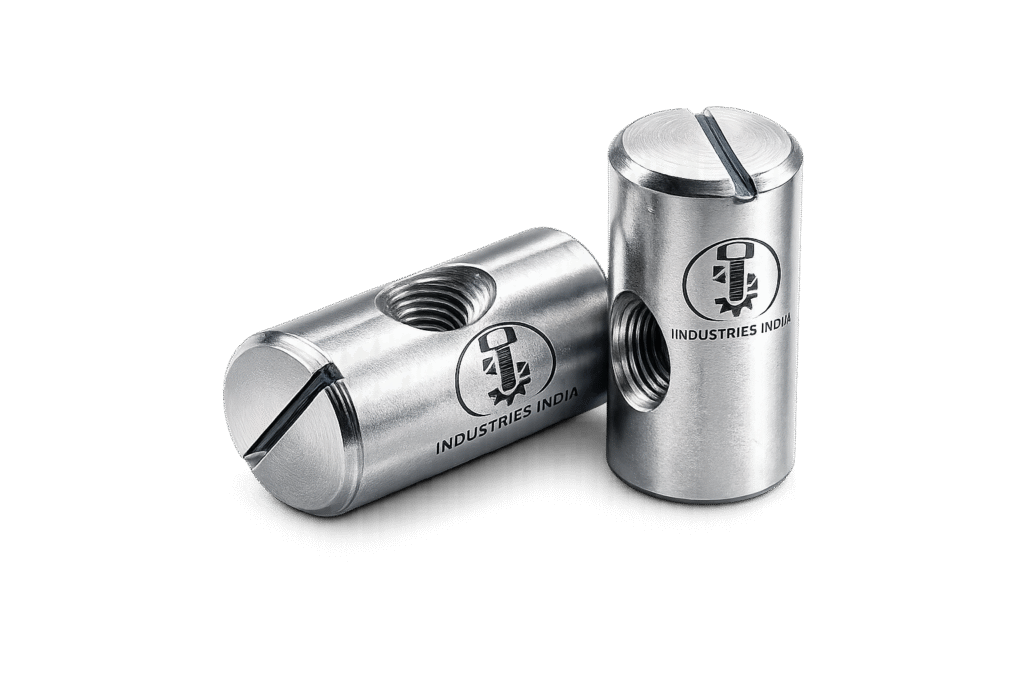
Barrel Nuts are specialized internal-threaded fastening elements used in assemblies where conventional nut-bolt systems are not geometrically feasible or do not meet structural or aesthetic constraints. Their application is centered on perpendicular fastening interfaces, hidden joint systems, and precision-aligned modular assemblies.
Role in Knock-Down (KD) Structures
In knock-down (KD) structures, repeated assembly and disassembly cycles require:
- Controlled thread engagement
- Minimal material degradation
- Consistent alignment across cycles
Barrel Nuts enable:
- Reusable threaded interfaces embedded within structural members
- Reduced wear compared to direct tapping in softer materials (e.g., wood, composites, aluminum)
- Controlled load transfer independent of base material thread strength
Application in Modular Assemblies
Modular systems demand:
- Interchangeability
- Field assembly without specialized tooling
- Predictable load paths
Barrel Nuts provide:
- Cross-axis fastening capability
- Self-contained internal threading within cylindrical geometry
- Compatibility with pre-drilled orthogonal holes
Typical modular applications include:
- Panel-to-frame connections
- Beam-to-post assemblies
- Equipment housing frameworks
Use in Furniture Systems & OEM Assemblies
Within engineered furniture and OEM product design:
- Aesthetic requirements eliminate exposed fasteners
- Material constraints limit direct threading
- Alignment tolerance is critical
Barrel Nuts are used because they:
- Enable concealed fastening
- Maintain structural integrity without external nut projections
- Provide repeatable assembly in mass production environments
Mechanical Enclosures & Structural Frames
For sheet metal enclosures and tubular frames:
- Internal fastening is often required in confined geometries
- Access for standard hex nuts is restricted
Barrel Nuts allow:
- Installation through access holes
- Perpendicular fastening across structural members
- Reduced assembly space requirements
Why Barrel Nuts Are Used Instead of Conventional Methods
Vs Direct Threading
| Parameter | Direct Threading | Barrel Nuts |
|---|---|---|
| Thread durability | Limited (material dependent) | High (independent insert) |
| Reusability | Low | High |
| Load capacity | Material-dependent | Controlled by fastener grade |
Vs Welded Joints
| Parameter | Welded Joint | Barrel Nut System |
|---|---|---|
| Disassembly | Not possible | Fully reversible |
| Heat distortion | Present | None |
| Field installation | Limited | Flexible |
Vs Standard Hex Nut Systems
| Parameter | Hex Nut | Barrel Nut |
|---|---|---|
| Space requirement | High | Minimal |
| Accessibility | Required from both sides | Single-side access |
| Aesthetic impact | Visible | Hidden |
Functional Advantages in Engineering Systems
Barrel Nuts are selected in design due to:
- Hidden fastening capability
- Precise axial alignment via cross-hole orientation
- Load distribution across cylindrical body
- Reduced eccentric loading
- Compatibility with automated assembly systems
2. Technical Definition of Barrel Nuts
Barrel Nuts are cylindrical internally threaded fasteners, typically machined or cold-formed, designed to receive a mating bolt from a perpendicular direction.
Core Characteristics
- Cylindrical external geometry
- Internal metric or unified thread
- Transverse (cross) hole for bolt engagement
- External slot, hex socket, or drive feature for alignment
Functional Mechanism
The system consists of:
- A Barrel Nut (cross dowel)
- A mating bolt or machine screw
The bolt enters through one component and threads into the Barrel Nut positioned orthogonally within another component.
Types of Barrel Nuts
Cross Dowel Barrel Nuts
- Standard cylindrical form
- Through cross-hole aligned with internal thread axis
- Used in structural KD joints
Slotted Barrel Nuts
- External slot provided for screwdriver alignment
- Enables rotational positioning during installation
- Common in furniture and enclosure assemblies
Hex Socket Barrel Nuts
- Internal hex for precise torque-controlled positioning
- Suitable for automated or controlled assembly environments
Offset Hole Barrel Nuts
- Thread axis offset from centerline
- Used where misalignment compensation is required
- Enables tolerance absorption in modular assemblies
Terminology
| Term | Definition |
|---|---|
| Cross Dowel | Barrel nut with transverse threaded bore |
| Engagement Axis | Direction of bolt insertion |
| Alignment Slot | Feature used to orient internal thread |
| Thread Axis | Axis along which internal thread is cut |
Super Industries
Global Manufacturer of Heavy & Custom Engineered Fasteners & Flanges
3. Engineering & Load Transfer Principle
Thread Engagement Mechanics
The primary load path is:
Bolt → Internal Thread → Barrel Nut Body → Parent Material
Key considerations:
- Thread engagement length must exceed minimum requirement to prevent stripping
- Load is distributed across engaged thread flanks
- Internal thread quality directly impacts joint strength
Shear vs Tensile Load Distribution
Tensile Load
- Generated by bolt preload
- Acts along bolt axis
- Resisted by thread engagement and bearing surface
Shear Load
- Occurs perpendicular to bolt axis
- Transferred via:
- Barrel nut body
- Contact surfaces between joined components
Bearing Stress on Parent Material
The cylindrical body of the Barrel Nut distributes load:
- Along outer surface in contact with drilled hole
- Reduces localized stress concentration
Critical factors:
- Hole tolerance
- Material strength of host component
- Contact area
Joint Clamping Mechanics
Clamping force is generated by bolt tightening:
- Axial force compresses components
- Friction between surfaces resists external loads
Factors affecting clamping:
- Torque applied
- Thread friction coefficient
- Surface finish
- Lubrication condition
Alignment & Tolerance Compensation
Barrel Nuts allow:
- Rotational adjustment for thread alignment
- Compensation for minor drilling inaccuracies
- Controlled engagement even under imperfect alignment conditions
Thread Engagement Length Theory
Minimum engagement length depends on:
- Bolt diameter (d)
- Material strength
- Thread type
General guideline:
- Steel-to-steel: 1.0 × diameter
- Steel-to-soft material interface: 1.5–2.0 × diameter
Pull-Out Resistance
Pull-out failure occurs when:
- Threads strip under axial load
Resistance depends on:
- Engagement length
- Material shear strength
- Thread profile accuracy
Joint Rigidity vs Flexibility
| Parameter | High Rigidity | Controlled Flexibility |
|---|---|---|
| Engagement length | High | Moderate |
| Material hardness | High | Medium |
| Application | Structural frames | Modular systems |
Failure Modes
Thread Stripping
- Cause: insufficient engagement or low material strength
- Prevention: proper engagement length and material selection
Shear Failure
- Occurs at barrel body or bolt shank
- Controlled by material grade and diameter
Misalignment Failure
- Cross-threading
- Partial engagement
- Uneven load distribution
Bearing Failure
- Deformation of parent material
- Occurs under high compressive loads
Engineering Summary
Barrel Nuts function as:
- Internal load transfer nodes
- Alignment-controlled fastening elements
- Reusable threaded interfaces in modular systems
Their performance is governed by:
- Thread engagement integrity
- Material strength
- Dimensional accuracy
- Installation precision
4. Applicable Standards (ASTM / DIN / ISO / ASME)
Barrel Nuts, while often application-specific and custom-engineered, are governed by a combination of material standards, thread standards, and general dimensional practices. No single universal standard fully defines all Barrel Nut geometries; therefore, compliance is established through mapped standards integration.
Thread Standards
ISO Metric Threads
- ISO 261 – General plan for metric screw threads
- ISO 965 – Tolerances and fits for metric threads
Application:
- M4 to M16 Barrel Nuts (standard range)
- Used in global EPC and OEM assemblies
Unified Thread Standards
- ASME B1.1 – Unified Inch Screw Threads (UNC/UNF)
Application:
- US-based equipment
- Oil & gas skid systems
- Export to North America
Material Standards (ASTM)
Material selection for Barrel Nuts follows ASTM specifications to ensure:
- Mechanical consistency
- Traceability
- Inspection compliance
Carbon Steel
- ASTM A29 / A29M – General requirements for carbon steel bars
- ASTM A108 – Cold-finished carbon steel bars
Alloy Steel
- ASTM A322 – Alloy steel bars for high-strength applications
Stainless Steel
- ASTM A276 – Stainless steel bars and shapes
- ASTM A479 – Stainless steel bars for pressure applications
DIN References (Contextual Application)
Although no direct DIN standard defines Barrel Nuts universally, the following references are applied:
- DIN 7979 – Cylindrical pins (reference for precision cylindrical geometry)
- DIN practices for tolerances and fits are used for:
- OD tolerance
- Concentricity
- Cross-hole positioning
Fit & Tolerance Standards
- ISO 286 – Limits and fits (shaft-hole system)
- ISO 1101 – Geometrical tolerancing
Applied for:
- Barrel outer diameter vs drilled hole
- Concentricity between OD and internal thread
- Cross-hole alignment accuracy
Export Compliance Mapping
| Region | Standard Preference | Thread System |
|---|---|---|
| Europe | ISO / DIN | Metric |
| USA | ASTM / ASME | UNC / UNF |
| Middle East | ASTM + ISO | Mixed |
| Southeast Asia | ISO | Metric |
5. Material & Grade Options for Barrel Nuts
Material selection defines:
- Load capacity
- Wear resistance
- Corrosion performance
- Thread life
Carbon Steel Barrel Nuts
Low Carbon Steel (C15 / C20)
Characteristics:
- Moderate strength
- Good machinability
- Suitable for case hardening
Applications:
- Furniture systems
- Light modular assemblies
- Non-structural joints
Medium Carbon Steel
Characteristics:
- Higher strength than low carbon steel
- Suitable for quenching and tempering
Applications:
- Industrial assemblies
- Structural KD joints
- Machinery enclosures
Stainless Steel Barrel Nuts
AISI 304
- Austenitic stainless steel
- Good corrosion resistance
- Non-magnetic (annealed condition)
Applications:
- Indoor industrial environments
- Humid conditions
- Food-grade equipment (non-critical)
AISI 316
- Enhanced corrosion resistance due to molybdenum content
- Suitable for aggressive environments
Applications:
- Marine exposure
- Chemical plants
- Offshore modular systems
Alloy Steel Barrel Nuts
Used where:
- High preload is required
- High fatigue resistance is critical
Characteristics:
- High tensile strength
- Heat treatable
- Suitable for demanding mechanical applications
Applications:
- Structural frames
- Equipment subjected to cyclic loading
- High-strength modular systems
Material Selection Considerations
| Parameter | Carbon Steel | Stainless Steel | Alloy Steel |
|---|---|---|---|
| Strength | Moderate | Moderate | High |
| Corrosion Resistance | Low | High | Moderate |
| Cost | Lower | Higher | Higher |
| Machinability | High | Moderate | Moderate |
Mandatory Material Comparison Table
| Grade | Yield Strength (MPa) | Tensile Strength (MPa) | Hardness (HRC) | Corrosion Resistance | Typical Application |
|---|---|---|---|---|---|
| C15 / C20 | 250–350 | 400–500 | 10–20 (pre-HT) | Low | Furniture, light assemblies |
| Medium Carbon Steel | 400–600 | 600–800 | 20–30 | Low | Structural KD systems |
| Alloy Steel (Q&T) | 700–1100 | 900–1300 | 28–40 | Moderate | High-load joints |
| AISI 304 | 215–300 | 500–700 | 15–25 | High | Indoor, humid |
| AISI 316 | 220–300 | 500–700 | 15–25 | Very High | Marine, chemical |
6. Heat Treatment of Barrel Nuts
Heat treatment is applied based on:
- Load requirements
- Wear resistance
- Thread durability
Case Hardening (Carburizing)
Process:
- Surface carbon enrichment followed by quenching
Result:
- Hard outer layer
- Tough core
Typical hardness:
- Surface: 55–62 HRC
- Core: 20–30 HRC
Application:
- Barrel Nuts subjected to repeated assembly/disassembly
Through Hardening
Process:
- Heating followed by quenching and tempering
Result:
- Uniform hardness throughout cross-section
Hardness range:
- 28–40 HRC
Application:
- Structural load-bearing Barrel Nuts
Quenching & Tempering (Q&T)
Applied to alloy steels:
- Improves toughness
- Enhances fatigue resistance
Stress Relieving
Used after machining:
- Reduces internal stresses
- Improves dimensional stability
Heat Treatment Impact on Performance
| Property | Effect of Heat Treatment |
|---|---|
| Thread wear resistance | Increased |
| Load capacity | Increased |
| Brittleness | Controlled via tempering |
| Fatigue life | Improved |
Manufacturing Process of Barrel Nuts
Production of Barrel Nuts requires controlled machining to maintain:
- Thread alignment
- Cross-hole precision
- Surface integrity
Raw Material Selection
- Certified bars as per ASTM standards
- Chemical composition verification
- Traceability maintained
Bar Cutting
- Cut to required blank length
- Tolerance maintained for machining allowance
CNC Turning
Operations:
- Outer diameter (OD) machining
- Face finishing
- Chamfering
Critical controls:
- OD tolerance (typically ±0.01–0.03 mm)
- Surface finish
Cross Hole Drilling
- Precision drilling perpendicular to axis
- Alignment critical for bolt engagement
Control parameters:
- Positional tolerance
- Diameter accuracy
- Burr minimization
Internal Threading (Tapping)
- Metric or UNC/UNF threads
- Controlled via tapping or thread milling
Inspection:
- GO / NO-GO gauges
- Thread pitch accuracy
Slotting / Hex Socket Machining
Depending on design:
- Slotted head (milling or broaching)
- Hex socket (broaching)
Purpose:
- Alignment during installation
- Torque-controlled positioning
Heat Treatment (If Applicable)
- Batch or continuous furnace
- Controlled atmosphere
Post-process:
- Hardness verification
- Distortion control
Surface Finishing
Applied after heat treatment:
- Coating selection based on application
- Thickness control critical
Final Inspection
Includes:
- Dimensional verification
- Thread inspection
- Surface quality check
- Coating thickness
Marking & Traceability
Where applicable:
- Batch marking
- Heat number traceability
- Inspection records
Surface Finish Options for Barrel Nuts
Surface finish affects:
- Corrosion resistance
- Friction behavior
- Assembly torque
Zinc Plating
- Electroplated coating
- Typical thickness: 5–25 microns
Advantages:
- Basic corrosion protection
- Cost-effective
Limitations:
- Not suitable for aggressive environments
Black Oxide
- Conversion coating
- Minimal dimensional impact
Advantages:
- Uniform appearance
- Low friction
Limitations:
- Limited corrosion resistance (requires oil)
Nickel Plating
- Decorative and protective coating
Advantages:
- Improved corrosion resistance
- Smooth surface finish
Phosphate Coating
- Used for oil retention
Advantages:
- Improved lubrication
- Suitable for assembly applications
Passivation (Stainless Steel)
- Chemical treatment
Purpose:
- Removes free iron
- Enhances corrosion resistance
Surface Finish Comparison
| Finish | Corrosion Resistance | Friction Impact | Typical Use |
|---|---|---|---|
| Zinc Plating | Moderate | Medium | General industrial |
| Black Oxide | Low | Low | Indoor applications |
| Nickel Plating | High | Low | Decorative + industrial |
| Phosphate | Moderate | Low | Assembly lubrication |
| Passivation | High | Low | Stainless steel |
Engineering Considerations
- Coating thickness affects thread fit
- Friction coefficient influences torque-preload relationship
- Hydrogen embrittlement risk (for high-strength steels) must be controlled
A. Technical Dimension Tables for Barrel Nuts
Dimensional configuration of Barrel Nuts is governed by:
- Thread size
- Outer diameter (OD)
- Length (L)
- Cross-hole diameter (d₁)
- Installation compatibility with mating bolt
The following table represents typical engineering proportions used in EPC and OEM applications. Final dimensions remain drawing-controlled.
Standard Metric Barrel Nuts Dimension Table
| Thread Size | Outer Diameter (OD) mm | Length (L) mm | Cross Hole Diameter (d₁) mm | Recommended Bolt Size |
|---|---|---|---|---|
| M4 | 6–8 | 10–12 | 4.2–4.5 | M4 |
| M5 | 8–10 | 12–14 | 5.2–5.5 | M5 |
| M6 | 10–12 | 14–18 | 6.2–6.5 | M6 |
| M8 | 12–14 | 18–22 | 8.2–8.5 | M8 |
| M10 | 14–18 | 20–25 | 10.2–10.5 | M10 |
| M12 | 18–22 | 25–30 | 12.2–12.5 | M12 |
| M16 | 22–28 | 30–40 | 16.2–16.5 | M16 |
Dimensional Engineering Notes
- OD tolerance: Typically H8 / H9 depending on fit requirement
- Cross-hole positional tolerance: ≤ ±0.05 mm (critical for alignment)
- Thread tolerance: ISO 6H (metric) / 2B (UNC/UNF)
- Chamfering: Required to assist bolt entry
Concentricity & Alignment Requirements
| Parameter | Typical Requirement |
|---|---|
| OD to thread concentricity | ≤ 0.05 mm |
| Cross-hole perpendicularity | ≤ 0.1 mm / 100 mm |
| Slot alignment with thread axis | Mandatory |
Misalignment directly affects:
- Thread engagement efficiency
- Load distribution
- Assembly ease
B. Load Capacity Table for Barrel Nuts
Load capacity is influenced by:
- Thread size
- Material grade
- Engagement length
- Heat treatment condition
Typical Load Capacity (Steel Barrel Nuts)
| Thread Size | Tensile Load Capacity (kN) | Shear Load Capacity (kN) | Recommended Safety Factor |
|---|---|---|---|
| M4 | 3–5 | 2–3 | 2.5–3 |
| M5 | 5–7 | 3–4 | 2.5–3 |
| M6 | 8–12 | 5–7 | 2–3 |
| M8 | 15–22 | 10–14 | 2–3 |
| M10 | 25–35 | 18–25 | 2–3 |
| M12 | 40–55 | 30–40 | 2–3 |
| M16 | 70–100 | 50–70 | 2–3 |
Engineering Interpretation
- Tensile capacity is governed by thread stripping strength
- Shear capacity depends on:
- Barrel body cross-section
- Bolt diameter
- Safety factor depends on:
- Application criticality
- Dynamic vs static loading
Combined Loading Consideration
In real applications:
- Loads are rarely purely axial or shear
- Combined loading must satisfy:
![\[\left(\frac{F_t}{F_{\text{allow}}}\right)^2 + \left(\frac{F_s}{F_{\text{allow}}}\right)^2 \leq 1\]](https://superindustriesindia.in/wp-content/ql-cache/quicklatex.com-b0830429f7b8a32b36db89b92be876b9_l3.png "Rendered by QuickLaTeX.com")
Where:
- (F_t) = applied tensile load
- (F_s) = applied shear load
C. Torque Chart for Barrel Nut Assemblies (MANDATORY)
Torque is applied to the mating bolt, not the Barrel Nut directly.
Torque–Preload Relationship
![\[T = K \cdot F \cdot d\]](https://superindustriesindia.in/wp-content/ql-cache/quicklatex.com-637ae80de10d14a2f4d17cc6dfd9f1fa_l3.png "Rendered by QuickLaTeX.com")
Where:
- (T) = tightening torque (Nm)
- (K) = friction factor (0.15–0.25)
- (F) = preload (N)
- (d) = nominal bolt diameter (m)
Recommended Torque Values (Carbon Steel Bolts – Property Class 8.8)
| Thread Size | Torque (Nm) – Dry | Torque (Nm) – Lubricated |
|---|---|---|
| M4 | 2.5–3.5 | 2–3 |
| M5 | 5–7 | 4–6 |
| M6 | 9–12 | 7–10 |
| M8 | 22–30 | 18–25 |
| M10 | 45–60 | 35–50 |
| M12 | 75–100 | 60–85 |
| M16 | 180–240 | 140–200 |
Torque Engineering Notes
- Lubrication reduces friction → increases preload at same torque
- Over-torque leads to:
- Thread stripping
- Barrel deformation
- Under-torque leads to:
- Joint loosening
- Reduced clamping force
D. Preload & Joint Calculation Guide (MANDATORY)
Preload Determination
![\[F = \frac{T}{K \cdot d}\]](https://superindustriesindia.in/wp-content/ql-cache/quicklatex.com-047c3812ff26cb229181955bd579e870_l3.png "Rendered by QuickLaTeX.com")
Used to estimate preload generated in the joint.
Thread Engagement Requirement
Minimum engagement length:
![\[L_e \geq 1.0 \times d \quad (\text{steel-to-steel})\]](https://superindustriesindia.in/wp-content/ql-cache/quicklatex.com-9d65349d109cbe022716068b49045d44_l3.png "Rendered by QuickLaTeX.com")
![\[L_e \geq 1.5 \text{ to } 2.0 \times d \quad (\text{soft materials})\]](https://superindustriesindia.in/wp-content/ql-cache/quicklatex.com-15c162551dd8dc7f8977bc2d87926727_l3.png "Rendered by QuickLaTeX.com")
Sample Engineering Calculation
Given:
- Bolt size: M8
- Torque applied: 25 Nm
- Friction factor: 0.2
- Diameter: 0.008 m
Calculation:
![\[F = \frac{25}{0.2 \times 0.008} = 15{,}625 \, \text{N}\]](https://superindustriesindia.in/wp-content/ql-cache/quicklatex.com-c5886b2d9ed15e43ebd67e7862f4d63e_l3.png "Rendered by QuickLaTeX.com")
Interpretation:
- Preload ≈ 15.6 kN
- Must be within allowable thread capacity of Barrel Nut
Joint Design Considerations
| Parameter | Impact |
|---|---|
| Higher preload | Increased rigidity |
| Excess preload | Thread damage risk |
| Low preload | Joint loosening |
Thread Stripping Check
Thread shear area:
![\[A_s = \pi \cdot d \cdot L_e\]](https://superindustriesindia.in/wp-content/ql-cache/quicklatex.com-b9f557b372ac5d0d6bec8cc3182e7221_l3.png "Rendered by QuickLaTeX.com")
Allowable load:
![\[F_{\text{allow}} = A_s \cdot \tau_{\text{material}}\]](https://superindustriesindia.in/wp-content/ql-cache/quicklatex.com-5a54bc026cbe6887a5446aa4c65065fa_l3.png "Rendered by QuickLaTeX.com")
E. Mechanical Property Table
Typical Mechanical Properties of Barrel Nut Materials
| Material | Yield Strength (MPa) | Tensile Strength (MPa) | Hardness (HRC) | Elongation (%) |
|---|---|---|---|---|
| Low Carbon Steel | 250–350 | 400–500 | 10–20 | 20–30 |
| Medium Carbon Steel | 400–600 | 600–800 | 20–30 | 15–25 |
| Alloy Steel (Q&T) | 700–1100 | 900–1300 | 28–40 | 10–18 |
| SS304 | 215–300 | 500–700 | 15–25 | 35–45 |
| SS316 | 220–300 | 500–700 | 15–25 | 30–40 |
Engineering Observations
- Higher hardness improves wear resistance
- Higher elongation improves ductility
- Alloy steel provides best load performance
F. Corrosion Resistance Table
Environmental Performance Comparison
| Material | Indoor | Humid | Industrial | Marine |
|---|---|---|---|---|
| Carbon Steel (Plated) | Good | Moderate | Moderate | Poor |
| SS304 | Excellent | Excellent | Good | Moderate |
| SS316 | Excellent | Excellent | Excellent | Excellent |
Selection Logic
- Indoor systems → Carbon steel (zinc plated)
- Humid environments → SS304
- Marine / chemical → SS316
7. Inspection & Quality Control Methods
Quality assurance for Barrel Nuts is structured to meet:
- EPC documentation requirements
- Third-party inspection readiness
- International supply chain compliance
Thread Inspection
- GO / NO-GO gauges (ISO / ASME compliant)
- Thread pitch verification
- Surface finish inspection
Dimensional Inspection
Measured parameters:
- Outer diameter
- Length
- Cross-hole diameter
- Concentricity
- Perpendicularity
Tools:
- Vernier calipers
- Micrometers
- CMM (Coordinate Measuring Machine)
Hardness Testing
Methods:
- Rockwell hardness test (HRC)
- Microhardness (case depth verification)
Surface Coating Inspection
- Coating thickness measurement (microns)
- Adhesion testing
- Visual inspection for uniformity
Salt Spray Testing
- Conducted as per ASTM B117
- Evaluates corrosion resistance performance
PMI (Positive Material Identification)
Used for:
- Stainless steel verification
- Alloy composition confirmation
Methods:
- XRF analysis
Third-Party Inspection
Inspection agencies:
- Independent third-party bodies (as per project requirement)
Includes:
- Witness inspection
- Batch verification
- Documentation validation
Certification
| Certificate Type | Description |
|---|---|
| EN 10204 3.1 | Manufacturer test certificate |
| EN 10204 3.2 | Third-party verified certificate |
Traceability System
Maintained through:
- Heat number tracking
- Batch identification
- Inspection records
Inspection Summary
Quality control ensures:
- Dimensional accuracy
- Thread integrity
- Material compliance
- Coating performance
8. Industries Served by Barrel Nuts
Barrel Nuts are deployed across multiple engineering sectors where perpendicular fastening, concealed joints, and repeatable assembly cycles are required. Their selection is typically driven by design constraints, space limitations, and joint serviceability requirements.
Modular Furniture Systems
Engineering requirements:
- Repeated assembly/disassembly cycles
- Controlled alignment across panels
- Concealed fastening interfaces
Application of Barrel Nuts:
- Panel-to-panel joints
- Frame connectors
- Structural furniture modules
Design considerations:
- Use of low to medium carbon steel or stainless steel
- Case-hardened threads for wear resistance
- Slotted or hex-drive alignment features
OEM Equipment Manufacturing
Typical systems:
- Industrial equipment housings
- Machine frames
- Sub-assembly modules
Engineering requirements:
- Controlled preload
- Limited installation space
- Maintenance accessibility
Barrel Nuts enable:
- Internal fastening without external projections
- Reduced assembly footprint
- Modular component replacement
Construction & Prefabricated Systems
Applications:
- Prefabricated structural modules
- Light structural frames
- Panelized construction systems
Engineering requirements:
- Site assembly under constrained conditions
- Alignment tolerance compensation
- Reusability during transport and installation
Barrel Nuts are used for:
- Cross-member fastening
- Modular frame connections
- Temporary structural assemblies
Automotive Interior Systems
Applications:
- Seat structures (non-critical joints)
- Interior panels
- Modular dashboard assemblies
Engineering requirements:
- Lightweight fastening systems
- Hidden joints for aesthetics
- Controlled torque application
Material selection:
- Low carbon steel (coated)
- Stainless steel for corrosion-prone environments
Aerospace Interior Applications (Non-Critical Fastening)
Applications:
- Cabin interiors
- Panel mounting systems
- Modular interior assemblies
Requirements:
- Weight optimization
- Corrosion resistance
- Precision alignment
Barrel Nuts are used only in:
- Non-load-critical applications
- Secondary fastening systems
Electrical Enclosures
Applications:
- Control panels
- Switchgear housings
- Instrumentation enclosures
Engineering requirements:
- Compact fastening
- Accessibility from limited directions
- Electrical grounding considerations
Barrel Nuts provide:
- Internal fastening capability
- Reduced protrusion
- Compatibility with sheet metal structures
Industrial Machinery
Applications:
- Machine guards
- Equipment frames
- Access panels
Engineering requirements:
- Frequent maintenance access
- Repeatable fastening
- Resistance to vibration-induced loosening
9. Export Capability & Global Supply
Super Industries operates as a manufacturer and exporter of Barrel Nuts with alignment to EPC procurement standards and international supply chain requirements.
Export Regions
Supply capability includes:
- United States
- European Union
- Middle East (GCC countries)
- Southeast Asia
Thread & Standard Compatibility
| Region | Thread Standard | Compliance |
|---|---|---|
| USA | UNC / UNF | ASME B1.1 |
| Europe | Metric | ISO / DIN |
| Middle East | Mixed | ASTM + ISO |
| Asia | Metric | ISO |
Packaging Standards
Packaging is defined based on:
- Shipment mode
- Product size
- Project requirements
Bulk Packaging
- HDPE bags + corrugated cartons
- Palletized loads
- Moisture protection included
Kit-Based Packaging
- Pre-counted sets (Barrel Nut + Bolt combinations)
- Labeled for assembly identification
- Used in modular and OEM supply
Export Documentation
Provided as per project requirements:
- Commercial Invoice
- Packing List
- Certificate of Origin
- EN 10204 3.1 / 3.2 Test Certificates
- Inspection Reports
- Coating compliance reports
Logistics Handling
- Sea freight (FCL / LCL)
- Air freight for urgent supply
- Containerized pallet shipment
Handling considerations:
- Corrosion protection during transit
- Impact protection for machined components
- Batch traceability maintained
10. Procurement & Installation View
Engineering Procurement Considerations
When evaluating Barrel Nuts for EPC or OEM applications, procurement teams assess:
- Material grade compliance
- Thread standard compatibility
- Dimensional tolerance capability
- Coating specification
- Inspection documentation
Technical Evaluation Checklist
| Parameter | Requirement |
|---|---|
| Thread class | ISO 6H / ASME 2B |
| Material certification | ASTM compliant |
| Heat treatment | Verified (if applicable) |
| Coating thickness | Specified range |
| Inspection records | Available |
Supplier Qualification Criteria
- Manufacturing capability (CNC precision)
- Inspection infrastructure
- Traceability system
- Export documentation readiness
11. Installation Practices for Barrel Nuts
Pre-Installation Preparation
- Verify hole diameter and alignment
- Ensure burr-free drilled holes
- Confirm correct Barrel Nut orientation
Alignment During Installation
- Use slot or hex drive for positioning
- Align internal thread axis with bolt path
- Avoid forced insertion
Bolt Insertion Sequence
- Insert Barrel Nut into cross hole
- Align thread axis using slot/drive
- Insert bolt through mating component
- Engage threads manually before torque application
Torque Application
- Apply torque using calibrated tools
- Follow recommended torque values (Part 3)
- Avoid impact tightening
Reusability Considerations
Barrel Nuts support multiple cycles provided:
- Threads are not damaged
- Coating integrity is maintained
- No deformation occurs
Field Inspection Checkpoints
- Thread engagement completeness
- Proper seating of Barrel Nut
- Absence of misalignment
- Torque verification
Storage Conditions
- Dry environment
- Protection from moisture
- Segregation by size and grade
- Preservation of coating integrity
12. Custom Engineering Capabilities
Super Industries manufactures Barrel Nuts based on application-specific engineering requirements.
Dimensional Customization
- Non-standard outer diameters
- Extended or reduced lengths
- Tight tolerance machining
Thread Customization
- Metric (fine/coarse)
- UNC / UNF
- Special pitch threads
Functional Design Variants
- Offset hole Barrel Nuts
- Double-threaded configurations
- Blind-end Barrel Nuts
Material Customization
- High-strength alloy steels
- Corrosion-resistant stainless grades
- Application-specific metallurgical requirements
Surface Engineering
- Specialized coatings
- Anti-galling treatments
- Low-friction coatings for controlled torque
OEM-Specific Development
- Drawing-based manufacturing
- Prototype development
- Batch validation and testing
- Integration with assembly systems
13. Engineering Conclusion
Barrel Nuts function as precision internal fastening elements designed for perpendicular joint systems where:
- Conventional nut access is restricted
- Joint disassembly is required
- Alignment accuracy is critical
Their performance is governed by:
- Thread engagement mechanics
- Material strength and heat treatment
- Dimensional accuracy and concentricity
- Proper torque-controlled installation
From an EPC and OEM perspective, Barrel Nuts are evaluated based on:
- Compliance with international standards
- Manufacturing precision
- Load-bearing capability
- Inspection and traceability systems
Super Industries manufactures Barrel Nuts aligned with:
- ASTM material standards
- ISO / ASME thread systems
- Controlled machining and inspection processes
- Export-compliant documentation practices
This ensures suitability for:
- Technical bid evaluation
- Consultant review
- Third-party inspection
- Global project supply