
Hydraulic Male Stud Couplings
Hydraulic Male Stud Couplings – Design, Types, Threads, Sealing & Applications
Super Industries
“Global Manufacturer of Heavy & Custom Engineered Fasteners for Oil & Gas, Power & EPC Contractors.”
Introduction
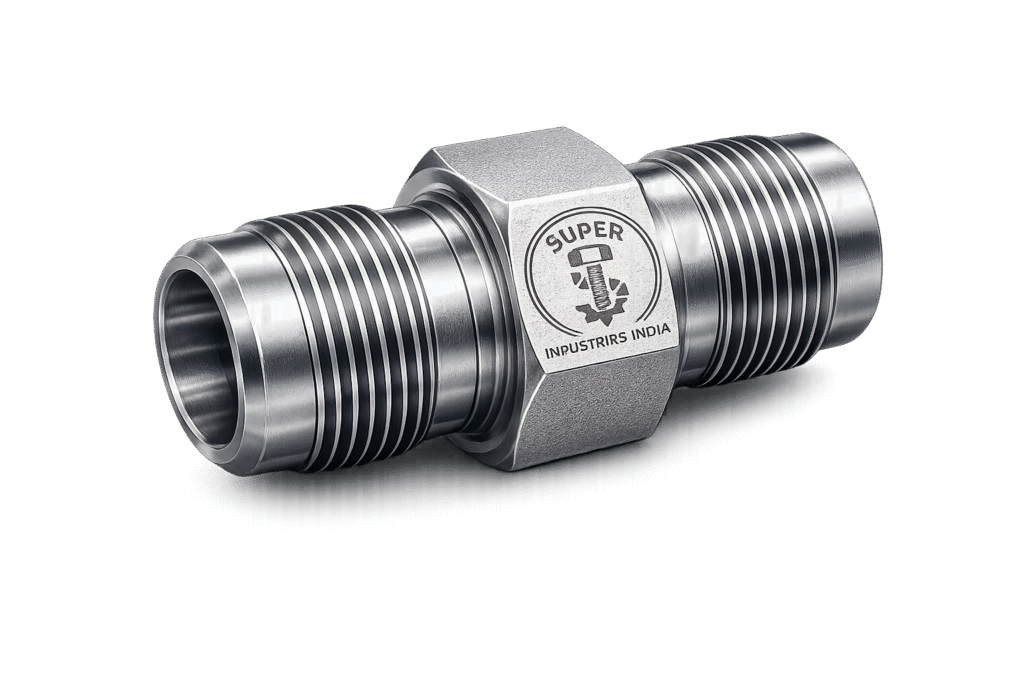
Hydraulic Male Stud Couplings are among the most commonly used connection fittings in hydraulic systems. They are designed to connect hoses, tubes, or pipes to hydraulic components such as valves, pumps, cylinders, manifolds, and power packs. Because these connections often operate under high pressure and vibration, male stud couplings must be precisely engineered to ensure leak-free and durable performance.
In this article, we explore hydraulic male stud couplings in complete technical detail—covering their design, thread standards, sealing methods, materials, pressure ratings, applications, and selection criteria. This page builds directly on the previous posts and sets the base for all stud-type hydraulic fittings.
Super Industries
Global Manufacturer of Heavy & Custom Engineered Fasteners & Flanges
What Is a Hydraulic Male Stud Coupling?
A hydraulic male stud coupling is a fitting with:
- A male threaded end that screws into a port or female fitting
- A connection end that joins to a hose, pipe, or tube
The male threaded portion is designed to engage directly with:
- Female ports
- Manifold blocks
- Hydraulic equipment housings
The sealing is achieved either through:
- Metal-to-metal contact
- O-ring sealing
- Tapered thread interference
Primary Function of Male Stud Couplings
The core functions of hydraulic male stud couplings include:
- Providing a secure mechanical connection
- Maintaining pressure integrity
- Ensuring leak-free fluid transfer
- Allowing easy installation and maintenance
Because they connect hydraulic lines directly to equipment ports, male stud couplings are often exposed to:
- High pressure
- Temperature variations
- Mechanical stress
- Vibration
Basic Construction of a Male Stud Coupling
A standard hydraulic male stud coupling consists of the following parts:
1️⃣ Male Threaded Stud
This portion screws into the hydraulic port. The thread type determines compatibility and sealing.
2️⃣ Hex Section
Allows tightening using spanners or torque tools.
3️⃣ Sealing Area
Can be a cone seat, O-ring groove, or tapered thread section.
4️⃣ Connection End
Used to connect hose fittings, compression fittings, or tube assemblies.
Types of Hydraulic Male Stud Couplings
Hydraulic male stud couplings are classified based on thread type and sealing method.
1️⃣ BSP Male Stud Couplings
BSPP (Parallel) Male Stud Couplings
Features:
- Parallel threads
- Seal achieved using bonded seal or O-ring
- High reliability
Applications:
- Industrial machinery
- European and Asian hydraulic systems
BSPT (Tapered) Male Stud Couplings
Features:
- Tapered threads
- Seal achieved by thread interference
- Requires sealant
Applications:
- Low to medium pressure systems
Super Industries
Global Manufacturer of Heavy & Custom Engineered Fasteners & Flanges
2️⃣ NPT Male Stud Couplings
NPT male stud couplings are widely used in North America.
Features:
- Tapered threads
- Pressure-tight seal through deformation
- Requires thread sealant
Limitations:
- Not ideal for frequent assembly/disassembly
- Higher risk of leakage if misaligned
3️⃣ Metric Male Stud Couplings
Metric male stud couplings are common in European and Asian equipment.
Metric Straight Thread with O-Ring
Features:
- Parallel metric threads
- O-ring provides primary seal
- Excellent leak prevention
Applications:
- High-pressure hydraulic systems
- Mobile equipment
4️⃣ JIC Male Stud Couplings
JIC male stud couplings seal using a 37° flare.
Features:
- Metal-to-metal sealing
- High vibration resistance
- Reusable
Applications:
- Mobile hydraulics
- Agricultural and construction equipment
5️⃣ ORFS Male Stud Couplings
ORFS (O-Ring Face Seal) male stud couplings are designed for zero-leak systems.
Features:
- O-ring face sealing
- Extremely high pressure capability
- Excellent vibration resistance
Applications:
- Heavy-duty machinery
- High-pressure industrial hydraulics
Sealing Methods Used in Male Stud Couplings
Understanding sealing is critical to correct selection.
🔹 O-Ring Sealing
- Most reliable
- Prevents micro-leakage
- Used in ORFS and metric fittings
🔹 Metal-to-Metal Sealing
- No elastomers required
- Used in JIC fittings
🔹 Thread Sealing
- Depends on thread deformation
- Requires sealant
Materials Used in Hydraulic Male Stud Couplings
Carbon Steel
- Most common
- High strength
- Cost-effective
Stainless Steel
- Corrosion resistant
- Marine & chemical industries
Alloy Steel
- Extreme pressure applications
Brass
- Low pressure & instrumentation
Pressure Ratings of Male Stud Couplings
Pressure capacity depends on:
- Thread type
- Material
- Sealing method
- Manufacturing precision
Typical ranges:
- Medium pressure: 2000–3000 PSI
- High pressure: 4000–6000+ PSI
ORFS and JIC fittings generally handle higher pressures more reliably.
Installation Best Practices
Incorrect installation is a major cause of leakage.
✔ Installation Guidelines:
- Verify thread compatibility
- Clean threads and sealing surfaces
- Use correct torque values
- Avoid over-tightening
- Replace damaged O-rings
Common Applications of Hydraulic Male Stud Couplings
🏭 Industrial Machinery
- Power packs
- Presses
🚜 Construction Equipment
- Excavators
- Loaders
🌾 Agricultural Machinery
- Tractors
- Harvesters
🛢 Oil & Gas
- Hydraulic control systems
Common Problems & Failure Causes
❌ Thread mismatch
❌ Over-tightening
❌ Improper seal selection
❌ Poor material quality
Using standardized fittings from reliable manufacturers reduces these risks.
How to Choose the Right Male Stud Coupling
Key parameters:
- Thread standard
- Pressure rating
- Sealing method
- Material
- Environment
Correct selection improves system safety and performance.
Role of Manufacturing Quality
High-quality male stud couplings require:
- Precision CNC machining
- Heat treatment
- Surface finishing
- Dimensional inspection
Poor manufacturing leads to leaks and failures under pressure.
Conclusion
Hydraulic male stud couplings are essential components that directly impact the safety and efficiency of hydraulic systems. Their performance depends on correct selection, precise manufacturing, and proper installation.
Understanding their types, threads, sealing methods, and applications helps engineers and buyers make informed decisions and ensures long-term system reliability.