
ISO 7090 – Flat Washers, Large Outside Diameter
Metric Load-Distribution Washers for Structural and Mechanical Bolted Assemblies
Manufacturer: Super Industries
Website: https://superindustriesindia.in
Role: Manufacturer & Global Exporter
1. Industry Context: Role of ISO 7090 – Flat Washers, Large Outside Diameter
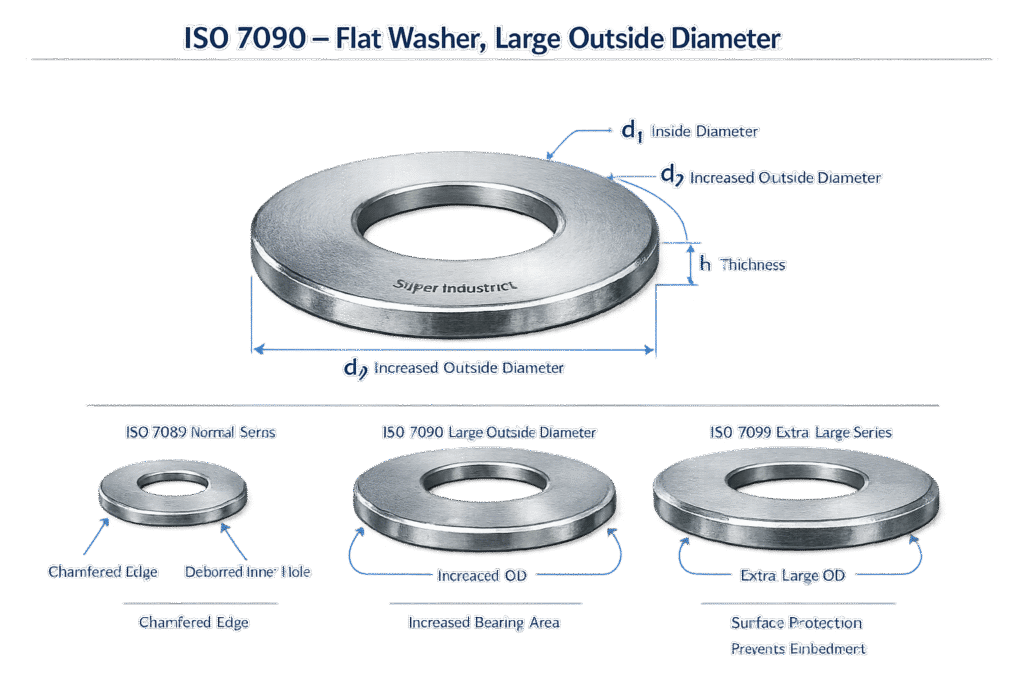
In engineered bolted joints used across structural steel frameworks, mechanical assemblies, pressure-retaining equipment, and EPC installations, washers are not secondary hardware components. They are defined load-distribution elements that directly influence clamp force retention, bearing stress, surface protection, and joint durability.
ISO 7090 – Flat Washers, Large Outside Diameter are selected where:
- Enlarged bearing area is required
- Substrate materials exhibit lower compressive strength
- Oversized or slotted holes are specified
- Surface coatings require protection from localized pressure
- Clamp load uniformity is critical
In capital projects governed by ISO, EN, and ASTM specifications, large OD washers are frequently included in structural connection schedules and mechanical installation drawings.
1.1 Structural Steel Assemblies
In structural steel joints, particularly those involving:
- Slotted holes
- Oversized clearance holes
- Galvanized surfaces
- Plate thickness transitions
ISO 7090 washers increase the effective bearing surface beneath bolt heads and nuts, reducing contact pressure and minimizing surface embedment.
Structural engineers evaluate washer selection in conjunction with:
- Bolt property class (8.8, 10.9)
- Plate thickness
- Surface coating type
- Slip-critical requirements
The washer becomes part of the joint design logic rather than a generic accessory.
1.2 High-Strength Bolted Connections
For preloaded structural bolting systems, large OD washers are used to:
- Improve clamp force distribution
- Reduce bearing stress on structural steel
- Mitigate indentation under high preload
- Maintain tension consistency
When used alongside ISO 898-1 property class bolts, the washer must not plastically deform under applied tightening torque.
1.3 Mechanical Equipment Mounting
In mechanical installations involving:
- Baseplates
- Skid-mounted systems
- Rotating machinery
- Anchoring systems
ISO 7090 washers compensate for:
- Variable surface finish
- Coated substrates
- Slight irregularities in mounting interfaces
The increased outside diameter improves seating stability and reduces localized surface damage.
1.4 Pressure-Retaining Bolted Joints
Although gasketed flange joints typically use hardened washers per specific flange standards, ISO 7090 washers may be used in:
- Equipment support structures
- Secondary bolted connections
- Non-pressure boundary bolting
Where surface protection and load spread remain important.
1.5 Why Large Outside Diameter Washers Are Selected
Compared to normal series washers (ISO 7089), ISO 7090 provides:
- Greater projected bearing area
- Reduced compressive stress on substrate
- Improved performance over painted or galvanized steel
- Reduced risk of bolt head pull-through in slotted holes
The engineering decision is driven by bearing stress calculations rather than visual dimension preference.
2. Technical Definition of ISO 7090 – Flat Washers, Large Outside Diameter
ISO 7090 defines:
- Metric flat washers
- Increased outside diameter (d2) relative to ISO 7089
- Standardized thickness (h) by nominal bolt size
- Compatibility with hex bolts and screws
They are designed primarily for use in:
- Steel structures
- Mechanical assemblies
- Installations requiring improved load distribution
2.1 Dimensional Characteristics
ISO 7090 specifies three principal dimensions:
- d1 – Inside diameter
- d2 – Outside diameter
- h – Thickness
The defining characteristic is the increased d2 relative to ISO 7089 for the same bolt size.
2.2 Comparison with Related Standards
ISO 7089 – Normal Series
- Smaller outside diameter
- Standard load distribution
- Used in general mechanical assemblies
ISO 7090 – Large Outside Diameter
- Increased bearing area
- Preferred for structural applications
ISO 7093 – Extra-Large Series
- Significantly larger OD
- Used for very large clearance holes or soft materials
Load-Bearing Area Comparison (Illustrative)
| Bolt Size | ISO 7089 Bearing Area (mm² approx.) | ISO 7090 Bearing Area (mm² approx.) | Increase (%) |
|---|---|---|---|
| M12 | ~314 | ~491 | ~56% |
| M16 | ~531 | ~804 | ~51% |
| M20 | ~804 | ~1,256 | ~56% |
| M24 | ~1,131 | ~1,963 | ~73% |
Bearing area calculated from washer projected contact surface. Actual values depend on final dimensions.
The increase in area directly reduces bearing stress under preload.
3. Engineering Function & Load Distribution Logic
3.1 Contact Pressure Distribution
Contact pressure (σ) is calculated as:
σ = F / A
Where:
F = clamp force
A = projected washer bearing area
By increasing A, ISO 7090 washers reduce surface compressive stress.
3.2 Bearing Stress Reduction
In structural steel assemblies:
- Reduced indentation
- Lower risk of coating damage
- Improved long-term preload retention
Particularly relevant for:
- Hot-dip galvanized members
- Painted structural frames
3.3 Surface Protection in Coated Structures
Large OD washers reduce:
- Coating cracking
- Zinc layer fracture
- Powder coat compression damage
Maintaining coating integrity directly supports corrosion performance.
3.4 Prevention of Embedment
Embedment relaxation reduces bolt preload over time.
ISO 7090 washers mitigate embedment by:
- Spreading load
- Reducing surface yielding
- Improving stiffness beneath bolt head
3.5 Washer-to-Bolt Compatibility
Washer inside diameter must:
- Allow bolt clearance
- Prevent excessive lateral movement
Compatibility is aligned with metric bolt sizes and ISO tolerance logic.
4. Mechanical & Load Relevance
4.1 Compressive Strength & Hardness
Washer hardness must be sufficient to resist:
- Plastic deformation
- Surface brinelling
- Permanent flattening under preload
For compatibility with bolt classes:
| Bolt Class | Recommended Washer Hardness (HV) |
|---|---|
| 8.8 | 140–300 HV |
| 10.9 | 200–380 HV |
| 12.9 | 300–420 HV |
Hardness must align with bolt strength to prevent washer yielding.
4.2 Washer Thickness vs Load Transfer
Thickness (h) affects:
- Stiffness
- Resistance to bending
- Load distribution efficiency
Insufficient thickness may result in:
- Dish deformation
- Loss of preload
ISO 7090 thickness is standardized to maintain mechanical integrity.
4.3 Slip-Critical Joint Considerations
In slip-critical structural joints:
- Surface friction governs performance
- Washer deformation must not affect bolt tension
Hardness and flatness are critical.
5. Dimensional & Tolerance Logic
5.1 Principal Dimensions (Representative Values)
| Size | d1 (mm) | d2 (mm) | h (mm) |
|---|---|---|---|
| M6 | 6.4 | 18 | 1.6 |
| M8 | 8.4 | 24 | 2.0 |
| M10 | 10.5 | 30 | 2.5 |
| M12 | 13 | 37 | 3.0 |
| M16 | 17 | 50 | 3.0 |
| M20 | 21 | 60 | 4.0 |
| M24 | 25 | 72 | 5.0 |
| M30 | 31 | 92 | 6.0 |
Values are representative; full dimensional tables follow ISO 7090.
5.2 Tolerance Classes
ISO dimensional tolerances govern:
- Hole diameter (d1)
- Outside diameter (d2)
- Thickness variation
Flatness requirements ensure uniform seating.
Parallelism between faces ensures even load transfer.
5.3 Dimensional Verification Discipline
Inspection methods include:
- Digital calipers (ID/OD)
- Micrometer thickness measurement
- Surface flatness plate checks
- Batch sampling per ISO inspection plans
6. Size Range & Series Coverage
ISO 7090 washers typically cover:
- M3 through M64
OD-to-ID ratio increases progressively with bolt size to maintain adequate bearing area.
Thickness increases proportionally to preserve structural rigidity under higher preload.
Engineering rationale:
As bolt diameter increases, preload increases exponentially. Washer stiffness must scale accordingly.
7. Material & Standard Alignment
7.1 Carbon Steel
Common materials:
- Low carbon steel
- Medium carbon steel (C45 equivalent)
Used for structural assemblies and general mechanical installations.
7.2 Alloy Steel Options
Where higher hardness is required for compatibility with property class 10.9 or 12.9 bolts.
7.3 Stainless Steel (ISO 3506 Alignment)
| Stainless Grade | Application |
|---|---|
| A2 (304) | General outdoor |
| A4 (316) | Marine, corrosive environments |
7.4 Surface Finishes
| Coating | Standard Alignment | Application |
|---|---|---|
| Zinc plated | ISO 4042 | Indoor structural |
| Hot dip galvanized | EN/ISO galvanizing standards | Outdoor steel |
| Black oxide | Project specific | Indoor machinery |
| Mechanical galvanizing | Structural | Heavy infrastructure |
Coating thickness must not excessively reduce hole clearance.
7.5 Material vs Application Suitability
| Material | Environment |
|---|---|
| Carbon steel zinc plated | Dry interior |
| HDG carbon steel | Outdoor structural |
| Stainless A2 | Moderate corrosion |
| Stainless A4 | Marine & chemical |
8. Manufacturing & Quality Discipline
8.1 Production Process
- Coil-fed stamping
- Progressive die punching
- OD blanking
- Controlled deburring
For large sizes, machining may supplement stamping.
8.2 Edge & Surface Control
- Burr removal
- Chamfer control
- Surface uniformity
Prevents stress concentration.
8.3 Heat Treatment (Where Applicable)
- Through hardening
- Controlled cooling
- Hardness verification
8.4 Hardness Testing
- Vickers (HV)
- Rockwell (HRB/HRC)
Batch-based sampling.
8.5 Coating Thickness Control
Measured using:
- Magnetic DFT gauges
- Micron verification
Coating uniformity impacts joint geometry.
8.6 Batch Traceability
Each production lot linked to:
- Raw material heat
- Hardness batch
- Coating batch
- Inspection report
Traceability maintained through production control systems.
9. Procurement & Inspection Perspective
EPC procurement teams typically verify:
- ISO 7090 dimensional conformity
- Hardness certificates
- Coating compliance documentation
- Material Test Certificates
- Batch traceability
Inspection Test Plans (ITP) may include:
- Incoming raw material verification
- In-process dimensional sampling
- Hardness test witness
- Final inspection release
Packaging review ensures corrosion prevention during export shipment.
10. Application Mapping
Structural Steel Connections
Used beneath bolt heads and nuts in steel frames.
Equipment Base Mounting
Improves load spread on baseplates.
Pipe Support Systems
Distributes anchor loads.
Heavy Machinery Installation
Prevents embedment in painted or machined surfaces.
Renewable Energy Structures
Wind and solar steel assemblies requiring corrosion resistance.
Infrastructure Projects
Bridges, substations, transmission towers.
Service environment determines:
- Material
- Coating
- Hardness class
Manufacturer Discipline – Super Industries
ISO 7090 – Flat Washers, Large Outside Diameter manufactured by Super Industries are controlled through:
- Dimensional inspection aligned with ISO tolerances
- Hardness verification per application class
- Surface finish validation
- Coating thickness measurement
- Batch-level traceability
Production is aligned with:
- ISO dimensional standards
- Bolt property class compatibility
- EPC documentation expectations
Export packaging incorporates:
- Moisture protection
- Batch identification
- Inspection document inclusion
The manufacturing approach prioritizes:
Project-level compliance readiness
Dimensional precision
Load-distribution reliability
Metallurgical consistency