
Swagelok
Table of Contents
Precision Instrumentation Compression Fittings for High-Integrity Tube Systems
Manufacturer: Super Industries
Website: https://superindustriesindia.in
Role: Manufacturer & Global Exporter
1. Industry Context: Role of Swagelok-Type Tube Fittings in Instrumentation Systems
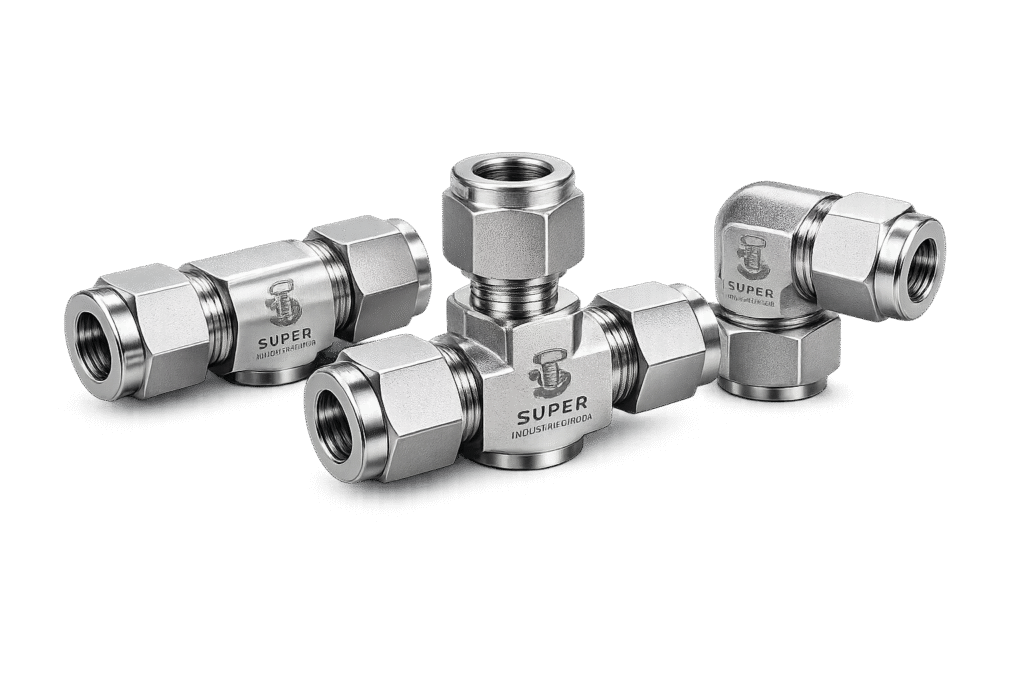
Instrumentation and small-bore tubing systems operate under conditions where leak integrity, dimensional precision, and repeatable assembly performance are critical to plant safety and process reliability. In oil & gas facilities, refineries, LNG terminals, hydrogen units, power plants, and chemical processing installations, tubing connections are used extensively for:
- Impulse lines to transmit pressure signals
- Analyzer sampling systems
- Gas distribution panels
- Hydraulic actuation circuits
- Pneumatic control systems
- Modular skid-mounted packages
Swagelok-Type Tube Fittings (twin ferrule compression fittings) are widely adopted in these systems because they provide controlled mechanical grip and metal-to-metal sealing without requiring welding, flaring, or cutting ring deformation into the tube.
1.1 Instrumentation Impulse Lines
Impulse lines connecting process taps to transmitters often carry:
- High-pressure hydrocarbons
- Steam
- Corrosive process fluids
- Hydrogen-rich gas
These lines must maintain zero leakage over long-term cyclic pressure variation. Twin ferrule fittings allow:
- Reliable tube grip
- Controlled sealing compression
- Re-make capability during maintenance
The absence of welding reduces risk of heat-affected zone metallurgical variation.
1.2 Process Sampling Systems
Sampling panels require compact routing, tight spacing, and frequent maintenance access. Swagelok-Type Tube Fittings are preferred because:
- Assembly is torque-controlled
- Ferrule geometry ensures uniform sealing
- Components can be dismantled and reassembled without compromising tube integrity
1.3 Gas Distribution Panels
Laboratory gas systems and industrial gas manifolds demand:
- High-purity sealing
- Minimal dead volume
- Reliable pressure containment
Twin ferrule systems provide consistent sealing even under low torque variation when correctly assembled.
1.4 Hydraulic Control Systems
Hydraulic circuits require fittings capable of:
- Withstanding impulse pressure
- Resisting vibration
- Maintaining seal integrity under dynamic load
The back ferrule in twin ferrule systems reinforces tube grip and prevents axial movement under pulsation.
1.5 EPC Modular Skids
Pre-fabricated modules for process plants rely on:
- Compact routing
- Predictable installation performance
- Interchangeability across global projects
Swagelok-Type Tube Fittings are selected for their compatibility with established twin ferrule dimensional standards.
2. Technical Definition of Swagelok-Type Tube Fittings
Swagelok-Type Tube Fittings are mechanical compression fittings based on a twin ferrule design, consisting of:
- Body
- Nut
- Front ferrule
- Back ferrule
They operate on a controlled deformation principle to achieve metal-to-metal sealing.
2.1 Twin Ferrule Compression Design
Front Ferrule Function
- Provides primary seal
- Radially compresses against tube OD
- Creates metal-to-metal seal at body seat
Back Ferrule Function
- Provides axial tube grip
- Transfers torque load
- Prevents tube pull-out
The interaction between ferrules distributes load progressively.
2.2 Controlled Deformation Principle
Upon tightening:
- Nut advances forward.
- Back ferrule drives front ferrule.
- Front ferrule wedges into fitting body seat.
- Controlled radial compression seals tube OD.
- Back ferrule grips tube, resisting axial displacement.
Deformation is elastic-plastic but engineered to avoid excessive tube wall thinning.
2.3 Difference from Other Systems
Single Ferrule Systems
- Combine sealing and gripping in one component
- Less controlled load distribution
DIN 2353 Cutting Ring Fittings
- Cutting ring bites into tube
- More aggressive tube deformation
- Primarily hydraulic heavy-duty systems
Flare Fittings
- Require tube flaring
- Seal achieved at flare face
- Dependent on flare geometry precision
Twin ferrule fittings provide balanced sealing and grip without deep tube penetration.
3. Sealing & Engineering Principle
3.1 Front Ferrule Radial Compression
The front ferrule has a geometry that:
- Creates circumferential sealing line
- Seats into precision-machined body cone
- Generates uniform radial pressure
Surface finish of the body seat is critical to seal formation.
3.2 Tube Bite Mechanics
The back ferrule:
- Slightly embeds into tube surface
- Provides axial retention
- Prevents tube movement under pressure
Bite depth is controlled to prevent:
- Tube cracking
- Excessive wall thinning
3.3 Axial Load Transfer
Torque applied to nut translates into:
- Axial compressive force
- Radial sealing force
- Tube retention load
Load path is:
Nut → Back Ferrule → Front Ferrule → Body Seat
3.4 Vibration Resistance
Twin ferrule design:
- Distributes mechanical stress
- Reduces concentration at single point
- Maintains preload under vibration
Common in offshore platforms and rotating machinery environments.
3.5 Pressure Containment Mechanism
Seal integrity achieved through:
- Metal-to-metal interface
- Circumferential sealing ring
- Tube OD compression
System remains leak-tight within rated pressure envelope when installed per torque guidelines.
3.6 Re-Make Capability
Properly installed fittings allow:
- Controlled disassembly
- Reassembly without loss of seal
- Ferrule repositioning via gaugeable makeup
This is critical in maintenance-intensive installations.
4. Pressure & Load Relevance
4.1 Working Pressure vs Tube Size (Illustrative Stainless Steel)
| Tube OD | Typical Max Working Pressure (bar)* |
|---|---|
| 6 mm (1/4″) | up to 413 bar |
| 8 mm (5/16″) | up to 350 bar |
| 10 mm (3/8″) | up to 300 bar |
| 12 mm (1/2″) | up to 250 bar |
| 16 mm (5/8″) | up to 200 bar |
| 25 mm (1″) | up to 137 bar |
*Actual pressure depends on tube material and wall thickness.
4.2 Burst Pressure
Burst pressure typically exceeds working pressure by significant safety factor. Final allowable pressure governed by:
- Tube specification
- Temperature derating
- Application code
4.3 Gas vs Liquid Service
Gas service requires:
- Higher leak-tightness margin
- Lower tolerance for micro-leaks
Liquid service may tolerate slightly different seal behavior but still demands full integrity.
4.4 Temperature Range vs Material
| Material | Typical Service Temperature |
|---|---|
| SS 316 | -196°C to 450°C |
| Duplex | -50°C to 300°C |
| Brass | -40°C to 200°C |
| Carbon Steel | -29°C to 400°C |
Derating may apply per application.
4.5 Installation Torque Importance
Under-tightening:
- Insufficient ferrule bite
- Potential leakage
Over-tightening:
- Excessive ferrule deformation
- Tube damage
Torque control is essential for pressure integrity.
5. Dimensional & Compatibility Logic
5.1 Tube OD vs Fitting Size
| Nominal Size | Tube OD (mm) | Tube OD (inch) |
|---|---|---|
| 1/8″ | — | 3.18 mm |
| 1/4″ | 6 mm | 6.35 mm |
| 3/8″ | 10 mm | 9.52 mm |
| 1/2″ | 12 mm | 12.70 mm |
| 3/4″ | 18 mm | 19.05 mm |
| 1″ | 25 mm | 25.40 mm |
Metric and imperial versions are not interchangeable.
5.2 Tube Wall Thickness Compatibility
Fittings must match tube wall to prevent:
- Tube collapse
- Insufficient grip
Wall thickness selected per pressure rating.
5.3 Thread Forms
| Thread Type | Standard |
|---|---|
| NPT | ASME B1.20.1 |
| BSPT | ISO 7 |
| BSPP | ISO 228 |
| UNF | Unified |
| ISO Metric | ISO 261 |
Thread gauge verification required for compatibility.
5.4 Surface Finish & Tube Preparation
Tube requirements:
- Cut square
- Deburred internal and external edges
- Cleaned surface free of contamination
Surface roughness affects sealing consistency.
6. Fitting Types & Configurations
Swagelok-Type Tube Fittings are available in:
- Straight unions
- Male connectors
- Female connectors
- 45° elbows
- 90° elbows
- Tees
- Cross fittings
- Bulkhead unions
- Reducers
- Tube adapters
- End caps
Configuration selection based on:
- Flow direction
- Space constraints
- Thread interface requirements
- Tube routing geometry
7. Material & Standard Alignment
7.1 Stainless Steel 316 / 316L
Aligned with ASTM A182 / ASTM A479.
Used in corrosive process environments.
7.2 Duplex / Super Duplex
For high chloride service.
7.3 Brass
For low-pressure instrumentation.
7.4 Carbon Steel
Used in hydraulic and general industrial service.
7.5 Material vs Service Suitability
| Material | Typical Application |
|---|---|
| SS 316 | Offshore, chemical |
| Duplex | High chloride |
| Brass | Laboratory gas |
| Carbon Steel | Hydraulic circuits |
8. Manufacturing & Quality Discipline
8.1 CNC Machining Precision
Bodies machined to:
- Controlled bore tolerances
- Accurate cone angle
- Thread precision
8.2 Ferrule Forming Process
Ferrules formed with:
- Controlled geometry
- Hardness consistency
- Surface finish control
Ferrule dimensional accuracy directly influences sealing behavior.
8.3 Surface Finish Control
- Ra controlled machining
- Burr-free internal passages
8.4 Passivation
Stainless steel components chemically passivated to improve corrosion resistance.
8.5 Heat Number Traceability
All fittings traceable to raw material heat.
8.6 Dimensional Inspection
- Thread gauge testing
- Bore measurement
- Ferrule geometry verification
Batch-level inspection maintained.
9. Procurement, Installation & Inspection View
EPC engineers verify:
- Material Test Certificates
- Dimensional conformity
- Thread compliance
- Ferrule consistency
- Pressure rating documentation
Installation guidelines include:
- Finger-tight plus specified turns
- Use of gap inspection gauges
- Avoid reusing damaged ferrules
Field installation requires trained personnel.
10. Application Mapping
Oil & Gas Instrumentation
Impulse lines and analyzer panels.
Refinery Control Systems
High-temperature service.
LNG Cryogenic Systems
Low-temperature compatibility required.
Hydrogen Service
Leak-tight performance critical due to small molecule size.
Chemical Plants
Corrosion-resistant materials required.
Power Plants
Steam instrumentation lines.
Laboratory Gas Systems
High-purity gas handling.
Material selection must consider:
Manufacturer Discipline – Super Industries
Swagelok-Type Tube Fittings manufactured by Super Industries are controlled through:
- CNC-machined dimensional precision
- Ferrule geometry verification
- Hardness consistency control
- Thread gauge inspection
- Surface finish validation
- Heat traceability documentation
Production discipline aligns with:
- ASTM material standards
- ASME thread specifications
- ISO dimensional expectations
Export packaging ensures:
- Component segregation
- Corrosion protection
- Batch identification
The manufacturing approach prioritizes:
EPC documentation readiness
Pressure integrity
Dimensional repeatability
Interchangeable compatibility discipline