
Threadolets
Table of Contents
Threadolets – Complete Technical, Application & Buyer Guide & Procure threadolets
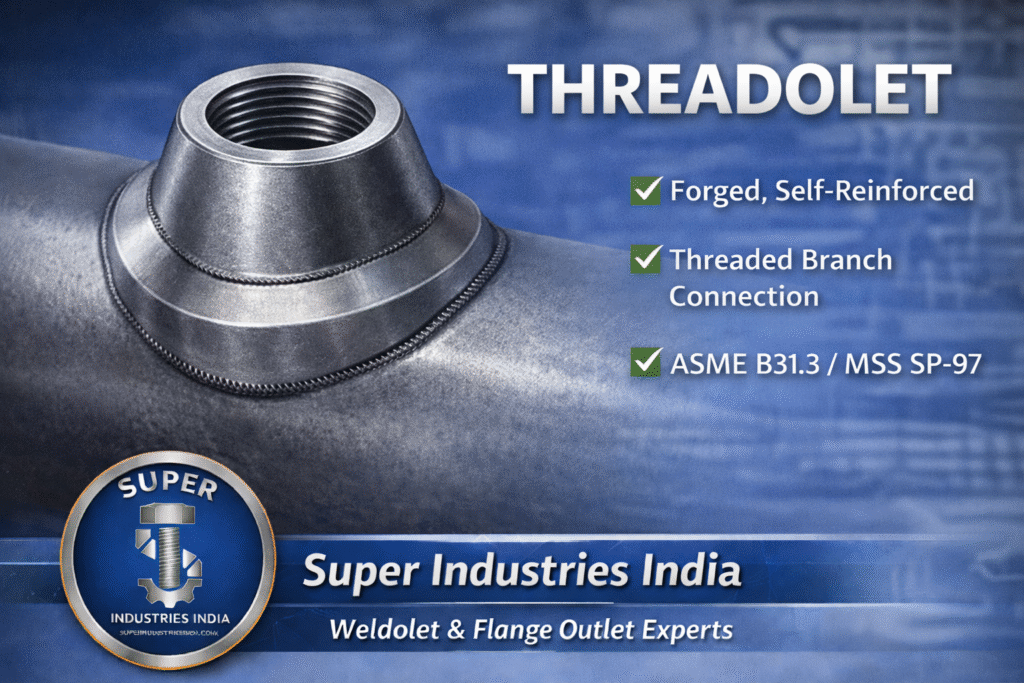
What Is a Threadolet?
A Threadolet is a forged outlet fitting designed to create a threaded branch connection from a run pipe. Instead of butt-weld or socket-weld connections, Threadolets feature internal threads—allowing the branch pipe or fitting to be screwed directly into the outlet.
Threadolets are commonly used in small-bore piping systems, where:
- Welding access is limited
- Quick installation is required
- Frequent disassembly or maintenance is expected
As a top manufacturer of weldolet and threaded outlet fittings, Super Industries India supplies Threadolets that conform to international threading and material standards.
Engineering Design of Threadolets
The Threadolet is engineered with a reinforced forged body, similar to a Weldolet, but includes precision-cut internal threads.
Key Design Elements:
- Contoured base for stress distribution
- Threaded bore (NPT or BSP)
- Forged construction for mechanical strength
- Controlled thread engagement depth
This combination ensures:
✔ Structural integrity of the run pipe
✔ Leak-resistant threaded joint
✔ Long-term performance under moderate pressure
Super Industries
Global Manufacturer of Heavy & Custom Engineered Fasteners & Flanges
Thread Types Used in Threadolets
Thread standards vary based on geographic and project requirements.
Common Thread Standards:
- NPT (National Pipe Thread) – widely used in the USA
- BSPT (British Standard Pipe Tapered)
- BSPP (British Standard Pipe Parallel) – on request
Correct thread selection is critical to prevent leakage and ensure compatibility with mating components.
How Threadolets Work in Piping Systems
Installation involves:
- Cutting a branch hole in the run pipe
- Welding the Threadolet onto the run pipe
- Applying sealant (PTFE tape or thread compound)
- Threading the branch pipe or fitting into the outlet
This makes Threadolets especially suitable for:
- Instrument connections
- Pressure gauges
- Sampling lines
- Temporary branch connections
Threadolet vs Sockolet vs Weldolet
| Feature | Threadolet | Sockolet | Weldolet |
|---|---|---|---|
| Branch Connection | Threaded | Socket-weld | Butt-weld |
| Installation | Fastest | Moderate | Complex |
| Pressure Rating | Moderate | Moderate | High |
| Maintenance | Easy removal | Permanent | Permanent |
| Typical Size | Up to 2″ | Up to 2″ | All sizes |
For a 1-inch branch connection, engineers often choose a 1-inch Threadolet when flexibility and ease of maintenance are priorities.
Sizes of Threadolets
Threadolets are commonly available in:
- 1-inch Threadolet
- 2-inch Threadolet
These sizes are ideal for:
- Instrumentation lines
- Drain and vent piping
- Utility and service connections
Super Industries India manufactures Threadolets in standard sizes and customized configurations as per client drawings.
Materials Used in Threadolets
Material selection depends on the service conditions and fluid type.
Standard Materials:
- Carbon Steel (ASTM A105)
- Stainless Steel (SS304, SS316, SS316L)
- Alloy Steel (ASTM A182)
- Duplex Steel (on request)
For corrosive or high-temperature environments, stainless steel or alloy steel Threadolets are recommended.
Applicable Standards & Specifications
Threadolets are manufactured according to:
- ASME B16.11 – Threaded fittings
- MSS SP-97 – Outlet fittings
- ASTM material specifications
Compliance with these standards ensures reliability when you procure weldolet or Threadolet for industrial projects.
Manufacturing Process of Threadolets
1️⃣ Forging
High-grade steel billets are forged to achieve superior strength and grain flow.
2️⃣ Precision Threading
Threads are machined using CNC lathes to ensure accurate pitch and taper.
3️⃣ Heat Treatment
Performed as per material grade to enhance mechanical properties.
4️⃣ Quality Control
- Thread gauging
- Dimensional inspection
- PMI testing
- Visual examination
Installation Best Practices
To ensure leak-free performance:
✔ Use compatible thread standards
✔ Apply proper sealant
✔ Avoid over-tightening
✔ Ensure correct thread engagement
Incorrect installation can damage threads or cause leakage.
Pressure & Temperature Limitations
Threadolets are suitable for low to moderate pressure and temperature applications. They are not recommended for:
- High-vibration systems
- Extremely high-pressure pipelines
- Critical safety services
For such cases, butt-weld options like Weldolets or Sweepolets are preferred.
Industrial Applications of Threadolets
🛢 Oil & Gas
- Instrumentation lines
- Pressure gauge connections
🧪 Chemical Plants
- Sampling points
- Low-pressure process piping
⚡ Power Plants
- Auxiliary and control piping
🏭 Industrial Utilities
- Air and water lines
- Temporary branch connections
Advantages of Threadolets
✔ Quick installation
✔ Easy maintenance
✔ No socket welding required
✔ Compact design
✔ Cost-effective for small lines
Limitations of Threadolets
❌ Thread leakage risk if improperly sealed
❌ Limited pressure rating
❌ Not suitable for critical high-stress systems
Understanding these limitations helps engineers choose the right outlet fitting.
How to Procure Threadolets – Buyer Guide
When sourcing Threadolets, verify:
- Thread standard (NPT/BSP)
- Material grade
- Compliance with ASME B16.11
- Dimensional accuracy
- Supplier documentation
Sourcing from a top manufacturer of weldolet and Threadolet like Super Industries India ensures quality and traceability.
Why Super Industries India for Threadolets
✔ Precision-threaded outlet fittings
✔ Wide material range
✔ International standard compliance
✔ Export documentation support
✔ Technical assistance