
HEAVY HEX NUTS
Super Industries
“Global Manufacturer of Heavy & Custom Engineered Fasteners for Oil & Gas, Power & EPC Contractors.”
1. Industry Context & System Relevance
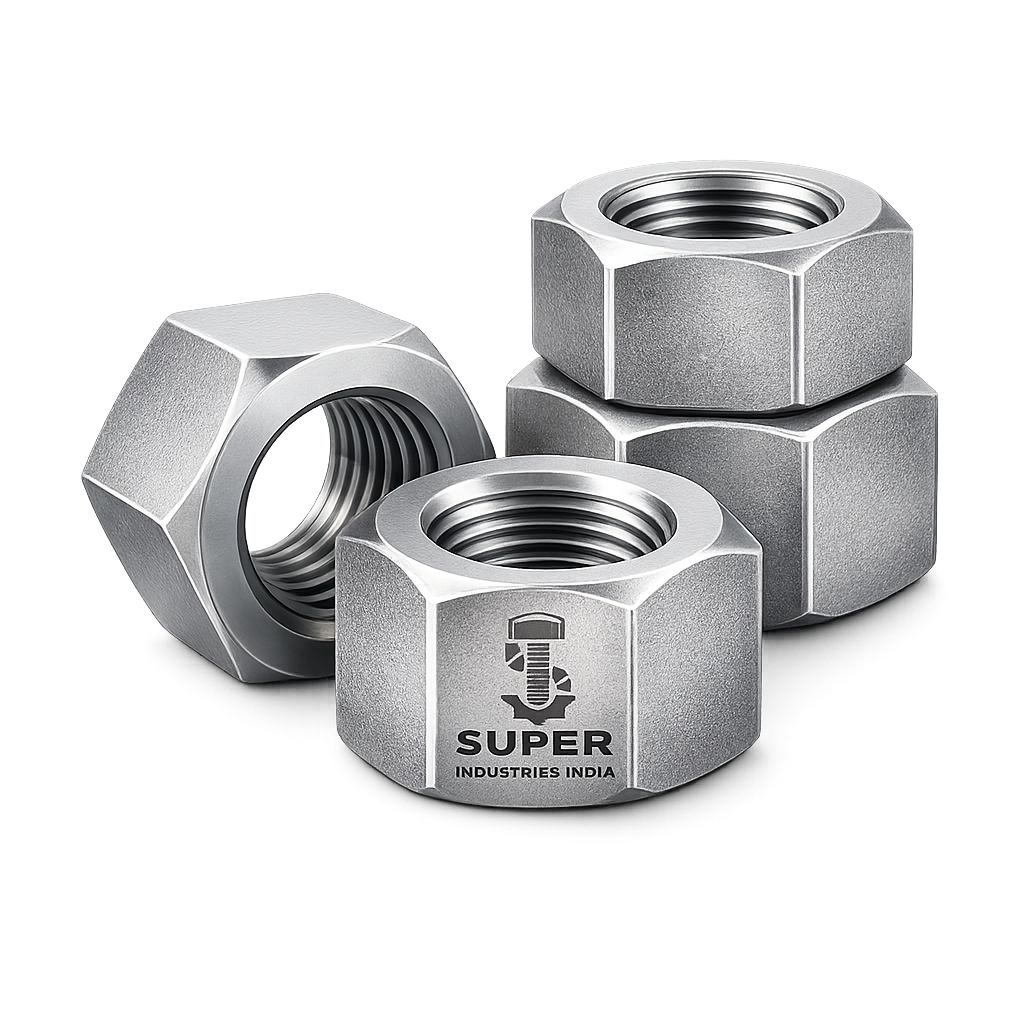
Role of Heavy Hex Nuts in Engineered Systems
Heavy Hex Nuts are critical components within high-integrity bolted joints where structural stability, pressure containment, and load transfer reliability are essential. Their use is standard across industries where failure of bolted joints can lead to system downtime, leakage, or safety risks.
High-Pressure Bolted Joints
In pressure-retaining assemblies such as:
- Pressure vessels
- Heat exchangers
- High-pressure piping systems
Heavy hex nuts are paired with high-strength bolts (e.g., ASTM A193 B7, B16, L7) to maintain:
- Required gasket seating stress
- Leak-tight sealing performance
- Resistance to pressure-induced separation forces
Their increased bearing surface and thickness allow higher preload levels without localized yielding.
Flanged Connections (ASME B16.5 / B16.47)
In flanged joints:
- Bolts generate clamping force
- Nuts sustain thread engagement and preload retention
Heavy hex nuts are preferred due to:
- Larger width across flats (WAF) enabling higher torque application
- Increased bearing face area reducing flange face stress concentration
- Compatibility with high-strength bolting assemblies
They are extensively used in:
- Raised face flanges
- Ring-type joint (RTJ) flanges
- Large diameter flanges (B16.47 Series A/B)
Structural Steel Assemblies
In structural applications:
- Bridges
- Industrial frameworks
- Steel support systems
Heavy hex nuts provide:
- Improved load distribution across connection plates
- Enhanced resistance to loosening under dynamic loads
- Compatibility with structural bolts (e.g., ASTM A325 / A490 equivalent systems)
Pipeline Bolting Systems
For pipeline infrastructure:
- Transmission pipelines
- Pumping stations
- Compressor stations
Heavy hex nuts ensure:
- Consistent preload across multiple bolted joints
- Resistance to vibration and cyclic pressure loading
- Long-term integrity under thermal expansion conditions
Offshore & Subsea Applications
In offshore environments:
- Platform structures
- Subsea connectors
- Riser systems
Heavy hex nuts are selected due to:
- Higher mechanical robustness
- Improved corrosion resistance (when paired with appropriate materials/coatings)
- Suitability for extreme load and fatigue conditions
Why Heavy Hex Nuts Over Standard Hex Nuts
| Parameter | Standard Hex Nuts | Heavy Hex Nuts |
|---|---|---|
| Width Across Flats | Smaller | Larger |
| Load Bearing Area | Limited | Increased |
| Torque Capacity | Moderate | Higher |
| Thread Engagement | Standard | Improved |
| Application | General use | High-load / critical joints |
Engineering Justification
- Higher preload capability without localized crushing
- Improved wrenching surface for controlled torque application
- Enhanced joint reliability under cyclic and dynamic loads
Compatibility with High-Strength Bolts
Heavy hex nuts are specifically designed to match:
- ASTM A193 B7 / B16 (high-temperature alloy bolts)
- ASTM A320 L7 (low-temperature service)
- ASTM A325 / A490 (structural bolting)
Compatibility ensures:
- Matching mechanical strength
- Thread engagement integrity
- Balanced load distribution
Super Industries
Global Manufacturer of Heavy & Custom Engineered Fasteners & Flanges
2. Technical Definition of Heavy Hex Nuts
Core Definition
A Heavy Hex Nut is:
A six-sided internally threaded fastener with increased width across flats and thickness, designed for high-load bolted assemblies requiring enhanced strength, bearing area, and preload capability.
Geometrical Characteristics (ASME B18.2.2)
Heavy hex nuts are defined by:
- Six-sided geometry (hexagonal shape)
- Internal threading (UNC / UNF / Metric)
- Increased width across flats (WAF) compared to standard hex nuts
- Greater nut height to support higher engagement length
Width Across Flats (WAF)
The defining feature:
- Larger than standard hex nuts
- Enables higher torque application
- Reduces tool slippage risk
Engineering Impact:
- Improved torque transfer
- Reduced rounding during tightening
- Increased stability during installation
Thread Engagement Length
Thread engagement:
- Typically equal to or greater than nominal bolt diameter
- Ensures adequate shear area to prevent stripping
Function:
- Distributes load across multiple threads
- Minimizes risk of thread shear failure
- Supports high preload applications
Load-Bearing Surface Area
The underside of the nut provides:
- Bearing surface against flange or washer
- Load distribution across contact area
Engineering Significance:
- Reduced bearing stress
- Prevention of surface indentation
- Improved preload retention
3. Engineering & Load Transfer Principle
Bolt–Nut Interaction Mechanics
In a bolted joint:
- Bolt undergoes tensile loading
- Nut experiences compressive and shear interaction through threads
The system functions as:
- A preloaded tension member (bolt)
- A reaction and locking element (nut)
Clamp Load Generation
When torque is applied:
- Nut rotates along bolt threads
- Axial movement generates tension in bolt
- Components are compressed between bolt head and nut face
Result:
- Clamp load holds joint members together
- External forces must overcome preload before separation
Thread Load Distribution
Load is not evenly distributed:
- First engaged thread carries highest load
- Load reduces progressively along threads
Engineering Implication:
- Adequate engagement length is critical
- Material strength must support localized stress
Thread Shear vs Tensile Failure
Thread Shear Failure
Occurs when:
- Internal threads strip due to insufficient shear area
Bolt Tensile Failure
Occurs when:
- Bolt stress exceeds tensile strength
Design Principle:
- Nut strength must exceed bolt strength
- Failure should occur in bolt, not nut
Friction Coefficient Impact
Torque applied is divided into:
- Thread friction (~40–50%)
- Bearing surface friction (~40–50%)
- Useful preload (~10–15%)
Factors Affecting Friction:
- Surface finish
- Lubrication
- Coating type
Engineering Relevance:
- Variability in friction affects preload accuracy
- Controlled lubrication improves consistency
Torque–Preload Relationship
Torque is used as an indirect method to achieve preload.
General relationship:
- Higher torque → higher preload
- Friction variability → preload uncertainty
Implication:
- Torque control must consider lubrication and coating
Nut Dilation Under Load
Under high preload:
- Nut undergoes slight elastic expansion
- Thread interface deforms to distribute load
Effect:
- Improved load sharing across threads
- Reduced localized stress concentration
Bearing Stress Under Nut Face
Bearing stress = Load / Contact Area
Heavy hex nuts provide:
- Larger contact area
- Reduced stress on flange or washer
Engineering Outcome:
- Prevention of embedding
- Improved joint longevity
4. Load & Stress Engineering
Proof Load vs Working Load
- Proof Load: Maximum load without permanent deformation
- Working Load: Design load under service conditions
Design Approach:
Working load < Proof load (with safety margin)
Yield vs Ultimate Strength
| Property | Definition | Relevance |
|---|---|---|
| Yield Strength | Start of plastic deformation | Defines safe operating limit |
| Tensile Strength | Maximum load before fracture | Defines failure limit |
Axial Tensile Loading
Primary load condition:
- Bolt carries tensile force
- Nut maintains engagement
Heavy hex nuts must:
- Sustain thread shear resistance
- Maintain integrity under high preload
Shear Loading (Secondary Condition)
Occurs due to:
- Misalignment
- External forces
- Structural movement
Heavy hex nuts provide:
- Additional safety due to increased geometry
Fatigue Behavior Under Cyclic Loads
In cyclic conditions:
- Load varies over time
- Micro-cracks may initiate
Heavy hex nuts support fatigue resistance by:
- Maintaining consistent preload
- Reducing stress concentration
Safety Factor Philosophy
Typical approach:
- Safety factor = 2 to 4 (depending on application)
Considerations:
- Load variability
- Material uncertainty
- Environmental effects
Joint Integrity Under Vibration
Vibration can cause:
- Loss of preload
- Self-loosening
Mitigation through:
- Proper torque
- Lubrication control
- Use of hardened washers
High-Temperature Performance
At elevated temperatures:
- Material strength reduces
- Creep deformation may occur
Heavy hex nuts used with:
- Alloy steel grades (B16, A194 Gr 7)
- Heat-treated materials
Ensure:
- Stability under sustained temperature exposure
Dimensional & Design Logic
Key Dimensional Parameters
| Parameter | Description |
|---|---|
| Width Across Flats (WAF) | Distance between opposite faces |
| Nut Height | Overall thickness |
| Thread Pitch | Distance between threads |
| Nominal Diameter | Matching bolt size |
Thread Types
- UNC (Unified Coarse)
- UNF (Unified Fine)
- Metric (ISO)
Selection depends on:
- Load requirements
- Vibration conditions
- Application standards
Tolerance Classes
- Metric: 6H
- Unified: 2H
Purpose:
- Ensure proper fit with bolt threads
- Control looseness and engagement
Impact of Dimensional Tolerances on Preload
Variations in:
- Thread fit
- Surface finish
Can lead to:
- Preload inconsistency
- Uneven load distribution
Concentricity & Perpendicularity
Critical geometric controls:
- Thread axis must align with nut center
- Bearing face must be perpendicular
Impact:
- Uniform load transfer
- Prevention of bending stresses
Thread Accuracy
Controlled through:
- Thread gauges (GO/NO-GO)
- Precision tapping
Ensures:
- Proper mating with bolt
- Reliable load transfer
5. Applicable Standards (ASTM / ASME / DIN / ISO)
Standards Framework for Heavy Hex Nuts
Heavy Hex Nuts are governed by a combination of dimensional, material, and mechanical property standards. Compliance with these standards ensures interchangeability, mechanical integrity, and suitability for pressure and structural applications.
Dimensional Standard – ASME B18.2.2
ASME B18.2.2 defines:
- Geometry of heavy hex nuts
- Width across flats (WAF)
- Nut height
- Thread series compatibility (UNC/UNF)
- Tolerances and fit
Engineering Relevance
- Ensures compatibility with ASME bolting systems
- Guarantees proper wrenching clearance
- Maintains dimensional consistency across EPC projects
ASTM Material Standards
ASTM A194 – Carbon & Alloy Steel Nuts
Applies to high-pressure and high-temperature bolting.
Common Grades:
- Grade 2H – Carbon steel, quenched and tempered
- Grade 7 – Alloy steel for high-temperature service
- Grade 8 / 8M – Stainless steel (304 / 316)
Applications:
- Pressure vessels
- Flanged joints
- Refineries and petrochemical plants
ASTM A563 – Carbon Steel Nuts
Used in structural and general engineering applications.
Common Grades:
- DH – High strength structural applications
- C / D – General purpose
Applications:
- Structural steel assemblies
- Infrastructure projects
ISO Standards
ISO 4032
- Standard hex nuts (reference geometry)
- Used for metric systems
ISO 898-2
Defines:
- Mechanical properties of nuts
- Proof load classes
Engineering Significance:
- Enables global interchangeability
- Standardizes strength classification
DIN Standards
DIN 934
- Metric hex nuts (standard type)
DIN 6915
- High-strength structural heavy hex nuts
- Used with high-strength structural bolts
Applications:
- Steel structures
- Bridge construction
- Heavy equipment assemblies
Standards Mapping to Service Conditions
| Service Condition | Recommended Standard | Typical Grade |
|---|---|---|
| High Pressure / Temperature | ASTM A194 | 2H / 7 |
| Structural Steel | ASTM A563 / DIN 6915 | DH |
| Corrosive Environments | ASTM A194 | 8 / 8M |
| Metric Global Projects | ISO 898 / DIN | Class 8 / 10 |
EPC Relevance
For EPC projects:
- Standards ensure interchangeability across vendors
- Enable inspection compliance (ITP / QAP)
- Support third-party certification (TPIA)
Material & Grade Options
Material Selection Philosophy
Material selection for Heavy Hex Nuts is governed by:
- Load requirements
- Temperature conditions
- Corrosion exposure
- Compatibility with bolt material
Carbon Steel Grades
ASTM A194 Grade 2H
- Heat-treated carbon steel
- High strength and hardness
Characteristics:
- Suitable for high-pressure bolting
- Good load-bearing capacity
- Moderate corrosion resistance (requires coating)
ASTM A563 Grade DH
- High-strength structural carbon steel
Characteristics:
- Used in structural bolting
- Good mechanical strength
- Typically used with structural bolts
Stainless Steel Grades
ASTM A194 Grade 8 (SS 304)
- Austenitic stainless steel
Characteristics:
- Good corrosion resistance
- Suitable for atmospheric and mild chemical environments
- Moderate strength
ASTM A194 Grade 8M (SS 316)
- Molybdenum-bearing stainless steel
Characteristics:
- Enhanced resistance to chlorides
- Suitable for marine and chemical environments
- Lower strength compared to carbon/alloy steel
Alloy Steel Grades
ASTM A194 Grade 7
- Alloy steel with enhanced temperature resistance
Characteristics:
- Suitable for elevated temperature service
- Maintains strength at higher temperatures
- Used with B16 bolts
Duplex & Super Duplex (Project-Specific)
Used in:
- Offshore platforms
- Subsea systems
- Chemical plants
Characteristics:
- High strength
- Excellent corrosion resistance
- Resistance to stress corrosion cracking
Material Selection Considerations
| Factor | Impact |
|---|---|
| Temperature | Determines alloy vs carbon steel |
| Corrosion | Drives stainless or duplex selection |
| Load | Requires high-strength grades |
| Environment | Influences coating or material type |
MANDATORY: Material Comparison Table
| Grade | Yield Strength (MPa) | Tensile Strength (MPa) | Temperature Range | Corrosion Resistance | Typical Use |
|---|---|---|---|---|---|
| ASTM A194 2H | ~640 | ~850 | Up to ~450°C | Low (coating required) | Pressure vessels, flanges |
| ASTM A563 DH | ~550 | ~760 | Ambient to ~300°C | Low | Structural steel |
| ASTM A194 7 | ~720 | ~860 | Up to ~500°C | Moderate | High-temp bolting |
| ASTM A194 8 (304) | ~205 | ~515 | Up to ~400°C | Good | General corrosion environments |
| ASTM A194 8M (316) | ~205 | ~515 | Up to ~450°C | Excellent | Marine, chemical |
| Duplex (Typical) | ~450 | ~700 | Up to ~300°C | Very high | Offshore, subsea |
6. Heat Treatment Information
Purpose of Heat Treatment
Heat treatment is applied to:
- Achieve required mechanical strength
- Control hardness
- Improve microstructure
Quenching & Tempering
Applicable to:
- ASTM A194 Grade 2H
- ASTM A194 Grade 7
Process:
- Heating to austenitizing temperature
- Rapid cooling (quenching)
- Reheating (tempering)
Outcome:
- Increased strength
- Controlled hardness
- Improved toughness
Stress Relieving
Applied after:
- Thread cutting
- Forming
Purpose:
- Reduce residual stresses
- Prevent distortion
Hardness Control
Typical hardness ranges:
| Grade | Hardness Range |
|---|---|
| 2H | 24–35 HRC |
| 7 | 24–36 HRC |
| Stainless Steel | Lower hardness |
Importance:
- Prevent brittle failure
- Ensure ductility
Microstructure Influence
- Fine-grained structure improves toughness
- Uniform microstructure ensures consistent strength
Hydrogen Embrittlement Considerations
Occurs when:
- Hydrogen enters material during plating
Risk:
- Delayed brittle failure
Mitigation:
- Post-plating baking
- Controlled plating processes
Impact Testing
Required for:
- Low-temperature applications (e.g., ASTM A320 systems)
Ensures:
- Resistance to brittle fracture
7. Manufacturing Process
Raw Material Inspection
- Chemical composition verification
- Ultrasonic testing (if required)
- Mill test certificate validation
Forging / Forming
Hot Forging (Common for Heavy Hex Nuts)
- Billets heated and forged into hex shape
Advantages:
- Grain flow alignment
- Improved mechanical strength
Cold Forming (Limited Use)
- Used for smaller sizes
Machining & Thread Tapping
- Internal threads cut or tapped
- Precision tools used
Control Parameters:
- Thread pitch accuracy
- Surface finish
Heat Treatment
- As per grade requirements
- Controlled furnace cycles
Surface Finishing
- Cleaning
- Coating or plating
Inspection
- Dimensional checks
- Thread gauge verification
- Hardness testing
Marking & Traceability
Marking includes:
- Grade identification
- Manufacturer identification
- Heat number (traceability)
Dimensional Control Discipline
Maintained through:
- Calibrated measuring instruments
- Statistical process control
Thread Gauge Verification
- GO gauge → Acceptable fit
- NO-GO gauge → Reject limit
Ensures:
- Proper mating with bolts
- Interchangeability
Surface Finish Options
Purpose of Surface Finishing
- Corrosion protection
- Friction control
- Surface durability
Black Oxide
- Minimal corrosion protection
- Used for indoor or controlled environments
Zinc Plating
- Electroplated zinc coating
Advantages:
- Moderate corrosion resistance
- Smooth finish
Consideration:
- Hydrogen embrittlement risk
Hot-Dip Galvanizing (HDG)
- Thick zinc coating
Advantages:
- High corrosion resistance
- Suitable for outdoor and marine environments
Engineering Impact:
- Increased thread thickness
- Requires thread oversizing
PTFE Coating
- Fluoropolymer coating
Benefits:
- Reduced friction
- Chemical resistance
Phosphate Coating
- Improves lubrication
- Used in conjunction with oiling
Passivation (Stainless Steel)
- Removes free iron
- Enhances corrosion resistance
Coating Thickness Impact on Threads
Coatings affect:
- Thread fit
- Torque requirements
Engineering Consideration:
- Adjust torque values for coated fasteners
- Ensure compatibility with tolerance class
A. Dimensional Table (ASME B18.2.2 Reference)
The following table represents typical dimensions for Heavy Hex Nuts based on ASME B18.2.2 (UNC series). Values are indicative and subject to tolerance limits defined in the standard.
Heavy Hex Nuts – Dimensional Data
| Nominal Size (in) | Thread Type | Threads per Inch (TPI) | Width Across Flats (WAF) (mm) | Nut Height (mm) | Pitch (mm) |
|---|---|---|---|---|---|
| 1/2″ | UNC | 13 | 22.2 | 12.7 | 1.95 |
| 5/8″ | UNC | 11 | 26.9 | 15.9 | 2.31 |
| 3/4″ | UNC | 10 | 31.8 | 19.1 | 2.54 |
| 7/8″ | UNC | 9 | 36.5 | 22.2 | 2.82 |
| 1″ | UNC | 8 | 41.3 | 25.4 | 3.18 |
| 1-1/8″ | UNC | 7 | 46.0 | 28.6 | 3.63 |
| 1-1/4″ | UNC | 7 | 50.8 | 31.8 | 3.63 |
| 1-1/2″ | UNC | 6 | 60.3 | 38.1 | 4.23 |
| 1-3/4″ | UNC | 5 | 71.4 | 44.5 | 5.08 |
| 2″ | UNC | 4.5 | 82.6 | 50.8 | 5.64 |
Engineering Notes
- WAF is significantly larger than standard hex nuts
- Nut height supports increased thread engagement
- Pitch determines thread density and load distribution
B. Mechanical Strength Table
Mechanical properties depend on material grade. Below are representative values for commonly used grades.
Mechanical Strength – Typical Values
| Grade | Proof Load (MPa) | Yield Strength (MPa) | Tensile Strength (MPa) |
|---|---|---|---|
| ASTM A194 2H | ~850 | ~640 | ~850–1000 |
| ASTM A563 DH | ~600 | ~550 | ~760 |
| ASTM A194 7 | ~860 | ~720 | ~860–1030 |
| ASTM A194 8 (304) | ~450 | ~205 | ~515 |
| ASTM A194 8M (316) | ~450 | ~205 | ~515 |
Engineering Interpretation
- Proof load defines maximum safe preload
- Alloy grades maintain higher strength at temperature
- Stainless steel provides corrosion resistance with lower strength
C. Torque Chart (MANDATORY)
Torque values depend on:
- Bolt size
- Material grade
- Lubrication condition
- Friction coefficient
Torque Values for ASTM A193 B7 Bolting with Heavy Hex Nuts
| Bolt Size (in) | Torque (Nm) – Dry | Torque (Nm) – Lubricated |
|---|---|---|
| 1/2″ | 110 | 80 |
| 5/8″ | 220 | 160 |
| 3/4″ | 380 | 280 |
| 7/8″ | 600 | 440 |
| 1″ | 900 | 650 |
| 1-1/8″ | 1250 | 900 |
| 1-1/4″ | 1750 | 1250 |
| 1-1/2″ | 3000 | 2100 |
| 1-3/4″ | 4800 | 3400 |
| 2″ | 7000 | 5000 |
Engineering Considerations
- Lubrication reduces friction → lower torque required
- Dry conditions lead to higher torque variability
- Torque must align with target preload
D. Preload Calculation Guide (MANDATORY)
Fundamental Preload Formula
![\[F = \frac{T}{K \cdot d}\]](https://superindustriesindia.in/wp-content/ql-cache/quicklatex.com-047c3812ff26cb229181955bd579e870_l3.png "Rendered by QuickLaTeX.com")
Where:
- ( F ) = Preload (N)
- ( T ) = Applied torque (Nm)
- ( K ) = Nut factor (friction coefficient, typically 0.10–0.25)
- ( d ) = Nominal diameter (m)
Torque–Tension Relationship
- Torque is an indirect method of generating preload
- Friction factor (K) significantly influences result
- Small variation in K leads to large variation in preload
Typical Friction Factors
| Condition | Nut Factor (K) |
|---|---|
| Dry | 0.18 – 0.25 |
| Lubricated | 0.10 – 0.16 |
| PTFE Coated | 0.08 – 0.12 |
Sample Calculation
Given:
- Bolt size = 1″ (d = 0.0254 m)
- Torque = 900 Nm
- K = 0.18
Preload:
F = 900 / (0.18 × 0.0254)
F ≈ 196,850 N
Engineering Observations
- Lubrication increases preload for same torque
- Preload should be 60–75% of bolt proof load
- Controlled tightening improves joint reliability
E. Thread Engagement & Shear Calculation
Thread Shear Area Formula
![\[A_s = \pi \cdot d \cdot L_e\]](https://superindustriesindia.in/wp-content/ql-cache/quicklatex.com-b9f557b372ac5d0d6bec8cc3182e7221_l3.png "Rendered by QuickLaTeX.com")
Where:
- ( A_s ) = Shear area
- ( d ) = Nominal diameter
- ( L_e ) = Engagement length
Thread Engagement Requirement
- Minimum engagement length ≈ 1 × bolt diameter
- Increased engagement required for softer materials
Failure Mode Comparison
| Failure Mode | Description | Prevention |
|---|---|---|
| Thread Shear | Nut threads strip | Increase engagement length |
| Bolt Fracture | Bolt fails in tension | Use proper grade |
| Bearing Failure | Surface indentation | Use washers / larger nuts |
Engineering Insight
- Heavy hex nuts increase engagement length
- Improved thread area reduces shear failure risk
F. Mechanical Property Table
Detailed Mechanical Properties
| Grade | Yield Strength (MPa) | Tensile Strength (MPa) | Hardness | Elongation (%) |
|---|---|---|---|---|
| ASTM A194 2H | 640 | 850–1000 | 24–35 HRC | ~16 |
| ASTM A563 DH | 550 | ~760 | ~200 HB | ~18 |
| ASTM A194 7 | 720 | 860–1030 | 24–36 HRC | ~14 |
| SS 304 (8) | 205 | ~515 | ~95 HRB | ~40 |
| SS 316 (8M) | 205 | ~515 | ~95 HRB | ~40 |
G. Corrosion Resistance Table
Material vs Environment Performance
| Material | Marine | Chemical | High Humidity | Hydrocarbon |
|---|---|---|---|---|
| Carbon Steel | Poor | Poor | Moderate | Good |
| Alloy Steel | Moderate | Moderate | Moderate | Good |
| SS 304 | Good | Moderate | Good | Good |
| SS 316 | Excellent | Excellent | Excellent | Good |
| Duplex | Excellent | Excellent | Excellent | Excellent |
Engineering Interpretation
- SS316 preferred for chloride environments
- Carbon steel requires coating for outdoor exposure
- Duplex materials used for aggressive environments
8. Inspection & Quality Control Methods
Inspection Philosophy
Inspection ensures:
- Dimensional accuracy
- Material compliance
- Mechanical integrity
- Traceability
Positive Material Identification (PMI)
- Verifies chemical composition
- Confirms grade authenticity
Used for:
- Alloy steel
- Stainless steel
- Critical applications
Hardness Testing
Methods:
- Rockwell (HRC)
- Brinell (HB)
Purpose:
- Verify heat treatment
- Ensure compliance with standards
Thread Gauge Inspection
- GO Gauge: Ensures proper fit
- NO-GO Gauge: Prevents oversize threads
Critical for:
- Interchangeability
- Assembly reliability
Magnetic Particle Inspection (MPI)
- Detects surface and near-surface cracks
- Used for ferromagnetic materials
Dye Penetrant Inspection (DPI)
- Detects surface defects
- Used for stainless and non-magnetic materials
Dimensional Inspection
Includes:
- WAF measurement
- Height verification
- Thread pitch accuracy
Certification Requirements
EN 10204 3.1
- Manufacturer test certificate
EN 10204 3.2
- Third-party verified certification
Third-Party Inspection
Conducted by:
- Independent inspection agencies
Includes:
- Witness testing
- Document verification
- Pre-dispatch inspection
Traceability System
Maintained through:
- Heat number marking
- Batch tracking
- Inspection records
9. Industries Served
Heavy Hex Nuts are deployed across sectors where bolted joint integrity is critical to operational safety, pressure containment, and structural reliability.
Oil & Gas (Upstream / Midstream / Downstream)
Applications
- Wellhead assemblies
- Christmas tree equipment
- Pipeline flanges
- Refinery process units
Engineering Requirements
- High-pressure resistance
- Compatibility with ASTM A193 bolting systems
- Resistance to hydrocarbons and corrosive media
Material Preference
- ASTM A194 Grade 2H
- ASTM A194 Grade 7
- ASTM A194 Grade 8M (corrosive environments)
Refineries & Petrochemical Plants
Applications
- Heat exchangers
- Reactors
- Distillation columns
- Process piping
Engineering Considerations
- Elevated temperature operation
- Chemical exposure
- Long-term preload retention
Power Generation (Thermal / Nuclear / Renewable)
Applications
- Boiler assemblies
- Turbine casings
- High-pressure steam lines
Engineering Requirements
- High-temperature strength
- Resistance to creep and relaxation
- Consistent preload under thermal cycling
Typical Grades
- ASTM A194 Grade 7
- Alloy steel bolting systems
Offshore & Marine Infrastructure
Applications
- Offshore platforms
- Subsea connectors
- Riser systems
Engineering Conditions
- Saltwater exposure
- Cyclic loading
- High humidity
Material Selection
- ASTM A194 Grade 8M
- Duplex / Super Duplex
Structural Steel & Infrastructure Projects
Applications
- Bridges
- Industrial steel structures
- Heavy equipment foundations
Engineering Considerations
- Static and dynamic loads
- Fatigue resistance
- Structural stability
Typical Standards
- ASTM A563 Grade DH
- DIN 6915
LNG, Hydrogen & Cryogenic Systems
Applications
- LNG terminals
- Cryogenic pipelines
- Hydrogen processing systems
Engineering Requirements
- Low-temperature toughness
- Resistance to brittle fracture
- Compatibility with cryogenic bolting
10. Export Capability & Global Supply
Global Supply Regions
Super Industries supplies Heavy Hex Nuts to:
- United States (ASME-compliant projects)
- European Union (DIN / ISO-based projects)
- Middle East (Oil & Gas EPC projects)
- Southeast Asia (Infrastructure and power sectors)
Export Packaging Standards
Packaging is aligned with international logistics and project handling requirements:
- Wooden boxes / fumigated pallets
- Moisture-resistant packaging
- Batch-wise segregation
- Marking aligned with packing lists
Documentation Package
Each shipment can include:
- Mill Test Certificates (MTC)
- EN 10204 3.1 / 3.2 certification
- Heat treatment records
- Inspection reports
- Dimensional inspection reports
- Coating thickness reports
- Certificate of Origin (COO)
Traceability & Identification
- Heat number stamping
- Grade marking as per ASTM/ASME
- Batch traceability maintained from raw material to dispatch
Logistics for EPC Projects
- Bulk supply capability
- Project-based scheduling
- Containerized shipping
- Coordination with EPC timelines
11. Procurement & Installation View
Procurement Considerations
EPC and procurement teams evaluate Heavy Hex Nuts based on:
- Compliance with ASTM / ASME standards
- Mechanical property certification
- Dimensional conformity
- Coating and corrosion resistance
- Traceability and documentation
Compatibility Verification
Ensure:
- Nut grade matches or exceeds bolt grade
- Thread type compatibility (UNC/UNF/Metric)
- Coating compatibility between nut and bolt
Installation Practices
Torque Application Methods
- Manual torque wrench
- Hydraulic torque tools
- Tensioning systems (for critical joints)
Tightening Sequence
- Cross-pattern tightening for flanges
- Incremental torque application
- Final torque verification
Lubrication Requirements
- Controlled lubrication improves preload accuracy
- Reduces friction variability
- Prevents galling (especially in stainless steel)
Reuse Limitations
Reuse depends on:
- Thread condition
- Deformation
- Corrosion
General Practice:
- Avoid reuse in critical pressure joints
- Inspect threads before reuse
Inspection During Installation
- Torque verification
- Visual inspection
- Thread engagement confirmation
- Alignment check
Joint Integrity Control
Maintained through:
- Correct preload application
- Proper tightening sequence
- Use of calibrated tools
12. Custom Engineering Capabilities
Super Industries supports project-specific requirements for Heavy Hex Nuts.
Non-Standard Threads
- Fine threads (UNF)
- Metric special pitch
- Custom thread profiles
Oversized & Special Dimensions
- Large diameter nuts
- Increased height for extended engagement
- Custom WAF configurations
Special Coatings
- PTFE coatings for low friction
- Xylan coatings for chemical resistance
- Hot-dip galvanizing for outdoor applications
Project-Specific Marking
- Client-specific identification
- Heat number traceability
- Inspection stamp requirements
High-Temperature Bolting Solutions
- Alloy steel grades
- Controlled heat treatment
- Application-specific engineering support
13. Engineering Summary & Conclusion
Functional Role
Heavy Hex Nuts serve as critical components in bolted joint systems by:
- Maintaining thread engagement
- Sustaining preload
- Distributing load across bearing surfaces
Engineering Advantages
- Increased width across flats enables higher torque application
- Greater height improves thread engagement
- Enhanced bearing area reduces surface stress
- Compatibility with high-strength bolting systems
Compliance & Reliability
When manufactured and inspected in accordance with:
- ASME B18.2.2
- ASTM A194 / A563
- ISO / DIN standards
Heavy hex nuts provide:
- Consistent mechanical performance
- Interchangeability across global projects
- Reliability under pressure and structural loads
EPC Suitability
From an EPC evaluation perspective, Heavy Hex Nuts supplied by Super Industries align with:
- Pressure system requirements
- Structural load demands
- Inspection and certification protocols
- Global supply and documentation standards
Final Engineering Statement
For high-load bolted assemblies in pressure, structural, and offshore systems, Heavy Hex Nuts provide the necessary geometry, material strength, and dimensional control required to ensure joint integrity, preload stability, and long-term performance under demanding service conditions.