
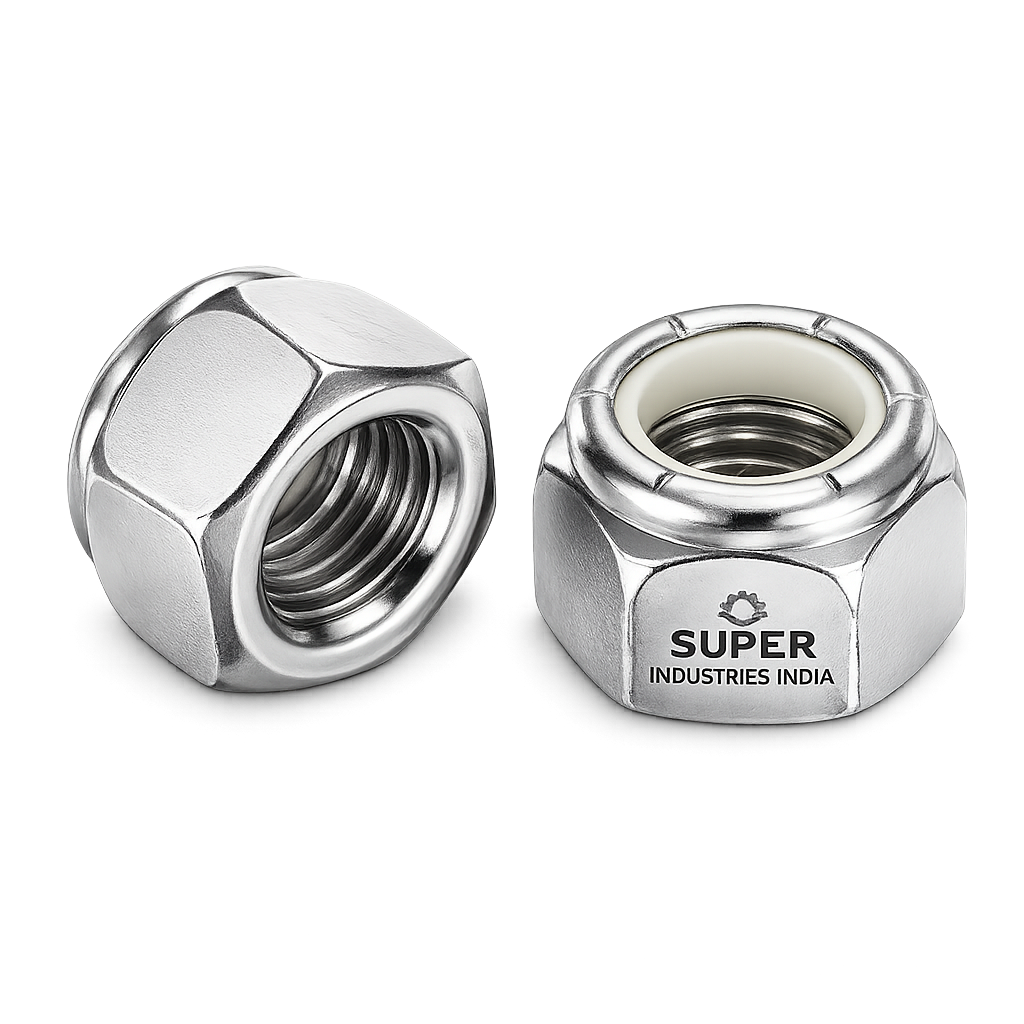
NYLON INSERT LOCK NUTS
Super Industries
“Global Manufacturer of Heavy & Custom Engineered Fasteners for Oil & Gas, Power & EPC Contractors.”
1. Industry Context & System Relevance
Role in Bolted Joint Integrity
Nylon Insert Lock Nuts are deployed in bolted assemblies where self-loosening due to vibration, cyclic loading, or dynamic forces presents a measurable risk to joint integrity.
In engineered systems, bolted joints are subjected to:
- Transverse vibration
- Axial cyclic loading
- Thermal expansion and contraction
- Rotational or oscillatory motion
Under such conditions, standard threaded fasteners may experience loss of preload, leading to:
- Reduced clamp force
- Joint separation
- Fatigue failure
- Structural instability
Nylon Insert Lock Nuts address this by introducing prevailing torque, which resists rotational loosening independent of clamp load.
Application Environments
Oil & Gas Installations
- Pipe supports and clamps
- Equipment skids
- Valve assemblies
- Non-critical flange bolting (where permitted)
Refineries & Petrochemical Plants
- Rotating equipment guards
- Structural steel connections
- Cable tray systems
- Instrument mounting structures
Power Plants
- Turbine auxiliary systems
- Boiler structures
- Electrical enclosures
- Vibration-prone support systems
Offshore Structures
- Deck equipment
- Secondary structural fastening
- Marine exposure assemblies
Heavy Machinery
- Pumps and compressors
- Gear assemblies
- Engine mounting systems
Railways & Infrastructure
- Track components (non-primary load joints)
- Signal equipment
- Structural fastening
Automotive & Mechanical Assemblies
- Engine components
- Suspension systems
- Chassis assemblies
Selection vs Alternative Locking Methods
Comparison with Standard Hex Nuts
Standard hex nuts rely solely on:
- Friction between threads
- Clamp load
Limitations:
- Susceptible to loosening under vibration
- No inherent locking mechanism
Comparison with Double Nut (Jam Nut) Systems
Jam nut systems:
- Require precise tightening sequence
- Increase assembly time
- Introduce dependency on installer skill
Limitations:
- Inconsistent preload distribution
- Space constraints in compact assemblies
Comparison with Thread-Locking Adhesives
Adhesives (e.g., anaerobic compounds):
- Provide chemical locking
- Require curing time
- Sensitive to contamination
Limitations:
- Difficult disassembly
- Temperature sensitivity
- Not suitable for all materials
Engineering Justification for Nylon Insert Lock Nuts
Nylon Insert Lock Nuts are selected where:
- Reusable locking is required
- No curing time is acceptable
- Installation simplicity is necessary
- Moderate temperature conditions exist
- Controlled prevailing torque is preferred
Super Industries
Global Manufacturer of Heavy & Custom Engineered Fasteners & Flanges
2. Technical Definition
Functional Classification
Nylon Insert Lock Nuts are defined as:
Prevailing Torque Type Hex Nuts with Integrated Polymer Insert for Self-Locking Thread Engagement
They function independently of clamp load to resist loosening.
Construction Elements
A Nylon Insert Lock Nut consists of:
- Metallic hex nut body
- Internal thread (metric or imperial)
- Polyamide (nylon) insert located at the top end
The insert is mechanically retained within a recess and does not rotate independently.
Thread System Compatibility
Metric Threads
- ISO metric coarse and fine pitch
- Tolerance class: 6H (internal thread)
Imperial Threads
- UNC (Unified National Coarse)
- UNF (Unified National Fine)
- Tolerance class: 2B
Geometry Types
Standard Height (DIN 985 / ISO 10511)
- Reduced height
- Suitable for moderate load applications
High Type (DIN 982 / ISO 7040)
- Increased height
- Higher thread engagement
- Improved load distribution
Insert Positioning
- Located at the top of the nut
- Engages after initial thread engagement
- Ensures controlled deformation during tightening
3. Locking Mechanism & Engineering Principle
Fundamental Operating Principle
The locking action is achieved through:
Elastic Deformation of Nylon Insert
When the bolt enters the nylon section:
- The insert deforms elastically
- Radial pressure is exerted on the bolt threads
- Interference fit is created
Radial Pressure & Friction Generation
The nylon insert applies:
- Radial compressive force
- Increased contact area
- Enhanced friction coefficient
This generates:
Prevailing torque independent of clamp load
Prevailing Torque vs Installation Torque
Prevailing Torque
- Torque required to overcome friction of insert
- Exists before clamp load is developed
Installation Torque
- Total torque applied during tightening
- Includes:
- Thread friction
- Bearing friction
- Prevailing torque
Torque-Tension Relationship
The relationship between applied torque and generated preload is:
![\[F = \frac{T}{K \cdot d}\]](https://superindustriesindia.in/wp-content/ql-cache/quicklatex.com-047c3812ff26cb229181955bd579e870_l3.png "Rendered by QuickLaTeX.com")
Where:
- F = Clamp force
- T = Applied torque
- K = Nut factor (friction coefficient)
- d = Nominal diameter
In Nylon Insert Lock Nuts:
- The K factor increases due to insert friction
- This must be considered during torque specification
Self-Locking Behavior
Unlike standard nuts:
- Locking is mechanical and friction-based
- No external locking device required
- No reliance on preload retention alone
Resistance to Vibration-Induced Loosening
Under vibration:
- Micro-movements attempt to rotate the nut
- Nylon insert provides continuous resistance
- Energy is dissipated through friction
This reduces:
- Rotational displacement
- Loss of clamp force
Friction Coefficient Influence
Factors affecting friction:
- Surface finish of threads
- Coating type
- Lubrication condition
- Nylon insert deformation characteristics
Typical behavior:
- Higher friction than standard nuts
- More stable under dynamic conditions
Reusability & Torque Degradation
Nylon Insert Lock Nuts are reusable within limits.
Performance Behavior Over Cycles
- First installation: Maximum prevailing torque
- Subsequent uses:
- Gradual reduction in torque
- Insert wear and relaxation
Engineering Consideration
- Reuse permitted only if:
- Prevailing torque remains within standard limits
- Excessive reuse leads to:
- Loss of locking function
Limitations of Locking Mechanism
Temperature Sensitivity
- Nylon softens at elevated temperatures
- Loss of elastic recovery above threshold
Chemical Exposure
- Certain hydrocarbons and chemicals may degrade insert
Mechanical Wear
- Repeated installation cycles reduce effectiveness
Functional Summary
Nylon Insert Lock Nuts provide:
- Controlled prevailing torque
- Resistance to loosening under vibration
- Reusable locking capability (within limits)
- Simplified installation without auxiliary locking devices
They are not intended for:
- High-temperature applications exceeding nylon limits
- Critical pressure-retaining joints unless specified
- Environments with aggressive chemical exposure affecting polymers
4. Applicable Standards (ASTM / DIN / ISO / ASME)
Nylon Insert Lock Nuts are governed by dimensional, mechanical, and functional standards that define geometry, material strength, and prevailing torque performance. Selection for EPC projects requires strict alignment with these standards.
International Dimensional & Functional Standards
ISO Standards
ISO 7040
- High-type hexagon nuts with nylon insert
- Metric thread system
- Higher nut height for improved load distribution
ISO 10511
- Standard height nylon insert lock nuts
- Reduced height version of ISO 7040
ISO 2320
- Governs prevailing torque performance testing
- Defines:
- Minimum prevailing torque
- Maximum prevailing torque
- Reusability performance criteria
DIN Standards
DIN 985
- Standard height nylon insert lock nuts
- Equivalent to ISO 10511
DIN 982
- High-type nylon insert lock nuts
- Equivalent to ISO 7040
ASME / ANSI Standards
ASME B18.16.6
- Covers inch-series nylon insert lock nuts
- Includes UNC and UNF threads
- Defines:
- Dimensions
- Tolerances
- Mechanical requirements
ASTM Material Standards
ASTM A194
- Covers carbon and alloy steel nuts
- Applicable grades:
- Gr. 2H (carbon steel, high strength)
- Gr. 7 / 7M (alloy steel for higher temperature)
Standards Mapping to Engineering Requirements
| Standard | Scope | Thread System | Application Suitability |
|---|---|---|---|
| ISO 7040 | High-type lock nuts | Metric | High-load structural applications |
| ISO 10511 | Standard-type lock nuts | Metric | General industrial use |
| DIN 985 | Standard height | Metric | Machinery, automotive |
| DIN 982 | High type | Metric | Heavy-duty assemblies |
| ASME B18.16.6 | Nylon insert lock nuts | UNC/UNF | US EPC projects |
| ASTM A194 | Material specification | Both | High-pressure & high-strength bolting |
| ISO 2320 | Performance testing | Both | Prevailing torque validation |
Temperature & Application Compatibility
| Standard / Component | Temperature Limitation | Remarks |
|---|---|---|
| Nylon Insert (PA6/PA66) | ~120°C (continuous) | Above this, torque retention reduces |
| ASTM A194 Gr. 2H | Up to ~425°C (metal only) | Insert becomes limiting factor |
| ASTM A194 Gr. 7 | Higher temperature capability | Requires non-nylon locking alternative |
Engineering Note:
For applications exceeding nylon temperature limits, all-metal prevailing torque nuts are recommended.
5. Material & Grade Options
Material selection is governed by:
- Load requirements
- Environmental exposure
- Compatibility with bolt material
- Temperature conditions
Carbon Steel Options
Property Class 8 / ASTM A194 Gr. 2H
Characteristics:
- High tensile strength
- Suitable for structural and mechanical applications
- Economical for large-scale projects
Typical applications:
- Structural steel assemblies
- Machinery fastening
- Industrial equipment
Stainless Steel Options
A2-70 (Equivalent to 304 Stainless Steel)
- Moderate strength
- Good corrosion resistance
- Suitable for general outdoor environments
A4-80 (Equivalent to 316 Stainless Steel)
- Higher corrosion resistance
- Suitable for:
- Marine environments
- Chemical plants
- Offshore structures
Alloy Steel Options
ASTM A194 Gr. 7 / 7M
- High strength at elevated temperatures
- Improved creep resistance
- Used in:
- Power plants
- High-pressure systems
Limitation:
Nylon insert restricts temperature capability.
Material Compatibility Considerations
| Bolt Grade | Recommended Nut Grade |
|---|---|
| 8.8 | Class 8 / A194 2H |
| 10.9 | Alloy steel (Gr. 7) |
| B7 | A194 Gr. 2H / Gr. 7 |
| Stainless A2-70 | A2-70 nut |
| Stainless A4-80 | A4-80 nut |
Mismatch can result in:
- Thread stripping
- Uneven load distribution
- Premature failure
Material Comparison Table (MANDATORY)
| Grade | Yield Strength (MPa) | Tensile Strength (MPa) | Temperature Limit | Corrosion Resistance | Typical Application |
|---|---|---|---|---|---|
| Class 8 / Gr. 2H | ~640 | ~800 | ~120°C (insert limit) | Moderate (requires coating) | Structural & machinery |
| A2-70 | ~450 | ~700 | ~120°C | Good | Outdoor, general industrial |
| A4-80 | ~600 | ~800 | ~120°C | High | Marine, offshore |
| Gr. 7 | ~720 | ~860 | Limited by insert | Moderate | High-strength assemblies |
6. Nylon Insert Material Properties
Polymer Composition
Nylon inserts are typically manufactured from:
- Polyamide 6 (PA6)
- Polyamide 66 (PA66)
These materials provide:
- Elastic deformation capability
- Wear resistance
- Dimensional stability
Thermal Properties
| Property | Typical Value |
|---|---|
| Melting Temperature | 220–260°C |
| Glass Transition Temperature | ~50°C |
| Continuous Operating Temperature | Up to ~120°C |
Mechanical Behavior
- Elastic deformation under load
- Recovery after unloading (within limits)
- Gradual degradation with repeated cycles
Chemical Resistance
Resistant to:
- Oils
- Greases
- Fuels (limited exposure)
Sensitive to:
- Strong acids
- Oxidizing agents
- Certain solvents
Aging & Environmental Effects
Factors affecting performance:
- UV exposure (long-term degradation)
- Thermal cycling
- Moisture absorption
Effect:
- Reduction in elasticity
- Decrease in prevailing torque
Functional Limitation Summary
Nylon insert performance is limited by:
- Temperature
- Chemical exposure
- Mechanical wear
For critical applications outside these limits, metallic locking systems are required.
7. Heat Treatment (Metal Component)
Heat treatment is applied to the metallic nut body to achieve specified mechanical properties.
Quenching & Tempering
Applicable to:
- Carbon steel
- Alloy steel nuts
Process:
- Heating to austenitizing temperature
- Rapid quenching
- Tempering to achieve desired hardness
Objectives
- Achieve required tensile strength
- Improve toughness
- Ensure uniform microstructure
Hardness Range
| Grade | Typical Hardness (HB/HRC) |
|---|---|
| Class 8 / 2H | 24–35 HRC |
| Gr. 7 | 28–38 HRC |
Stress Relieving
Performed to:
- Reduce residual stresses
- Improve dimensional stability
- Prevent distortion
Microstructure Control
Critical for:
- Fatigue resistance
- Crack prevention
- Load-bearing consistency
Case Hardening (If Applicable)
Used selectively for:
- Wear resistance improvement
- Surface hardness enhancement
Not typical for standard nylon insert lock nuts but may be used in specialized applications.
Manufacturing Process
Manufacturing of Nylon Insert Lock Nuts follows controlled industrial processes aligned with EPC quality expectations.
Process Flow
1. Raw Material Inspection
- Chemical composition verification
- Mechanical property validation
2. Forging
Cold Forging
- Used for smaller sizes
- High dimensional accuracy
- Improved grain flow
Hot Forging
- Used for larger diameters
- Reduced forming stress
3. Thread Tapping
- Internal threads created using precision taps
- Ensures:
- Pitch accuracy
- Thread class compliance (6H / 2B)
4. Heat Treatment
- Applied as per grade requirements
- Ensures mechanical strength compliance
5. Surface Finishing
- Cleaning and preparation
- Application of coating (if required)
6. Nylon Insert Installation
- Insert press-fitted into machined recess
- Controlled interference fit
- Ensures retention during operation
7. Prevailing Torque Testing
- Conducted as per ISO 2320
- Verification of torque range
8. Final Inspection
- Dimensional verification
- Thread gauge inspection
- Visual inspection
9. Marking & Traceability
- Grade marking
- Manufacturer identification
- Batch traceability
8. Surface Finish Options
Surface finishing affects both:
- Corrosion resistance
- Thread fit and torque characteristics
Zinc Plating
- Electroplated coating
- Moderate corrosion resistance
- Common for indoor applications
Hot Dip Galvanizing (HDG)
- Thick zinc coating
- Suitable for outdoor and structural use
- Requires thread oversizing
Black Oxide
- Minimal corrosion protection
- Used where coating thickness must be minimal
PTFE Coating
- Reduces friction
- Improves chemical resistance
- Used in specialized environments
Mechanical Galvanizing
- Uniform coating without hydrogen embrittlement
- Suitable for high-strength fasteners
Passivation (Stainless Steel)
- Enhances corrosion resistance
- Removes free iron contamination
Coating vs Thread Fit Consideration
| Coating Type | Impact on Threads |
|---|---|
| Electroplating | Minimal |
| HDG | Requires oversized threads |
| PTFE | Reduces friction |
| Mechanical Galvanizing | Moderate impact |
A. Dimensional Table (Metric Series – Reference per ISO 7040 / DIN 982 / DIN 985)
The following table provides standard dimensional references for Nylon Insert Lock Nuts. Actual dimensions may vary based on standard (ISO/DIN/ASME) and coating condition.
| Thread Size | Pitch (mm) | Nut Height (m) mm | Width Across Flats (s) mm | Nylon Insert Diameter (Approx.) mm |
|---|---|---|---|---|
| M6 | 1.0 | 6.0 – 8.0 | 10 | 5.5 – 6.0 |
| M8 | 1.25 | 8.0 – 10.0 | 13 | 7.5 – 8.0 |
| M10 | 1.5 | 10.0 – 12.0 | 17 | 9.5 – 10.0 |
| M12 | 1.75 | 12.0 – 14.0 | 19 | 11.5 – 12.0 |
| M16 | 2.0 | 16.0 – 18.0 | 24 | 15.5 – 16.0 |
| M20 | 2.5 | 18.0 – 22.0 | 30 | 19.0 – 20.0 |
| M24 | 3.0 | 22.0 – 28.0 | 36 | 23.0 – 24.0 |
| M30 | 3.5 | 26.0 – 34.0 | 46 | 29.0 – 30.0 |
| M36 | 4.0 | 30.0 – 38.0 | 55 | 35.0 – 36.0 |
Dimensional Engineering Notes
- Nut height affects:
- Thread engagement
- Load distribution
- Insert diameter determines:
- Interference fit
- Prevailing torque magnitude
- Pitch accuracy is critical for:
- Load sharing
- Thread life
B. Torque Chart (MANDATORY)
The tightening torque must consider:
- Thread condition (dry/lubricated)
- Coating type
- Nut factor (K)
- Additional prevailing torque due to nylon insert
Indicative Torque Values (Metric – Property Class 8.8 Bolts)
| Size | Torque (Dry) Nm | Torque (Lubricated) Nm |
|---|---|---|
| M6 | 10 – 12 | 7 – 9 |
| M8 | 24 – 30 | 18 – 22 |
| M10 | 48 – 60 | 35 – 45 |
| M12 | 85 – 105 | 65 – 80 |
| M16 | 210 – 260 | 160 – 200 |
| M20 | 410 – 510 | 310 – 390 |
| M24 | 710 – 880 | 540 – 670 |
| M30 | 1400 – 1700 | 1050 – 1300 |
Torque Adjustment for Nylon Insert Lock Nuts
- Add prevailing torque value to tightening torque
- Avoid over-tightening due to:
- Increased friction
- Insert deformation
Engineering Note
Torque values are application-dependent and must be verified through:
- Joint design calculations
- Field validation
- Project specifications
C. Prevailing Torque Table (MANDATORY – Reference ISO 2320)
Prevailing torque is measured before clamp load is applied.
Typical Prevailing Torque Values
| Thread Size | Min Torque (Nm) | Max Torque (Nm) | Typical Reuse Cycles |
|---|---|---|---|
| M6 | 0.5 | 2.0 | 3 – 5 |
| M8 | 1.0 | 3.5 | 3 – 5 |
| M10 | 1.5 | 5.0 | 3 – 5 |
| M12 | 2.0 | 7.0 | 3 – 5 |
| M16 | 3.5 | 12.0 | 2 – 4 |
| M20 | 5.0 | 18.0 | 2 – 4 |
| M24 | 7.0 | 25.0 | 2 – 3 |
Performance Behavior
- Initial torque: Maximum resistance
- Subsequent cycles:
- Reduction due to insert wear
- Rejection criteria:
- Torque below minimum specified
Inspection Requirement
Prevailing torque must be verified:
- At manufacturing stage
- During third-party inspection (if required)
D. Preload Calculation Guide (MANDATORY)
Torque–Preload Relationship
Where:
- F = Clamp force (N)
- T = Applied torque (Nm)
- K = Nut factor (typically 0.18–0.25 for steel fasteners)
- d = Nominal bolt diameter (m)
Engineering Considerations
- Nylon insert increases effective K value
- Results in:
- Lower preload for same torque (if not adjusted)
- Requires:
- Torque correction or calibration
Sample Calculation
Given:
- Bolt size: M12 (d = 0.012 m)
- Torque applied: 90 Nm
- Nut factor: 0.20
Calculation:
![\[F = \frac{90}{0.20 \times 0.012} = 37{,}500 \, \text{N}\]](https://superindustriesindia.in/wp-content/ql-cache/quicklatex.com-50f540a289a3b816ae800a3733a4794f_l3.png "Rendered by QuickLaTeX.com")
Practical Adjustment
For Nylon Insert Lock Nuts:
- Add prevailing torque (e.g., 5 Nm)
- Effective tightening torque:
- 90 + 5 = 95 Nm input
- Actual preload derived from net torque
Clamp Load Importance
Adequate preload ensures:
- Joint stability
- Resistance to fatigue
- Prevention of separation
E. Mechanical Property Table
| Material Grade | Yield Strength (MPa) | Tensile Strength (MPa) | Hardness | Elongation (%) |
|---|---|---|---|---|
| Class 8 | ~640 | ~800 | 24–35 HRC | ~12 |
| ASTM A194 2H | ~650 | ~850 | 24–35 HRC | ~14 |
| A2-70 | ~450 | ~700 | HRB 95 max | ~30 |
| A4-80 | ~600 | ~800 | HRB 95 max | ~25 |
| Gr. 7 | ~720 | ~860 | 28–38 HRC | ~16 |
Engineering Interpretation
- Higher strength grades:
- Suitable for high-load applications
- Stainless grades:
- Lower strength but higher corrosion resistance
- Selection must match bolt strength
F. Corrosion Resistance Comparison Table
| Material Type | Marine Environment | Chemical Exposure | High Humidity | Industrial Use |
|---|---|---|---|---|
| Carbon Steel (Plated) | Low | Low | Moderate | Moderate |
| HDG Carbon Steel | Moderate | Low | High | High |
| Stainless A2-70 | Moderate | Moderate | High | High |
| Stainless A4-80 | High | High | High | High |
| PTFE Coated | High | High | High | Specialized |
Engineering Selection Guidance
- Marine / Offshore → A4-80
- General Industrial → A2-70 or plated steel
- Structural Outdoor → HDG
- Chemical Plants → PTFE or A4
9. Inspection & Quality Control
Inspection ensures compliance with:
- Dimensional standards
- Mechanical properties
- Functional performance
Prevailing Torque Testing (ISO 2320)
Procedure:
- Nut is rotated on test bolt
- Torque measured:
- Before seating
- After multiple cycles
Acceptance criteria:
- Must fall within specified range
Proof Load Testing
- Ensures nut withstands:
- Specified axial load
- Prevents:
- Thread stripping
- Plastic deformation
Hardness Testing
Methods:
- Rockwell hardness test
- Brinell hardness test
Purpose:
- Verify heat treatment effectiveness
Thread Gauge Inspection
Tools:
- GO / NO-GO gauges
Checks:
- Thread pitch accuracy
- Fit tolerance (6H / 2B)
Coating Thickness Testing
Methods:
- Magnetic thickness gauge
- Micrometer measurement
Ensures:
- Corrosion protection compliance
- Thread compatibility
Salt Spray Testing
- Conducted as per ASTM B117
- Evaluates corrosion resistance
Visual & Dimensional Inspection
Includes:
- Surface defects
- Insert placement
- Marking verification
Certification & Documentation
EN 10204 Certification
- 3.1 Certificate
- Manufacturer test results
- 3.2 Certificate
- Third-party verified results
Third-Party Inspection (TPI)
Conducted by:
- Independent inspection agencies
Scope:
- Witness testing
- Document verification
- Batch approval
Traceability System
Ensures:
- Batch identification
- Material traceability
- Inspection history tracking
10. Industries Served
Nylon Insert Lock Nuts are utilized across multiple industries where moderate temperature conditions, vibration resistance, and controlled locking performance are required. Their application is governed by engineering specifications, load classification, and environmental constraints.
Oil & Gas Industry
Application Scope
- Equipment skids and modular units
- Pipe support structures
- Instrumentation mounting systems
- Secondary fastening in non-pressure retaining components
Engineering Considerations
- Not typically used in primary pressure-retaining flange joints unless explicitly specified
- Temperature limitations must be validated against process conditions
- Material selection aligned with corrosion environment
Power Generation Sector
Application Areas
- Turbine auxiliary systems
- Boiler external structures
- Electrical panel fastening
- Cable support assemblies
Performance Requirements
- Resistance to vibration from rotating equipment
- Stability under cyclic loading
- Compatibility with structural steel assemblies
Infrastructure & Structural Engineering
Typical Usage
- Steel framework connections (secondary)
- Bridge accessories and support components
- HVAC structural supports
- Industrial buildings
Engineering Constraints
- Load-bearing capacity must be validated
- Not preferred for critical structural joints requiring high preload retention under temperature variation
Railways & Transportation
Applications
- Signal equipment fastening
- Coach assembly components
- Trackside equipment
Operational Conditions
- Continuous vibration environment
- Exposure to dust, moisture, and mechanical shock
Heavy Engineering & Industrial Machinery
Use Cases
- Pumps and compressors
- Gearboxes and drive systems
- Conveyor systems
- Engine assemblies
Functional Requirement
- Resistance to loosening under dynamic loads
- Ease of maintenance and reassembly
Automotive & Mechanical Assemblies
Applications
- Suspension components
- Engine mounting
- Chassis assemblies
Engineering Focus
- Repeatability of assembly
- Controlled locking without adhesives
11. Procurement & Installation Practices
Procurement and installation of Nylon Insert Lock Nuts must align with project specifications, installation procedures, and inspection requirements.
Installation Procedure
Step-by-Step Engineering Practice
- Thread Inspection
- Verify cleanliness and absence of damage
- Ensure compatibility with bolt thread class
- Initial Engagement
- Hand-tighten until nylon insert is engaged
- Torque Application
- Apply torque using calibrated torque wrench
- Account for prevailing torque
- Final Tightening
- Achieve specified installation torque
- Avoid impact tools where torque control is critical
Lubrication Considerations
- Lubrication may be applied to metal threads only
- Avoid lubrication contact with nylon insert
- Excess lubrication may:
- Reduce friction excessively
- Affect preload accuracy
Reuse Guidelines
Reuse is permitted under controlled conditions:
Inspection Before Reuse
- Check insert integrity
- Verify prevailing torque manually
Rejection Criteria
- Insert deformation or damage
- Reduced resistance during engagement
Engineering Recommendation
- Limit reuse to defined cycles (typically 2–5) depending on size and application
Storage Conditions
Environmental Requirements
- Store below 30–35°C ambient temperature
- Avoid direct sunlight and UV exposure
- Protect from moisture and contaminants
Impact on Performance
Improper storage may lead to:
- Nylon aging
- Reduced elasticity
- Lower prevailing torque performance
Handling Practices
- Avoid mechanical damage to insert
- Prevent contamination with oils or chemicals
- Maintain packaging integrity until installation
12. Custom Engineering Capabilities
Super Industries supports project-specific requirements for Nylon Insert Lock Nuts through controlled manufacturing and engineering customization.
Dimensional Customization
- Non-standard thread sizes
- Custom pitch configurations
- Special nut heights
- Modified insert dimensions
Material Customization
- Project-specific alloy selection
- High-strength grades
- Stainless steel variants for corrosive environments
Surface Coating Customization
- PTFE-coated fasteners for low friction applications
- Heavy-duty galvanization for outdoor exposure
- Specialized coatings for chemical resistance
High-Temperature Alternatives
Where nylon is not suitable:
- Supply of all-metal prevailing torque lock nuts
- Alternative locking systems for elevated temperature applications
Marking & Traceability
- Project-specific marking
- Heat number traceability
- Batch identification aligned with EPC documentation
Bulk Supply Capability
- Large-volume production for EPC projects
- Scheduled dispatch aligned with project timelines
- Packaging customization based on logistics requirements
13. Export Capability & Global Supply
Super Industries operates as a global exporter of Nylon Insert Lock Nuts, supporting EPC contractors and international procurement teams.
Export Regions
- United States (ASME / ASTM compliance)
- European Union (DIN / ISO compliance)
- Middle East (Oil & Gas projects)
- Southeast Asia (Infrastructure and industrial projects)
Documentation Support
Each shipment can be supported with:
- EN 10204 3.1 / 3.2 certification
- Material test certificates (MTC)
- Dimensional inspection reports
- Heat treatment records
- Coating test reports
- Prevailing torque test reports
Packaging Standards
- Export-grade packaging
- Corrosion protection measures
- Batch-wise segregation
- Labeling with traceability details
Logistics Capability
- Containerized shipments
- Air and sea freight coordination
- Compliance with international shipping standards
Third-Party Inspection Integration
- Pre-dispatch inspection by approved agencies
- Documentation verification
- Compliance certification for project approval
14. Engineering Selection Guidance
When to Use Nylon Insert Lock Nuts
Recommended for:
- Moderate temperature environments (<120°C)
- Vibration-prone assemblies
- Applications requiring reusable locking
- Assemblies where adhesives are not preferred
When Not to Use
Not recommended for:
- High-temperature applications exceeding nylon limits
- Critical pressure-retaining flange joints
- Severe chemical exposure environments
- Applications requiring zero torque degradation over time
Alternative Solutions
- All-metal lock nuts
- Double nut systems (where space permits)
- Chemical thread locking (controlled environments)
Engineering Compliance Summary
Nylon Insert Lock Nuts supplied by Super Industries are designed to comply with:
- ISO / DIN dimensional standards
- ASME / ASTM material specifications
- ISO 2320 prevailing torque requirements
- EPC project documentation requirements
- Third-party inspection protocols
Final Engineering Conclusion
Nylon Insert Lock Nuts function as prevailing torque locking fasteners designed to mitigate loosening in vibration-prone assemblies through controlled frictional resistance generated by a polymer insert.
From an engineering and EPC procurement perspective, their performance is defined by:
- Insert material behavior (polyamide limits)
- Torque-preload relationship adjustments
- Prevailing torque consistency across reuse cycles
- Compatibility with bolt grade and application environment
Their correct application requires:
- Adherence to international standards (ISO, DIN, ASME, ASTM)
- Proper torque control during installation
- Verification of prevailing torque performance
- Consideration of temperature and chemical exposure limits
When selected within defined operating parameters, Nylon Insert Lock Nuts provide:
- Reliable resistance to self-loosening
- Simplified installation without auxiliary locking devices
- Controlled and repeatable locking performance
For EPC contractors, consultants, and inspection agencies, the suitability of Nylon Insert Lock Nuts depends on clear alignment between application conditions, material selection, and standard compliance.