
T Bolts
Super Industries “Global Manufacturer of Heavy & Custom Engineered Fasteners for Oil & Gas, Power & EPC Contractors.”
Within large-scale industrial structures, mechanical fastening systems form the backbone of structural stability, equipment mounting, and load-transfer reliability. Among specialized fastening components used in industrial frameworks, T Bolts occupy a critical position in systems where adjustable positioning, slot engagement, and distributed load transfer are required.
1. Industry Context & Structural System Relevance
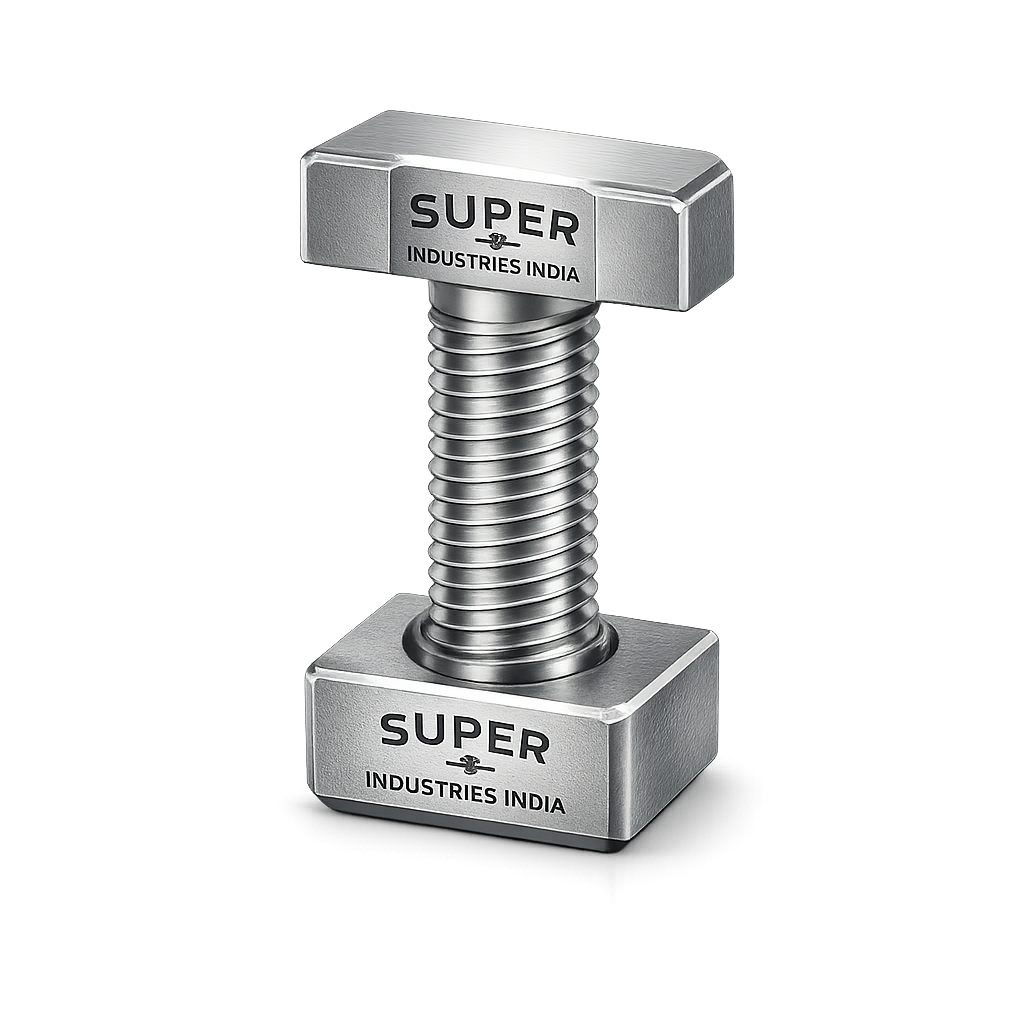
Role of T Bolts in Heavy Mechanical Fastening Systems
Industrial structures frequently require fastening systems that allow controlled adjustability before final tightening. In these situations, T Bolts provide a fastening mechanism that can slide along slot channels before locking in position.
This capability allows engineers and installation teams to:
- Align mechanical components
- Adjust equipment positioning
- Distribute structural loads along rails
- Facilitate modular assembly of industrial systems
These characteristics make T Bolts particularly valuable in structural systems where mounting slots are integrated into beams, machine beds, or aluminum/steel extruded profiles.
Key Functional Characteristics
T Bolts provide:
• Sliding engagement inside structural channels
• Load distribution across slot rails
• Adjustable positioning prior to tightening
• Secure clamping after torque application
Because of these characteristics, they are widely used in industrial channel-based mounting systems where precise alignment and repetitive assembly operations are required.
Major Industrial Applications
Steel Structures
In structural steel frameworks, T-slot channel systems are frequently used for installing secondary structural elements such as:
- Bracing components
- Cable support systems
- Instrumentation mounting structures
T Bolts allow these components to be installed without drilling additional holes into structural members, thereby maintaining structural integrity.
Industrial Machinery
Heavy industrial machinery often incorporates machined T-slot tables or base plates to allow mounting of tooling, mechanical attachments, or auxiliary equipment.
Typical applications include:
- CNC machine beds
- Fabrication machinery
- Industrial press structures
- Heavy machining fixtures
In such systems, T Bolts enable repositioning of tooling components while maintaining structural rigidity after tightening.
Equipment Mounting Systems
Large mechanical equipment frequently requires adjustable mounting solutions during installation. T Bolts facilitate:
- Alignment of rotating equipment
- Adjustment of motor mounts
- Positioning of pumps and compressors
- Installation of instrumentation racks
This adjustability significantly reduces installation time in large industrial projects.
Rail Infrastructure
Railway systems employ specialized track fastening and rail component mounting assemblies where T-slot bolts may be used within rail support structures or maintenance equipment.
Typical rail-related applications include:
- Rail inspection equipment mounts
- Track maintenance machinery
- Support frames for signaling systems
Power Plant Mechanical Structures
Power generation facilities contain extensive networks of structural support frames for piping systems, cable trays, and mechanical equipment.
In such environments, T-slot fastening systems allow:
- Modular installation of equipment supports
- Adjustment during commissioning
- Simplified maintenance and equipment replacement
Solar Mounting Structures
Large photovoltaic installations frequently employ aluminum extrusion frames with integrated T-slots.
Within these frameworks, T Bolts are used to secure solar panels, structural clamps, and mounting brackets while allowing flexibility during panel alignment.
Mining Equipment Frames
Mining operations utilize heavy-duty structural assemblies that must withstand vibration, shock loading, and harsh environmental conditions.
Applications include:
- Conveyor system frames
- Crusher support structures
- Material handling equipment mounts
T Bolts provide secure fastening while allowing rapid replacement of structural components during maintenance operations.
Industrial Support Systems
Within industrial plants, T-slot channel systems are commonly used to support:
- Cable tray installations
- Instrumentation racks
- Control panel mounting frames
- Structural bracing components
T Bolts enable efficient installation without the need for welding or drilling additional holes in structural members.
Why Engineers Select T Bolts Instead of Standard Hex Bolts
In conventional bolted joints, a hex bolt requires a drilled hole for installation. While effective for permanent structural connections, this approach limits adjustability.
T Bolts provide several advantages when slot-based structural systems are used.
Sliding Slot Engagement
The defining feature of a T Bolt is its T-shaped head geometry, which fits inside a slot channel. Once inserted into the slot, the head is retained within the channel rails.
This configuration allows the bolt to slide along the slot length before tightening.
Adjustable Mounting Systems
During installation, components such as brackets, frames, or mechanical assemblies can be moved along the slot axis until the correct position is achieved.
After alignment is completed, the bolt is tightened to create clamping force.
Load Distribution Along Channels
Because the bolt head contacts both sides of the slot channel, load transfer occurs along the channel rail surfaces rather than through a drilled hole.
This configuration improves structural load distribution and reduces stress concentration within the structural member.
Repetitive Assembly Systems
Industries that rely on modular mechanical systems benefit from the ability to disassemble and reconfigure equipment quickly.
Examples include:
- Industrial automation frameworks
- Modular equipment installations
- Machine tool fixtures
In these applications, T Bolts provide rapid installation and reconfiguration capability.
T-Slot Fastening Systems in Industrial Frameworks
T-slot fastening systems consist of several components working together to create a reliable mechanical joint.
Primary System Elements
A typical T-slot fastening assembly includes:
- Structural channel or extrusion with integrated T-slot
- T Bolt with head geometry compatible with the slot
- Washer for load distribution
- Nut or threaded component providing clamping force
Mechanical Engagement Principle
The bolt head is inserted into the slot and rotated into position so that:
- The head shoulders engage the channel rails
- The bolt shank protrudes through the mounted component
Once the nut is tightened, the bolt generates clamping force between the mounted component and the structural channel.
This configuration transforms the sliding bolt into a fixed structural fastener.
2. Technical Definition of T Bolts
Precise Engineering Definition
T Bolts are mechanical fasteners with a T-shaped head designed to engage T-slot channels or structural profiles, allowing adjustable positioning prior to tightening while providing secure clamping after torque application.
This geometry enables the bolt to function as a sliding head fastener within slotted structural systems.
Core Structural Characteristics
Key design features include:
• T-shaped head geometry
• Threaded cylindrical shank
• Slot engagement shoulders
• Controlled head thickness for channel compatibility
These characteristics allow the bolt head to remain captured inside the slot while transmitting loads to the structural channel surfaces.
T-Slot Engagement Mechanism
The engagement mechanism of a T Bolt relies on the interaction between the bolt head geometry and the slot channel rails.
Step-by-Step Engagement Process
- Bolt head is inserted into the channel opening.
- Head rotates or slides inside the slot cavity.
- Shoulders engage the internal channel surfaces.
- Mounted component is positioned along the slot.
- Nut tightening generates clamping force.
Once tightened, frictional resistance prevents further sliding movement.
Head Geometry Interaction with Structural Channels
The geometry of the T Bolt head determines how effectively it interacts with the slot.
Key geometric parameters include:
- Head width relative to slot opening
- Head thickness relative to slot depth
- Shoulder geometry for rail engagement
Proper dimensional matching ensures that:
• The bolt cannot rotate within the slot
• The head remains captured within the channel
• Load transfer occurs across both channel rails
Load Distribution Along Slot Rails
Unlike conventional bolted joints where loads pass through a drilled hole, T Bolts transfer loads through the channel rail surfaces.
This configuration offers several advantages:
- Reduced localized stress concentration
- Improved load distribution along the channel
- Reduced structural weakening caused by drilling
Mechanical Locking During Tightening
When torque is applied to the nut:
- The bolt shank experiences tensile loading.
- Clamping force develops between the mounted component and the structural channel.
- Friction between surfaces prevents sliding movement.
This frictional locking effect converts the sliding fastener into a rigid structural connection.
Common Head Variants of T Bolts
Several head geometries are used depending on the channel system and industrial application.
Standard T-Head Bolts
These bolts feature a symmetrical rectangular head designed to engage conventional T-slot channels used in structural steel systems.
Typical applications include:
- Structural support frames
- Industrial machinery bases
- Equipment mounting systems
Hammer Head Bolts
Hammer head bolts feature a head shape designed to rotate into position after insertion into a slot opening.
This design allows insertion into closed channels where the bolt cannot slide from the channel end.
Channel Bolts
Channel bolts are designed specifically for strut channel systems commonly used in industrial support structures.
These bolts are widely used in:
- Cable tray installations
- Mechanical support frames
- HVAC structural systems
Slot Bolts
Slot bolts are optimized for narrow slot channels where dimensional clearance is limited.
They are commonly used in:
- precision machinery mounting systems
- adjustable structural assemblies
- modular industrial frameworks
Super Industries
Global Manufacturer of Heavy & Custom Engineered Fasteners & Flanges
3. Engineering Load & Clamping Principle
The mechanical performance of T Bolts depends on the relationship between applied torque, bolt tension, and resulting clamping force.
Understanding these relationships is critical for structural engineers responsible for designing reliable bolted joints.
Bolt Preload Mechanics
When a nut is tightened onto a T Bolt, the bolt shank undergoes elastic elongation. This elongation produces tensile force within the bolt, known as preload.
Preload generates compressive clamping force between the connected components.
This clamping force is responsible for maintaining joint integrity under external loads.
Clamping Force Generation
Clamping force arises because the bolt attempts to return to its original length after tightening.
As the bolt stretches:
- The connected components are compressed
- Contact pressure increases
- Friction develops between surfaces
This frictional force resists relative motion between components.
Friction-Based Load Transfer
Most structural bolted joints rely on friction between clamped surfaces to resist applied loads.
In T-slot systems, friction occurs between:
- Mounted component surface
- Channel slot surface
- Washer contact area
Higher preload results in greater frictional resistance.
Bolt Tension vs Applied Torque
The torque applied during tightening determines the level of preload developed within the bolt.
However, torque does not directly convert into bolt tension.
A large portion of applied torque is lost due to:
- thread friction
- bearing surface friction
- lubrication conditions
Therefore, torque specifications must account for these friction effects.
Friction Coefficient Influence
The friction coefficient between mating surfaces significantly affects the relationship between torque and bolt tension.
Typical friction factors vary depending on:
- surface finish
- lubrication
- coating type
- material pairing
Because of this variability, engineers often apply safety margins when specifying tightening torque.
Load Transfer from Bolt to Channel Surface
In T-slot assemblies, loads are transferred through multiple interfaces:
- Bolt shank tension
- Clamped component compression
- Channel rail contact surfaces
This multi-surface load path helps distribute stresses across the structural system.
Slip Resistance Principle
Slip resistance refers to the ability of a bolted joint to prevent movement between connected components.
In T-slot assemblies, slip resistance is determined by:
- clamping force
- friction coefficient
- surface contact area
If external shear loads exceed frictional resistance, sliding may occur.
Therefore, engineers must ensure adequate preload to prevent slip under operational loads.
Channel Wall Stress Interaction
When loads are transmitted through T-slot channels, the channel walls experience bearing stress from the bolt head.
Proper channel design must ensure that:
- slot rails can sustain the applied loads
- deformation does not occur
- bolt head engagement remains stable
Shear, Tensile & Combined Loading Conditions
T Bolts may experience multiple load types simultaneously depending on the application.
Shear Load
Shear occurs when forces act perpendicular to the bolt axis, attempting to slide connected components relative to each other.
In well-designed joints, shear loads should be resisted primarily by friction generated through preload.
Tensile Load
Tensile loads act along the bolt axis, attempting to separate connected components.
These loads are resisted by the tensile strength of the bolt material.
Combined Load Conditions
Many industrial structures expose fasteners to combined tensile and shear loads.
Examples include:
- vibrating machinery
- dynamic equipment loads
- structural frameworks exposed to environmental forces
4. Applicable Standards (ASTM / DIN / ISO / ASME)
Industrial fasteners used in heavy mechanical systems must comply with internationally recognized standards governing dimensional tolerances, material properties, mechanical strength, and inspection requirements.
For T Bolts, these standards define the structural reliability of the fastener and ensure compatibility with global engineering specifications used in EPC projects.
Standards influence several critical parameters:
• Thread form and dimensional tolerances
• Mechanical strength classification
• Heat treatment requirements
• Surface finishing specifications
• Inspection and traceability procedures
Compliance with these standards ensures that T Bolts can be evaluated during EPC bid reviews and consultant design approvals without ambiguity.
DIN Standards for T Bolts
DIN standards historically define several widely used geometries for T-slot bolts.
DIN 186 – T-Head Bolts
DIN 186 defines T-head bolts designed for use with T-slot tables and machine beds.
These bolts are commonly used in:
- Machine tool fixtures
- Manufacturing equipment
- Industrial positioning systems
Key characteristics defined by DIN 186 include:
• Head width relative to slot width
• Head thickness for slot compatibility
• Threaded shank dimensions
• Metric thread specifications
DIN 188 – Hammer Head Bolts
DIN 188 specifies hammer head bolts designed for strut channels and structural support systems.
Hammer head bolts are frequently used in:
- Structural mounting systems
- Cable tray installations
- HVAC support structures
- Industrial channel frames
Their head geometry allows rotation after insertion into the slot, enabling installation in closed structural channels.
ISO Fastener Standards
ISO standards provide internationally harmonized specifications for metric fasteners used across global industrial sectors.
Relevant ISO standards include:
ISO 4014 – Hex Bolts (Partial Thread)
Although primarily defining hex bolts, ISO 4014 governs thread dimensions and tolerances used in many T Bolt threaded shanks.
ISO 4017 – Hex Bolts (Full Thread)
ISO 4017 establishes dimensional standards for fully threaded metric fasteners, which are often applied when T Bolts are manufactured with full thread lengths.
ISO Metric Thread Standards
ISO metric threads follow a 60-degree thread angle profile with defined pitch series.
Common thread sizes include:
- M6
- M8
- M10
- M12
- M16
- M20
- M24
Thread compatibility with ISO standards ensures that T Bolts can integrate with standard metric nuts and washers used in industrial assemblies.
ASTM Fastener Material Standards
ASTM standards specify mechanical properties, heat treatment conditions, and material chemistry for fasteners used in structural and pressure applications.
ASTM A307 – Carbon Steel Bolts
ASTM A307 covers general purpose carbon steel bolts and studs used in structural applications requiring moderate strength.
Typical uses include:
- structural assemblies
- machinery mounting
- infrastructure components
ASTM A325 – Structural High Strength Bolts
ASTM A325 defines high-strength structural bolts used in steel construction.
When T Bolt geometry is required in structural assemblies, A325 material properties may be applied to ensure higher tensile strength and structural reliability.
ASTM A193 – Alloy Steel Bolting Materials
ASTM A193 specifies high temperature and high strength alloy steel bolting materials used in pressure equipment and high-load industrial applications.
Common grades include:
- ASTM A193 B7 – chromium-molybdenum alloy steel
- ASTM A193 B16 – high temperature alloy steel
- ASTM A193 B8 / B8M – stainless steel grades
These materials are widely used in:
- oil & gas facilities
- petrochemical plants
- power generation equipment
ASME Fastener Standards
The ASME B18 series governs dimensional and mechanical specifications for industrial fasteners.
Relevant categories include:
• ASME B18.2 – dimensional standards for bolts and screws
• ASME B1.1 – unified thread form for UNC / UNF threads
These standards ensure compatibility with North American mechanical systems and equipment designs.
Influence of Standards on Application Selection
Engineering standards determine how T Bolts are specified in industrial projects.
Standards influence:
• allowable stress levels
• installation torque limits
• temperature operating range
• compatibility with mating components
During EPC procurement processes, engineers review fastener compliance with these standards to ensure:
- structural safety
- mechanical compatibility
- traceable manufacturing documentation
5. Material & Grade Options
Material selection is one of the most critical engineering decisions when specifying T Bolts for industrial structures.
The material must provide:
• adequate tensile strength
• resistance to environmental corrosion
• dimensional stability under temperature variation
• compatibility with structural components
Three primary material categories are commonly used.
Carbon Steel T Bolts
Carbon steel remains one of the most widely used materials for industrial fasteners due to its strength-to-cost ratio and structural reliability.
Common carbon steel grades include:
ASTM A307
ASTM A307 bolts provide moderate tensile strength and are suitable for:
- general industrial structures
- equipment mounting systems
- non-critical load-bearing assemblies
ASTM A325
ASTM A325 material provides higher tensile strength and improved structural reliability.
Typical applications include:
- structural steel assemblies
- heavy equipment frames
- infrastructure construction
ASTM A193 B7
ASTM A193 B7 is a chromium-molybdenum alloy steel widely used in demanding industrial environments.
Advantages include:
• high tensile strength
• elevated temperature resistance
• excellent fatigue performance
These properties make B7 suitable for:
- oil & gas processing equipment
- petrochemical installations
- power plant mechanical structures
Stainless Steel T Bolts
Stainless steel is selected when corrosion resistance is a critical requirement.
ASTM A193 B8 (Type 304 Stainless Steel)
B8 bolts provide:
• excellent corrosion resistance
• good mechanical strength
• compatibility with chemical processing environments
Common applications include:
- food processing equipment
- water treatment systems
- marine installations
ASTM A193 B8M (Type 316 Stainless Steel)
B8M bolts provide superior corrosion resistance compared to 304 stainless steel, particularly in chloride-rich environments.
Applications include:
- offshore equipment
- marine structures
- coastal industrial plants
Alloy Steel T Bolts
Alloy steels are used when high strength and elevated temperature performance are required.
ASTM A193 B16
B16 material offers:
• high temperature resistance
• superior creep resistance
• high mechanical strength
Typical applications include:
- power generation equipment
- high-pressure piping systems
- turbine assemblies
Material Comparison Table
| Grade | Yield Strength | Tensile Strength | Temperature Range | Corrosion Resistance | Typical Industry Use |
|---|---|---|---|---|---|
| ASTM A307 | ~250 MPa | ~415 MPa | −20°C to 200°C | Low | General industrial assemblies |
| ASTM A325 | ~660 MPa | ~830 MPa | −40°C to 300°C | Moderate | Structural steel connections |
| ASTM A193 B7 | ~720 MPa | ~860 MPa | −50°C to 450°C | Moderate | Oil & gas, petrochemical plants |
| ASTM A193 B8 (304) | ~205 MPa | ~515 MPa | −200°C to 400°C | High | Food processing, chemical plants |
| ASTM A193 B8M (316) | ~205 MPa | ~515 MPa | −200°C to 450°C | Very High | Marine and offshore structures |
| ASTM A193 B16 | ~760 MPa | ~950 MPa | −50°C to 550°C | Moderate | High temperature pressure equipment |
6. Heat Treatment Information
Heat treatment plays a critical role in achieving the required mechanical strength and durability of T Bolts.
Controlled heat treatment processes alter the microstructure of steel to produce the desired mechanical properties.
Quenching and Tempering
Quenching and tempering is commonly used for high-strength alloy steel fasteners such as ASTM A193 B7 and B16.
Process Steps
- Heating the steel above transformation temperature
- Rapid cooling (quenching) in oil or water
- Reheating at a controlled temperature (tempering)
This process produces:
• increased tensile strength
• improved fatigue resistance
• controlled hardness
Stress Relieving
Stress relieving reduces residual stresses generated during forging and machining.
Benefits include:
- improved dimensional stability
- reduced risk of distortion
- improved fatigue life
Stress relieving is particularly important for large diameter T Bolts used in heavy equipment structures.
Solution Annealing (Stainless Steel)
Stainless steel fasteners such as ASTM A193 B8 and B8M are often subjected to solution annealing.
The process involves:
- Heating the material to high temperature
- Rapid cooling
This treatment restores corrosion resistance and removes internal stresses.
Hardness Control
Hardness is an important quality parameter for fasteners.
Excessive hardness can lead to:
- brittle fracture
- hydrogen embrittlement risk
Controlled hardness ensures that the fastener maintains both strength and ductility.
Microstructure Control
Heat treatment processes modify the internal grain structure of steel.
Desired microstructures include:
• tempered martensite for alloy steels
• austenitic structure for stainless steels
These structures determine the mechanical performance of the fastener.
Charpy Impact Testing
For applications involving low temperature environments or dynamic loading, impact testing may be required.
Charpy impact tests measure the energy absorbed by the material during fracture, providing an indication of toughness.
This testing is commonly required for:
- offshore installations
- cryogenic service
- critical structural applications
7. Manufacturing Process
The production of T Bolts requires controlled manufacturing procedures to ensure dimensional accuracy, mechanical strength, and compliance with engineering specifications.
The manufacturing sequence typically includes the following steps.
1. Raw Material Inspection
Manufacturing begins with inspection of incoming raw materials.
Verification includes:
• chemical composition analysis
• material grade confirmation
• surface condition inspection
Material certification is verified against relevant standards such as ASTM A193 or ASTM A307.
2. Bar Cutting
Steel bars are cut into required lengths based on the final bolt dimensions.
Precision cutting ensures that sufficient material is available for head forming and thread rolling operations.
3. Hot Forging or Cold Heading
The bolt head is formed using forging processes.
Hot Forging
Hot forging is commonly used for:
- large diameter bolts
- alloy steel fasteners
The heated steel is shaped under high pressure to form the T-head geometry.
Cold Heading
Cold heading may be used for smaller bolts where dimensional precision is required.
This process improves:
- material grain flow
- mechanical strength
4. T-Head Forming
Specialized forging dies are used to form the T-shaped head geometry.
Dimensional accuracy of the head is critical to ensure compatibility with T-slot channels and structural profiles.
Key dimensional controls include:
• head width
• head thickness
• shoulder geometry
5. Thread Rolling
Threads are typically produced using thread rolling processes rather than cutting.
Thread rolling provides:
• improved fatigue strength
• smoother thread surfaces
• increased load capacity
The process forms threads by plastically deforming the material using hardened dies.
6. Heat Treatment
After forming, bolts may undergo heat treatment processes such as:
- quenching and tempering
- stress relieving
- solution annealing
These processes establish the required mechanical properties.
7. Surface Finishing
Surface coatings are applied to improve corrosion resistance or meet project specifications.
Common treatments include:
- zinc plating
- black oxide
- galvanizing
- passivation
8. Dimensional Inspection
Every production batch undergoes dimensional verification including:
• thread pitch verification
• head dimension measurement
• straightness inspection
• shank diameter tolerance checks
9. Marking & Traceability
Industrial fasteners used in EPC projects must be traceable to their manufacturing batch.
Marking may include:
• manufacturer identification
• material grade marking
• batch numbers
A. Technical Dimension Tables for T Bolts
Dimensional control is critical for T Bolts used in structural channels, machine beds, and slot-based fastening systems. The bolt head must fit within the slot while maintaining sufficient contact with channel rails to prevent rotation and ensure effective load transfer.
Key dimensional parameters include:
• Nominal thread diameter
• Thread pitch
• Head width
• Head thickness
• Shank diameter
• Thread length
The head geometry must be precisely matched with slot width and slot depth to ensure proper engagement.
Typical Dimensional Reference Table
| Bolt Size | Thread Pitch (mm) | Head Width (mm) | Head Thickness (mm) | Shank Diameter (mm) | Thread Length (mm) |
|---|---|---|---|---|---|
| M6 | 1.0 | 10 | 4 | 6 | 18 |
| M8 | 1.25 | 13 | 5 | 8 | 22 |
| M10 | 1.5 | 16 | 6 | 10 | 26 |
| M12 | 1.75 | 20 | 7 | 12 | 30 |
| M16 | 2.0 | 24 | 9 | 16 | 38 |
| M20 | 2.5 | 30 | 11 | 20 | 46 |
| M24 | 3.0 | 36 | 13 | 24 | 54 |
These dimensions are typically derived from DIN 186 / DIN 188 slot compatibility guidelines and may vary depending on channel manufacturer specifications.
Dimensional Design Considerations
Slot Compatibility
The head width must exceed the slot opening width but remain smaller than the internal slot cavity to ensure secure retention.
Head Rotation Control
The geometry must prevent unintentional rotation during tightening.
Tolerance Requirements
Critical tolerances include:
• head width tolerance
• thread major diameter tolerance
• thread pitch accuracy
• bolt straightness
Maintaining these tolerances ensures reliable installation in industrial channel systems.
B. Mechanical Strength Table
Mechanical properties determine the load-carrying capacity of T Bolts in structural and machinery applications.
Typical strength classifications correspond to common fastener material grades.
| Bolt Size | Proof Load (kN) | Yield Strength (MPa) | Tensile Strength (MPa) |
|---|---|---|---|
| M6 | 8.0 | 640 | 800 |
| M8 | 14.5 | 640 | 800 |
| M10 | 23.0 | 640 | 800 |
| M12 | 33.5 | 640 | 800 |
| M16 | 61.0 | 640 | 800 |
| M20 | 96.0 | 640 | 800 |
| M24 | 138.0 | 640 | 800 |
Values shown represent typical property class 8.8 fasteners. Higher strength classes such as 10.9 or ASTM A193 B7 provide greater tensile capacity.
C. Torque Chart for T Bolts
Proper tightening torque ensures that the bolt achieves sufficient preload to maintain joint stability without exceeding material limits.
Torque values depend on:
• bolt diameter
• material strength grade
• lubrication condition
• thread friction coefficient
Recommended Torque Guidelines
| Bolt Size | Property Class | Dry Torque (Nm) | Lubricated Torque (Nm) |
|---|---|---|---|
| M6 | 8.8 | 10 | 8 |
| M8 | 8.8 | 25 | 20 |
| M10 | 8.8 | 50 | 40 |
| M12 | 8.8 | 85 | 68 |
| M16 | 8.8 | 210 | 170 |
| M20 | 8.8 | 410 | 330 |
| M24 | 8.8 | 710 | 570 |
Higher-strength bolts such as property class 10.9 or ASTM A193 B7 require adjusted torque values based on allowable stress limits.
D. Preload Calculation Guide
The structural reliability of a bolted joint depends on the preload generated during tightening.
Preload creates the clamping force necessary to resist shear forces and prevent joint separation.
Bolt Stress Formula
![\[\sigma = \frac{F}{A}\]](https://superindustriesindia.in/wp-content/ql-cache/quicklatex.com-d820ba2a7649df33c4e35cab55485169_l3.png "Rendered by QuickLaTeX.com")
Where:
σ = bolt stress
F = preload force
A = tensile stress area of the bolt
This relationship determines the stress generated in the bolt due to applied preload.
Torque–Preload Relationship
![\[T = K \times F \times D\]](https://superindustriesindia.in/wp-content/ql-cache/quicklatex.com-b77362f084c2cba323986a6654811980_l3.png "Rendered by QuickLaTeX.com")
Where:
T = tightening torque
F = preload force
K = friction factor
D = nominal bolt diameter
This equation demonstrates that torque required to achieve preload depends on bolt diameter and friction conditions.
Typical Friction Factor Values
| Surface Condition | Friction Factor (K) |
|---|---|
| Dry steel threads | 0.20 – 0.25 |
| Light oil lubrication | 0.15 – 0.18 |
| Zinc-plated threads | 0.18 – 0.22 |
| PTFE coated fasteners | 0.10 – 0.15 |
These values significantly affect the relationship between torque and preload.
Sample Engineering Calculation
Consider an M16 T Bolt tightened with a torque of 210 Nm under lubricated conditions.
Given:
- Bolt diameter (D) = 16 mm = 0.016 m
- Friction factor (K) ≈ 0.18
- Applied torque (T) = 210 Nm
Using the torque-preload relationship:
Preload force can be estimated by rearranging the equation.
The resulting preload force determines the clamping capacity of the joint.
Engineers typically apply 70–75% of bolt yield strength as the design preload to maintain a safe operating margin.
Safety Margin Logic
Proper preload selection ensures:
• joint stability under dynamic loading
• prevention of bolt yielding
• resistance to vibration loosening
Design safety factors account for:
- torque scatter
- friction variability
- installation method accuracy
E. Mechanical Property Table
Mechanical properties vary depending on material grade and heat treatment condition.
| Property | ASTM A193 B7 | ASTM A193 B8 | ASTM A193 B8M | ASTM A325 |
|---|---|---|---|---|
| Yield Strength | 720 MPa | 205 MPa | 205 MPa | 660 MPa |
| Tensile Strength | 860 MPa | 515 MPa | 515 MPa | 830 MPa |
| Elongation | 16% | 30% | 30% | 14% |
| Hardness | 248–321 HB | 95 HRB | 95 HRB | 248–352 HB |
| Impact Toughness | Moderate | High | High | Moderate |
These mechanical properties influence fastener performance under static and dynamic loading conditions.
F. Corrosion Resistance Comparison Table
Environmental exposure plays a significant role in fastener material selection.
| Material | Marine Environment | Industrial Atmosphere | Chemical Plants | High Humidity |
|---|---|---|---|---|
| Carbon Steel | Poor | Moderate | Poor | Poor |
| Stainless Steel 304 | Moderate | Good | Moderate | Good |
| Stainless Steel 316 | Excellent | Excellent | Good | Excellent |
| Alloy Steel (B7/B16) | Moderate | Moderate | Moderate | Moderate |
For environments involving saltwater exposure or chloride contamination, stainless steel 316 (B8M) is typically specified.
9. Inspection & Quality Control Methods
Fasteners used in industrial projects are subject to strict inspection and verification procedures to ensure compliance with engineering specifications.
Quality control processes verify:
• material composition
• mechanical properties
• dimensional accuracy
• coating performance
Positive Material Identification (PMI)
PMI testing confirms that the fastener material corresponds to the specified alloy composition.
Methods include:
- X-ray fluorescence spectroscopy
- optical emission spectroscopy
PMI is frequently required in oil & gas and petrochemical projects.
Hardness Testing
Hardness testing verifies compliance with specified heat treatment conditions.
Common methods include:
• Rockwell hardness testing
• Brinell hardness testing
• Vickers hardness testing
Thread Gauge Inspection
Threads are inspected using GO / NO-GO gauges to confirm compliance with thread tolerance standards.
This ensures compatibility with mating nuts and prevents installation problems.
Dimensional Verification
Critical dimensions inspected include:
• head width
• head thickness
• shank diameter
• thread length
• straightness
Precision measuring tools include:
- digital calipers
- micrometers
- coordinate measuring systems
Coating Thickness Testing
Protective coatings such as galvanizing or zinc plating must meet specified thickness requirements.
Measurement techniques include:
• magnetic thickness gauges
• eddy current measurement systems
Magnetic Particle Testing (MPT)
Magnetic particle testing is used to detect surface cracks or forging defects in ferromagnetic fasteners.
This inspection is especially important for:
- high strength alloy bolts
- safety-critical structural applications
Ultrasonic Testing (UT)
Ultrasonic inspection may be applied for large diameter bolts where internal defects must be detected.
This method identifies:
- internal cracks
- material discontinuities
- forging defects
Third-Party Inspection (TPI)
Large industrial projects often require inspection by independent third-party agencies.
Typical agencies include:
- project inspection consultants
- EPC contractor quality teams
- independent testing laboratories
Certification Documentation
Fasteners supplied to industrial projects typically include certification according to EN 10204 documentation standards.
Common document types:
• EN 10204 3.1 Certificate — manufacturer test certificate
• EN 10204 3.2 Certificate — third-party verified certificate
These documents confirm:
- material composition
- mechanical properties
- heat treatment condition
- inspection results
10. Industries Served
T Bolts are widely used in industrial systems where adjustable mounting capability, structural slot engagement, and reliable mechanical fastening are required. Their ability to slide within slot channels before tightening allows efficient installation and alignment during equipment assembly and infrastructure construction.
Industrial sectors that utilize T Bolts typically involve large mechanical systems, structural frameworks, or modular equipment installations.
Oil & Gas Facilities
Oil and gas installations rely on extensive networks of structural support systems, equipment frames, and instrumentation mounting assemblies. In these environments, T-slot fastening systems allow flexible installation and adjustment of mechanical components.
Typical applications include:
- Instrumentation mounting frames
- Equipment support structures
- Cable tray mounting systems
- Structural channel assemblies
Fasteners used in these environments are often manufactured from materials such as ASTM A193 B7 or stainless steel grades to withstand corrosive process conditions and elevated temperatures.
Power Generation Plants
Power plants contain large mechanical structures that require precise alignment of equipment and structural support components.
Applications include:
- Turbine auxiliary equipment frames
- Pump and motor mounting structures
- Structural channel supports for piping systems
- Instrumentation and control system frames
T-slot fastening systems enable engineers to adjust component positions during commissioning and maintenance operations.
Heavy Machinery Manufacturing
Manufacturers of industrial equipment frequently incorporate machined T-slot tables or structural channels in their equipment designs.
Typical equipment includes:
- CNC machining centers
- fabrication machinery
- industrial presses
- heavy-duty machining fixtures
Within these systems, T Bolts allow mounting of tooling components while maintaining structural rigidity after tightening.
Steel Plants
Steel manufacturing facilities utilize large structural frameworks for supporting equipment such as:
- conveyor systems
- furnace auxiliary equipment
- material handling machinery
T-slot fastening systems allow installation teams to position equipment and structural components accurately before securing the connection.
Rail Infrastructure
Railway systems require numerous structural assemblies for maintenance equipment, track support systems, and signaling infrastructure.
T Bolts may be used in:
- rail maintenance machinery frames
- equipment support structures
- inspection system mounts
Their adjustable nature simplifies installation and maintenance operations within rail infrastructure systems.
Mining Equipment
Mining operations require heavy-duty machinery capable of operating under high vibration and shock loading conditions.
Typical mining equipment assemblies using T-slot fasteners include:
- conveyor system frames
- crushing and screening equipment structures
- material handling support systems
High-strength alloy steel fasteners are often selected for these applications.
Industrial Automation Systems
Modern industrial automation installations frequently use modular aluminum extrusion frameworks with integrated T-slots.
These frameworks support:
- robotic equipment
- control cabinets
- safety guarding systems
- conveyor structures
T Bolts provide a fastening solution that allows rapid reconfiguration of these modular systems.
Solar Mounting Structures
Large solar installations employ structural frameworks designed to hold photovoltaic panels in position.
Aluminum extrusion profiles with T-slots allow:
- panel mounting brackets
- support rail installations
- alignment adjustments during installation
T Bolts provide a simple fastening solution that allows installers to adjust panel positioning during field installation.
Infrastructure Construction
Infrastructure projects such as transportation facilities, industrial plants, and public utility systems often require adjustable fastening systems for secondary structural components.
Examples include:
- cable support systems
- structural bracing components
- equipment support frames
T Bolts allow these installations to be completed without modifying primary structural members.
11. Export Capability & Global Supply
Industrial fasteners used in large-scale projects must meet the documentation, packaging, and compliance requirements expected by international procurement teams.
Manufacturers supplying T Bolts for global EPC projects must maintain disciplined export processes and documentation control.
Regions Served
Global demand for engineered fasteners requires compliance with the procurement standards used by international industrial markets.
Export regions typically include:
United States
Supply to North American markets requires compliance with:
- ASTM fastener material standards
- ASME dimensional specifications
- Unified thread systems (UNC / UNF)
European Union
European markets typically specify:
- DIN fastener standards
- ISO metric thread systems
- CE-compliant documentation where required
Middle East
Industrial projects in the Middle East often involve:
- oil and gas infrastructure
- petrochemical plants
- large power generation projects
These projects typically require strict documentation including material test certificates and third-party inspection reports.
Southeast Asia
Manufacturing and infrastructure growth in Southeast Asia has increased demand for industrial fasteners used in:
- power generation facilities
- infrastructure construction
- manufacturing equipment installations
Export supply must comply with regional procurement standards and project specifications.
Export Packaging Standards
Industrial fasteners must be packaged to protect against mechanical damage and environmental exposure during transportation.
Typical export packaging includes:
- wooden crates
- palletized cartons
- moisture-resistant wrapping
- corrosion protection oils
Packaging methods must also support traceability and identification of fastener batches.
Documentation Support
International procurement teams typically require detailed documentation accompanying each shipment.
Common documentation includes:
• material test certificates
• heat treatment records
• inspection reports
• dimensional verification reports
• coating thickness certificates
These documents allow EPC contractors and consultants to verify that supplied fasteners comply with project specifications.
Logistics Capability
Efficient logistics are essential for supporting industrial construction schedules.
Export logistics planning may involve:
- containerized shipments
- palletized bulk fastener packaging
- coordination with international freight carriers
Reliable logistics ensure that fasteners arrive at project sites in accordance with construction timelines and installation schedules.
Procurement & Installation View
The installation process for T Bolts differs from conventional hex bolt fastening because the bolt head must engage with the structural slot channel before tightening.
Understanding the correct installation procedure ensures reliable structural performance.
Slot Engagement Installation Method
The bolt head is inserted into the slot channel opening.
Once inside the slot:
- The bolt slides along the channel to the required position.
- The mounted component is aligned over the bolt shank.
- A washer and nut are installed on the threaded end.
Proper engagement ensures that the bolt head is fully supported by the channel rails.
Bolt Positioning Before Tightening
Before torque is applied, the installer positions the bolt along the slot to achieve the required alignment of the mounted component.
This step allows:
- adjustment of structural elements
- precise equipment positioning
- alignment of mechanical components
Once alignment is confirmed, tightening begins.
Torque Tightening Procedure
The nut is tightened using calibrated torque tools to achieve the required preload.
Proper tightening ensures:
• sufficient clamping force
• resistance to vibration loosening
• stable structural connection
Torque values should follow engineering specifications based on bolt diameter and material grade.
Re-Torque Practices
In installations exposed to vibration or thermal cycling, engineers may specify re-torque procedures after initial installation.
This practice helps maintain the required preload level over the service life of the joint.
Inspection Checkpoints During Installation
Installation inspections verify that:
• bolt head is correctly seated inside the slot
• correct bolt size and grade are used
• tightening torque matches specification
• washers and nuts are properly installed
These inspections ensure the mechanical reliability of the fastening system.
Storage Discipline
Fasteners must be stored under controlled conditions before installation.
Recommended practices include:
- protection from moisture exposure
- separation of different material grades
- identification of batch numbers
- avoidance of contamination or corrosion
Proper storage ensures that fasteners maintain their mechanical properties until installation.
Custom Engineering Capabilities
Industrial projects frequently require non-standard fastener dimensions or specialized designs to match unique structural systems.
Custom manufacturing capability allows fasteners to be produced according to project-specific engineering drawings.
Non-Standard Head Dimensions
Structural slot systems vary across equipment manufacturers.
Custom head dimensions may be produced to match:
- specialized slot widths
- proprietary channel designs
- unique structural profiles
Custom Slot Compatibility
Fasteners can be engineered to match specific slot geometries used in industrial frameworks or equipment systems.
This ensures secure engagement with the channel structure.
Extra-Long Thread Lengths
Some applications require extended thread lengths to accommodate:
- thick structural components
- multiple clamped elements
- specialized mounting systems
Custom thread lengths can be manufactured accordingly.
High-Strength Custom Bolts
Projects involving high loads or dynamic forces may require special alloy steel fasteners with elevated strength properties.
Material grades and heat treatment processes can be selected to meet specific performance requirements.
Special Coatings
Environmental conditions may require specialized corrosion protection coatings such as:
- PTFE coatings
- heavy galvanizing
- chemical-resistant coatings
Coating selection depends on service environment and project specifications.
Engineering Summary
Within industrial mechanical systems, T Bolts provide a specialized fastening solution for structures that incorporate slot-based mounting channels.
Their T-shaped head geometry allows insertion into structural slots where the bolt can slide into position before tightening.
Once torque is applied, the bolt develops preload that generates clamping force and frictional resistance, converting the sliding fastener into a rigid structural connection.
Because of these characteristics, T Bolts are widely used in:
- industrial machinery frameworks
- structural support systems
- modular equipment installations
- infrastructure assemblies
Proper specification of T Bolts requires consideration of:
• dimensional compatibility with slot channels
• material grade and mechanical strength
• corrosion resistance requirements
• installation torque and preload control
• inspection and certification documentation